
Which of the following is exempt from taxation (a tax exemption)?
a. interest on a home mortgage
b. interest from municipal bonds
c. rent
d. property taxes
Member banks of the Federal Reserve System
a. advise the Fed on monetary policy.
b. are immune from the effects of monetary policy.
c. vote on members of the Board of Governors.
d. have little control over the system they “own.”
Conservatives usually favor increasing government spending to increase aggregate
demand.
a. True
b. False
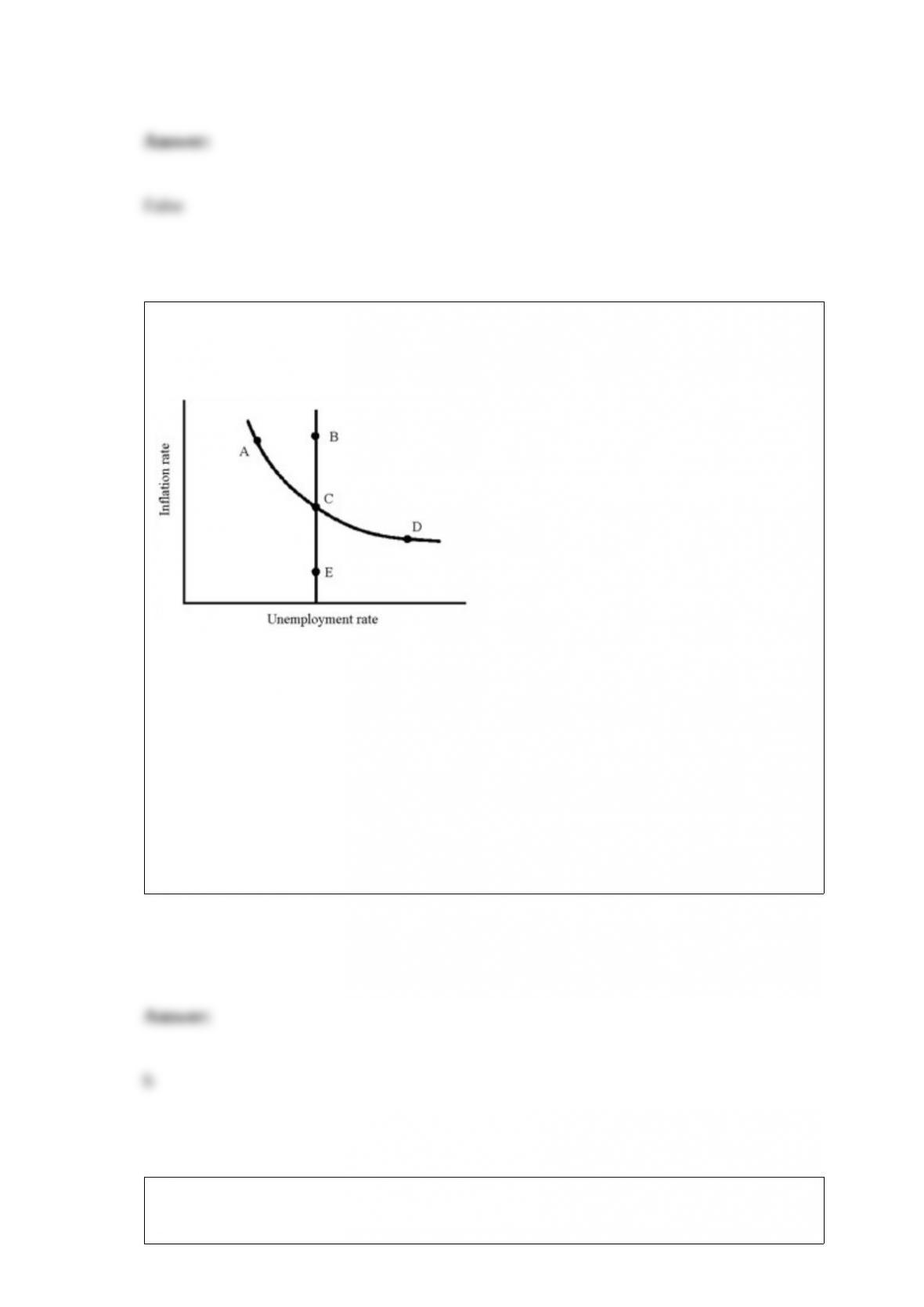
Figure 17-8
In Figure 17-8, which of the following movements illustrates the response of the
economy to an increase in aggregate demand when expectations are “rational”?
a. C to A
b. C to B
c. C to D
d. C to E
For a macroeconomist, the case for aggregation is based on two principles⎯1) the
composition of demand and supply may not matter for some purposes, and 2)

a. during fluctuations markets normally move together.
b. individual markets allocate resources efficiently.
c. inflation, unemployment, and growth never go together.
d. individual markets distribute income efficiently.
In Country X, the government requires employers to collect 9 percent of every
employee’s compensation as payroll tax. This is an example of
a. progressive tax.
b. regressive tax.
c. digressive tax.
d. proportional tax.
The United States was among the first of the modern industrial nations to establish a
central banking system.
a. True
b. False

The principal benefit of unemployment insurance is that it
a. reduces the occurrence of unemployment in the economy.
b. replaces income lost due to unemployment.
c. increases labor force participation.
d. helps reduce the period of unemployment.
When one currency appreciates, another currency must depreciate.
a. True
b. False

Economists would describe cartels as
a. the opposite of ignoring interdependence.
b. a collusive arrangement.
c. an undesirable form of market organization that may charge a monopoly price.
d. All of the above are correct.
Mr. Calhoun owned a worn-out piece of farmland for growing cotton, which he had
been unable to rent for years. Suddenly he was getting offers from cotton farmers to
lease his land. What is the most likely explanation of this?
a. The price of cotton went down.
b. The physical productivity of the land went up.
c. Taxes on land went up.
d. The price of cotton went up.
The main process by which a recessionary gap is eliminated is a(n)
a. increase in wages that shifts the aggregate supply curve inward.
b. drop in wages that shifts the aggregate demand curve inward.

c. increase in wages that shifts the aggregate demand curve outward.
d. drop in wages that shifts the aggregate supply curve outward.
An exchange rate depreciation appears to consumers as a markdown on foreign
products.
a. True
b. False
Since the end of World War II, corporate income taxes have accounted for
a. an increasing share of federal revenue.
b. a steady share of federal revenue.
c. a declining share of federal revenue.
d. a rising share of revenue until 1980, and then a falling share.

The money multiplier process is based on the principle of fractional reserve banking.
a. True
b. False
Compared to OECD countries, in the U.S.
a. the poverty level is above the OECD average, but inequality is below the average
b. the poverty level is below the OECD average, but inequality is above the average
c. both poverty and inequality levels are below the OECD average
d. both poverty and inequality levels are above the OECD average
Expansionary fiscal policy can cause a rise in real GDP in combination with
a. an increase in the price level.
b. a decrease in the price level.

c. no change in the price level.
d. a decrease in the price level if the aggregate supply curve is upward sloping.
According to the monetarists, the velocity of money is
a. constant by definition.
b. highly variable and unpredictable.
c. constant as a matter of empirical proof.
d. not constant but predictable.
How does an increase in government transfer payments affect aggregate demand?
a. It has the same effect as a tax increase, which lowers AD with a larger multiplier than
a spending decrease.
b. It has the same effect as a tax cut, which increases AD but with a smaller multiplier
than a change in spending.
c. It has the same effect as a spending increase, which increases AD with a larger
multiplier than a tax cut.
d. It has the same effect as a spending decrease, which increases AD with a larger

multiplier than a spending decrease.
Statistical studies in the United States have reached the conclusion that for most
workers the response of labor supply to wage changes is
a. quite strong.
b. not very strong.
c. inverted.
d. always zero.
The welfare program economists believe to be most compatible with economic
efficiency is
a. a regressive tax system.
b. AFDC.
c. a negative income tax.
d. Medicare/Medicaid.

The relative concept of poverty means that poverty will never be eliminated.
a. True
b. False
Which of the following phrases would be used to describe an income amount?
a. per year
b. per month
c. per week
d. All of the above are correct.
In 2009, the U.S. had a budget deficit of approximately
a. $161 billion.

b. $459 billion.
c. $800 billion.
d. $1.4 trillion.
Firms choose the highest indifference curve they can obtain given the lowest possible
budget line.
a. True
b. False
An economist might be hired to answer which of the following questions?
a. What will the price of oil be next year?
b. Why is the median income of women about half the median income of men?
c. How much will interest rates change as the federal deficit decreases?
d. How much will inflation change if import restrictions are imposed?
e. All of the above are correct.
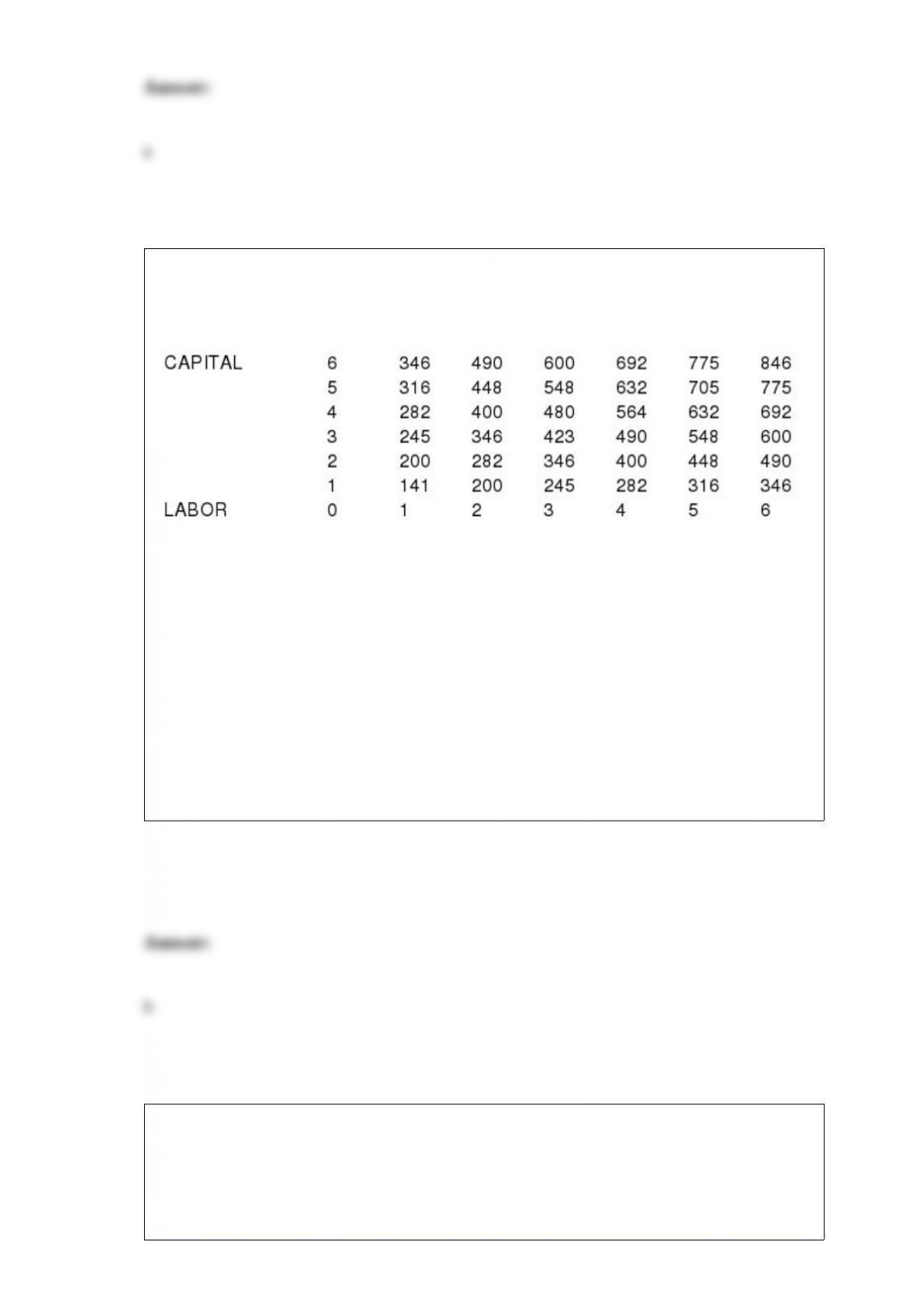
Table 7-4
Table 7-4 shows a production relationship. The cost of one day of labor is $65 and the
product price is $1 per unit. How much will the labor input increase if the capital stock
were increased from 3 to 4?
a. from 3 to 4
b. from 4 to 5
c. from 4 to 6
d. stays the same
“Equilibrium” is a situation in which there are no inherent forces to produce change.
a. True
b. False

How does a budget deficit lead to a trade deficit?
a. The trade deficit triggers higher interest rates, which increase the budget deficit.
b. The budget deficit leads to higher interest rates and exchange rates, which shrink net
exports.
c. The trade deficit causes lower interest rates, which leads to economic recession and a
budget deficit.
d. The budget deficit causes lower exchange rates, which decrease net exports.
Compensating wage differentials explain some income differences.
a. True
b. False

If you wanted to measure changes in fiscal policy intentions, you should use the
a. capital budget.
b. actual deficit.
c. inflation-accounted deficit.
d. structural deficit.
National defense and coastal lighthouses are examples of
a. public goods.
b. private goods.
c. high marginal cost goods.
d. depletable goods.
The deposit creation formula can be defined as
a. one minus the required reserve ratio.
b. the same as the GDP income multiplier.
c. the reciprocal of the required reserve ratio.

d. one plus the required reserve ratio.