
1) Under freely flexible (floating) exchange rates a U.S. trade deficit with Japan will
eventually cause the dollar price of yen to rise.
2) Demand is the active and supply the passive determinant of land rent.
3) a moral hazard problem arises in the health care market because health insurance
causes people to overconsume health care.
4) Thomas Malthus argued that increases in living standards tend to reduce birthrates.
5) supply refers to the amount of a product that a producer will offer in the market at
some particular price.
6) cross elasticity of demand measures the effect of a change in the price of one product
on the quantity demanded of another product.
7) A change in the reserve ratio will affect both the amount of the banking system’s
excess reserves and the multiple by which the system can lend on the basis of excess
reserves.

8) A firm should reduce its employment of a resource whose marginal resource cost
exceeds its marginal revenue product.
9) The marginal productivity theory of income distribution holds that all resources are
paid according to their marginal contribution to society’s output.
10) Efficiency wages are established at below-equilibrium levels.
11) a nation has a comparative advantage in some product when it can produce that
good at a lower domestic opportunity cost than can a potential trading partner.
12) The marginal revenue product curve of a purely competitive seller declines solely
because of the law of diminishing returns.
13) In 2007, approximately 5 percent of all work time lost was due to work stoppages.
14)
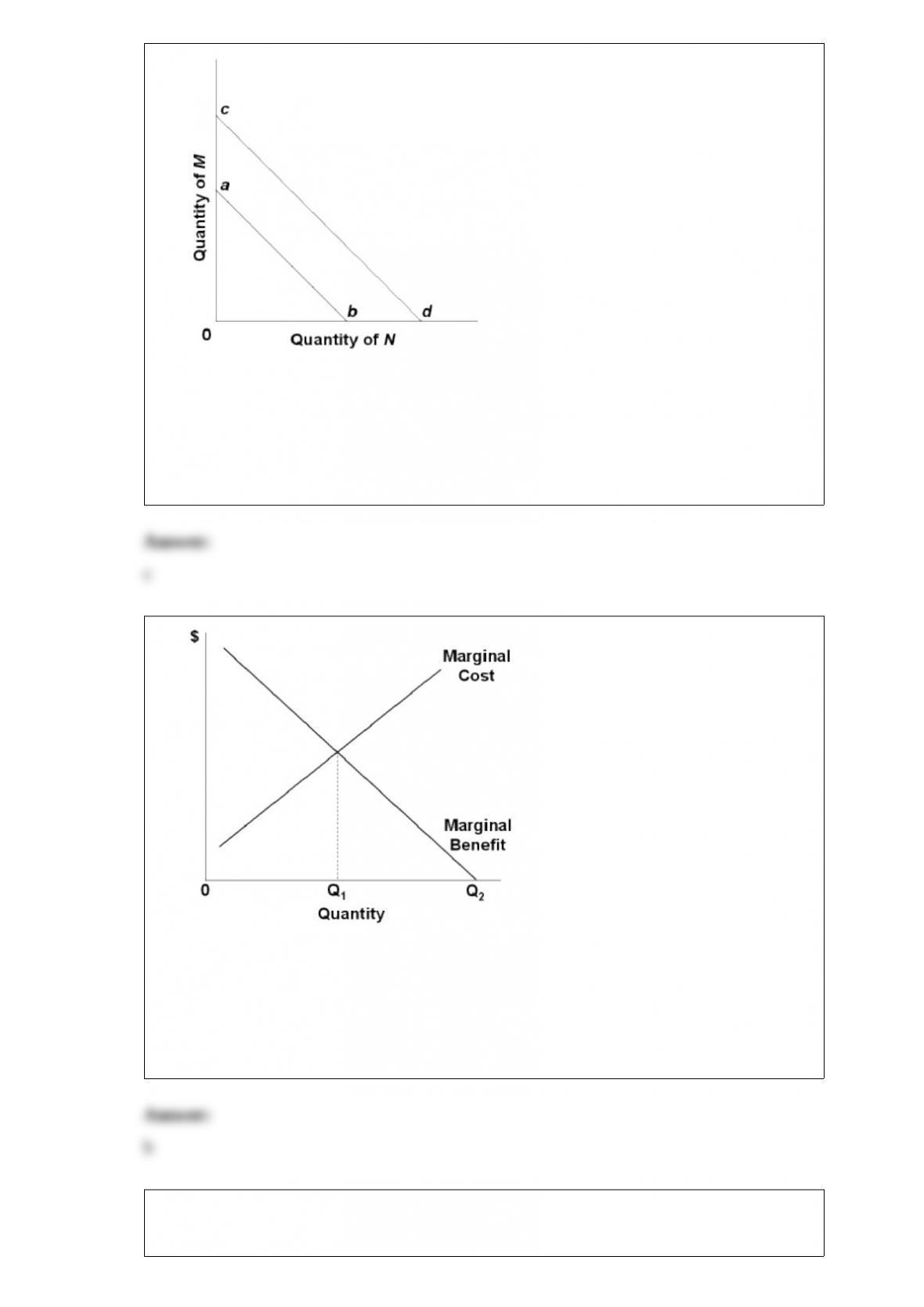
the shift of the budget line from cd to ab in the above figure is consistent with:
a.decreases in the prices of both m and n.
b.an increase in the price of m and a decrease in the price of n.
c.a decrease in money income.
d.an increase in money income.
15)
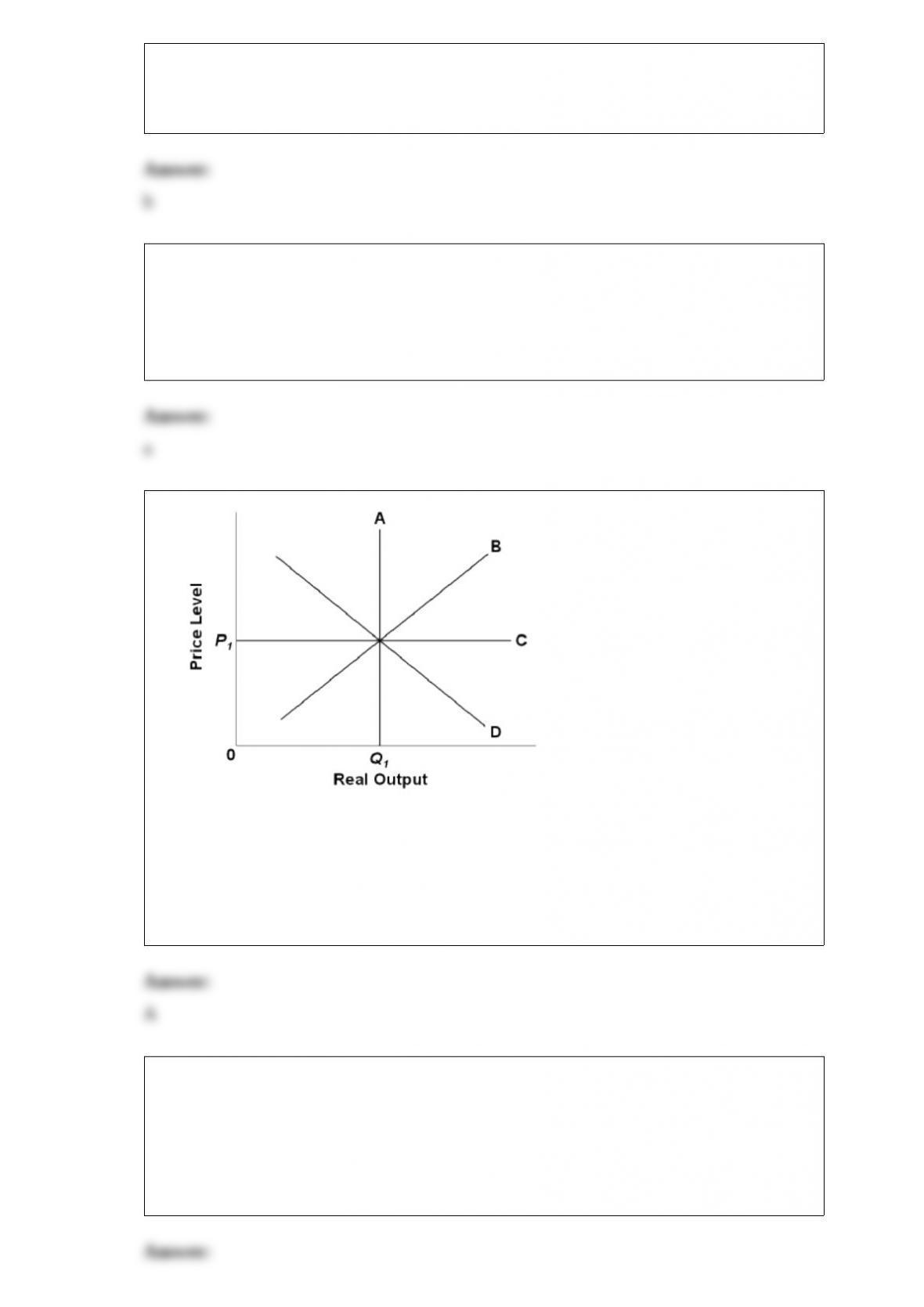
refer to the above diagram. economists would argue that health care should be provided
to patients in:
a.some amount less than q1.
b.amount q1.
c.some amount between q1and q2.
d.amount q2.
16) costs to an economist:
a.consist only of explicit costs.
b.may or may not involve monetary outlays.
c.never reflect monetary outlays.
d.always reflect monetary outlays.
17) according to economists, economic self-interest:
a.is a reality that underlies economic behavior.
b.has the same meaning as selfishness.
c.is more characteristic of men than of women.
d.is usually self-defeating.
18)
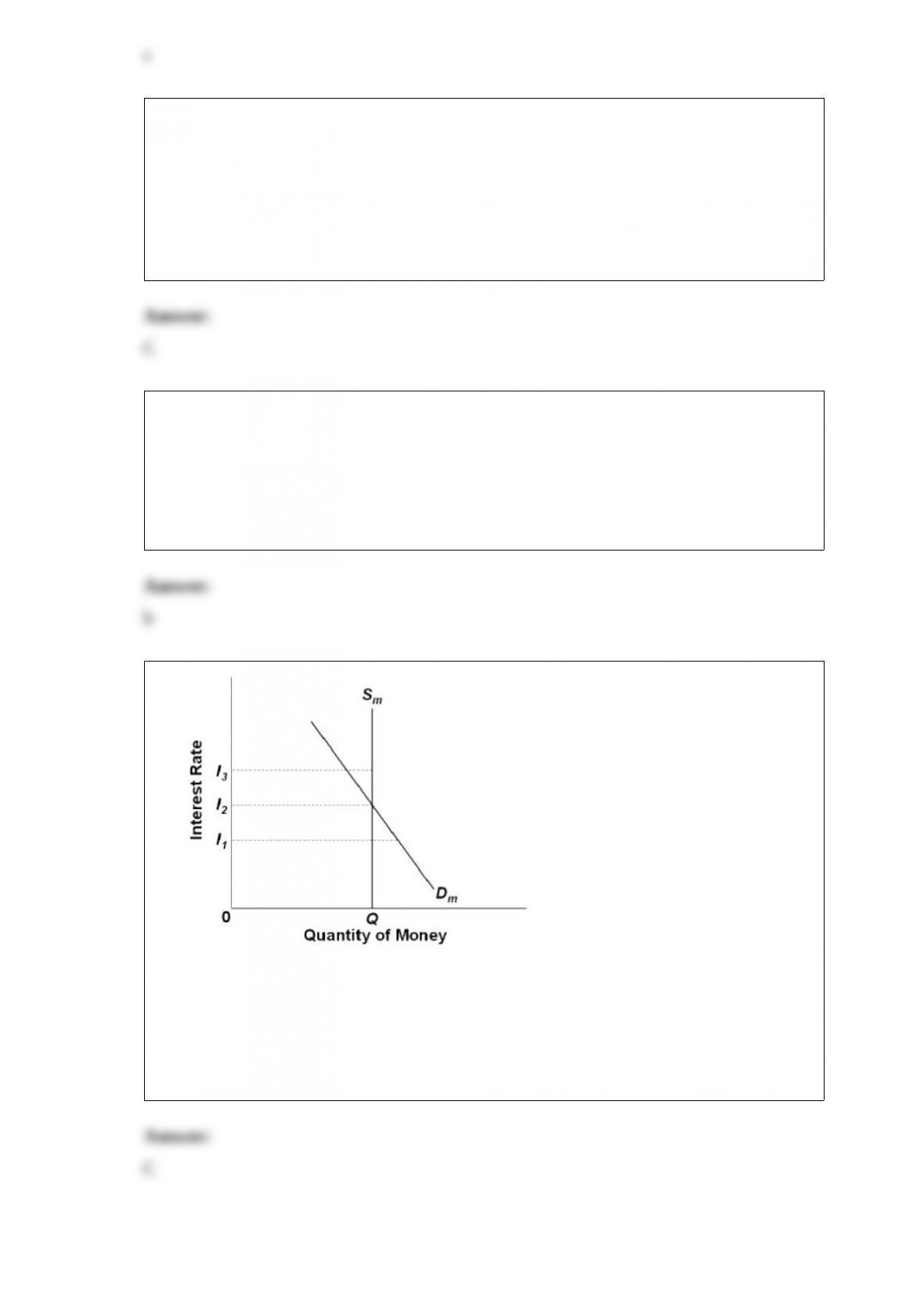
Refer to the above diagram. If the price level rises above P1 because of an increase in
aggregate demand, the:
A.economy will move up along curve B and output will temporarily increase.
B.long-run aggregate supply curve C will shift upward.
C.short-run aggregate supply curve B will automatically shift to the right.
D.economy’s output first will decline, then increase, and finally return to Q1.
19) which of the following terms implies the greatest degree of confidence in an
economic generalization?
a.a hypothesis.
b.a theory.
c.a principle.
d.an anomaly.
20) The median-voter model implies that:
A.political voting will be as economically efficient as “dollar voting” in competitive
markets.
B.all voters have about the same preferences for various public goods and services.
C.many people will be dissatisfied with the size of government in the economy.
D.with majority voting there can never be a consistent ordering of public good
preferences.
21) other things equal, if the wage rates paid to a firm’s labor inputs were to rise, we
would expect the:
a.afc, avc, atc, and mc curves all to rise.
b.avc, atc, and mc curves all to rise.
c.afc and atc curves to fall.
d.mp curve to fall.
22)
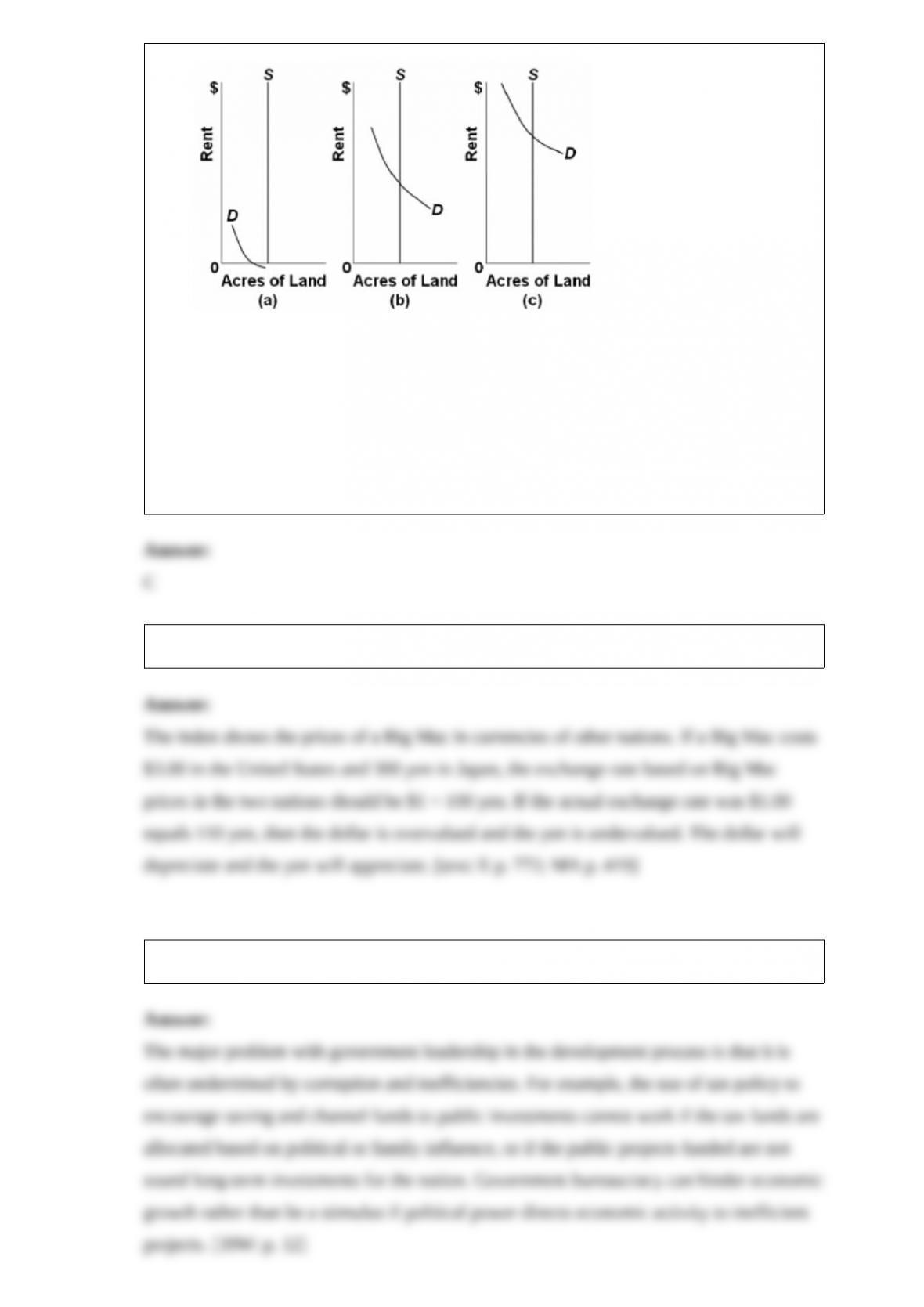
Refer to the above diagram of the market for money. Other things equal, the money
demand curve in the diagram would shift leftward if:
A.the asset demand for money increased.
B.the transactions demand for money increased.
C.nominal GDP decreased.
D.the overall price level rose.
23)
Refer to the above diagrams. Assume that only wheat can be grown on the three grades
of land shown in Figures a, b, and c. Also assume that identical amounts of labor,
capital, and other needed inputs are used in farming each grade of land. On the basis of
these three figures we:
A.can say that the land in Figure a is most productive.
B.can say that the land in Figure b is most productive.
C.can say that the land in Figure c is most productive.
D.cannot compare the productivity of the three grades of land.
24) How can the Big Mac index be used to explain purchasing power parity theory?
25) What are the problems with government actions in DVCs?
26) What is the sociopolitical significance of income shares; that is, what might income
shares tell us about the overall character of our society? What implications might
income shares have for economic stability? For economic growth?
27) The increasing gap between the advanced and the developing nations is not simply
a matter of economics; it is also a matter of the political choice between democracy and
capitalism or communism and central planning. Evaluate and explain.
28) What are the likely economic effects of social regulation on prices, innovation, and
competition?
29) Differentiate between nominal and real GDP.
30) What is the risk-free interest rate?
31) If the Phillips Curve exists in reality, what dilemma does this create for fiscal and
monetary policies? Explain.