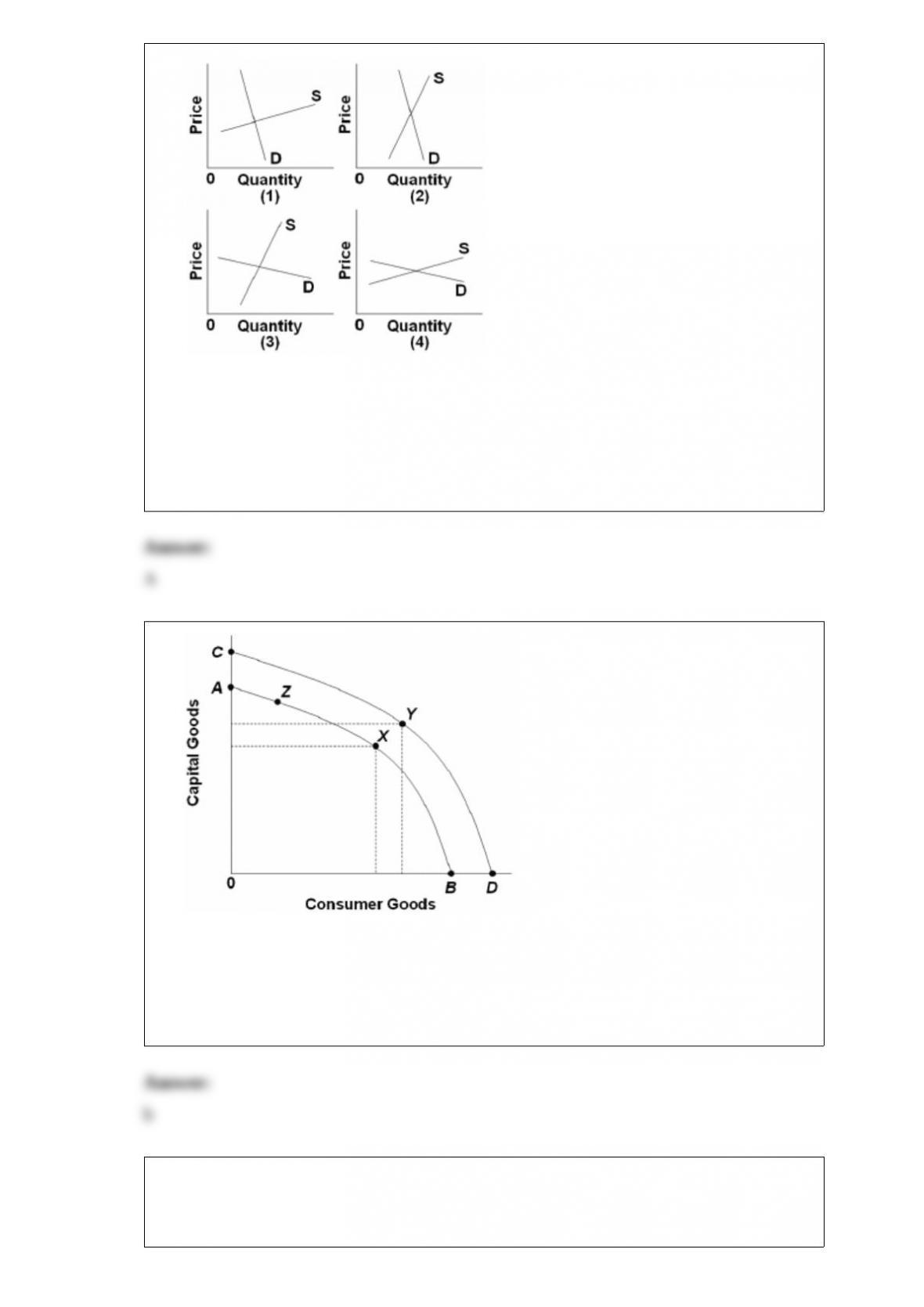
1)
In which of the above market situations will the efficiency loss of an excise tax be the
greatest?
A.4
B.3
C.1
D.2
2)
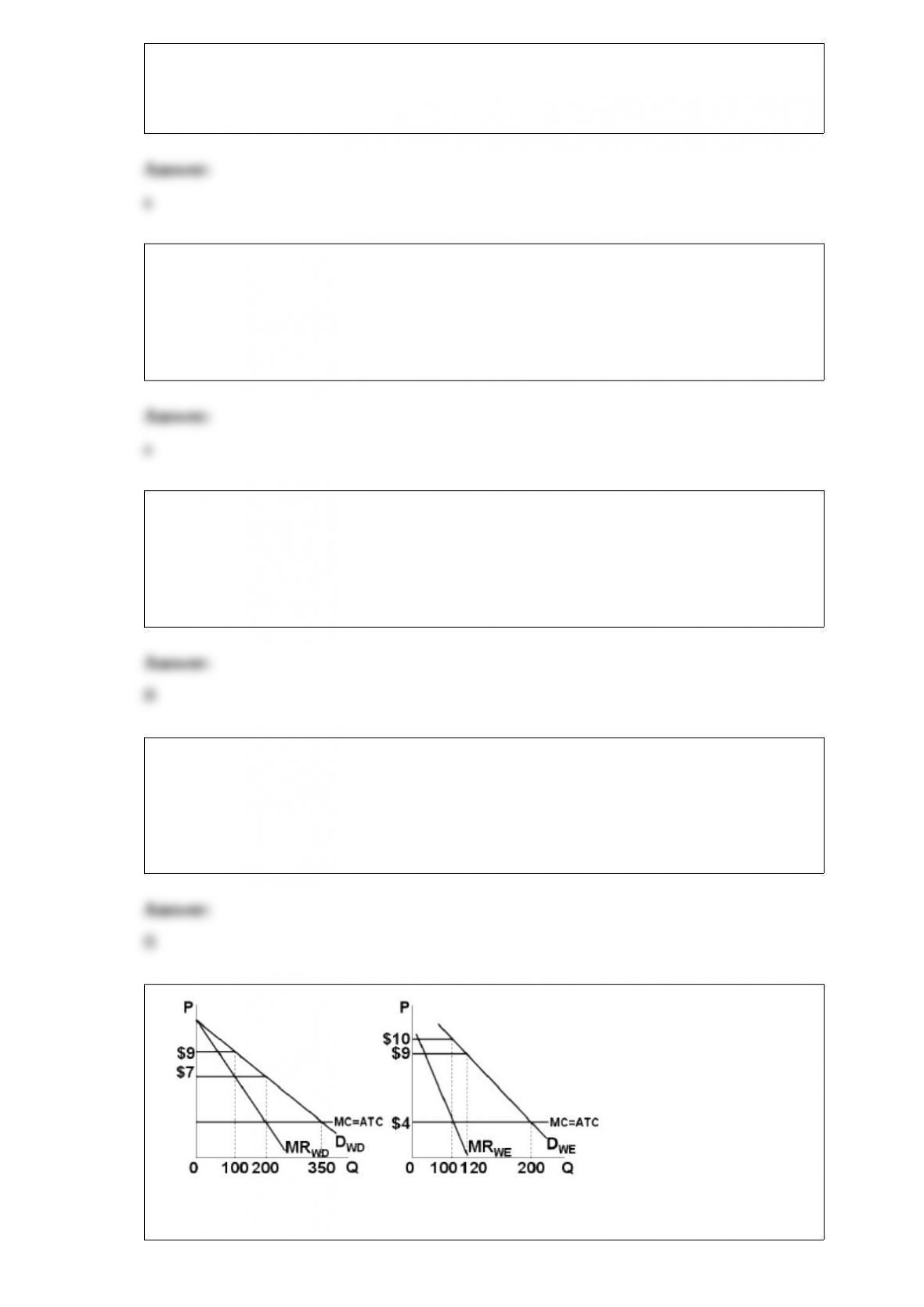
refer to the above diagram. realized economic growth is best represented by a:
a.a move from z to x along ab.
b.move from x on ab to y on cd.
c.shift in the production possibilities curve from cd to ab.
d.move from x to z along ab.
3) welfare checks and food stamps are examples of _____________ used by the
government to redistribute income.
a.transfer payments.
b.market intervention.
c.taxation.
d.corporate subsidies.
4) to the economist, total cost includes:
a.explicit and implicit costs, including a normal profit.
b.neither implicit nor explicit costs.
c.implicit, but not explicit, costs.
d.explicit, but not implicit, costs.
5) A major adverse aggregate supply shock:
A.automatically shifts the aggregate demand curve rightward.
B.causes the Phillips Curve to shift rightward and upward.
C.can be caused by rising productivity.
D.can be caused by falling wages.
6) An appropriate fiscal policy for a severe recession is:
A.a decrease in government spending.
B.a decrease in tax rates.
C.appreciation of the dollar.
D.an increase in interest rates.
7)
refer to the figure above. suppose the graphs represent the demand for use of a local
golf course for which there is no significant competition (it has a local monopoly); p
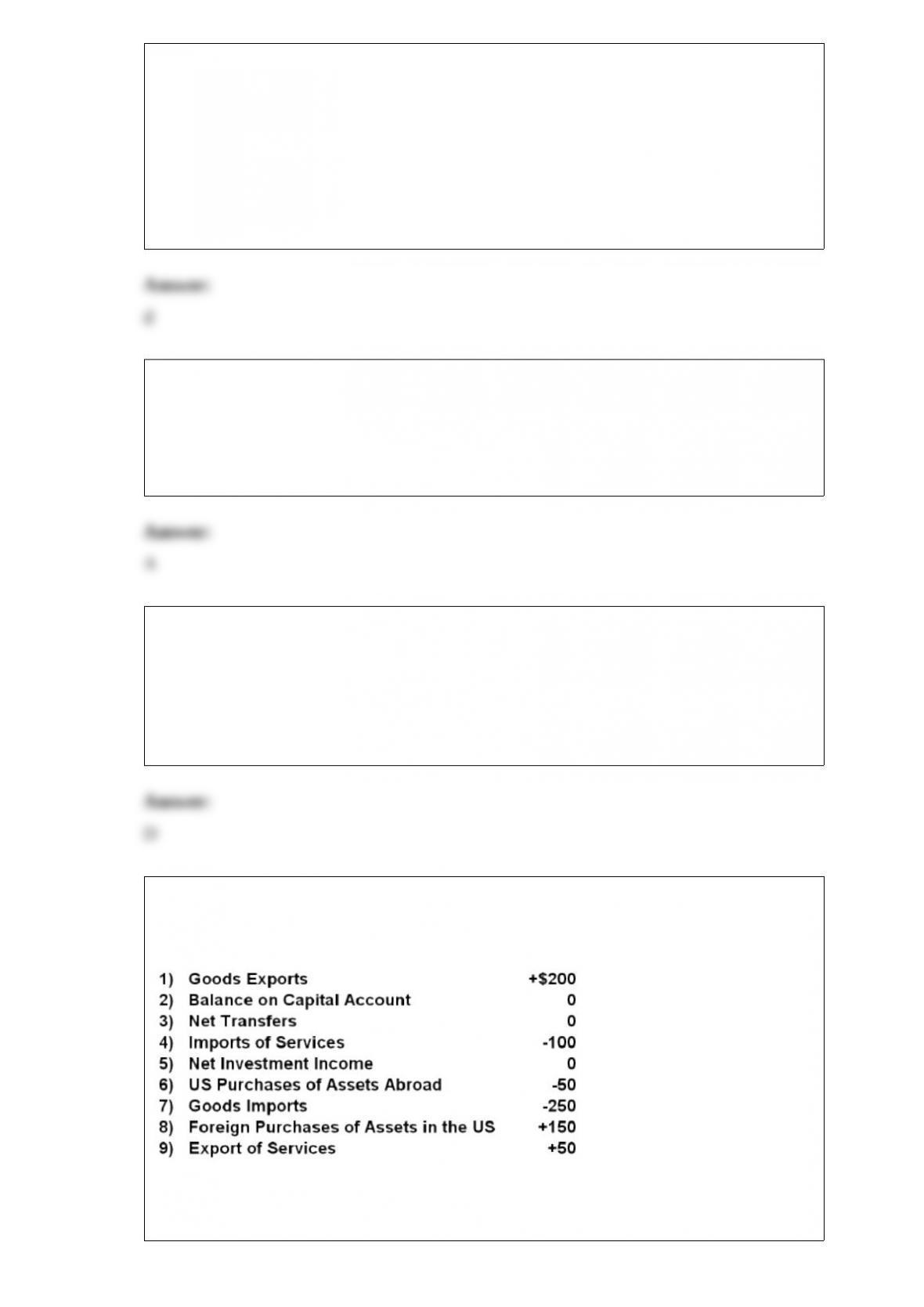
denotes the price of a round of golf; q is the quantity of rounds ‘sold” each day. if the
left graph represents the demand during weekdays, and the right graph the weekend
demand, then over the course of a full seven-day week this price-discriminating,
profit-maximizing golf course should sell at total of:
a.300 rounds.
b.740 rounds.
c.900 rounds.
d.1,200 rounds.
8) Which one of the following would not shift the aggregate demand curve?
A.a change in the price level
B.depreciation of the international value of the dollar
C.a decline in the interest rate at each possible price level
D.an increase in personal income tax rates
9) The graphical relationship between the price level and the amount of real GDP that
businesses will offer for sale is known as the:
A.aggregate demand curve.
B.investment supply curve.
C.investment demand curve.
D.aggregate supply curve.
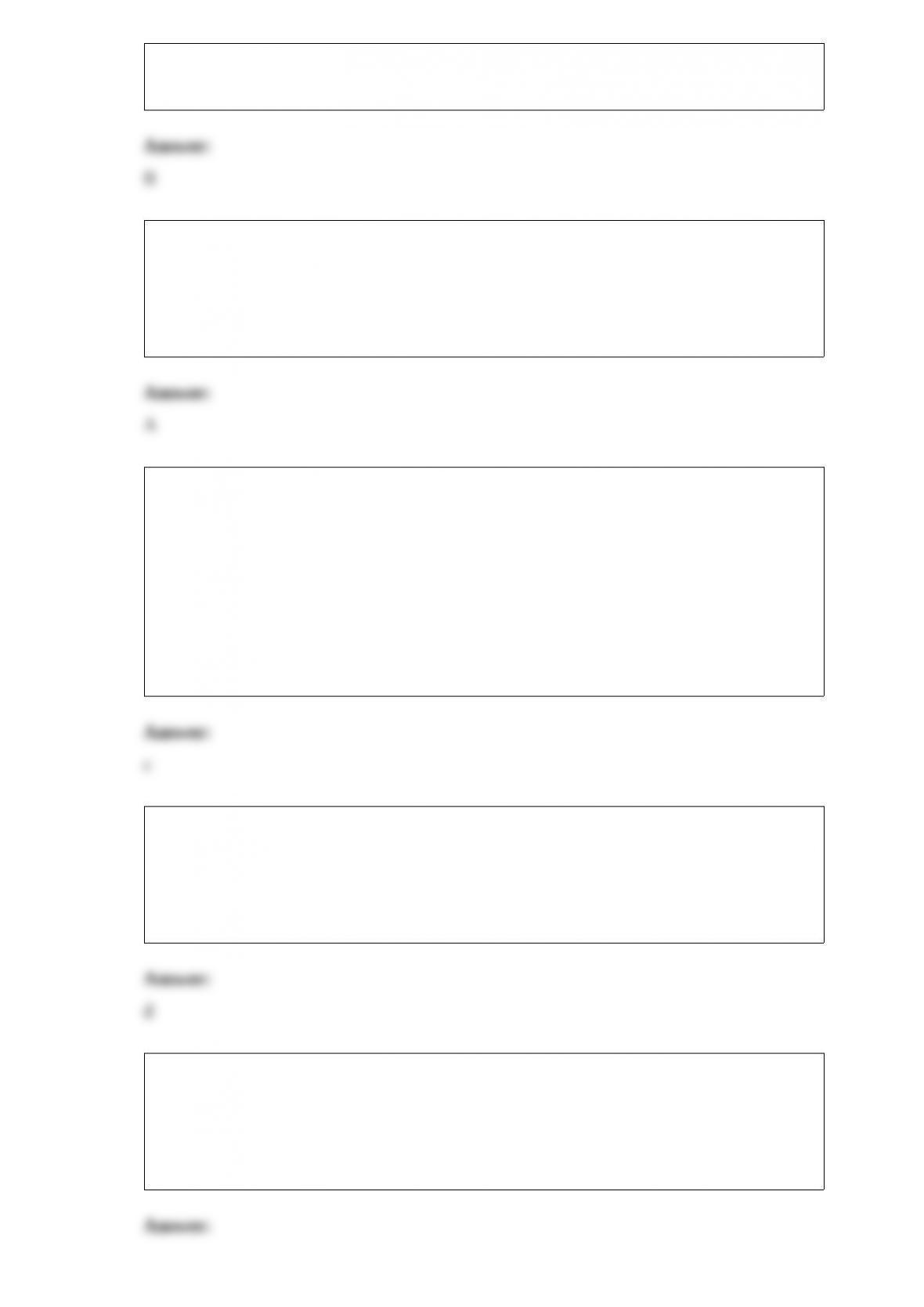
10) The plus items below are “export-type” entries and the minus items are
“import-type” entries in the balance of payments for the hypothetical country of Zippo.
Refer to the above information. The current account items for Zippo are:
A.1, 2, 3, and 4
B.1, 3, 4, 5, 7, and 9
C.6 and 8
D.1, 2, 4, 7, and 9
11) Since 1950, U.S. farm exports have:
A.increased as a percentage of U.S. farm output.
B.declined as a percentage of U.S. farm output.
C.average about 10 percent of U.S. farm output.
D.averaged about 50 percent of U.S. farm output.
12) the availability of health insurance tends to:
a.decrease the demand for health care and cause an underallocation of resources to the
health care industry.
b.increase the quantity of health care demanded and cause an underallocation of
resources to the health care industry.
c.increase the quantity of health care demanded and cause an overallocation of
resources to the health care industry.
d.decrease the quantity of health care demanded and cause an overallocation of
resources to the health care industry.
13) which of the following is not a supply factor in economic growth?
a.the stock of capital
b.technological advance
c.the size and quality of the labor force
d.aggregate expenditures of households, businesses, and government
14) unlike demand-pull inflation, cost-push inflation:
a.is self-limiting.
b.drives up the price level.
c.increases nominal income.
d.increases real income.
15) The economic cost of unemployment is measured by the GDP gap. Explain this
statement.
16) Who sits on the Federal Open Market Committee and what does this committee do?
17) The Federal Reserve Banks are bankers banks. Explain.
18) (Consider This) What is a reverse wealth effect? Why did it not have much of an
effect on the U.S. economy during the stock market bubble in the 20002002 period?
19) What are the characteristics of the recent productivity acceleration that distinguish it
from the economy of previous periods?
20) Are currency and checkable deposits owned by the government (U.S. Treasury) and
the Federal Reserve Bank, commercial banks, and other financial institutions part of the
money supply? Explain.
21) Why is there emphasis on nonprice competition in oligopoly?
22) What are the basic sources of profit in a market economy?
23) Economists often speak as if there is a single interest rate when in fact there are
many interest rates. What factors explain the differences in these interest rates?