In 2013, corporate profits in the U.S. economy were about 14 percent of national
income.
a. True
b. False
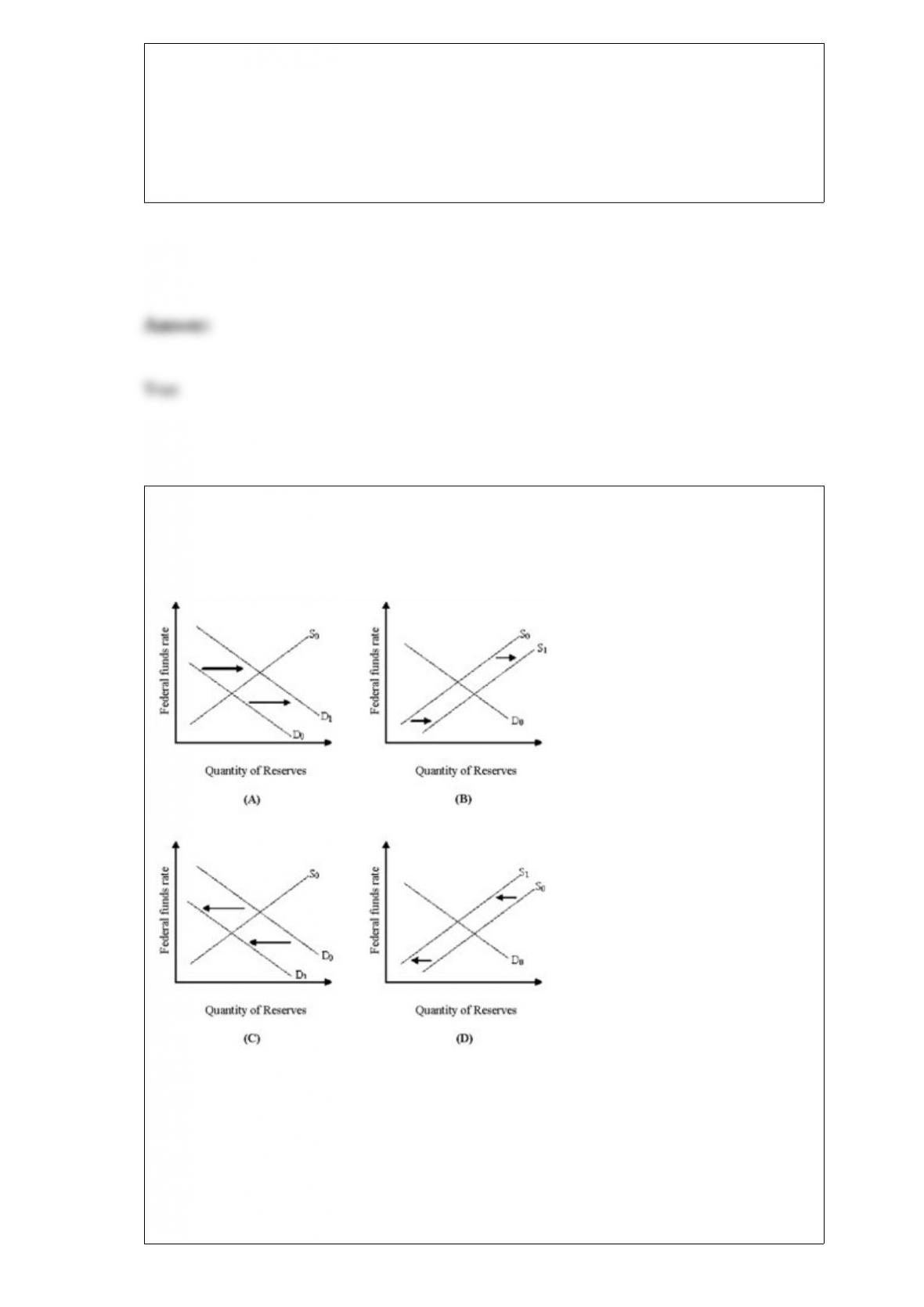
Figure 13-1
In Figure 13-1, which panel shows the effect of a recession on the interest rate?
a. Panel (A)
b. Panel (B)
c. Panel (C)

d. Panel (D)
Interest is the payment for the use of
a. borrowed funds.
b. natural resources.
c. labor.
d. any factor of production.
For most industries, average costs decrease indefinitely as output expands.
a. True
b. False

Under EPA regulations, a factory
a. must pay for the right to pollute.
b. can increase air pollution from its grinding process if it decreases air pollution from
its smelting process.
c. cannot under any circumstances build a polluting factory in an area where pollution
standards are not being met by existing firms.
d. None of the above is correct.
In 2001 the United States and its NATO allies dropped millions of dollars’ worth of
bombs on Afghanistan. These bombs and the aircraft from which they were dropped
a. were netted out of GDP.
b. increased GDP and increased personal welfare.
c. decreased GDP and decreased personal welfare.
d. were added to GDP.
Under current federal antipoverty programs,

a. economic equality is promoted at the least possible cost in economic efficiency.
b. a family’s benefits do not depend on its earnings from work.
c. a family’s total income (cash and in-kind benefits) may actually fall if its earnings
from work rise.
d. families with children are entitled to no more assistance than families without
children.
Demand-side changes explain everything about stagflation.
a. True
b. False
AZT is a drug that inhibits the reproduction of the AIDS virus, thus preventing the full
development of the disease. The drug, which is sold in an unregulated market, is very
expensive and many AIDS patients who can’t afford it die from the disease. This case
provides ammunition to critics of the market system on the basis of its
a. fairness.
b. externalities.
c. cost disease in services.

d. inefficiency.
One popular definition of economics is the study of
a. how scarcity increases opportunities to meet ends.
b. how markets overcome scarcity.
c. one goal and three tasks.
d. how to use limited means to meet unlimited wants.
e. wants versus needs.
The payroll tax system is a proportional tax for all income earners.
a. True
b. False

As a result of pure free trade in a commodity the
a. price of the commodity must be the same in all countries.
b. total quantity imported will exceed the total quantity exported.
c. price of the commodity will be higher in the producing country.
d. price of the commodity will be lower in the producing country.
Economists make assumptions because
a. they need to incorporate value judgments into their models.
b. analysis without assumptions would be impossibly complex.
c. they always have imperfect information about reality.
d. assumptions are the final product of careful economic analysis.
e. assumptions allow economists to ignore things that they cannot explain.
The equation of exchange is written as
a. M V = P Y.

b. M P = V Y.
c. M Y = P V.
d. M Y = Y P.
In a free market, economic activity is coordinated by
a. central planners.
b. prices.
c. costs.
d. majority rule.
Which of the following countries has the lowest level of average educational
attainment?
a. Canada
b. Italy
c. India
d. Sudan

Which of the following is a bank liability?
a. cash in the vault
b. loans made to customers
c. money market deposit accounts
d. bank computers
e. All of the above are correct.
Unions can only achieve wage gains by sacrificing employment.
a. True
b. False

Which of the following definitions of the money supply is the least liquid?
a. M1
b. M2
c. M3
d. L
A rise in the domestic interest rate leads to capital
a. outflows and exchange rate appreciation.
b. outflows and exchange rate depreciation.
c. inflows and exchange rate depreciation.
d. inflows and exchange rate appreciation.
When the dollar appreciates, the cost to Americans of foreign goods
a. rises and the CPI falls.
b. rises and the CPI rises.
c. falls and the CPI rises.
d. falls and the CPI falls.
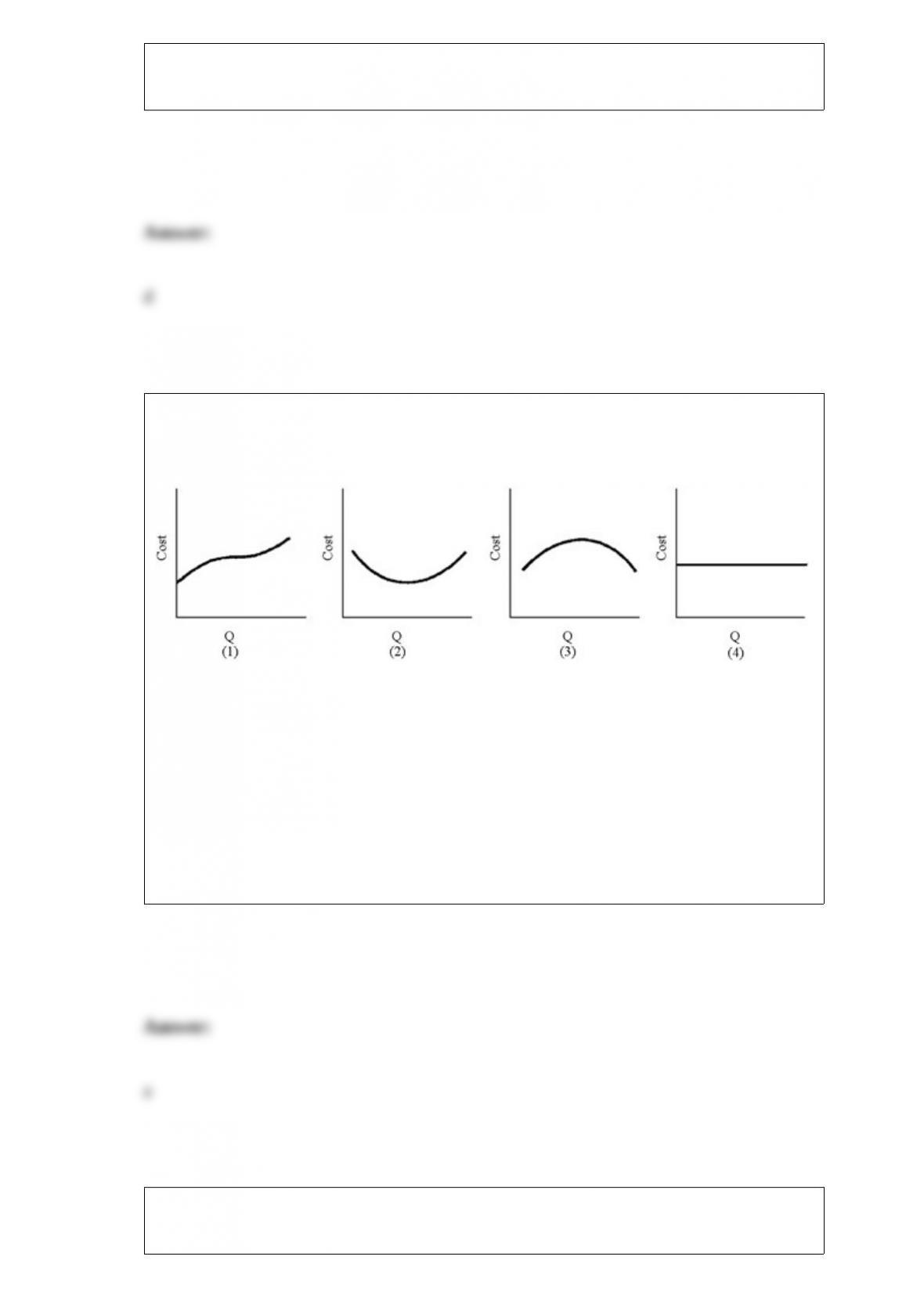
Figure 7-8
Of the graphs in Figure 7-8, which represents total cost?
a. 1
b. 2
c. 3
d. 4
In the typical AC curve, the downward-sloping part is attributable to

a. spreading fixed costs over larger outputs and increasing returns to the variable inputs.
b. declining administrative costs as output increases.
c. falling fixed costs.
d. rising total product.
Which of the following events would increase the four-firm concentration ratio in a
milk industry with six firms?
a. The two largest milk producers merge.
b. The largest milk producer buys an ice cream-making plant.
c. The largest milk producer lures customers away from the second-largest producer.
d. The four largest milk producers collusively fix prices.
The Fed’s quick response to the threat to the economy after September 11, 2001, makes
a strong case for
a. a rules-based monetary policy regime.
b. a discretionary-based monetary policy regime.
c. the superiority of fiscal policy.

d. the dominant role of Congress in activist policy.
The value of an investment in an index fund depends on
a. the earnings estimate for the major index constituent.
b. the average performance of all mutual funds.
c. what happens to the prices of all stocks in that index.
d. the specific stock selection practices employed by the fund manager.
A process through which a firm seeks to obtain earnings without contributing to
production, thus wasting valuable resources, is known as
a. moral hazard.
b. rent seeking.
c. detrimental externality.
d. a defective telescopic faculty.
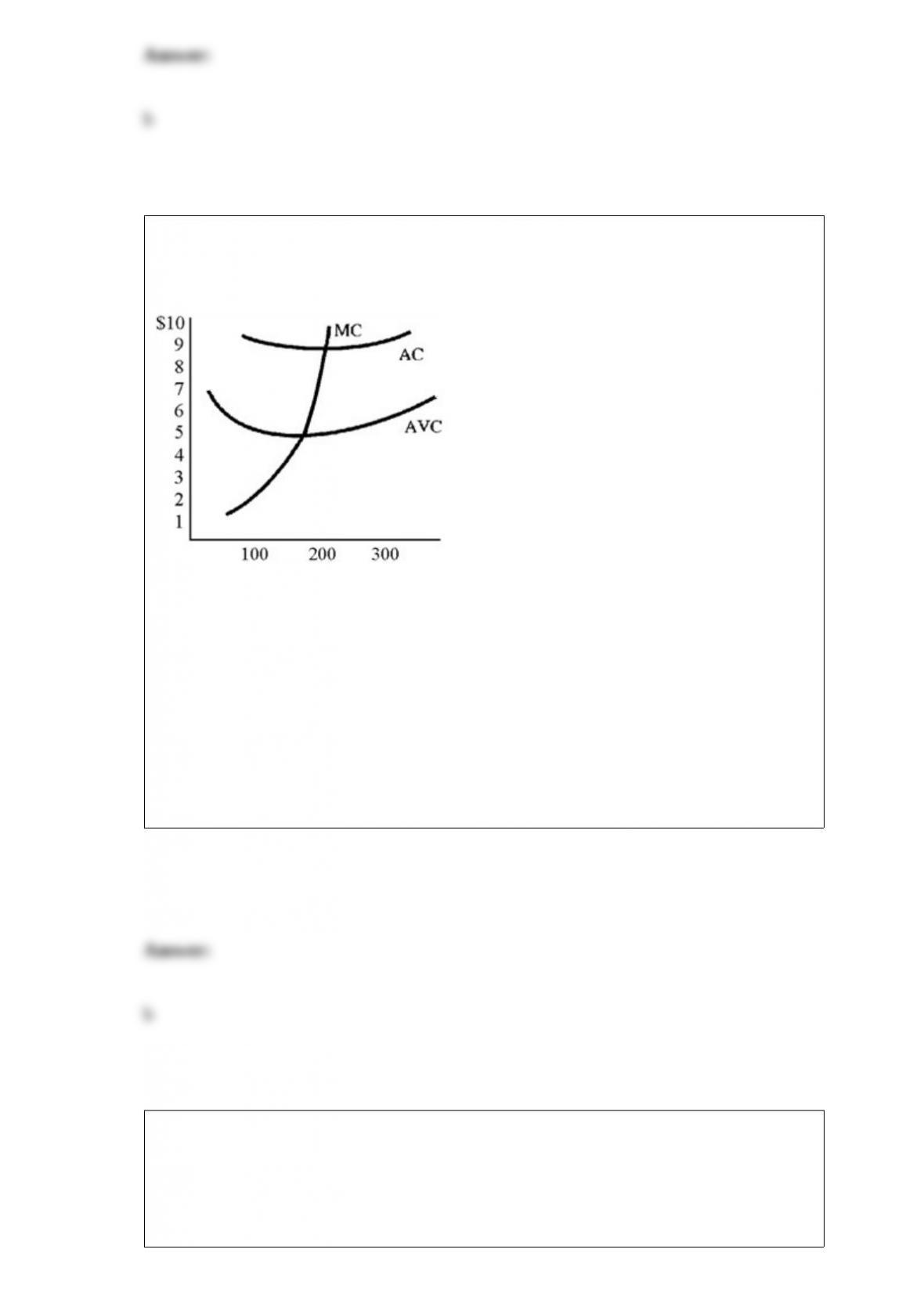
Figure 10-8
For the perfectly competitive firm in Figure 10-8, what is the long-run price and
quantity?
a. P = 4, Q = 150
b. P = 9, Q = 200
c. P = 10, Q = 200
d. P = 5, Q = 150
The actual multiplier for the U.S. economy is estimated to be
a. about 10.
b. approximately 5.

c. between 3 and 4.
d. less than 2.
An exchange rate appreciation will shift the aggregate demand curve inward.
a. True
b. False
Some of the newer pollutants that have appeared
a. are far more visible to the eye than older pollution.
b. cause damage that is easily reversible.
c. pose no significant long-term hazards.
d. are far more dangerous than older forms of pollution.

Faster economic growth imposes an opportunity cost in the form of
a. reduced current consumption.
b. a larger capital stock.
c. increased investment.
d. increased future income.
The difference between disposable income and consumption spending is
a. transfer payments.
b. personal taxes.
c. net exports.
d. personal investment.
e. personal saving.

An excise tax on gasoline is regressive if
a. rich people buy more gasoline than poor people.
b. the demand for gasoline is elastic.
c. the tax causes people to buy less gasoline.
d. poor people spend a larger portion of their incomes on gasoline than rich people.
Which of the following observations is true?
a. Increase in taxes shifts the consumption schedule upward.
b. Tax reductions increase equilibrium GDP.
c. Taxes reduce total spending directly.
d. Taxes do not have a multiplier effect on equilibrium GDP.