
A firm has three different investment options. Option A will give the firm $10 million at
the end of one year, $10 million at the end of two years, and $10 million at the end of
three years. Option B will give the firm $15 million at the end of one year, $10 million
at the end of two years, and $5 million at the end of three years. Option C will give the
firm $30 million at the end of one year, and nothing thereafter. Which of these options
has the highest present value?
a. Option A
b. Option B
c. Option C
d. The answer depends on the rate of interest, which is not specified here.
Of the following interest rates, which is the highestone at which you would prefer to
have $170 ten years from today instead of $100 today?
a. 3 percent
b. 5 percent
c. 7 percent
d. 9 percent
Any item that people can use to transfer purchasing power from the present to the future

is called
a. a medium of exchange.
b. a unit of account.
c. a store of value.
d. None of the above is correct.
Below are pairs of GDP growth rates and unemployment rates. Economists would be
shocked to see most of these pairs in the U.S. Which pair of GDP growth rates and
unemployment rates is realistic?
a. 10 percent, 1 percent
b. 2 percent, 12 percent
c. -1 percent, 8 percent
d. -2 percent, 2 percent
Figure 2-23
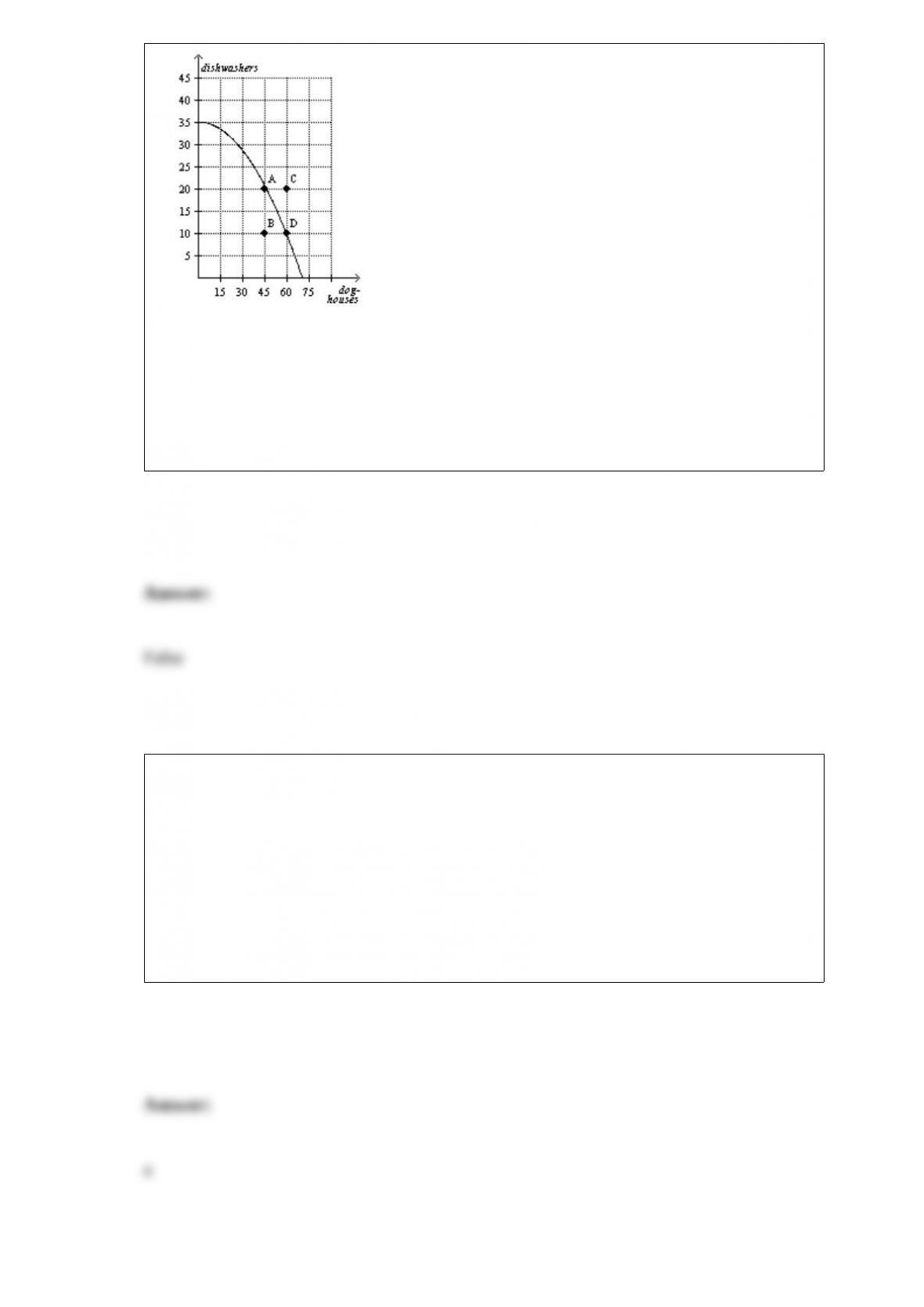
Refer to Figure2-23. When this economy produces 30 doghouses and 25 dishwashers
there is full employment.
a. True
b. False
During recessions which type of spending falls?
a. consumption and investment
b. investment but not consumption
c. consumption but not investment
d. neither consumption nor investment
If the U.S. imposes a quota on cotton, then
a. both exports and imports of other goods will rise.
b. exports of other goods will rise and imports of other goods will fall.
c. exports of other goods will fall and imports of other goods will rise.
d. both imports and exports of other goods will fall.
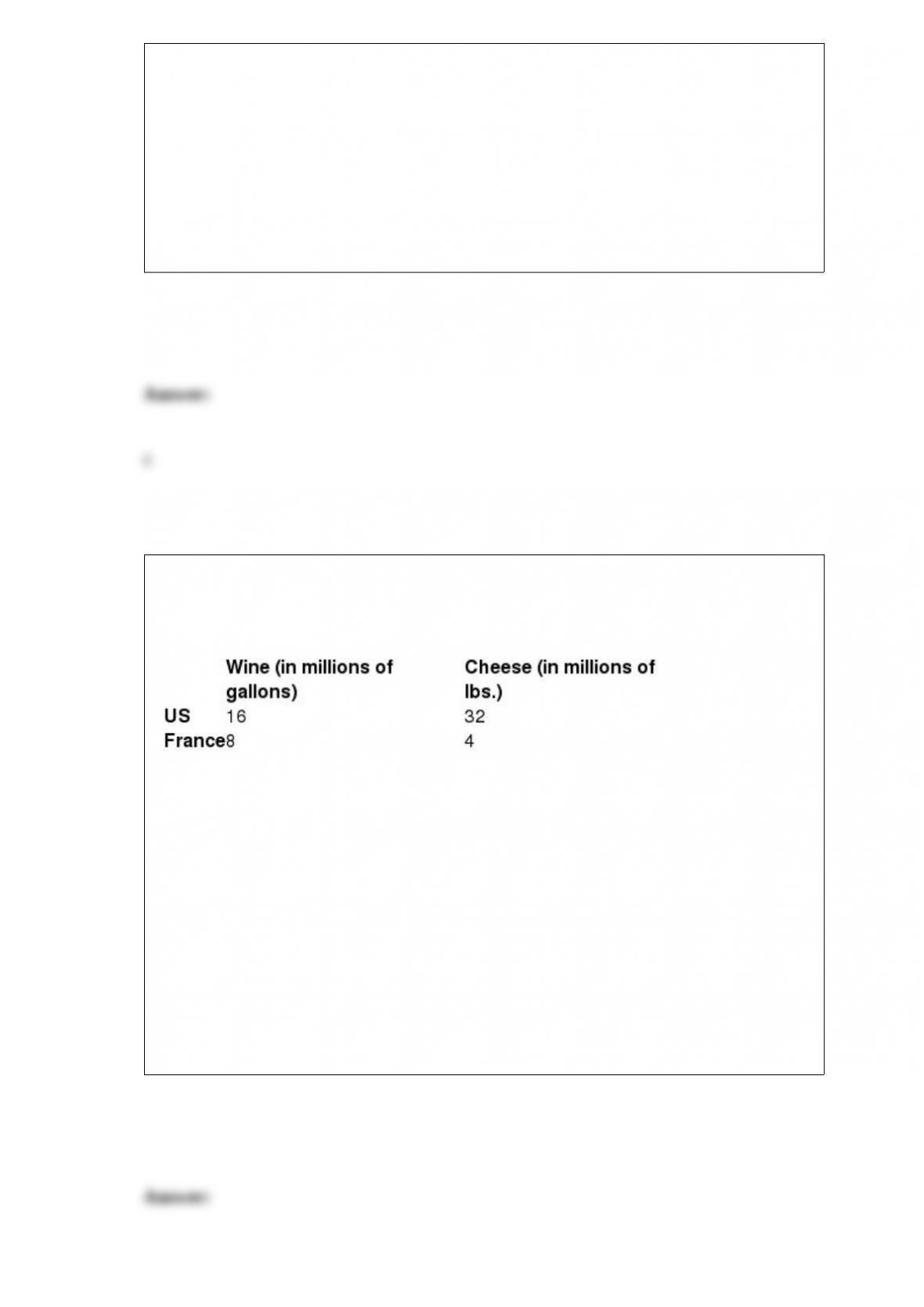
Table 3-32
USandFrenchProductionOpportunities
RefertoTable3-32The opportunity costs for the US and France are as follows:
a. In the US 1 million gallons of wine costs 1/2 million pounds of cheese and in France
1 million gallons of wine costs 2 million pounds of cheese.
b. In the US 1 million gallons of wine costs 2 million pounds of cheese and in France 1
million gallons of wine costs 1/2 million pounds of cheese.
c. In the US 1 million pounds of cheese costs 1/2 million gallons of wine and in France
1 million pounds of cheese costs 2 million gallons of wine.
d. In the US 1 million pounds of cheese costs 16 million gallons of wine and in France
1 million pounds of cheese costs 8 million gallons of wine.

Figure 3-9
Refer to Figure3-9. If the production possibilities frontiers shown are each for two
days of production, then which of the following combinations of bolts and nails could
Uzbekistan and Azerbaijan together make in a given 2- day production period?
a. 12 bolts and 120 nails
b. 24 bolts and 96 nails
c. 38 bolts and 50 nails
d. 44 bolts and 24 nails
Like any cartel, a union is a group of sellers acting together in the hope of exerting their
joint market power.
a. True
b. False

The YouLookMarvelous!cosmetic company is considering building a new shampoo
factory. Its accountants and board of directors meet and decide that it is not a good idea
to build the factory. If interest rates fall after the meeting
a. the present value of the factory rises. It’s more likely the company will build the
factory.
b. the present value of the factory rises. It’s less likely the company will build the
factory.
c. the present value of the factory falls. It’s more likely the company will build the
factory.
d. the present value of the factory falls. It’s less likely the company will build the
factory.
At any given time, the voting members of the Federal Open Market Committee include
a. five of the presidents of the regional Federal Reserve banks.
b. the president of the Federal Reserve Bank of New York.
c. the seven members of the Board of Governors.
d. All of the above are correct.
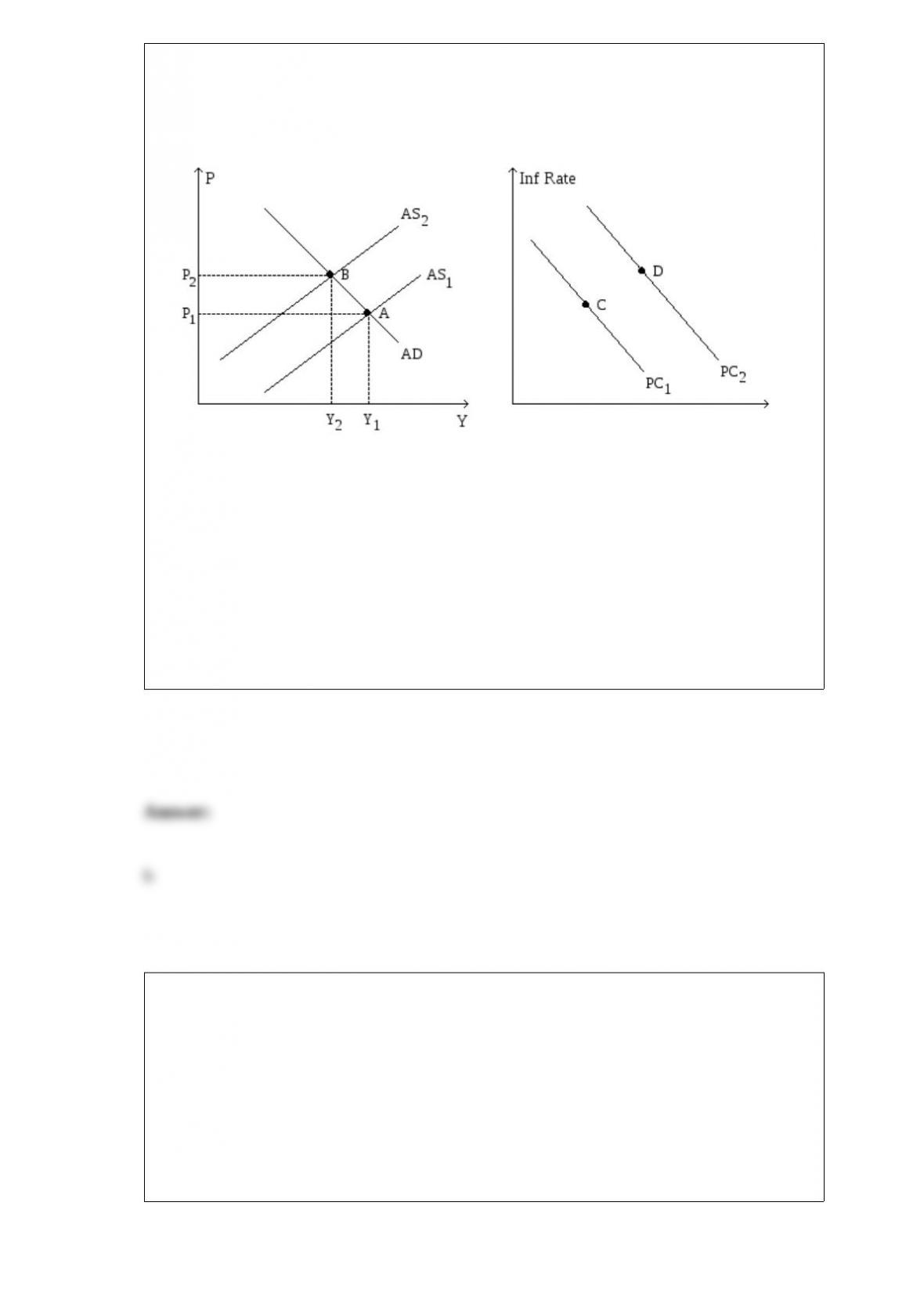
Figure 35-9. The left-hand graph shows a short-run aggregate-supply (SRAS) curve
and two aggregate-demand (AD) curves. On the right-hand diagram, “Inf Rate” means
“Inflation Rate.”
RefertoFigure35-9. What is measured along the horizontal axis of the right-hand
graph?
a. time
b. the unemployment rate
c. real GDP
d. the growth rate of real GDP
Since the 1940’s U.S. union membership has
a. fallen. This decline should have reduced structural unemployment.
b. fallen. This decline should not have reduced structural unemployment.
c. risen. This increase should have raised structural unemployment.
d. risen. This increase should not have raised structural unemployment.

Household spending on education is included in
a. consumption, although it might be argued that it would fit better in investment.
b. investment, although it might be argued that it would fit better in consumption.
c. government spending, based on the fact that most higher-education students attend
publicly-supported colleges and universities.
d. None of the above is correct; in general, household spending on services is not
included in any component of GDP.
Suppose the demand for hard-wood flooring increases, while the demand for
wall-to-wall carpeting decreases. Based on this change in consumer tastes, the demand
for hard-wood-flooring factory workers in North Carolina increases, while the demand
for carpet factory workers in Georgia decreases. This is an example of
a. frictional unemployment created by efficiency wages.
b. structural unemployment created by efficiency wages.
c. frictional unemployment created by sectoral shifts.
d. structural unemployment created by sectoral shifts.

Which of the following is notan explanation for the existence of structural
unemployment?
a. efficiency wages
b. job search
c. minimum-wage laws
d. unions
Which of the following would not be associated with a favorable supply shock?
a. the short-run Phillips curve shifts left
b. unemployment falls
c. the price level rises
d. output rises.

During recessions, unemployment insurance payments tend to rise.
a. True
b. False
When the Fed conducts open-market purchases,
a. banks buy Treasury securities from Fed, which increases the money supply.
b. banks buy Treasury securities from the Fed, which decreases the money supply.
c. it buys Treasury securities, which increases the money supply.
d. it buys Treasury securities, which decreases the money supply.
Economists generally believe that inward-oriented policies are more likely to foster
growth than outward-oriented policies.
a. True
b. False

Foreign saving is used for domestic investment when foreigners engage in
a. foreign direct investment.
b. foreign portfolio investment.
c. either foreign direct investment or foreign portfolio investment.
d. None of the above is correct.
When the consumer price index is computed, the base year is always the first year
among the years being considered.
a. True
b. False
Changes in tax laws that reduce taxes more for those who save a lot will
a. favor low-income households.

b. favor people with high income.
c. create a more egalitarian society.
d. unambiguously increase national saving.
Data from the Bureau of Labor Statistics show that the largest category of consumer
spending is housing.
a. True
b. False
As a result of a successful attempt by government to cut the economic pie into more
equal slices,
a. the pie gets larger, and there will be more pie overall.
b. the pie gets smaller, and there will be less pie overall.
c. it increases the reward for working hard, resulting in people producing more goods
and services.
d. those who earn more income pay less in taxes.
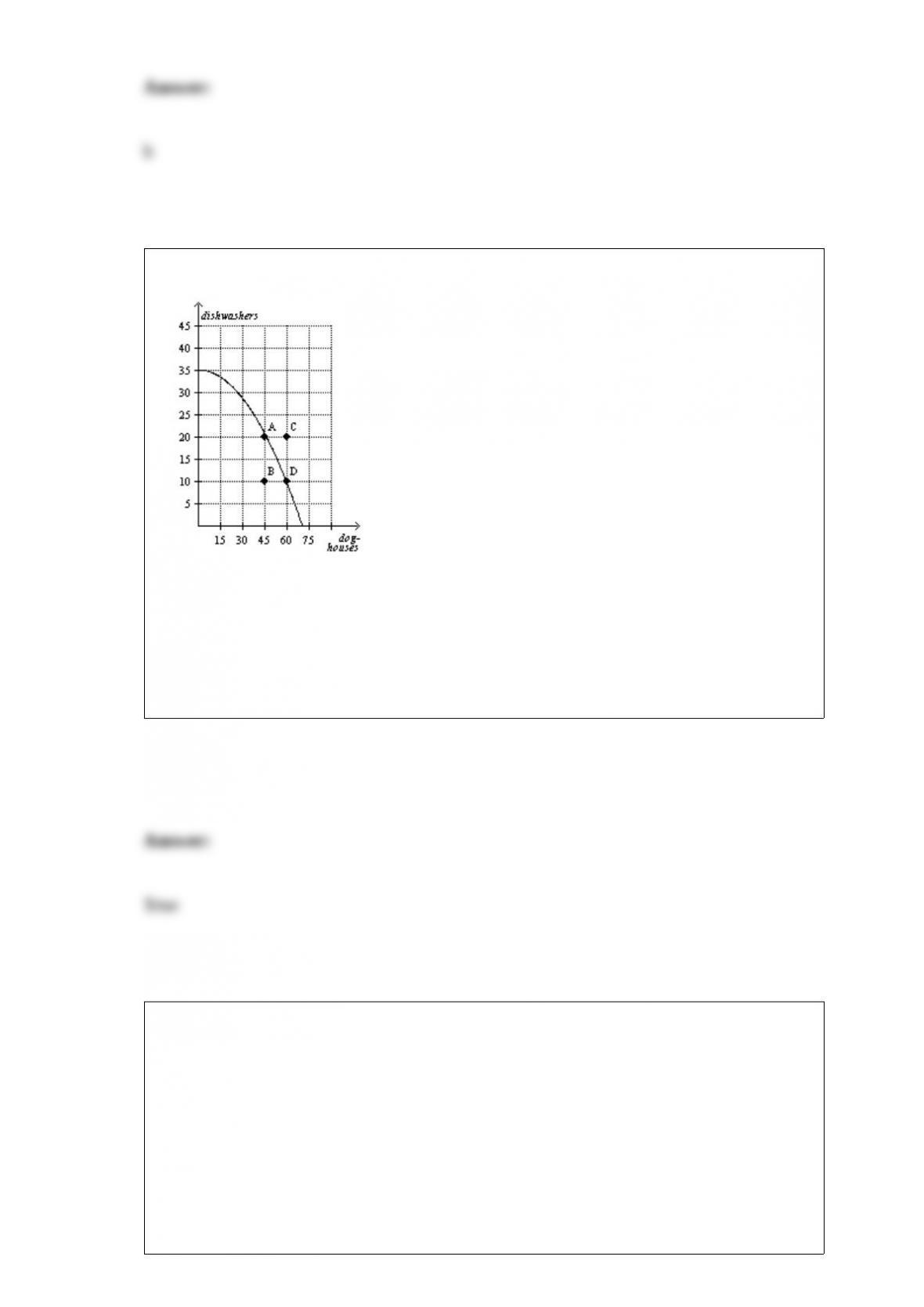
Figure 2-23
Refer to Figure2-23. If this economy uses all its resources in the dishwasher industry,
it produces 35 dishwashers and no doghouses.
a. True
b. False
Consider the expressions T– Gand Y– T– C. Which of the following statements is
correct?
a. Each one of these is equal to national saving.
b. Each one of these is equal to public saving.
c. The first of these is private saving; the second one is public saving.
d. The first of these is public saving; the second one is private saving.
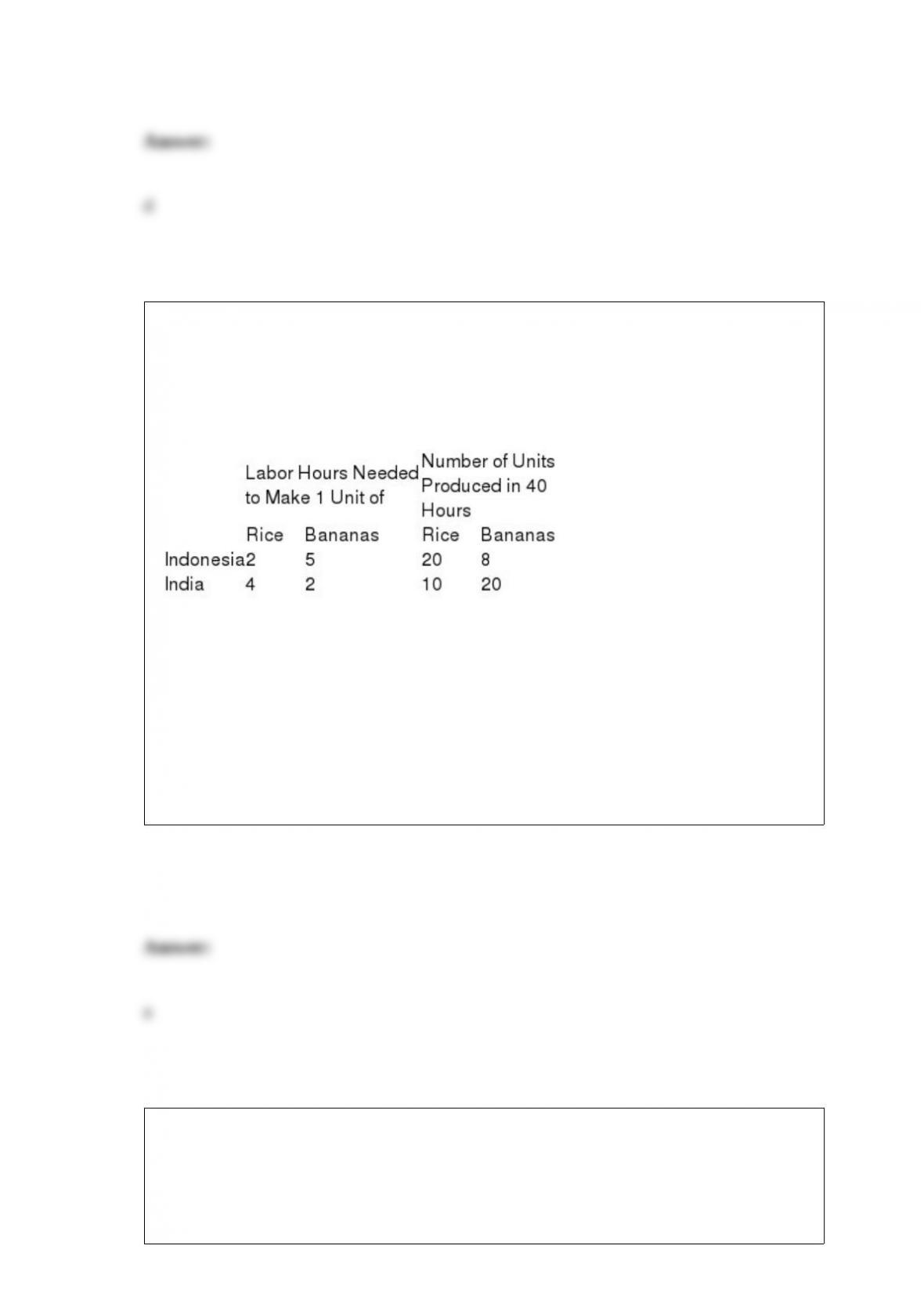
Table3-34
Assume that Indonesia and India can switch between producing rice and bananas at a
constant rate.
RefertoTable3-34.Indonesia’s opportunity cost of producing bananas is
a. 2.5 units of rice. This is higher than India’s opportunity cost of producing bananas.
b. 2.5 units of rice. This is lower than India’s opportunity cost of producing bananas.
c. 2/5 units of rice. This is higher than India’s opportunity cost of producing bananas.
d. 2/5 units of rice. This is lower than India’s opportunity cost of producing bananas.
The price of imported oil rises. If the government wanted to stabilize output, which of
the following could it do?
a. increase government expenditures or increase the money supply

b. increase government expenditures or decrease the money supply
c. decrease government expenditures or increase the money supply
d. decrease government expenditures or decrease the money supply
The future value of a deposit in a savings account will be larger
a. the longer a person waits to withdraw the funds.
b. the higher the interest rate is.
c. the larger the initial deposit is.
d. All of the above are correct.
The term crowding-outeffectrefers to
a. the reduction in aggregate supply that results when a monetary expansion causes the
interest rate to decrease.
b. the reduction in aggregate demand that results when a monetary expansion causes the
interest rate to decrease.
c. the reduction in aggregate demand that results when a fiscal expansion causes the
interest rate to increase.
d. the reduction in aggregate demand that results when a decrease in government
spending or an increase in taxes causes the interest rate to increase.
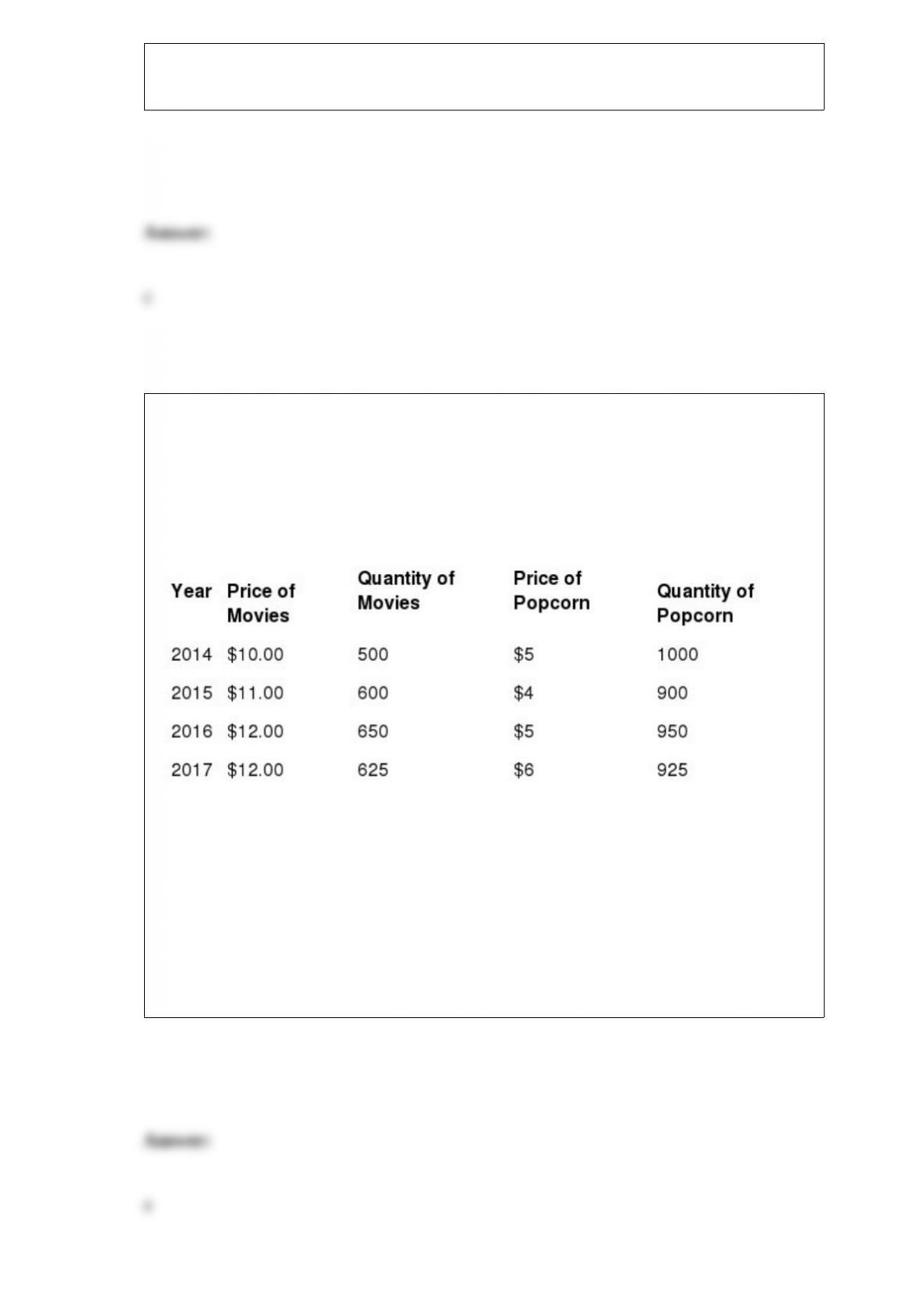
Table 23-10
A hypothetical country of Lahland produces only movies and popcorn. Quantities and
prices of these goods for the last several years are shown below. The base year is 2015 .
RefertoTable23-10.What was this country’s GDP deflator in 2017?
a. 123.4
b. 116.7
c. 120.0
d. None of the above is correct.
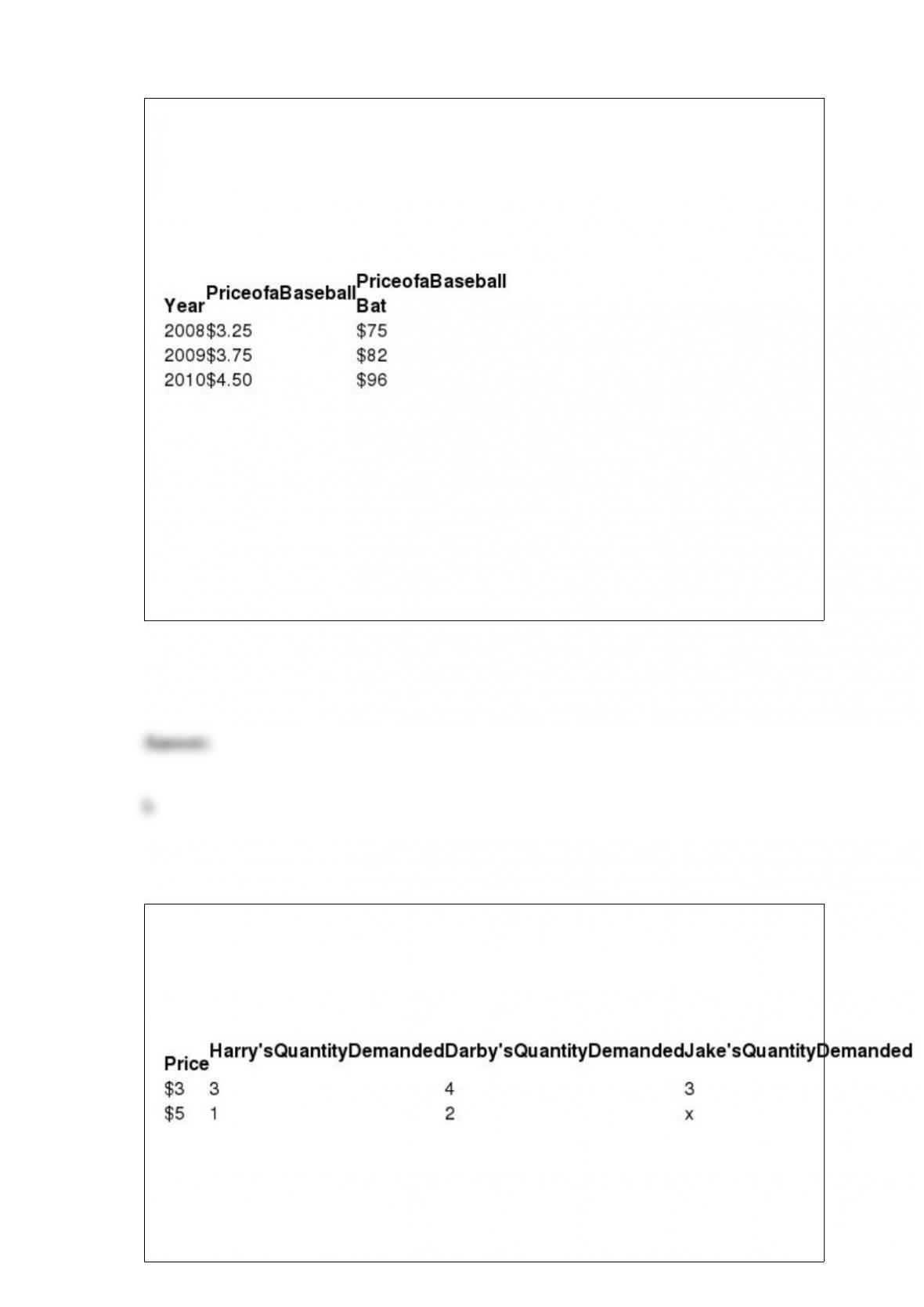
Table 24-10
The table below shows the prices of baseballs and baseball bats for three years. Assume
the typical consumer’s basket consists of 6 baseballs and 2 baseball bats.
RefertoTable24-10.If 2008 is the base year, then the consumer price index was
a. 100.00 in 2008, 110.03 in 2009, and 117.43 in 2010.
b. 100.00 in 2008, 110.03 in 2009, and 129.20 in 2010.
c. 100.00 in 2008, 117.00 in 2009, and 132.50 in 2010.
d. 169.50 in 2008, 186.50 in 2009, and 219.00 in 2010.
Table 4-13
The demand schedule below pertains to sandwiches demanded per week.
RefertoTable4-13.Suppose Harry, Darby, and Jake are the only demanders of
sandwiches. Also suppose the following:
x = 2.

The current price of a sandwich is $5.00.
The market quantity supplied of sandwiches is 10.
The law of supply applies to the supply of sandwiches.
Then there is a
a. shortage of 5 sandwiches, and the price would be expected to rise from its current
level of $5.00.
b. shortage of 5 sandwiches, and the price would be expected to fall from its current
level of $5.00.
c. surplus of 5 sandwiches, and the price would be expected to rise from its current
level of $5.00.
d. surplus of 5 sandwiches, and the price would be expected to fall from its current level
of $5.00.