1) In the situation involving a bilateral monopoly, a
A) single firm acts as both the monopsonist and the monopoly.
B) single seller sells to a single buyer.
C) monopsonist sells to a monopsonist.
D) monopolist sells to a monopolist.
If MUa/Pa is greater than MUb/Pb, and the consumer is consuming both goods, the
consumer is not maximizing utility. True or false. Explain.
A lawsuit seeking compensation for damage from pollution
A) will ruin any chances the Coase theorem has of working to avoid the situation in the
first place.
B) is a substitute for bargaining, but an inefficient one.
C) is a substitute for bargaining, and it can lead to the efficient solution.
D) is preferable to switching the property rights between the parties.
E) is how the Coase theorem was meant to work in the first place.
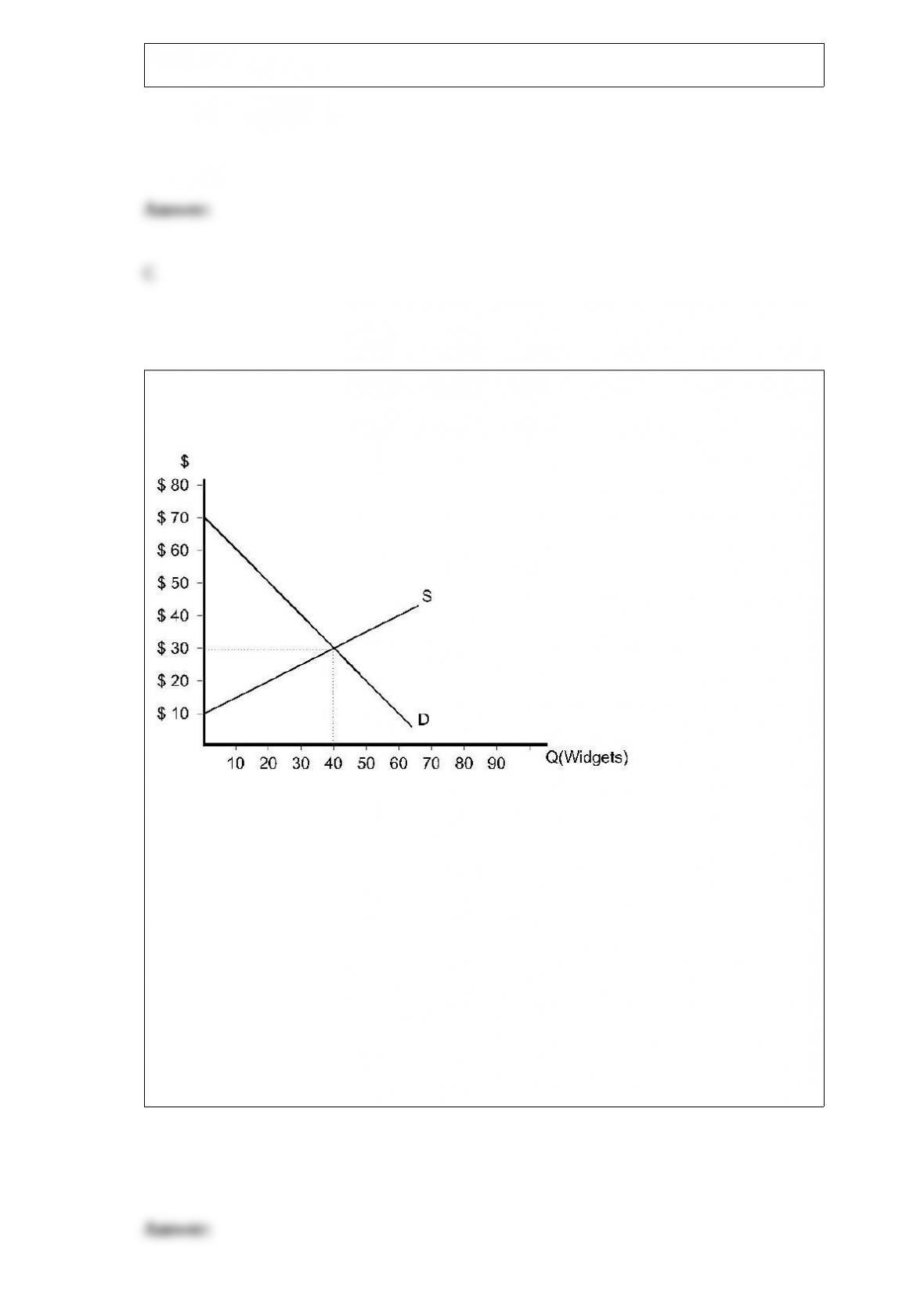
Figure 9.1
Refer to Figure 9.1. Suppose the market is currently in equilibrium. If the government
establishes a price ceiling of $20, consumer surplus will
A) fall by $200.
B) fall by $300.
C) remain the same.
D) rise by $200.
E) rise by $300.
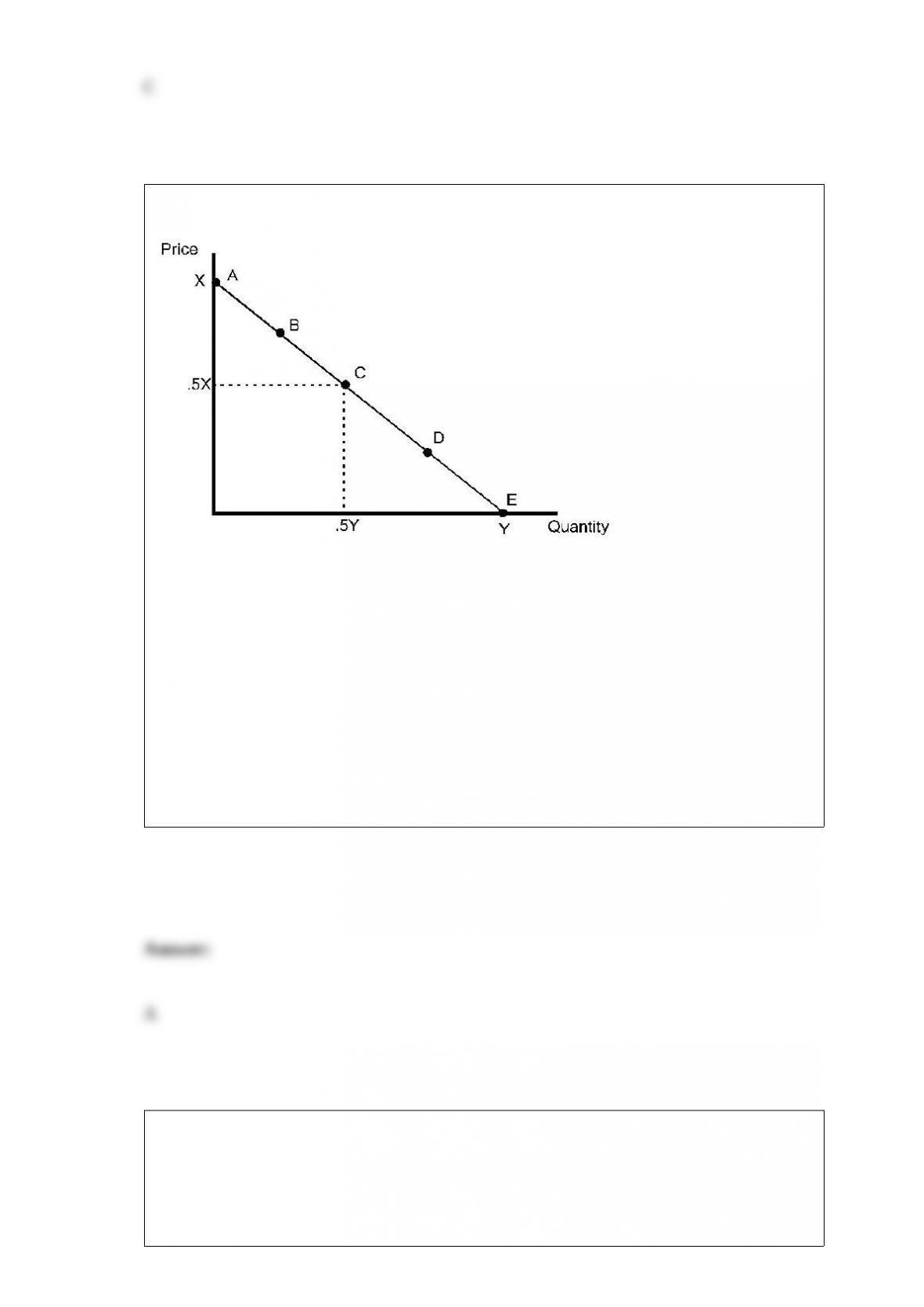
At point E, demand is:
A) completely inelastic.
B) inelastic, but not completely inelastic.
C) unit elastic.
D) elastic, but not infinitely elastic.
E) infinitely elastic.
If households pay a fixed annual fee for trash disposal,
A) households will all tend to produce the same amount of garbage.
B) households have no incentive to cut back on the amount of garbage they generate.

C) that fee will provide households with an incentive to cut back on the amount of
garbage they generate.
D) that fee will discourage households from throwing out reusable materials.
E) that fee will discourage households from throwing out toxic or otherwise harmful
materials.
Firms often use patent rights as a:
A) barrier to exit.
B) barrier to entry.
C) way to achieve perfect competition.
D) none of the above
Sarah and Jane are two representative individuals living in an economy that produces
two goods, X and Y. Sarah’s and Jane’s utility functions are given as:
Sarah: US = 100X0.5Y0.5
Jane: UJ = 50X0.4Y0.6
The market determined prices of X and Y are $10 and $20, respectively. Current outputs
are 58 units of X per time period and 36 units of Y. Jane’s current income is $600 per
time period, while Sarah’s income is $700 per time period.
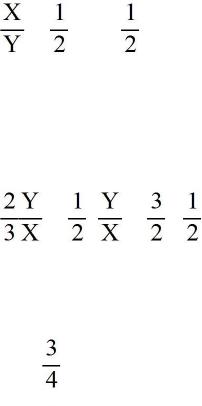
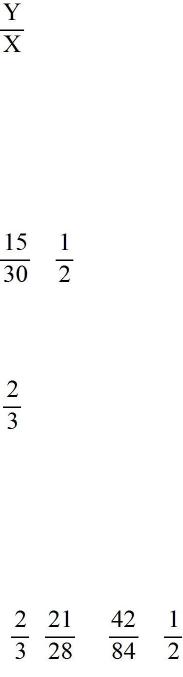
a. Write expressions for Sarah and Jane’s marginal rates of substitution.
b. Determine the quantities of X and Y that Sarah and Jane should consume in
equilibrium.
c. Do the values calculated in part (b) satisfy the conditions for equilibrium in
exchange? Explain using numbers.
d. Examine your answers in parts (b) and (c). If equilibrium has not been achieved,
what would be necessary to reach equilibrium? If equilibrium has been achieved,
comment on the process by which equilibrium was reached.

Which of the following pairs of goods are most likely to have a negative cross-price
elasticity of demand?
A) Hotdogs and hotdog buns
B) Coke and Pepsi
C) Rail tickets and plane tickets
D) A Luciano Pavarotti compact disc and a Placido Domingo compact disc (Both
Pavarotti and Domingo are opera stars.)
An important determinant of the amount of grains harvested next year by Ethiopian
farmers is the amount of seeds planted this year. Given that Western nations have
guaranteed to donate five hundred tons of grain next year, this year the Ethiopian
farmers will:
A) plant more seeds as the food aid establishes a minimum price for grain.
B) plant more seeds as the farmers’ confidence is restored.
C) plant the same amount of seeds as they would have without the food aid.
D) plant fewer seeds as consumers demand for grain is completely price elastic.
E) plant fewer seeds as the price of grain will be lower with the food aid.

A situation in which the unregulated competitive market outcome is inefficient because
prices fail to provide proper signals to buyers and sellers is known as:
A) an imperfectly competitive market.
B) a market failure.
C) a deadweight loss.
D) a disequilibrium.
If Jill’s MRS of popcorn for candy is 2 (popcorn is on the horizontal axis), Jill would
willingly give up:
A) 2, but no more than 2, units of popcorn for an additional unit of candy.
B) 2, but no more than 2, units of candy for an additional unit of popcorn.
C) 1, but no more than 1, unit of candy for an additional 2 units of popcorn.
D) 2, but no more than 2, units of popcorn for an additional 2 units of candy.

In which oligopoly model(s) do firms earn zero profit?
A) Cournot
B) Bertrand
C) Stackelberg
D) Oligopoly firms always earn positive economic profits.
A 10 percent decrease in advertising results in a 5 percent sales decrease. The
advertising elasticity of demand is ________.
A) -2.0
B) -0.5
C) 0.5
D) 2
E) none of the above
Which of the following is TRUE concerning equilibrium in a monopsonistic factor
market?

A) The firm uses the efficient level of the input but does not maximize profit.
B) The firm maximizes profit but does not use the efficient level of the input.
C) The firm maximizes profit and uses the efficient level of the input.
D) The firm either maximizes profit or uses the efficient level of the input, but it cannot
do both at the same time.
The price of coffee is always equal to one-half the price of tea. When we plot the
budget line for coffee and tea, coffee is plotted on the horizontal axis. What is the slope
of this budget line?
A) -1/2
B) 1/2
C) -2
D) 2
When cost and demand are stable over time in an industry, repetition of Prisoners’
Dilemma situations
A) can yield cooperative outcomes because firms can explicitly collude to set prices.

B) can yield cooperative outcomes even when firms do not explicitly collude to set
prices.
C) cooperative or noncooperative outcomes may occur, but cooperation is harder than
when the market is unstable.
D) will tend to yield noncooperative outcomes.
E) will always yield noncooperative outcomes.
Scenario 4.4:
The demand curve for the new computer game, Rock and Roll Trivia, is given as
follows:
Q = 200 – 5P – .1Pc – .5Pd + .2A – I
where P is the price of the game
Pc is the price of a computer
Pd is the price of a diskette
A is the level of advertising
Q is the level of incomeSee the information in Scenario 4.4. From this demand curve,
one can infer that:
A) Rock and Roll Trivia is an inferior good.
B) computers and diskettes are substitutes.
C) computers and diskettes are complements.
D) computers are a normal good.
E) A, B and D are true.

In peak-load pricing,
A) marginal revenue is equal in both periods.
B) marginal revenue in the peak period is greater than in the off-peak period.
C) marginal revenue in the peak period is less than in the off-peak period.
D) the sum of the marginal revenues is greater than the sum of the marginal costs.
Tom Wilson is the operations manager for BiCorp, a real estate investment firm. Tom
must decide if BiCorp is to invest in a strip mall in a northeast metropolitan area. If the
shopping center is highly successful, after tax profits will be $100,000 per year.
Moderate success would yield an annual profit of $50,000, while the project will lose
$10,000 per year if it is unsuccessful. Past experience suggests that there is a 40%
chance that the project will be highly successful, a 40% chance of moderate success,
and a 20% probability that the project will be unsuccessful.
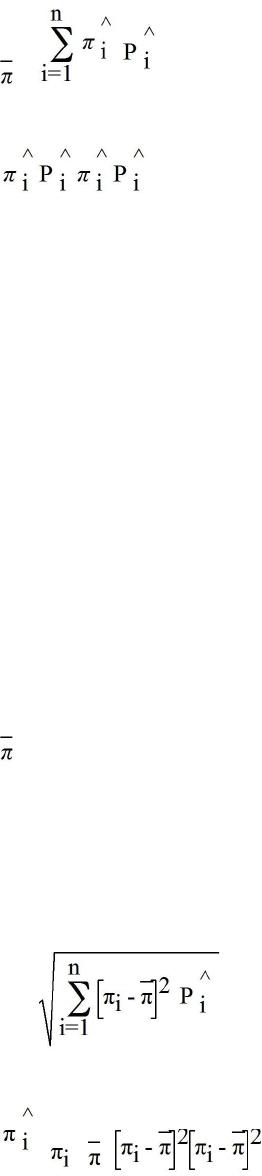
a. Calculate the expected value and standard deviation of profit.
b. The project requires an $800,000 investment. If BiCorp has an 8% opportunity cost
on invested funds of similar riskiness, should the project be undertaken?

Scenario 17.5
Consider the following information:
Income to the firm from workers who sell door-to-door
Bad Luck Good Luck
Low Effort (e = 0) $5,000 $7,000
High Effort (e = 1) $7,000 $13,000
Cost of effort: c = $2500e
Probabilities: Bad luck = .75; Good luck = .25
If a fixed wage of $3000 is given the individual worker, the result will be
A) low effort 75% of the time.
B) low effort 25% of the time.
C) low effort.
D) high effort.
E) high or low effort depending on whether the worker thinks the $3000 is an
acceptable wage.

Scenario 1:
This year Jacob Verytall signs a “Fifty Million Dollar” contract with the Mission City
Muckrakers, a new basketball team. He will be paid $10 million per year over the next
5 years beginning next year. The interest rate is 10%, and the Muckrakers have enough
in the bank to generate the payment stream.
If the interest rate is expected to fall to 5% in years 4 and 5, in terms of current dollars
the value of the Muckrakers payments will
A) rise.
B) stay the same.
C) fall.
D) change, but we cannot answer this question without further information.
If a firm can earn a profit stream of $50,000 per year for 10 years, that profit stream is
worth
A) more than $500,000 today.
B) $500,000 today.
C) less than $500,000 today, but a positive amount.

D) nothing today
E) some amount, but whether it is more, less or the same as $500,000 cannot be
determined.
Elasticity measures
A) the slope of a demand curve.
B) the inverse of the slope of a demand curve.
C) the percentage change in one variable in response to a one percent increase in
another variable.
D) sensitivity of price to a change in quantity.
The authors provide an example that illustrates the calculation of the present discounted
value for the lost wages from a deceased worker, and one component in this calculation
is the worker’s annual mortality rate (m). Suppose we conduct this computation in two
different ways — one calculation assumes m is constant for all future periods, and the
other calculation allows m to decline over time due to improvements in medical
technology. Which estimated PDV will be larger?
A) The PDV with constant m will be larger
B) The PDV with variable m will be larger

C) The two PDV’s will be equal
D) The answer to this question depends on the assumed interest rate
Use the following statements to answer this question:
I. The firm’s decision to produce zero output when the price is less than the average
variable cost of production is known as the shutdown rule.
II. The firm’s supply decision is to generate zero output for all prices below the
minimum AVC.
A) I and II are true.
B) I is true and II is false.
C) II is true and I is false.
D) I and II are false.
You produce stereo components for sale in two markets, foreign and domestic, and the
two groups of consumers cannot trade with one another. You will charge the higher
price in the market with the
A) lower own price elasticity of demand (more inelastic demand).
B) higher own price elasticity of demand (more elastic demand).
C) larger teenage population.
D) greater consumer incomes.
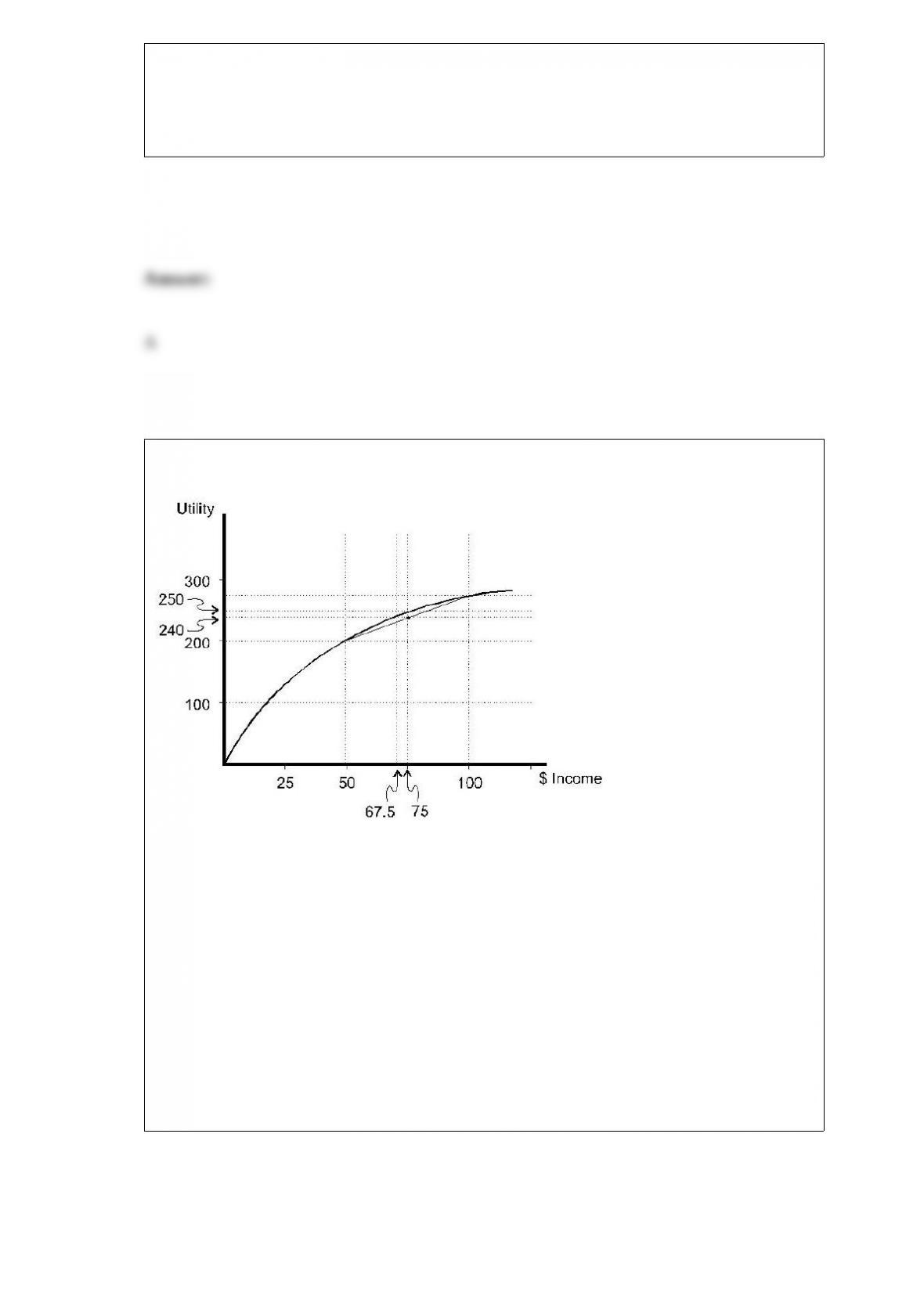
Figure 5.2
The individual pictured in Figure 5.2
A) must be risk-averse.
B) must be risk-neutral.
C) must be risk-loving.
D) could be risk-averse, risk-neutral, or risk-loving.
E) could be risk-averse or risk-loving, but not risk-neutral.
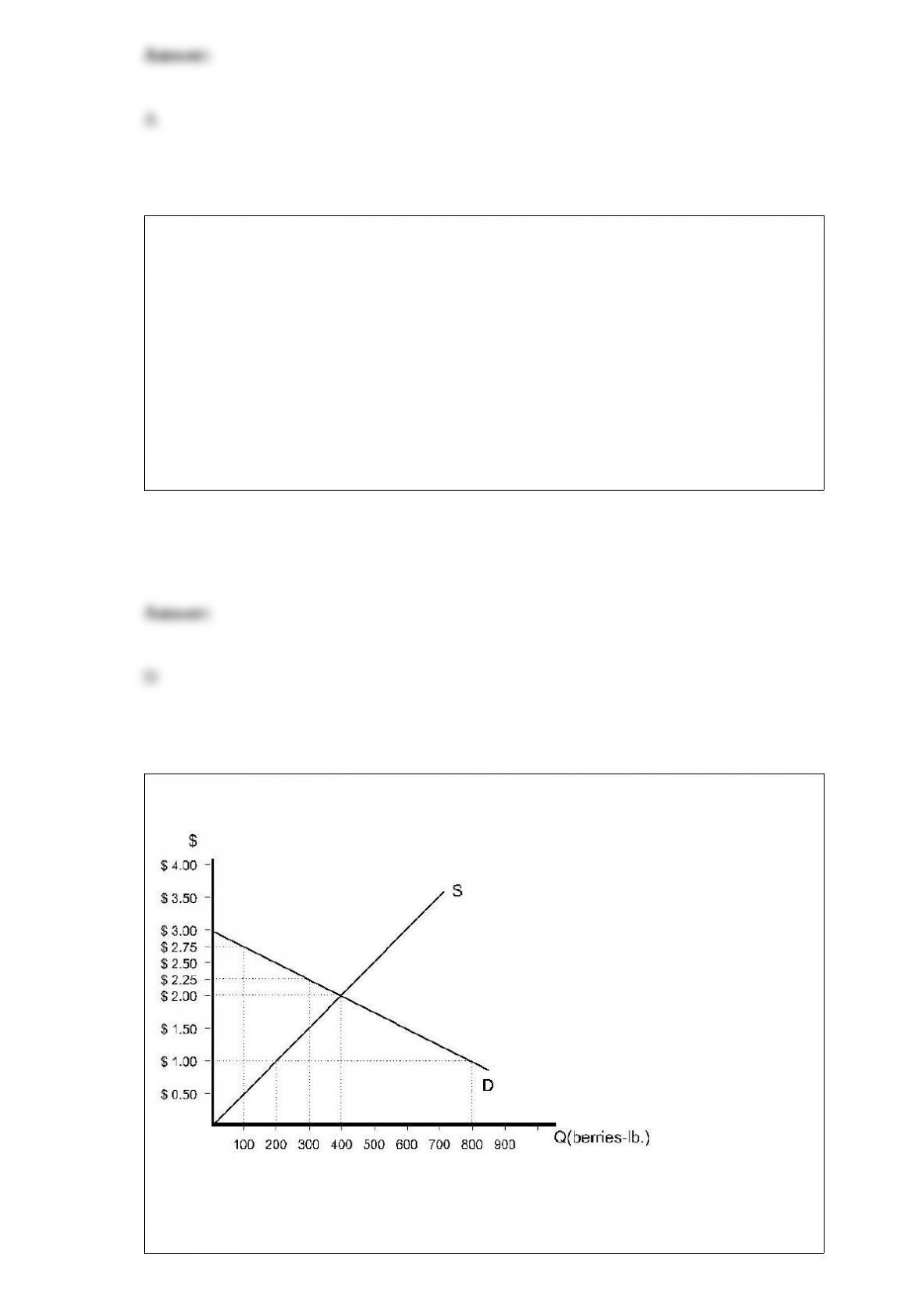
Suppose all firms have constant marginal costs that are the same for each firm in the
short run. In this case, the market level supply curve is ________ and producer surplus
equals ________:
A) perfectly inelastic, fixed costs
B) perfectly inelastic, zero
C) perfectly elastic, fixed costs
D) perfectly elastic, zero
Figure 9.3
Refer to Figure 9.3. If the market is in equilibrium, total consumer and producer surplus
is

A) $0.
B) $4.
C) $5.
D) $600.
E) $800.
A function that indicates the maximum output per unit of time that a firm can produce,
for every combination of inputs with a given technology, is called
A) an isoquant.
B) a production possibility curve.
C) a production function.
D) an isocost function.
Jane is trying to decide which courses to take next semester. She has narrowed down
her choice to two courses, Econ 1 and Econ 2. Now she is having trouble and cannot
decide which of the two courses to take. It’s not that she is indifferent between the two
courses, she just cannot decide. An economist would say that this is an example of
preferences that:
A) are not transitive.
B) are incomplete.
C) violate the assumption that more is preferred to less.
D) all of the above
Mr. Barnes operates a power plant in the local market. Mr. Barnes’ marginal cost
function is: MC(q) = 2 + 0.1q. Mr. Barnes can sell all the output he produces for $9 per
unit. In generating power, Mr. Barnes also emits pollution that causes damage to the
local community. The marginal external cost of his production is: MEC(q) = 0.05q.
What level of output will Mr. Barnes choose to maximize profits? Is this level of
production efficient? If not, what could the local community do to ensure efficiency?
Explain what the principal-agent problem is, and discuss evidence of its existence in the
banking industry in the United States.
As part of the most recent collective bargaining agreement with state employees, a state
government must offer dental insurance at “reasonable, nonprofit rates.” The state plans
to self insure in place of using a private insurance company. Statistical evidence
suggests that the average household currently spends $300 per year for corrective dental
work and $80 for routine checkups. Administrative costs are expected to average $20
per family. The collective bargaining agreement dictates that the plan’s coverages and
rates be fixed for a period of three years. The auditor considers the choice of the plan to
be extremely important. Consequently, the auditor has asked you to evaluate the three
proposals listed below in terms of their propensity to result in adverse selection and/or
moral hazard. Proposal 1 would charge a $400 premium with no deductible. Coverage
is extended to preexisting conditions, but to cover the nondeductible clause, routine
checkups are not covered. Proposal 2 charges a $200 premium with a $200 deductible.
The plan does not cover preexisting conditions, but does cover routine office visits.
Proposal 3 charges a $150 premium with a $150 deductible. This plan doesn’t cover
preexisting conditions or routine checkups. The collective bargaining agreement
dictates that participation in the plan must be at the employee’s option.
The demand for packs of Pokemon cards is given by the equation QD = 500,000 –
45,000P. At a price of $2.50 per pack, what is the quantity demanded? At $5.00 per
pack, what is the price elasticity of demand?
Sam’s utility of wealth function is U(w) = 15 . Sam owns and operates a farm. He is
concerned that a flood may wipe out his crops. If there is no flood, Sam’s wealth is
$360,000. The probability of a flood is 1/15. If a flood does occur, Sam’s wealth will
fall to $160,000. Calculate the risk premium Sam is willing to pay for flood insurance.
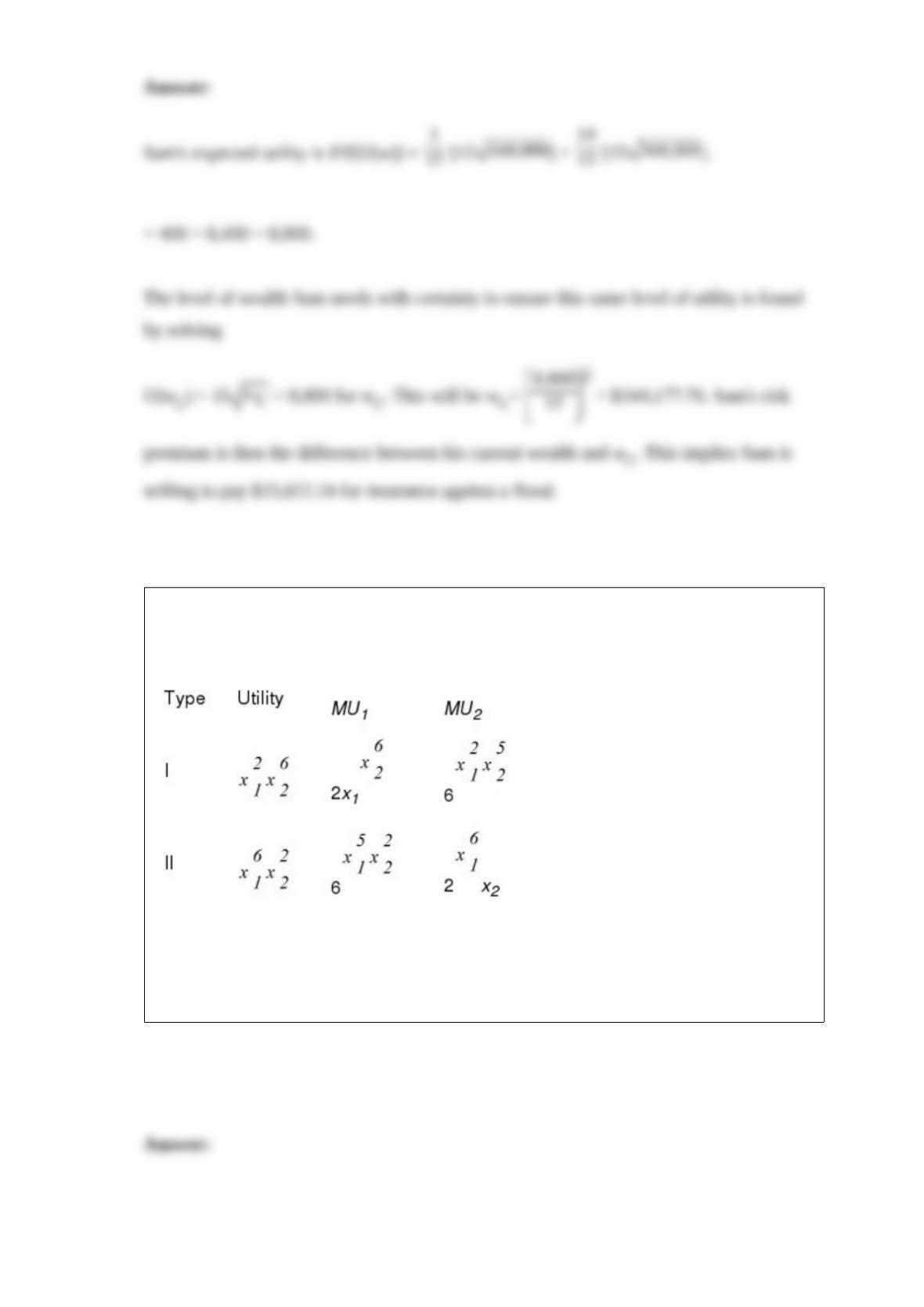
There are two types of people that live on planet Economus. The Utility function of
each type is given in the table.
Derive the demand curves for each type. Everyone on the planet has $1,000 of income
per period and there are 100 individuals of type I and 100 individuals that are type II.
Derive the market demand curve for each good.
Consider a situation in which the government has limited information about costs and
benefits of pollution abatement associated with a given industry. However, it is known
that the marginal social cost curve for emissions is much steeper than the marginal cost
of abatement curve (in absolute terms). In this situation, which method of emissions
control is preferable when the greatest concern is with accuracy of control rather than
the cost of control? That is, should a fee be used or should a standard be used? Explain.
Visitors to National Parks cause damage and increased maintenance costs on the parks.
The marginal external cost of visitors is: MEC(q) = 1.5q, where q is the number of
visitors to National Parks in thousands. The marginal benefit to visitors of attending
National Parks is: MB(q) = 75 – 0.5q. If the Parks do not charge a fee, how many
visitors will attend the National Parks. What is the optimal level of park visitation? If
the National Parks were to establish a park visitation fee, what is the optimal level of
the fee?
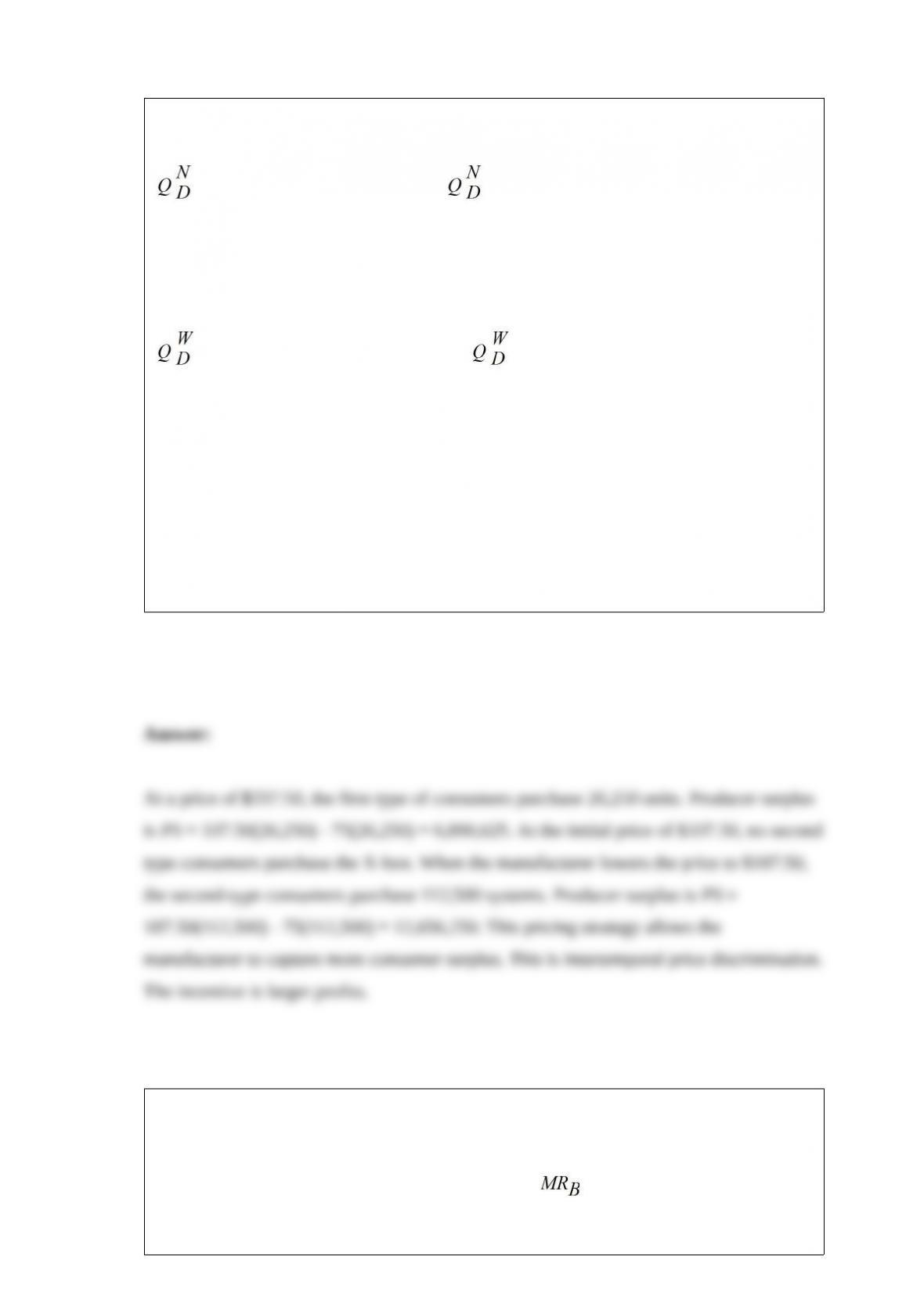
There are two types of consumers of X-box video game systems. The first type of
consumer is highly eager to purchase the newest game systems. Their demand is
= 60,000 – 100P ⇔P = 600 – 0.01 . The resulting marginal revenue function is
MR(QN) = 600 – 0.02QN. After the first month the X-box systems are on the market, the
first-type demand goes to zero at any price. The second type of consumer is more
sensitive to price and will be the same one month after the systems are on the market.
Their demand is
= 300,000 – 1,000P ⇔P = 300 – 0.01 . The resulting marginal revenue
function is
MR(QW) = 300 – 0.02 QW. The marginal cost to the manufacturers is constant at $75. If
the X-box manufacturer initially sets the system price at $337.50, calculate their
producer surplus. Do any second type customers purchase the X-box system at the
initial release? Sometime after the initial release, the manufacturer lowers the price to
$187.50. If only the second type of customer purchases the system at this later date,
calculate producer surplus from these sales. Why does the X-box manufacturer have an
incentive to charge a high relative price at initial release and then lower the price
considerably sometime later?
The Grand River Brick Corporation uses Business-to-Business internet technology to
set output before Bernard’s Bricks. This gives the Grand River Brick Corporation
“first-move” ability. The market demand for bricks is: Qd = 1,000 – 100P ⇔P = 10 –
0.01Qd. Bernard Brick’s marginal revenue curve is: (qB, qG) = 10 – 0.02qB – 0.01
qG. The marginal cost of producing an additional unit of bricks is constant at $2.00 for
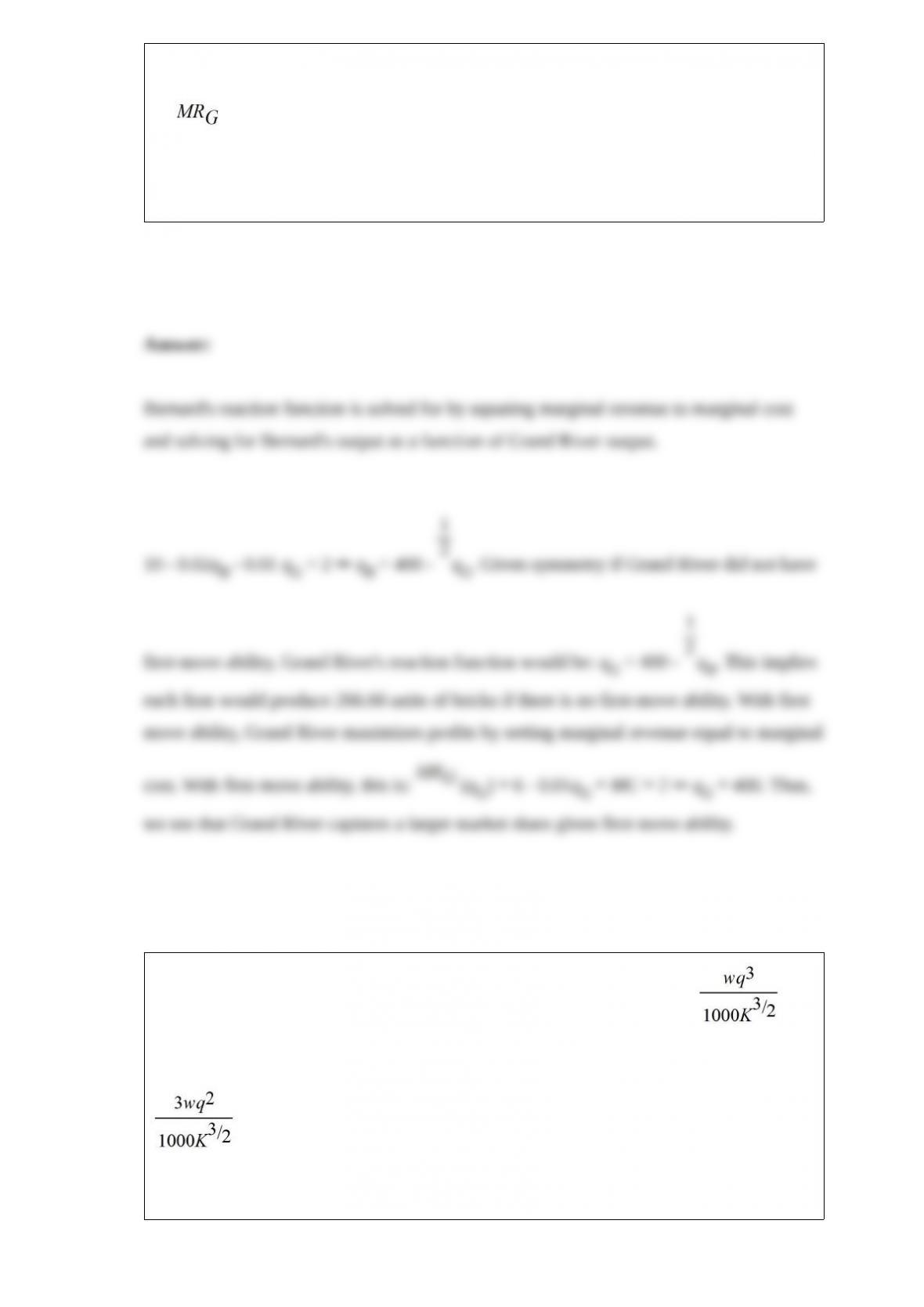
each firm. Determine Bernard’s reaction function. Given that the Grand River Brick
Corporation has this information and moves first, Grand River’s marginal revenue curve
is: (qG) = 6 – 0.01qG. Calculate Grand River Brick Corporations optimal output
level. Does the “first-move” ability of the Grand River Brick Corporation allow them to
capture a larger market share (note that the marginal revenue curves would be
symmetric if Grand River did not have first-move ability)?
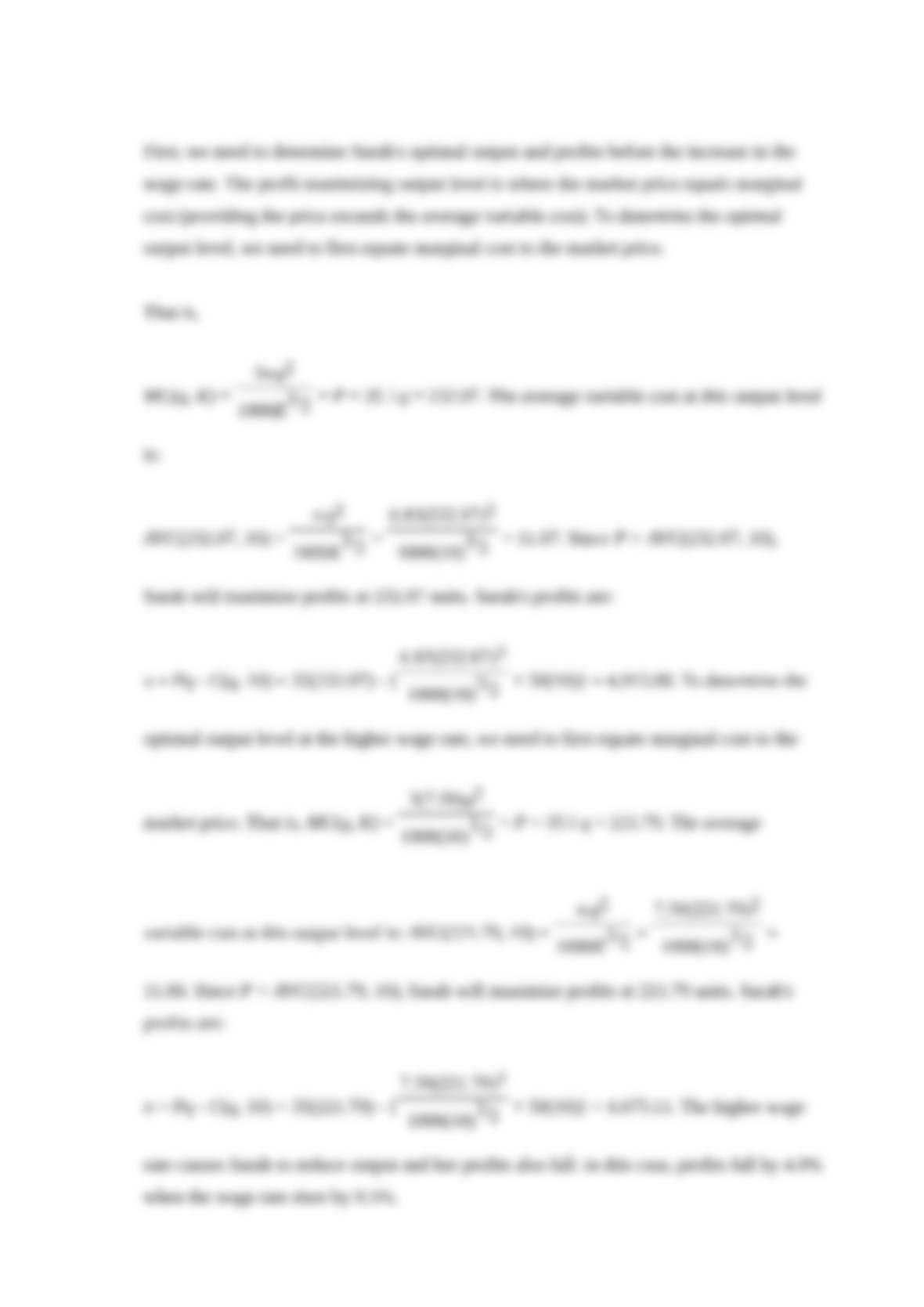
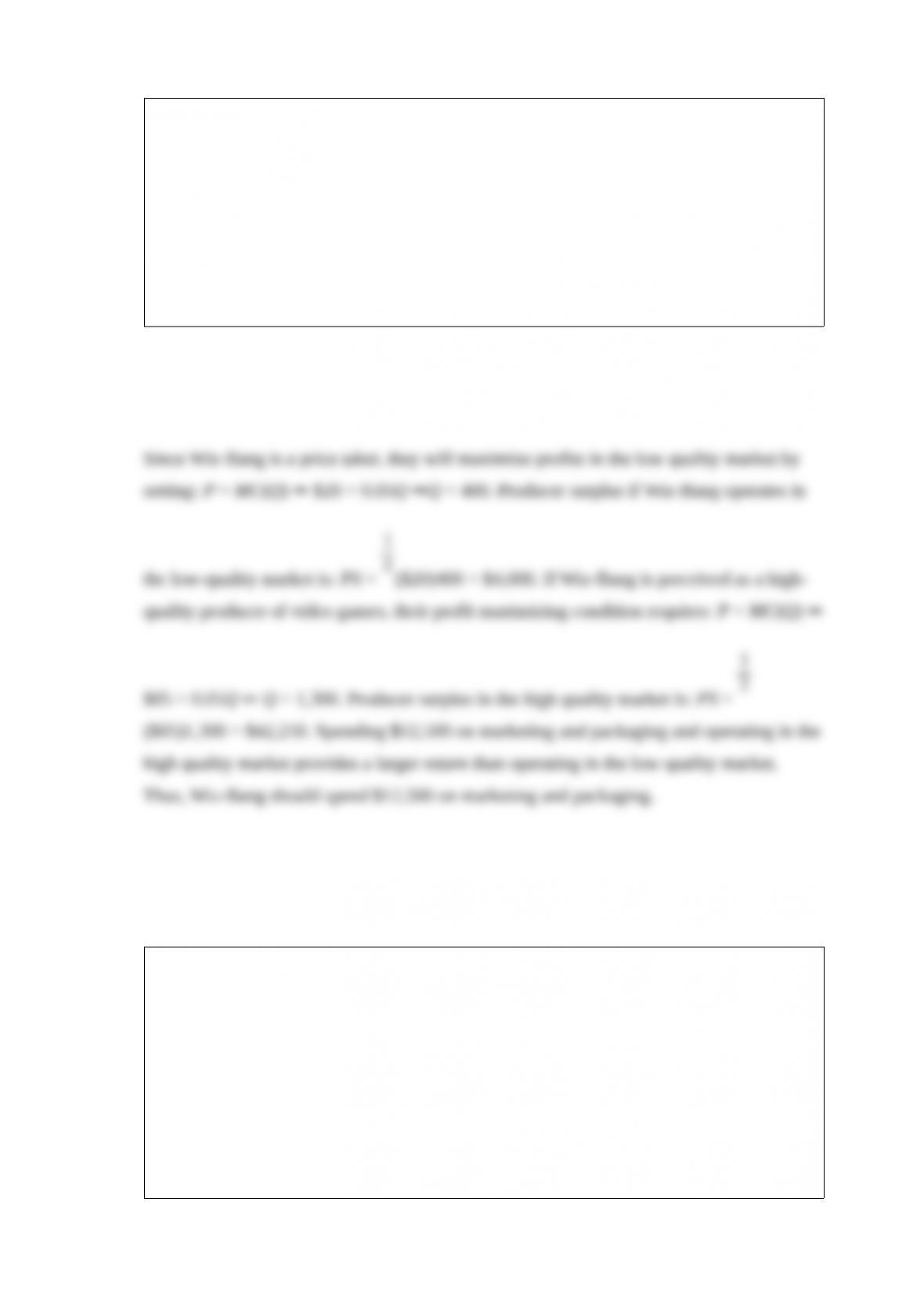
Sarah’s Pretzel plant has the following short-run cost function: C(q, K) = +
50K where q is Sarah’s output level, w is the cost of a labor hour, and K is the number
of pretzel machines Sarah leases. Sarah’s short-run marginal cost curve is MC(q, K) =
. At the moment, Sarah leases 10 pretzel machines, the cost of a labor hour is
$6.85, and she can sell all the output she produces at $35 per unit. If the cost per labor
hour rises to $7.50, what happens to Sarah’s optimal level of output and profits?
Wiz-Bang Games is a new video game maker for the latest game console. As a new
game maker, they have not established a reputation of providing quality games. The
marginal cost to Wiz-Bang for manufacturing games is: MC(Q) = 0.05Q. The market
price for low-quality games is $20. The market price for high-quality games is $65. If
Wiz-Bang sells their product in the low quality market, calculate their producer surplus.
If Wiz-Bang sells their product in the high quality market, calculate their producer
surplus. If Wiz-Bang spends $12,500 on marketing and packaging, they will be
perceived as a high quality producer of video games. Should Wiz-Bang spend the
$12,500 to provide a signal to video game consumers of producing high quality games?
Tammy and Tad’s father has given each of them a debit card and allows each of them to
use the card to spend $500 each month. Tammy and Tad use their $500 to buy only CDs
and gasoline. In February, the price of a CD was $10 and the price of gasoline was $1
per gallon. At these prices, Tammy purchased 45 CDs and 50 gallons of gas. Ted
consumed 20 CDs and 300 gallons of gas. For the month of March, Tammy and Tad’s
father lost the records indicating who had which debit card. From the bank statement in
March, their father learned that the price of a CD was $12 and a gallon of gas cost
$0.80. The first debit card was used to purchase 235 gallons of gas and 26 CDs. The
second debit card was used to purchase 265 gallons of gas and 24 CDs. Using revealed
preference theory, identify which card Tammy must possess.
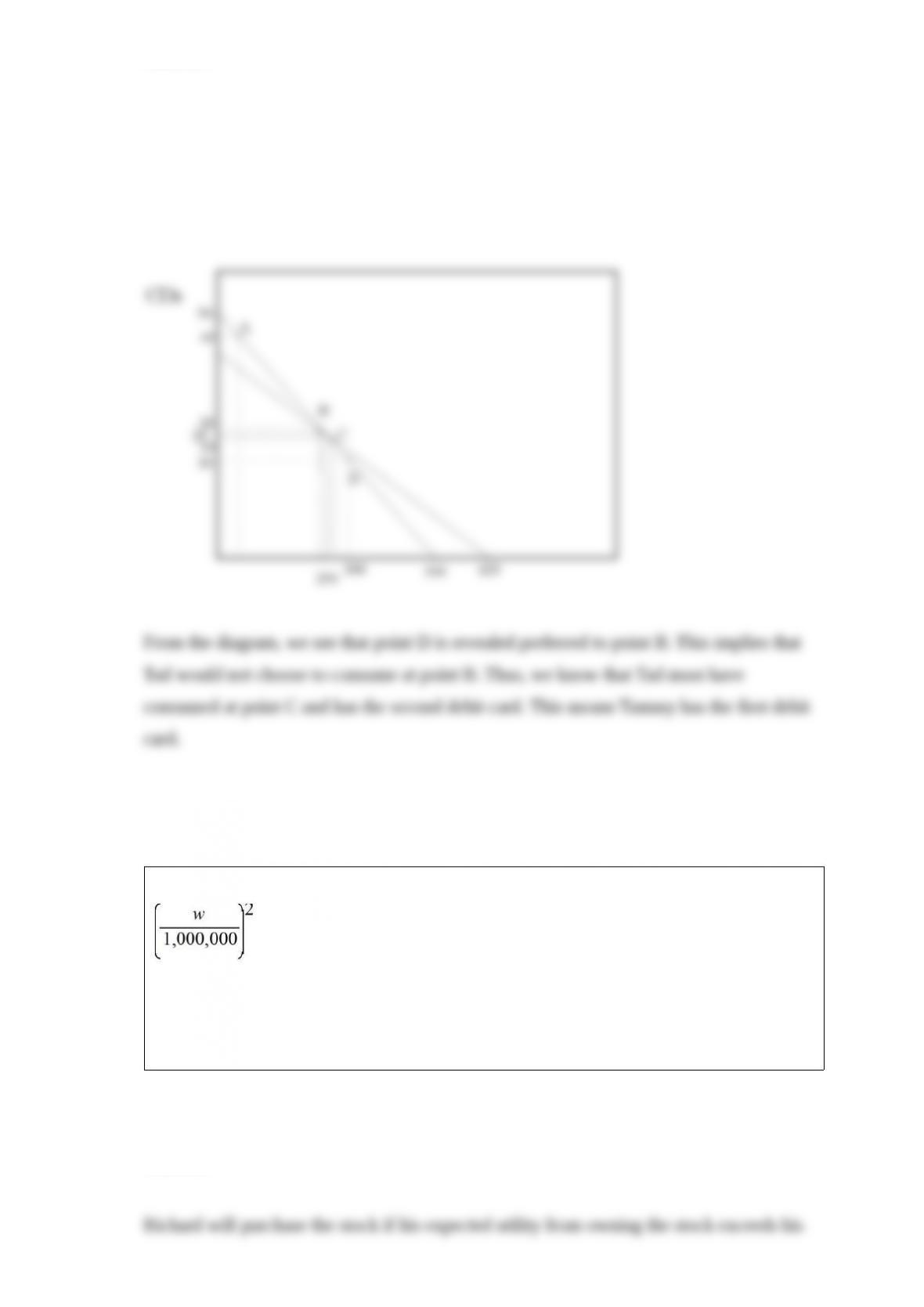
Richard is a stock market day trader. His utility of wealth function is U(w) = 4
. Richard has seen a recent upward trend in the price of Yahoo stock. He
feels that there is a 30% chance the stock will rise from $175 per share to $225.
Otherwise, he believes the stock will settle to about $150 per share. Richard’s current
wealth is $1.75 million. Assume that if Richard purchases the stock, he will use his
entire wealth. Given his risk preferences, will Richard buy Yahoo?
Hale’s One Stop and Auto Service competes with Murray’s Gas Mart. The local demand
is:
Qd = 25 – 10P ⇔P = 2.50 – 0.1Qd. Both firms sell exactly the same quality of gasoline.
Thus, if the firms charge a different price, the lower price firm will capture the entire
market share. If the firms charge the same price, they will split the market share. The
marginal cost functions are both constant at $1.25. If the firms compete by setting price,
what is the market output level? What is the market price level?

Your 65-year-old father is going to retire next year. He would like to have an income of
$20,000 per year for the remainder of his life. If he is expected to live for ten more
years, write an algebraic expression to indicate the amount of money he needs today to
pay him this sum of money if the interest rate is 10 percent.