
A decrease in a fixed exchange rate from $1.75 per pound to $1.60 per pound is called
a(n) ________ of the pound.
A) devaluation
B) depreciation
C) appreciation
D) revaluation
A decrease in individual income taxes ________ disposable income, which ________
consumption spending.
A) increases; increases
B) increases; decreases
C) decreases; increases
D) decreases; decreases
If the best lawyer in town is also the best at operating a word processor, then according
to economic reasoning, this person should
A) split her time evenly between being a lawyer and a word processor.
B) specialize in being a lawyer because its opportunity cost is lower.
C) should pursue the activity she enjoys more.

D) specialize in being a work processor because it is more capital-intensive.
The ratio of the increase in ________ to the increase in ________ is called the
multiplier.
A) equilibrium nominal GDP; autonomous expenditure
B) equilibrium real GDP; autonomous expenditure
C) autonomous expenditure; equilibrium real GDP
D) induced expenditure; equilibrium real GDP
In 2012, which component of GDP had a negative value?
A) consumption
B) investment
C) government spending
D) net exports
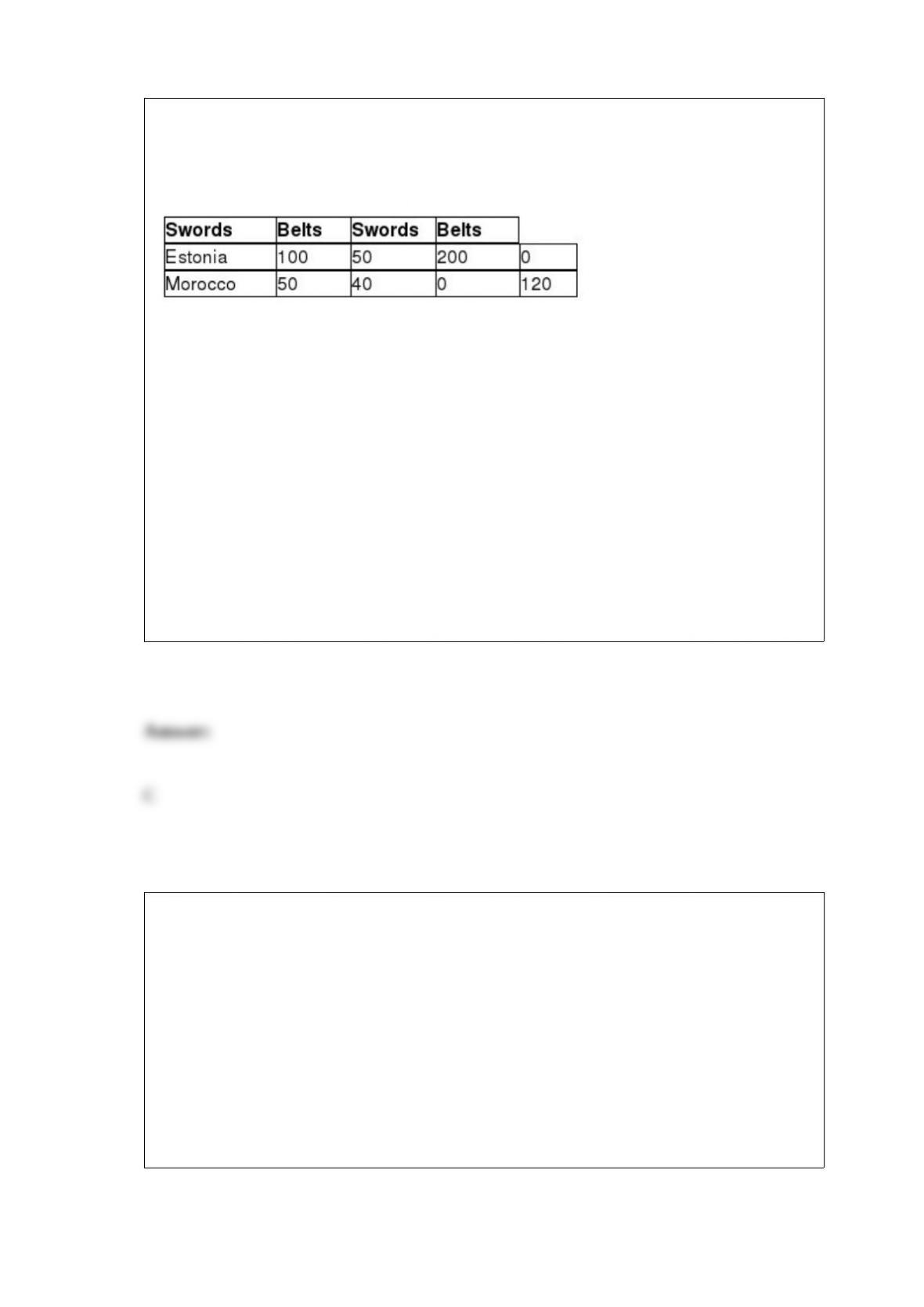
Table 7-6
Production and
Consumption Production
Without Trade With Trade
Estonia and Morocco can produce both swords and belts. Table 7-6 shows the
production and consumption quantities without trade, and the production numbers with
trade.
Refer to Table 7-6. If the actual terms of trade are 1 belt for 1.5 swords and 70 belts are
traded, how many swords will Estonia consume?
A) 95
B) 100
C) 105
D) 200
Monetary policy has a ________ effect on aggregate demand in a(n) ________
economy, and fiscal policy has a ________ effect on aggregate demand in a(n)
________ economy.
A) weaker; open; weaker; open
B) weaker; closed; stronger; closed
C) stronger; open; weaker; closed
D) stronger; closed; weaker; open
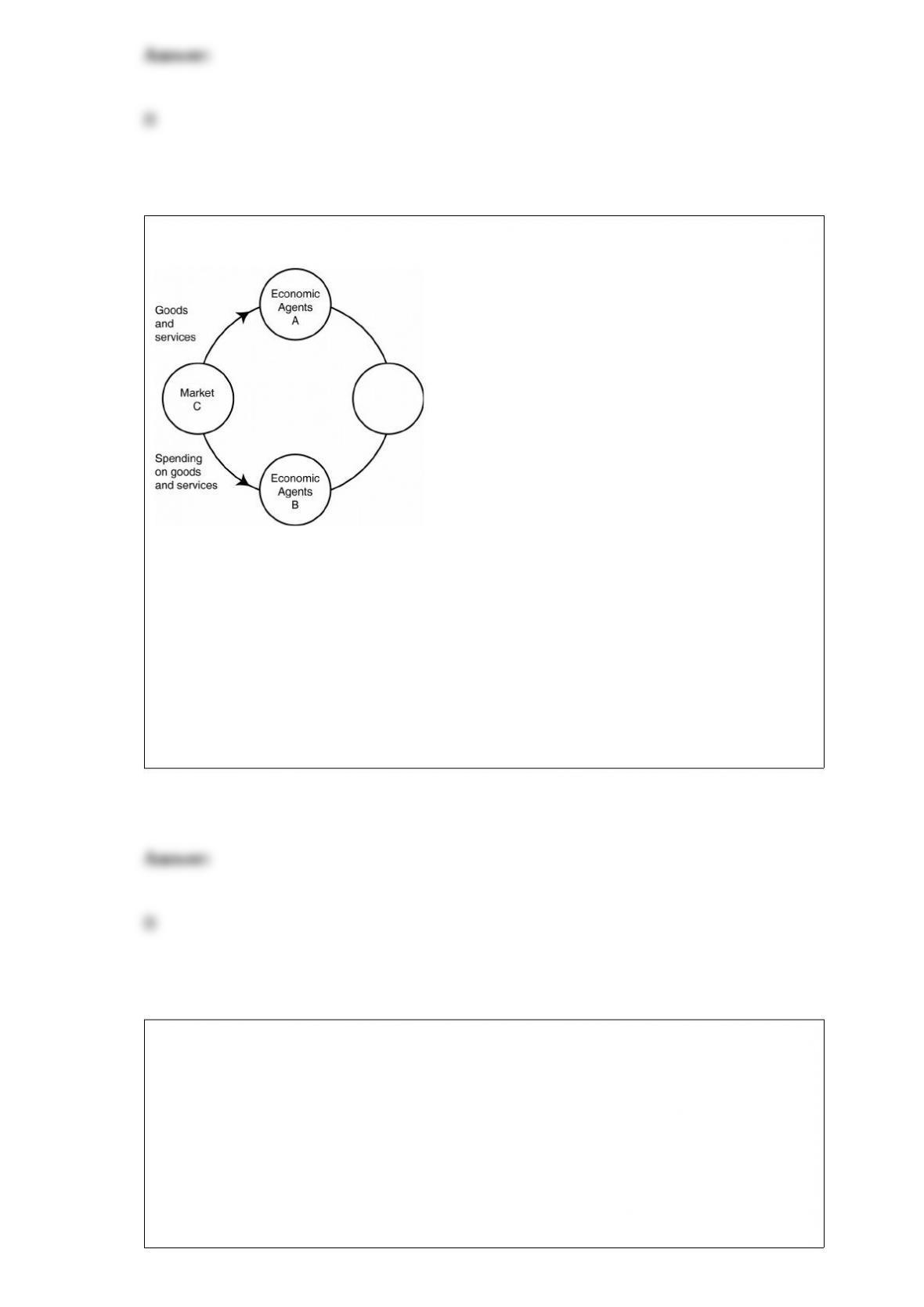
Figure 2-11
Refer to Figure 2-11. In the circular flow diagram, who are economic agents A and who
are economic agents B?
A) A = firms; B = households
B) A = households; B = firms
C) A = households; B = factor markets
D) A= firms; B = product markets
Which of the following is an appropriate policy for a central bank to follow if the
economy is plagued with deflation?
A) increasing the target interest rate on overnight loans
B) using contractionary monetary policy to drive up interest rates
C) consistently pursuing policy to promote the credibility of the central bank

D) gradually raising the required reserve rate
You decide to work in London for the next 5 years, accumulate some savings, then
move back to the United States and convert your savings from British pounds to dollars.
At the time of your move, economists predict that consumers in the United States have
lost their affinity for British products, and expect that this declining preference for
British products will continue for the next decade. How should this influence your
decision to work and save in London?
A) You should be discouraged as the declining U.S. preference for British goods should
increasethe value of the pound to the dollar and decrease the value of your savings
when converted to dollars.
B) You should be discouraged as the declining U.S. preference for British goods should
decrease the value of the pound to the dollar and decrease the value of your savings
when converted to dollars.
C) You should be encouraged as the declining U.S. preference for British goods should
decrease the value of the pound to the dollar and raise the value of your savings when
converted to dollars.
D) You should be encouraged as the declining U.S. preference for British goods should
increase the value of the pound to the dollar and raise the value of your savings when
converted to dollars.
Which of the following is not a true statement about the impact of World War II on the
U.S. economy?
A) U.S. GDP increased dramatically from 1941 to 1945.

B) The war time years were a period of prosperity for U.S. consumers.
C) More than 40% of the labor force was in the military or producing war goods.
D) Increased production of tanks, ships, planes, and munitions accounted for most of
the increase in GDP.
If GDP calculations included measurements of pollution and environmental damage,
GDP values would most likely be
A) greater than their values without these measurements.
B) less than their values without these measurements.
C) unchanged from their values without these measurements.
D) meaningless, since GDP values without these measurements would no longer be of
value.
Figure 3-4
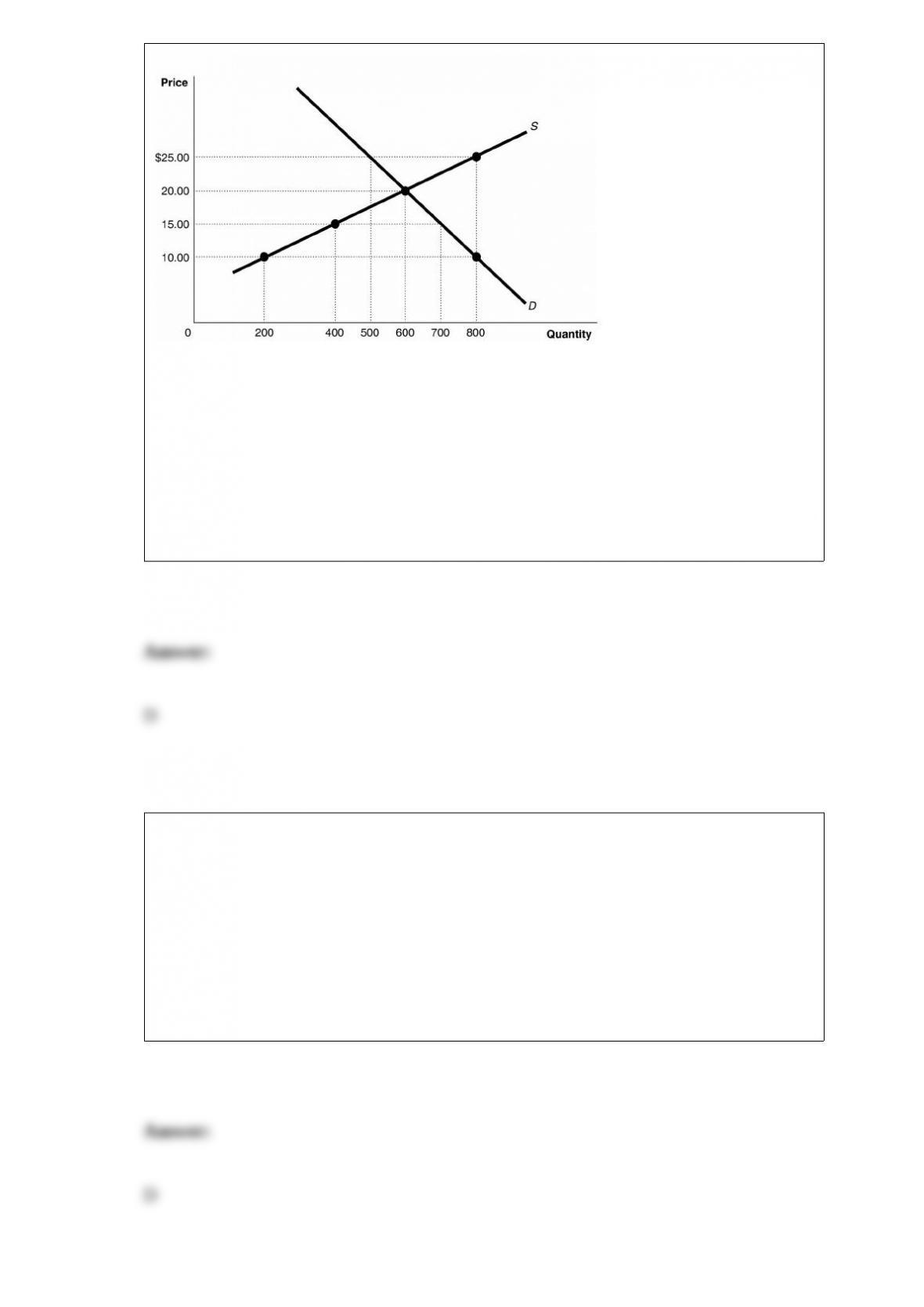
Refer to Figure 3-4. If the price is $20,
A) there would be a surplus of 600 units.
B) there would be a shortage of 600 units.
C) quantity demanded is zero.
D) the market is in equilibrium.
Inflation will
A) increase aggregate demand.
B) increase the quantity of real GDP demanded.
C) decrease aggregate demand.
D) decrease the quantity of real GDP demanded.

Public saving in the economy can be increased by
A) lowering taxes.
B) raising government spending.
C) raising taxes.
D) raising transfer payments.