
1) By driving onto a congested road for which no toll is charged, a driver
a.contributes to the overuse of a common resource.
b.contributes to a negative-externality problem.
c.is inflicting additional time cost on all of the other drivers.
d.All of the above are correct.
2) When a country allows international trade and becomes an importer of a good,
a.domestic producers of the good become better off.
b.domestic consumers of the good become worse off.
c.the gains of the winners exceed the losses of the losers.
d.All of the above are correct.
3) According to the human-capital view, education
a.has no effect on lifetime earnings.
b.alters work ethic.
c.enhances productivity.
d.is an indicator of natural ability.
4) Table 22-13
A high school Spanish class and their teacher are planning to take a Spring Break trip
abroad but they have to decide where to go. They have narrowed the options to: Spain,
Mexico, Ecuador, and Costa Rica. The voters’ preferences are shown in the table below.
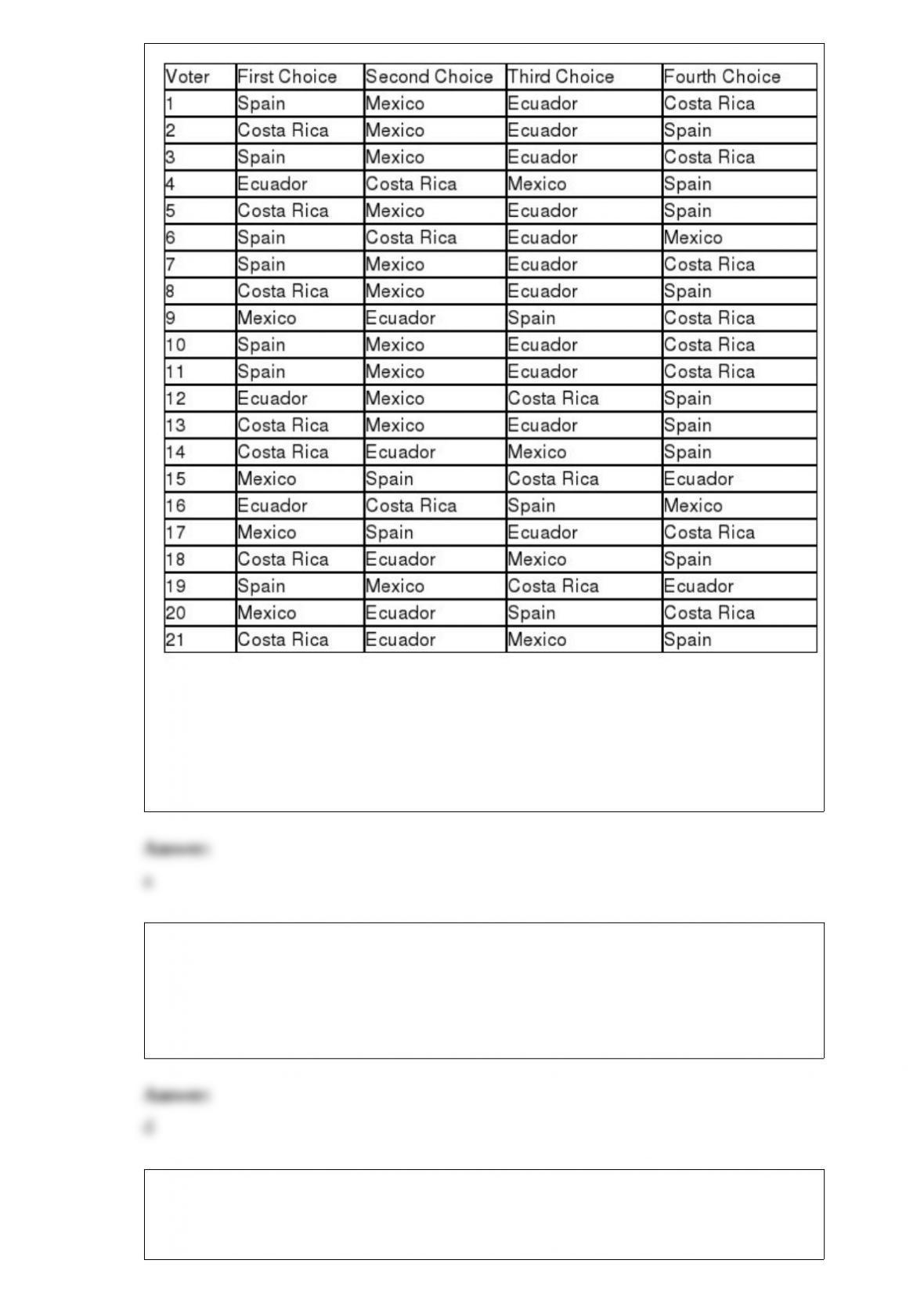
Refer to Table 22-13. In a pairwise election between Mexico and Spain and then a
second election between the winner and Costa Rica, which countries are chosen?
a.Mexico is chosen in the first and second elections.
b.Mexico is chosen in the first election and Costa Rica is chosen in the second.
c.Spain is chosen in the first and second elections.
d.Spain is chosen in the first election and Costa Rica is chosen in the second.
5) A family’s ability to buy goods and services depends largely on the family’s
a.economic mobility.
b.place in the economic life cycle.
c.transitory income.
d.permanent income.
6) According to a study by Michael Cox and Richard Alm, consumption per person in
the richest 20% of households was only 2.1 times consumption per person in the
poorest 20% of households.

a.True
b.False
7) Low rates of inflation are generally associated with
a.low rates of government spending.
b.small or nonexistent government budget deficits.
c.low rates of productivity growth.
d.low rates of growth of the quantity of money.
8) In a market that is characterized by imperfect competition,
a.firms are price takers.
b.there are always a large number of firms.
c.there are at least a few firms that compete with one another.
d.the actions of one firm in the market never have any impact on the other firms’ profits.
9) Total surplus measures the
a.loss to buyers from paying higher prices plus the benefit to sellers from receiving
lower prices.
b.buyers’ willingness to pay less the sellers’ costs.
c.fairness of the distribution of resources in society.
d.value to the government of goods and services sold in society.
10) If the United States changed its laws to allow for the legal sale of a kidney, which of
the following is least likely to occur?
a.The supply of kidneys would increase.
b.The shortage of kidneys would decrease.
c.Many lives would be saved.
d.The allocation of kidneys would be fair.

11) According to the principle of comparative advantage, all countries can benefit from
trading with one another because trade allows each country to specialize in doing what
it does best.
a.True
b.False
12) Which of the following is not correct?
a.Market power can cause markets to be inefficient.
b.When the decisions of buyers and sellers affect nonparticipants, markets may be
inefficient.
c.The tools of welfare economics cannot help economists when markets are inefficient.
d.Externalities can cause markets to be inefficient.
13) As a group, oligopolists would always earn the highest profit if they would
a.produce the perfectly competitive quantity of output.
b.produce more than the perfectly competitive quantity of output.
c.charge the same price that a monopolist would charge if the market were a monopoly.
d.operate according to their own individual self-interests.
14) Economists found evidence of discrimination in each of the following markets
except
a.1960s baseball games
b.baseball cards
c.live basketball games in the 1980s
d.current era baseball games
15) Suppose that the labor market for high school chemistry teachers is initially in
equilibrium. Chemistry teachers use laboratory chemicals as an important part of their
jobs. New environmental regulations ban the use of many chemicals, which means that
fewer laboratory chemicals are available for high school chemistry teachers to use in
their jobs. In the market for high school chemistry teachers, the equilibrium wage
a.increases because the marginal productivity of high school chemistry teachers
increases.
b.decreases because the marginal productivity of high school chemistry teachers
decreases.
c.increases because the supply of high school chemistry teachers increases.
d.decreases because the supply of high school chemistry teachers decreases.
16) An externality is an example of
a.a corrective tax.
b.a tradable pollution permit.
c.a market failure.
d.Both a and b are correct.
17) Construction work is much riskier than working as a server at a restaurant. As a
result, we’d expect a difference in wages between the two jobs. The difference is known
as
a.an efficiency wage.
b.a compensating differential.
c.a wage adjustment.
d.a minimum wage.
18) A positive externality arises when a person engages in an activity that has
a.an adverse effect on a bystander who is not compensated by the person who causes
the effect.
b.an adverse effect on a bystander who is compensated by the person who causes the
effect.
c.a beneficial effect on a bystander who pays the person who causes the effect.
d.a beneficial effect on a bystander who does not pay the person who causes the effect.
19) Recently, in Smalltown, the price of Twinkies fell from $0.80 to $0.70. As a result,
the quantity demanded of Ho- Ho’s decreased from 120 to 100. What would be the
appropriate elasticity to compute? Using the midpoint method, compute this elasticity.
What does your answer tell you?
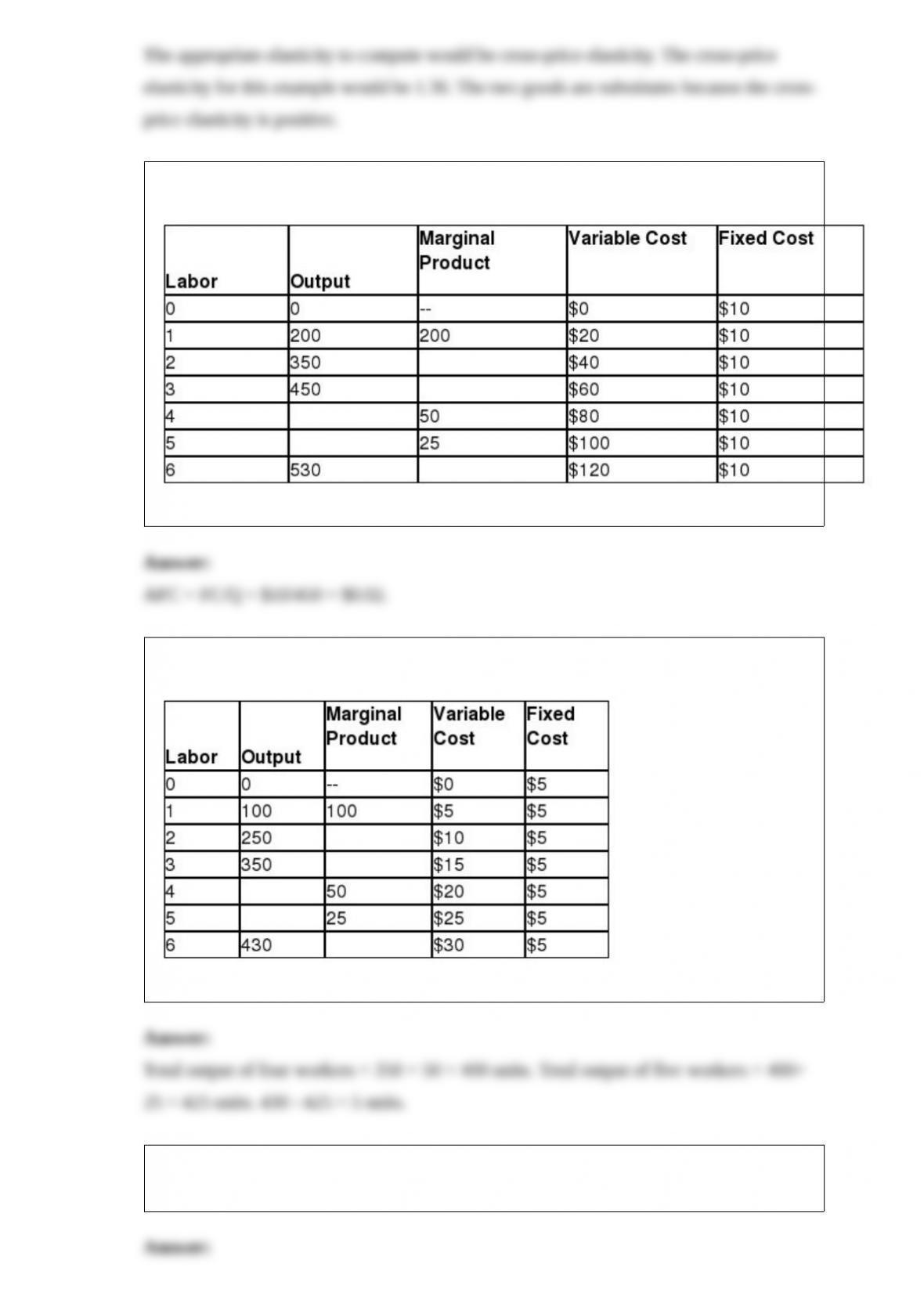
20) Table 13-18
What is the average fixed cost of producing 450 units of output?
21) Table 13-19
What is the marginal product of the sixth worker?
22) When we identify public policies toward externalities, we contrast
command-and-control policies with what other type of policies?
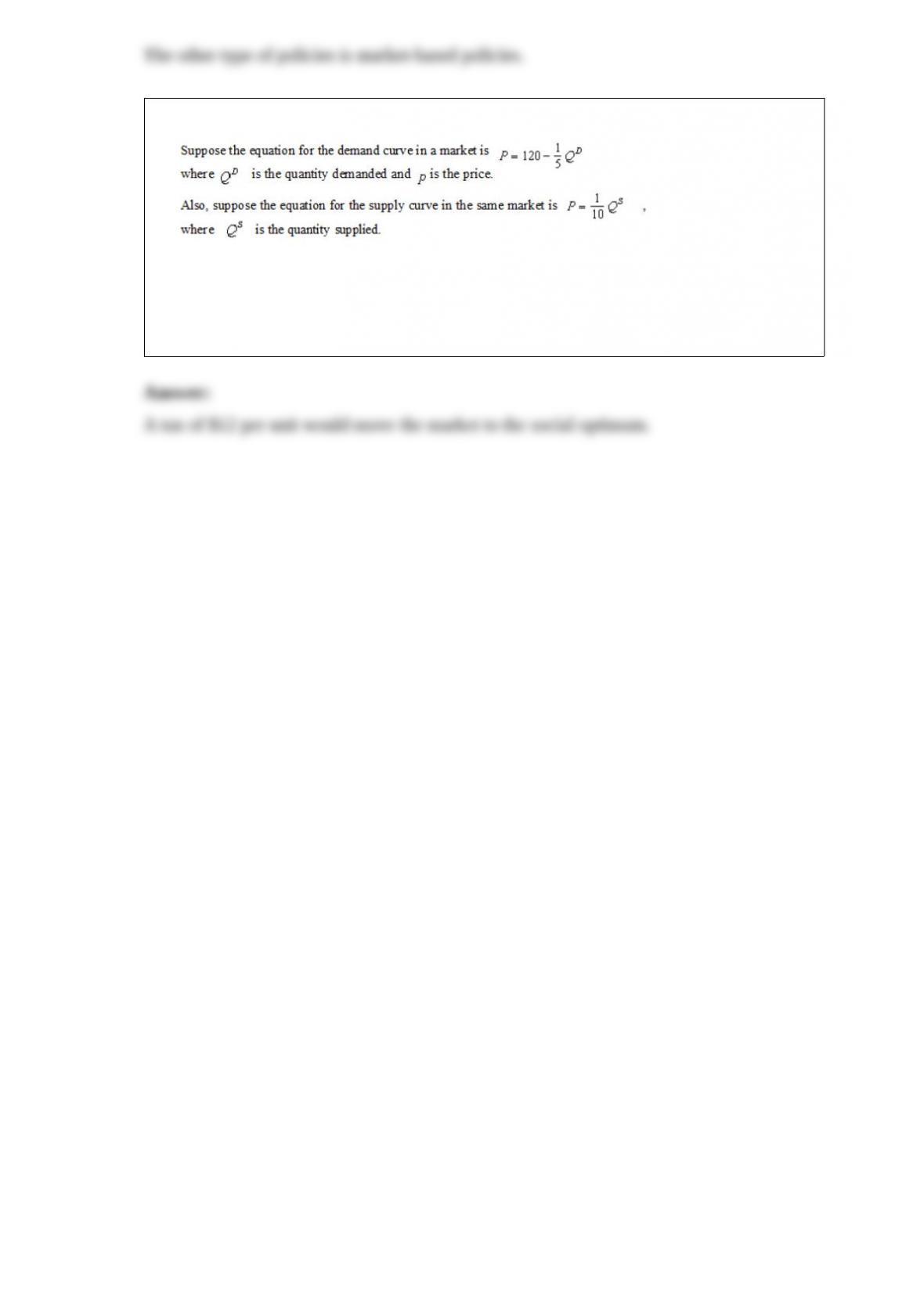
23) Scenario 10−3:
Suppose there is an external cost of $12 associated with the production of each unit of
the good. What particular tax or subsidy would move the market to the social optimum?