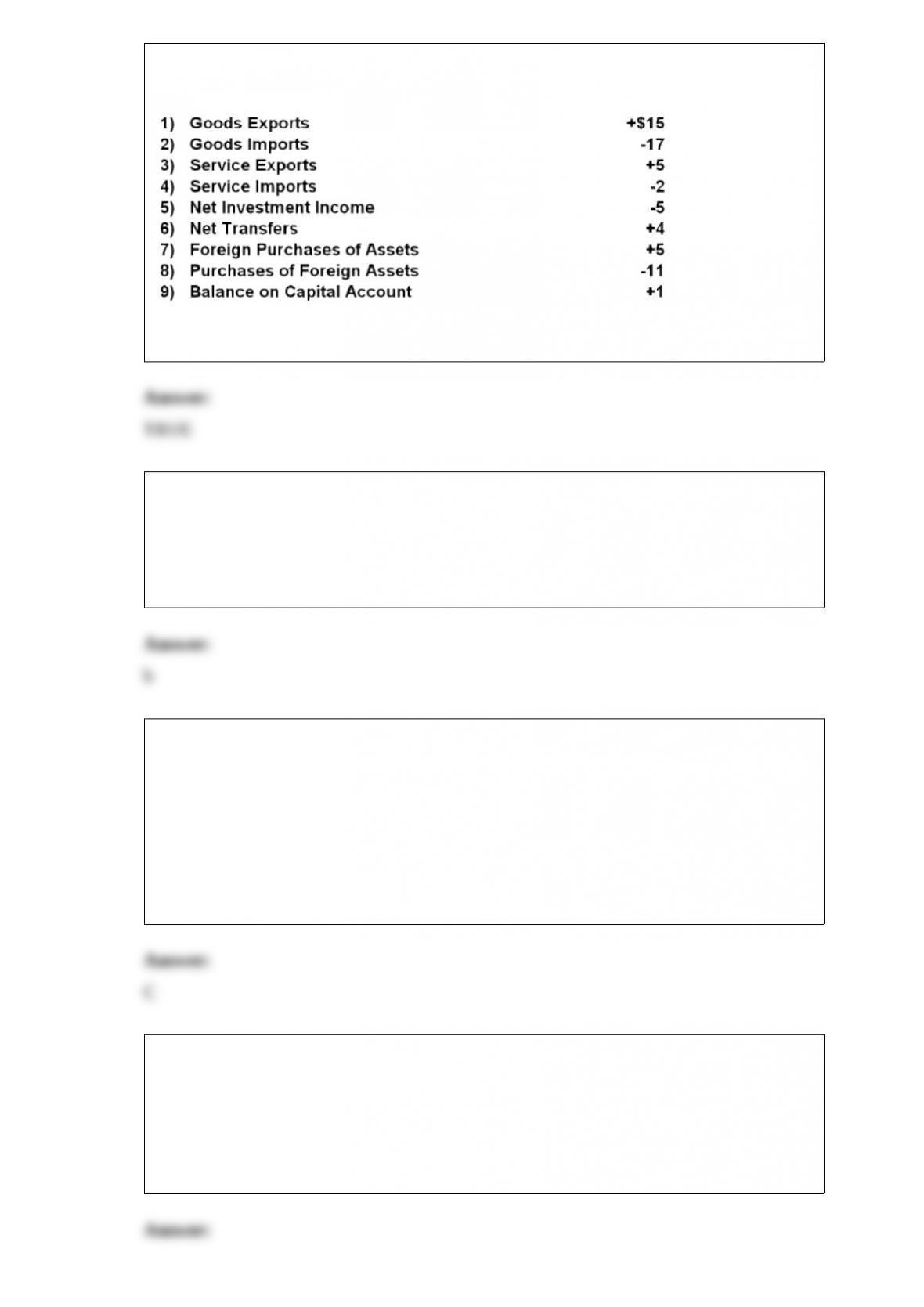
1) The following 2008 balance of payments statement for Transylvania. All figures are
in billions of dollars.
Refer to the above data. In 2008 Transylvania was a net recipient of transfers from the
rest of the world.
2) which of the following is real capital?
a.a pair of stockings
b.a construction crane
c.a savings account
d.a share of ibm stock
3) According to the Taylor rule:
A.for every 1 percentage point that unemployment exceeds the natural rate of
unemployment, there is a 2 percentage point gap between potential and actual GDP.
B.growth in the money supply should be limited to the long-run average growth rate of
real GDP.
C.if inflation rises by 1 percentage point above its target of 2 percent, then the Fed
should raise the real Federal funds rate by one-half a percentage point.
D.the rate of money growth should be set at 4 percent per year.
4) if an individual is less inclined to avoid accidents or illness because she has health
insurance, this is an example of:
a.the free-rider problem.
b.the moral hazard problem.
c.the adverse selection problem.
d.the coase theorem.
5) The following table shows government spending and tax revenue for a hypothetical
economy over a five-year period. All figures are in billions.
(a)In what years were there budget deficits and what were the amounts?
(b)In what year was there a budget surplus and what was the amount?
(c)What is the public debt in this economy over the five years?
(d)If the size of the economy (GDP) was $4000 billion, what would be the public debt
as a percentage of GDP?
6) Assume the price of capital doubles and, as a result, firms make no change in the
relative quantities of capital and labor they employ. This implies that:
A.labor is not readily substitutable for capital.
B.the law of diminishing returns is not applicable.
C.the firms are producing an inferior good.
7) The view that inappropriate monetary policy was the main reason for the depth of the
Great Depression in the United States is most closely associated with:
A.monetarism.
B.the mainstream view.
C.the rational expectations theory.
D.the real-business-cycle theory.
8) When critics of U.S. farm policy say that it treats symptoms rather than causes, they
mean that the:
A.policy attempts to bolster low farm income, while the real problem is an
overallocation of resources to agriculture.
B.policy deals with the overallocation of resources to agriculture, while the basic farm
problem is low incomes.
C.policy attempts to bolster low farm incomes, while the real problem is an
underallocation of resources to agriculture.
D.restriction of output in the short run may reduce productive capacity in agriculture in
the long run.
9) It is costly to hold money because:
A.deflation may reduce its purchasing power.
B.in doing so one sacrifices interest income.
C.bond prices are highly variable.
D.the rate at which money is spent may decline.
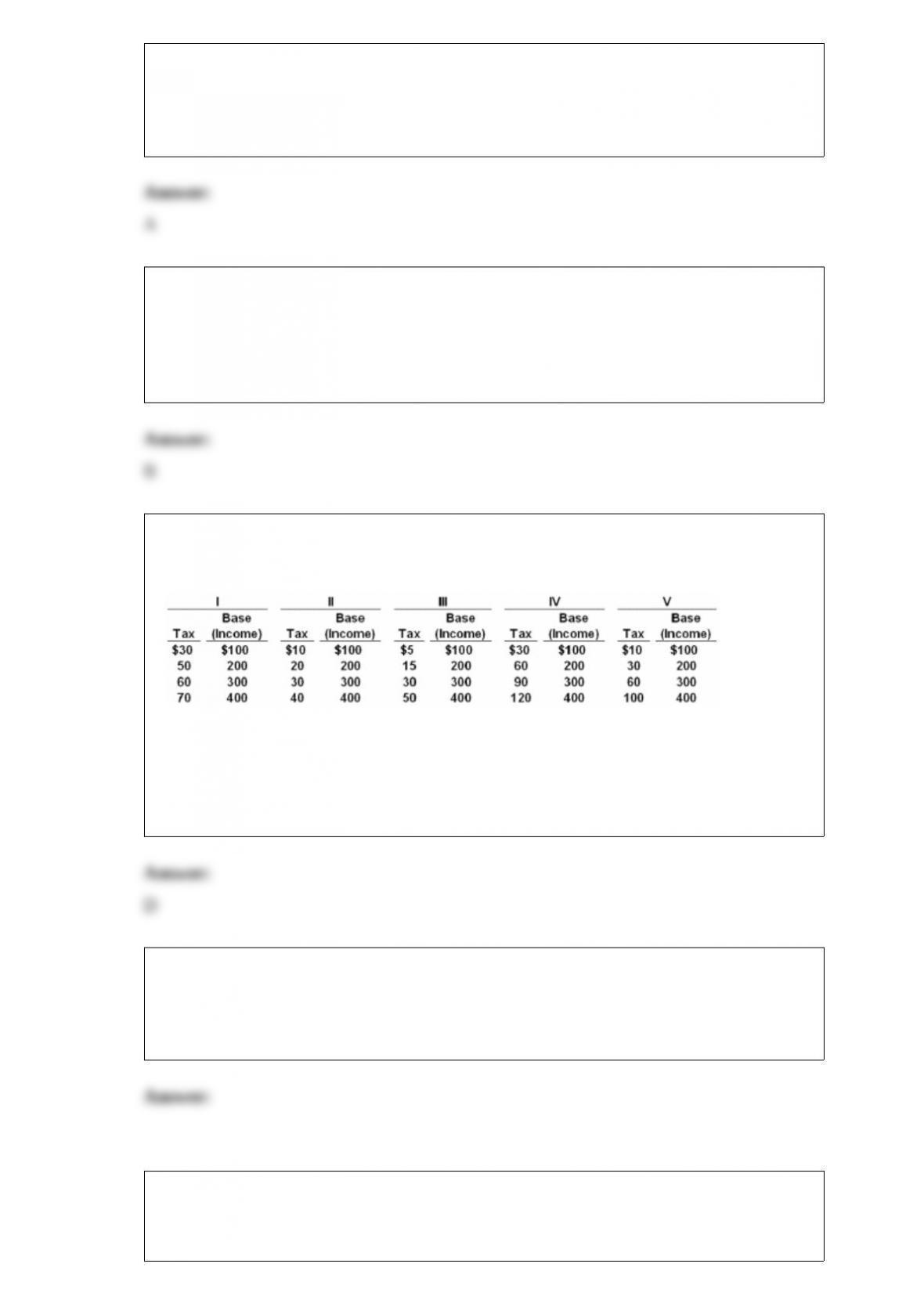
10) These five schedules represent income tax schedules for an economy. All figures are
in billions of dollars.
Which of the above schedules represent(s) a regressive tax?
A.V only
B.III and V
C.IV only
D.I only
11) Suppose a familys annual disposable income is $8000 of which it saves $2000.
(a)What is their APC?
(b)If income rises to $10,000 and they plan to save $2800, what are MPS and MPC?
(c)Did the familys APC rise or fall with their increase in income?
12) the social security program (excluding medicare) in the united states is projected to:
a.grow from 4.2 percent of gdp today to 6.2 percent of gdp in 2030.
b.grow from 1.0 percent of gdp today to 4.2 percent of gdp in 2030.
c.decline from 4.2 percent of gdp today to 1.0 percent in 2030.
d.stay relatively constant at 3 percent of gdp into the future.
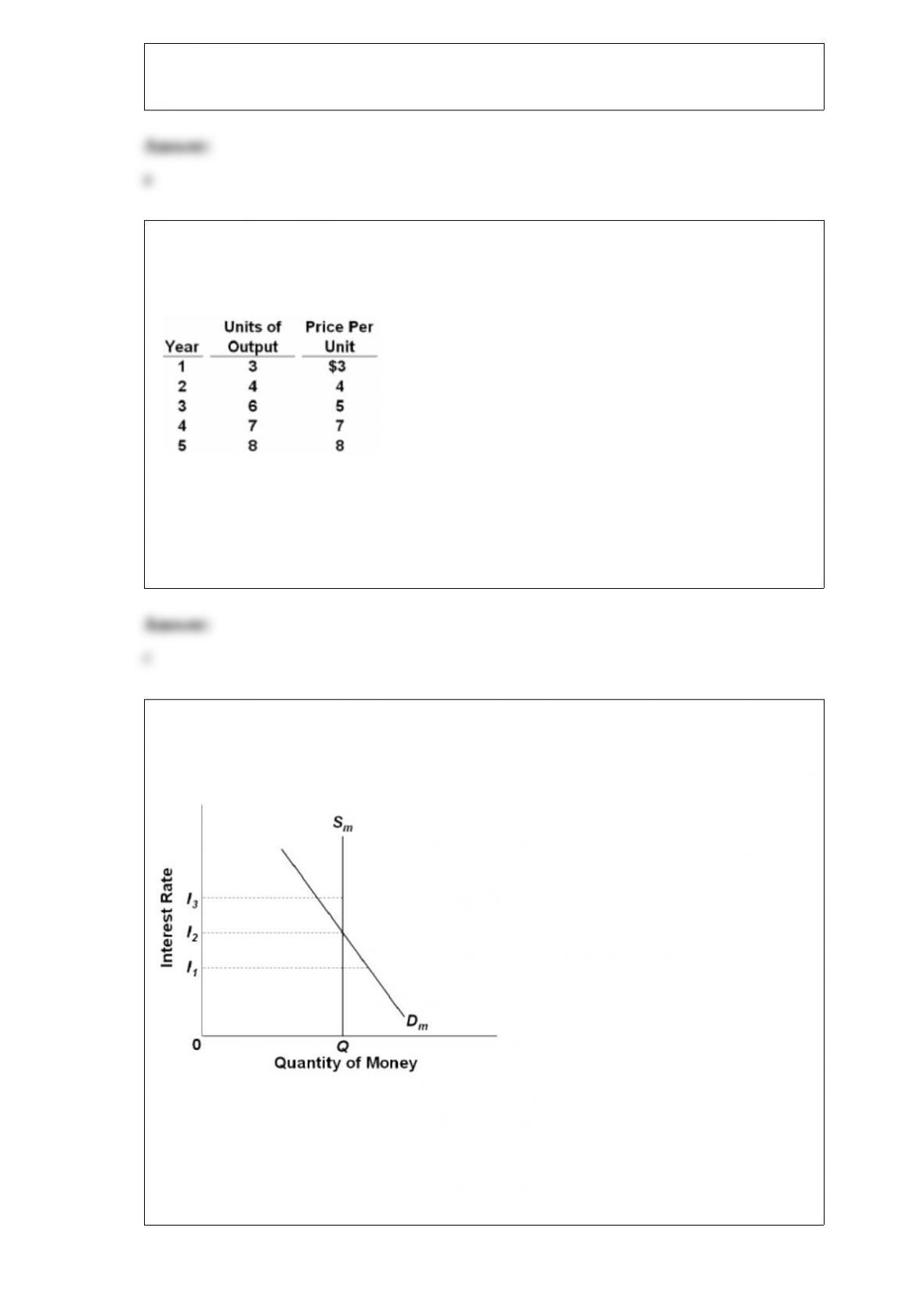
13) assume an economy that is producing only one product and that year 3 is the base
year. output and price data for a five-year period are as follows. answer the next
question(s) on the basis of these data.
refer to the above data. for the years shown the growth of:
a.real gdp has exceeded the growth of nominal gdp.
b.nominal gdp accurately reflects changes in real output.
c.nominal gdp overstates increases in real output.
d.nominal gdp understates increases in real output.
14) Answer the next question(s) on the basis of the following information for a bond
having no expiration date: bond price = $1000; bond fixed annual interest payment =
$100; bond annual interest rate = 10 percent.
Refer to the above information. If the price of this bond increases to $1250, the interest
rate will:
A.fall to 9 percent.
B.fall to 8 percent.
C.rise to 11 percent.
D.rise to 12 percent.