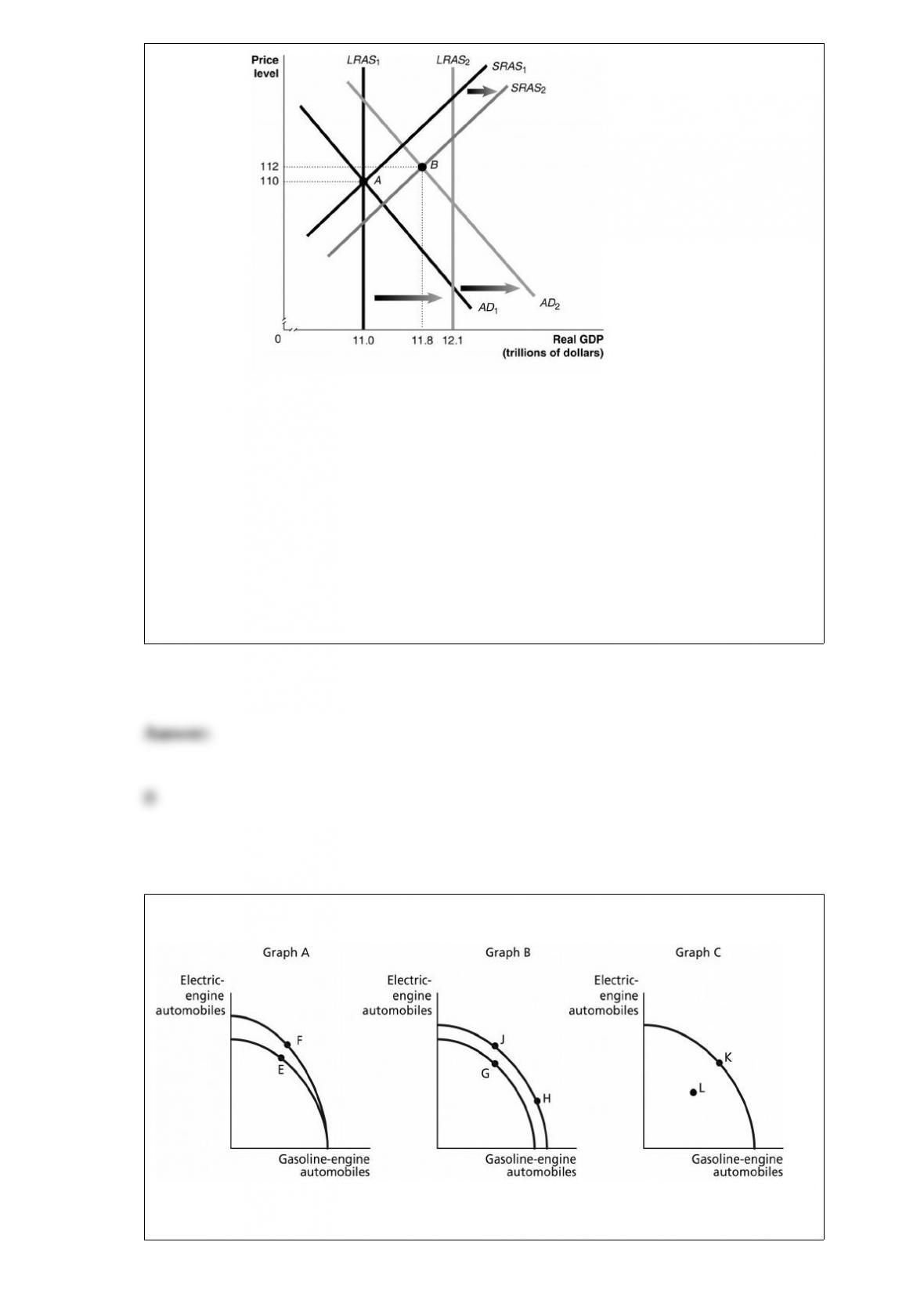
Figure 24-4
Given the economy is at point A in year 1, what is the inflation rate between year 1 and
year 2?
A) 0.9%
B) 1.8%
C) 2.7%
D) 3.0%
Figure 2-7
Mercedes Benz recently decided to introduce its B-class automobile in the U.S. market,
an electric car that is has designed and developed in a partnership with Tesla Motors.

Assume Mercedes Benz chooses to produce both electric-engine vehicles and
gasoline-engine vehicles. Figure 2-7 shows changes to its production possibilities
frontier in response to new developments and different strategic production decisions.
Assume that in response to changing consumer demands, Mercedes cuts back on the
production of electric vehicles and increased its production of gasoline-powered
vehicles. This strategy is best represented by the
A) movement from F to E in Graph A.
B) movement from G to J in Graph B.
C) movement from L to K in Graph C.
D) movement from J to H in Graph B.
Consider a tax cut which affects not only consumer disposable income, but also
after-tax earnings from labor supplied to labor markets and from financial assets
acquired through saving. In the long run we would expect this tax cut to
A) decrease both the price level and increase real GDP.
B) increase both the price level and the level of real GDP.
C) increase the level of real GDP.
D) increase the price level.
Which of the following products allows the seller to identify different groups of
consumers (segment the market) at virtually no cost?

A) early bird dinner specials
B) books sold online
C) a pair of Bose speakers
D) iPhones
Which of the following is an example of an activity undertaken by an entrepreneur?
A) designing your landscaping for your new home
B) holding a position as the president of a liberal arts college
C) running for the president of the United States
D) starting your own pet sitting business
Figure 12-11
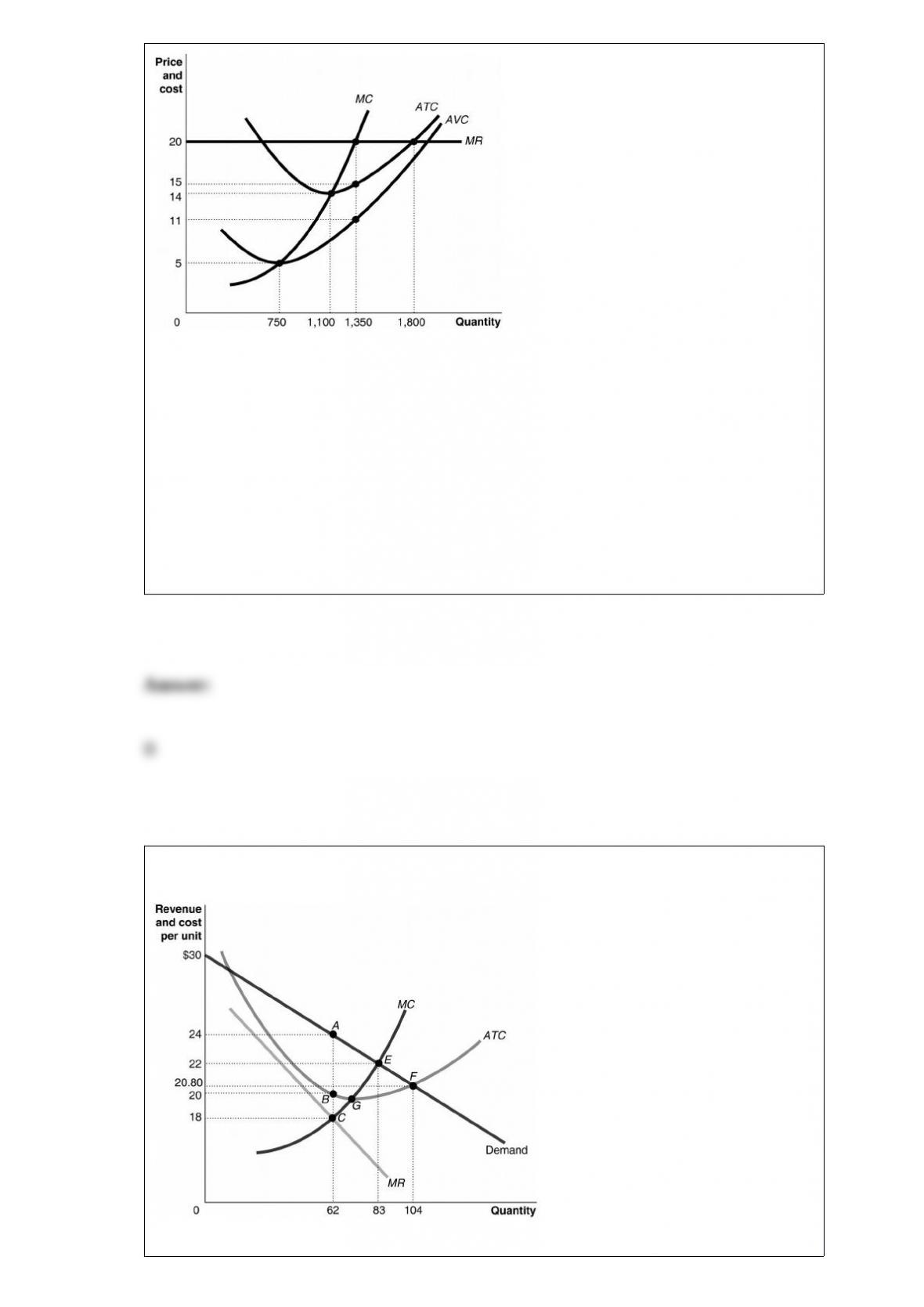
Suppose the prevailing price is $20 and the firm is currently producing 1,350 units. In
the long-run equilibrium, the firm represented in the diagram
A) will continue to produce the same quantity.
B) will reduce its output to 1,100 units.
C) will reduce its output to 750 units.
D) will cease to exist.
Figure 15-6
Figure 15-6 shows the cost and
demand curves for a monopolist. The monopolist’s total cost is

A) $1,116.
B) $1,240.
C) $1,660.
D) $1,726.40.
Under the gold standard, to increase the money supply in the country, the government
must
A) simply print more currency.
B) have enough gold to back up the increase in the money supply.
C) buy foreign currencies with dollars to increase foreign currency reserves.
D) increase the value of the country’s currency on foreign exchange markets.
Which of the following would increase disposable personal income?
A) a decrease in transfer payments received
B) a decrease in taxes paid
C) a decrease in personal income
D) All of the above would increase disposable income.

The U.S. Congress has given two government entities the authority to police mergers.
These two entities are
A) the antitrust division of the Department of State and the Securities and Exchange
Commission.
B) the Federal Trade Commission and the Internal Revenue Service.
C) the Antitrust Division of the U.S. Department of Justice and the Council of
Economic Advisors.
D) the Federal Trade Commission and the Antitrust Division of the U.S. Department of
Justice.
If the per-worker production function shifts up,
A) it now takes more capital per hour worked to get the same amount of real GDP per
hour worked.
B) an economy can increase its real GDP per hour worked without changing the level of
capital per hour worked.
C) the per-worker production function becomes flatter.
D) negative technological change has occurred in the economy.
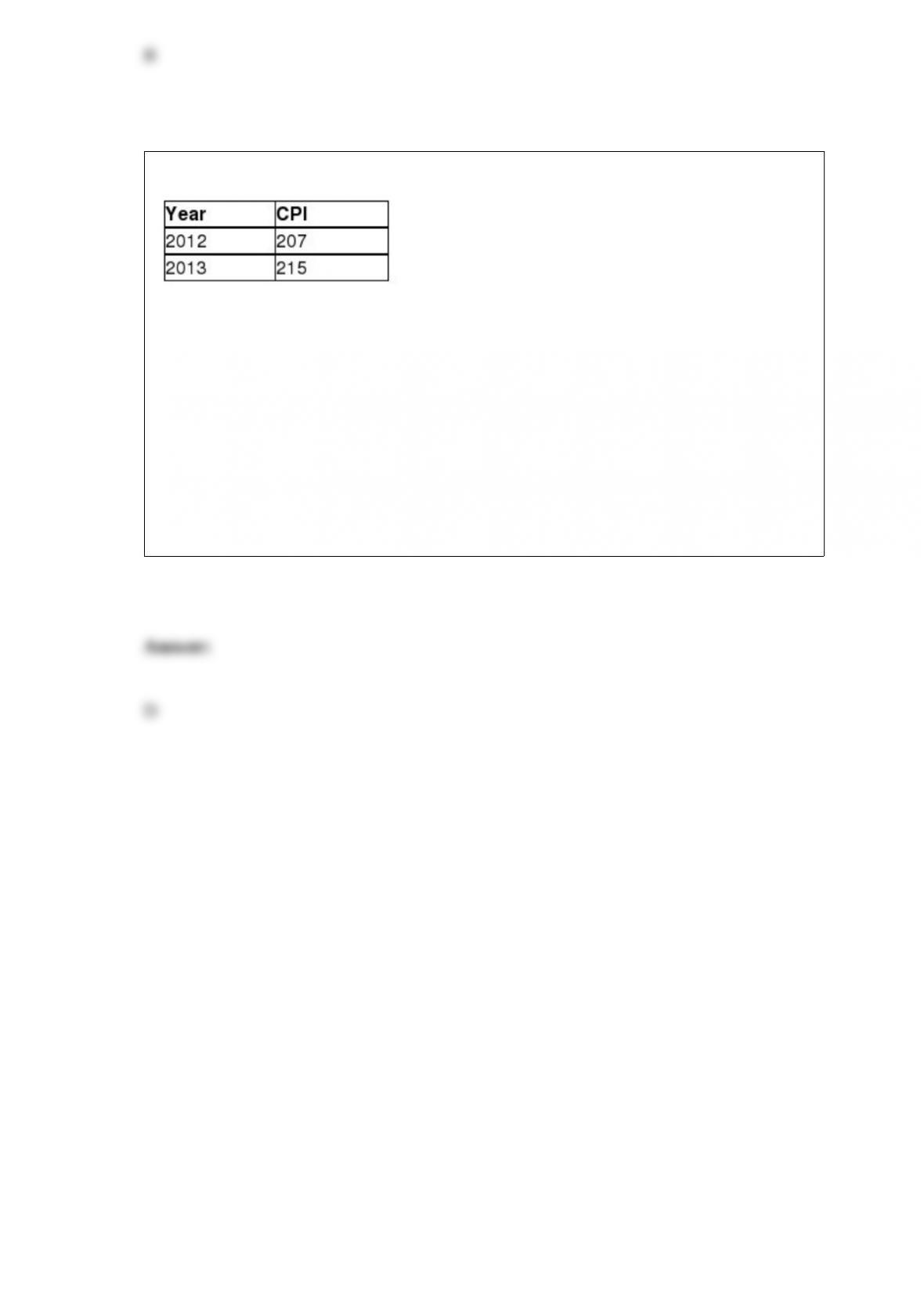
Table 20-5
Consider the following values of the consumer price index for 2012 and 2013. The
inflation rate for 2013 was equal to
A) 215 percent.
B) 21.5 percent.
C) 8.0 percent.
D) 3.9 percent.