
1) Income mobility:
A.makes lifetime income inequality among income receivers in the United States less
than income inequality in any single year.
B.is less in the United States than in most developing nations.
C.is the movement of wage earners from one job to another.
D.reduces the total percentage of households in the lowest quintile of the income
distribution over time.
2) (last word) the fallacy of composition is essentially the error of:
a.omitting relevant variables in constructing a model.
b.reasoning from the general to the particular.
c.confusing cause and effect in economic relationships.
d.generalizing from the particular to the general.
3) A firm is hiring resources X, Y, and Z in the profit-maximizing amounts when:
A.MRPx/Px equals MRPy/Py equals MRPz/Pz equals 1.
B.the sum of the MRPs of the three resources is at a minimum.
C.the marginal revenue productivity of all three resources is the same.
D.the marginal revenue product of the last dollar spent on each of the three resources is
the same.
4) (consider this) over the past several decades, the percentage of women in the paid
u.s. workforce has:
a.increased in spite of declining wages for women.
b.decreased because relatively more women are staying home to raise their children.
c.increased due to higher wages, expanded job accessibility, changing preferences and
attitudes, and other factors.
d.increased for unmarried women, but decreased for married women.
5) Built-in stability means that:
A.an annually balanced budget will offset the procyclical tendencies created by state
and local finance and thereby stabilize the economy.
B.with given tax rates and expenditures policies, a rise in domestic income will reduce
a budget deficit or produce a budget surplus while a decline in income will result in a
deficit or a lower budget surplus.
C.Congress will automatically change the tax structure and expenditure programs to
correct upswings and downswings in business activity.
D.government expenditures and tax receipts automatically balance over the business
cycle, though they may be out of balance in any single year.
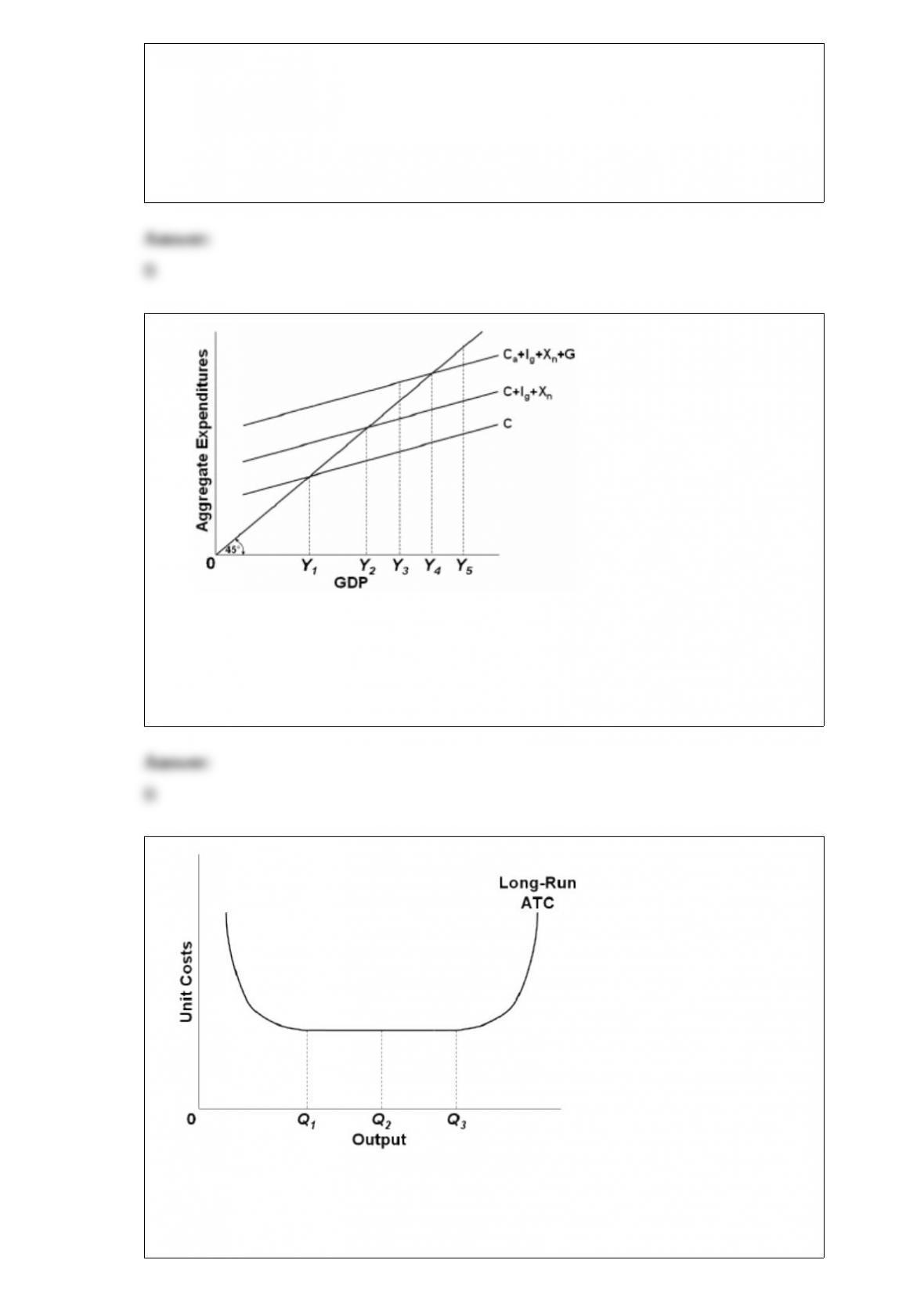
6)
Refer to the above diagram. The equilibrium level of GDP is:
A.Y5.
B.Y4.
C.Y3.
D.Y2.
7)
in the above diagram it is assumed that:
a.some costs are fixed and other costs are variable.
b.all costs are variable.
c.the law of diminishing returns determines the shape of the cost curve.
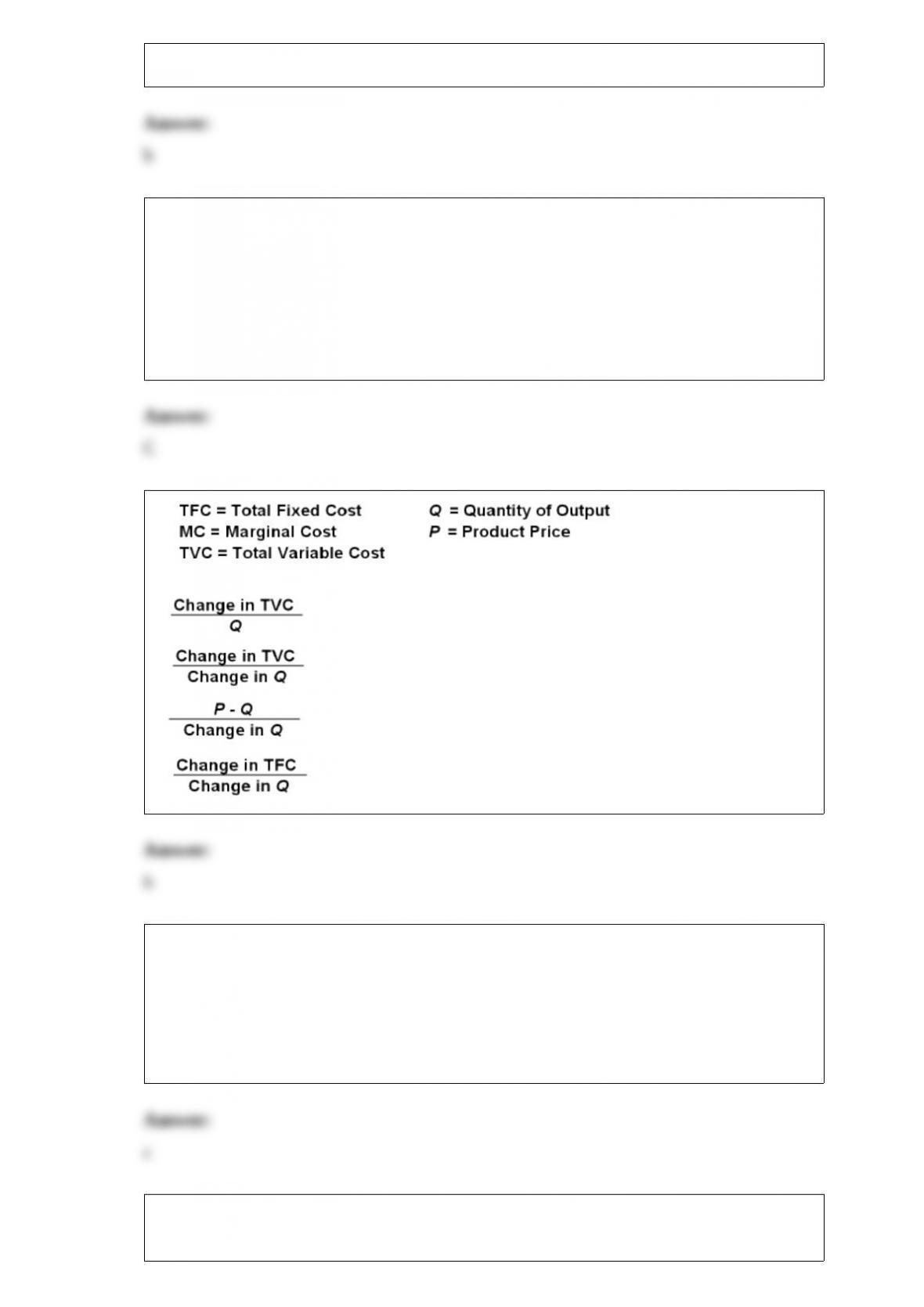
d.marginal product first falls, but ultimately rises as output is increased.
8) Suppose that Marlen Fisher has legal protection against anyone producing and
selling a fishing lure identical to his unique-action “MarFish” lure, whatever the
competitor might name the lure. This legal protection is most likely to be a:
A.trademark.
B.restraining order.
C.patent.
D.copyright.
9)
refer to the above information. marginal cost is:
a.
b.
c.
d.
10) the fact that a purely competitive firm’s total revenue curve is linear and upsloping
to the right implies that:
a.product price increases as output increases.
b.product price decreases as output increases.
c.product price is constant at all levels of output.
d.marginal revenue declines as more output is produced.
11) The following economic data for a hypothetical economy:

Refer to the above data. There is evidence that cost-push inflationary pressure is present
in this economy.
12) madison, the cpa, is faster than mason, the house painter, at both accounting
services and painting. this means that:
a.there is no reason for them to trade services.
b.madison should trade her accounting services for mason’s painting services, so long as
madison is relatively more efficient at accounting services.
c.madison should trade her accounting services for mason’s painting services, so long as
madison is relatively more efficient at painting.
d.madison has the comparative advantage in both services.
13) Other things equal, if the required reserve ratio was lowered:
A.banks would have to reduce their lending.
B.the size of the monetary multiplier would increase.
C.the actual reserves of banks would increase.
D.the Federal funds interest rate would rise.
14) Over time, technological change has:
A.reduced both the price elasticity and income elasticity of the demand for farm
products.
B.reduced the minimum efficient scale of production in agriculture and increased the
prices of farm products.
C.increased both price elasticity and income elasticity of the demand for farm products.
D.increased the minimum efficient scale of production in agriculture and reduced the
prices of farm products.

15)
refer to the above graph. which one of the following would cause a move from point b
on short-run average total cost curve atc1 to point e on short-run average cost curve
atc2?
a.diminishing marginal returns
b.an increase in the wage rate
c.a decrease in the wage rate
d.increasing marginal returns
16) Electronic money is:
A.closely associated with smart cards.
B.issued in real terms so that it is immune from the effects of inflation.
C.the money dispensed by automatic teller machines (ATMs).
D.also called share-draft money.