
1) Holding all other factors constant, the quantity demanded of an asset is
A) positively related to wealth
B) negatively related to its expected return relative to alternative assets
C) positively related to the risk of its returns relative to alternative assets
D) negatively related to its liquidity relative to alternative assets
2) If a pension fund has insufficient contributions and earnings to pay benefits, it is said
it be
A) underfunded.
B) at par
C) fully funded
D) under par
3) A reason why rogue traders have bankrupt their banks is due to
A) the separation of trading activities from the bookkeepers
B) stringent supervision of trading activities by bank management
C) accounting errors
D) a failure to maintain proper internal controls
4) ________ in the expected future domestic exchange rate causes the demand for
domestic assets to shift to the ________ and the domestic currency to depreciate,
everything else held constant.
A) An increase; right
B) An increase; left
C) A decrease; right
D) A decrease; left
5) When the value of the British pound changes from $1.50 to $1.25, then the pound
has ________ and the U.S. dollar has ________.
A) appreciated; appreciated
B) depreciated; appreciated
C) appreciated; depreciated
D) depreciated; depreciated

6) Suppose that from a new checkable deposit, First National Bank holds two million
dollars in vault cash, one million dollars in required reserves, and faces a required
reserve ratio of ten percent. Given this information, we can say First National Bank has
________ million dollars on deposit with the Federal Reserve.
A) one
B) two
C) eight
D) ten
7) The classical economists’ conclusion that nominal income is determined by
movements in the money supply rested on their belief that ________ could be treated as
________ in the short run.
A) velocity; constant
B) velocity; variable
C) money; constant
D) money; variable
8) In the absence of regulation, banks would probably hold
A) too much capital, reducing the efficiency of the payments system
B) too much capital, reducing the profitability of banks
C) too little capital
D) too much capital, making it more difficult to obtain loans
9) The real bills doctrine was the guiding principle for the conduct of monetary policy
during the
A) 1910s
B) 1940s
C) 1950s
D) 1960s

10) Three factors explain the risk structure of interest rates:
A) liquidity, default risk, and the income tax treatment of a security
B) maturity, default risk, and the income tax treatment of a security
C) maturity, liquidity, and the income tax treatment of a security
D) maturity, default risk, and the liquidity of a security
11) Suppose the economy is producing at the natural rate of output. An open market
purchase of bonds by the Fed will cause ________ in real GDP the the short run and
________ in inflation in the short run, everything else held constant.
A) an increase; an increase
B) a decrease; a decrease
C) no change; an increase
D) no change; a decrease
12) Which of the following is not a conflict of interest in accounting firms?
A) The firm provides consulting as well as rating creditworthiness
B) Auditors may be pressured to skew their opinions so the client will stay with the firm
C) Auditors may be reluctant to criticize advice put into place by nonaudit personnel of
the firm
D) Auditors release an overly favorable audit in order to solicit business
13) Consumer protection legislation includes legislation to
A) reduce discrimination in credit markets
B) require banks to make loans to everyone who applies
C) reduce the amount of interest that bank’s can charge on loans
D) require banks to make periodic reports to the Better Business Bureau
14) Under the Exchange Rate Mechanism of the European Monetary System, when the
German mark depreciated below its lower limit against the British pound, the German
central bank was required to buy ________ and sell ________, thereby ________
international reserves.
A) pounds; marks; losing
B) pounds; marks; gaining

C) marks; pounds; gaining
D) marks; pounds; losing
15) The Fed can engage in preemptive strikes against a rise in inflation by ________
the federal funds interest rate; it can act preemptively against negative demand shocks
by ________ the federal funds interest rate.
A) raising; lowering
B) raising; raising
C) lowering; lowering
D) lowering; raising
16) To hedge the interest rate risk on $4 million of Treasury bonds with $100,000
futures contracts, you would need to purchase
A) 4 contracts
B) 20 contracts
C) 25 contracts
D) 40 contracts
17) Factors that led to worsening conditions in Mexico’s 1994-1995 financial markets,
but did not lead to worsening financial market conditions in East Asia in 1997-1998
include
A) rise in interest rates abroad
B) bankers’ lack of expertise in screening and monitoring borrowers
C) deterioration of banks’ balance sheets because of increasing loan losses
D) stock market decline
18) Which is the most important category of Fed assets?
A) Securities
B) Discount loans
C) Gold and SDR certificates
D) Cash items in the process of collection

19) A substantial decrease in the aggregate price level that reduces firms’ net worth may
stall a recovery from a recession. This process is called
A) debt deflation
B) moral hazard
C) insolvency
D) illiquidity
20) Tobin’s q theory suggests that monetary policy may affect investment spending
through its impact on
A) stock prices
B) interest rates
C) bond prices
D) cash flow
21) In the market for reserves, if the federal funds rate is between the discount rate and
the interest rate paid on excess reserves, a decline in the reserve requirement ________
the demand of reserves, ________ the federal funds rate, everything else held constant.
A) decreases; lowering
B) increases; lowering
C) increases; raising
D) decreases; raising
22) When the federal funds rate equals the discount rate
A) the supply curve of reserves is vertical
B) the supply curve of reserves is horizontal
C) the demand curve for reserves is vertical
D) the demand curve for reserves is horizontal
23) Which of the following is not a benefit to an individual purchasing a mutual fund?
A) reduced risk

B) lower transactions costs
C) free-riding
D) diversification
24) Equity holders are a corporation’s ________. That means the corporation must pay
all of its debt holders before it pays its equity holders.
A) debtors
B) brokers
C) residual claimants
D) underwriters
25) Which of the following are not assets on the Fed’s balance sheet?
A) Securities
B) Discount loans
C) Cash items in the process of collection
D) Deferred availability cash items
26) Suppose you are currently in the long position of a long-term bond. In this case, to
hedge against a capital loss, you would enter into a ________ contract to ________ a
long-term bond in the future.
A) interest-rate forward; sell
B) interest-rate forward; buy
C) exchange-rate forward; buy
D) exchange-rate forward; sell
27) The net amount of international reserves that move between governments to finance
international transactions is called the ________ balance.
A) capital account
B) current account
C) trade
D) official reserve transactions
28) When a bank buys a government bond from the Federal Reserve, reserves in the
banking system ________ and the monetary base ________, everything else held
constant.
A) increase; increases
B) increase; decreases
C) decrease; increases
D) decrease; decreases
29) The Fed’s use of the ________ as an operating target in the 1970s resulted in
________ monetary policy.
A) federal funds rate; countercyclical
B) federal funds rate; procyclical
C) M1 money supply; countercyclical
D) M1 money supply; procyclical
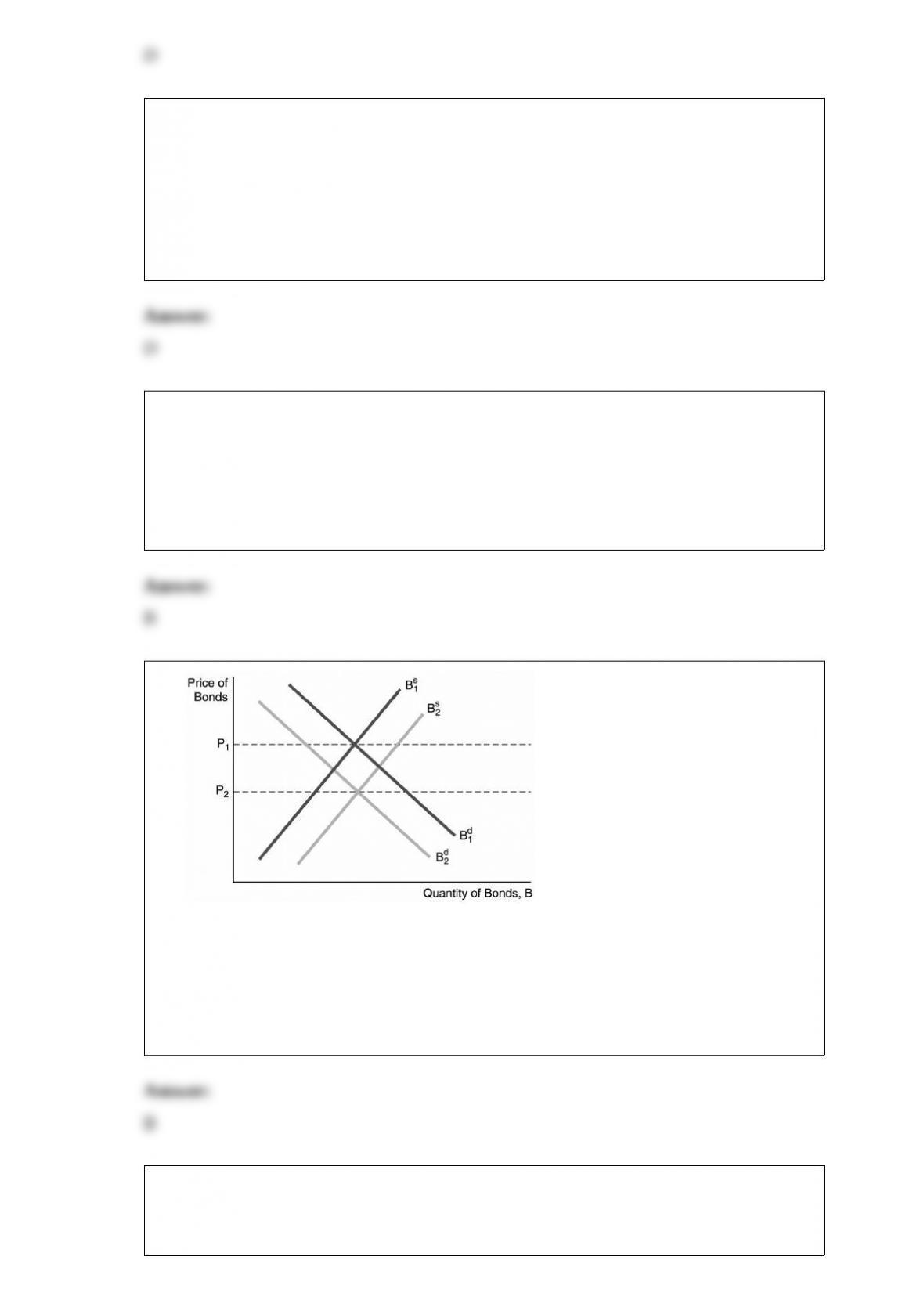
30)
In the figure above, a factor that could cause the demand for bonds to decrease (shift to
the left) is:
A) an increase in the expected return on bonds relative to other assets
B) a decrease in the expected return on bonds relative to other assets
C) an increase in wealth
D) a reduction in the riskiness of bonds relative to other assets
31) The effect of an open market purchase on reserves differs depending on how the
seller of the bonds keeps the proceeds. If the proceeds are kept in currency, the open
market purchase ________ reserves; if the proceeds are kept as deposits, the open

market purchase ________ reserves.
A) has no effect on; has no effect on
B) has no effect on; increases
C) increases; has no effect on
D) decreases; increases
32) Open market purchases raise the ________ thereby raising the ________.
A) money multiplier; money supply
B) money multiplier; monetary base
C) monetary base; money supply
D) monetary base; money multiplier
33) The president from which Federal Reserve Bank always has a vote in the Federal
Open Market Committee?
A) Philadelphia
B) Boston
C) San Francisco
D) New York
34) An increase in an asset’s expected return relative to that of an alternative asset,
holding everything else constant, ________ the quantity demanded of the asset.
A) increases
B) decreases
C) has no effect on
D) erases
35) When economists say that money promotes ________, they mean that money
encourages specialization and the division of labor.
A) bargaining
B) contracting
C) efficiency
D) greed

36) Distinguish between direct finance and indirect finance. Which of these is the most
important source of funds for corporations in the United States?
37) Why is it important to understand the bond market?
38) How can specializing in lending help to reduce the adverse selection problem in
lending?
39) Your best friend calls and gives you the latest stock market “hot tip” that he heard at
the health club. Should you act on this information? Why or why not?
40) What factors determine the demand for money in the Baumol-Tobin analysis of
transactions demand for money? How does a change in each factor affect the quantity
of money demanded?
41) Explain the similarities and differences between the European System of Central
Banks and the Federal Reserve System.