1) Saving is always equal to:
A.planned investment less unintended increases in inventories.
B.actual investment.
C.planned investment.
D.unintended changes in inventories.
2) Which of the following is the best example of a market failure that would lead a firm
to extract resources at a rate that is faster than the rate that would maximize its
long-term stream of profits?
A.The market price of the resource rises.
B.Weak property rights create fears that firms will not be allowed to extract in the
future.
C.An increase in market interest rates.
D.New information suggests that the demand for the resource will be greater in the
future.
3) The economic benefits from forests come from:
A.wood.
B.erosion prevention.
C.oxygen production.
D.all of these.
4) In the equation of exchange V indicates the:
A.value or purchasing power of the dollar.
B.number of times per year the average dollar is spent.
C.quantity of real output.
D.reciprocal of the price level.
5) Checkable deposits include:
A.both large and small time deposits.
B.the deposits of banks and thrifts on which checks can be written.
C.only the checkable deposits of commercial banks.
D.only the checkable deposits of thrift institutions.
6) assume that the price of product x rises by 5 percent and the quantity supplied of x
increases by 15 percent. the coefficient of price elasticity of supply for good x is:
a.negative and therefore x is an inferior good.
b.positive and therefore x is a normal good.
c.less than 1 and therefore supply is inelastic.
d.more than 1 and therefore supply is elastic.
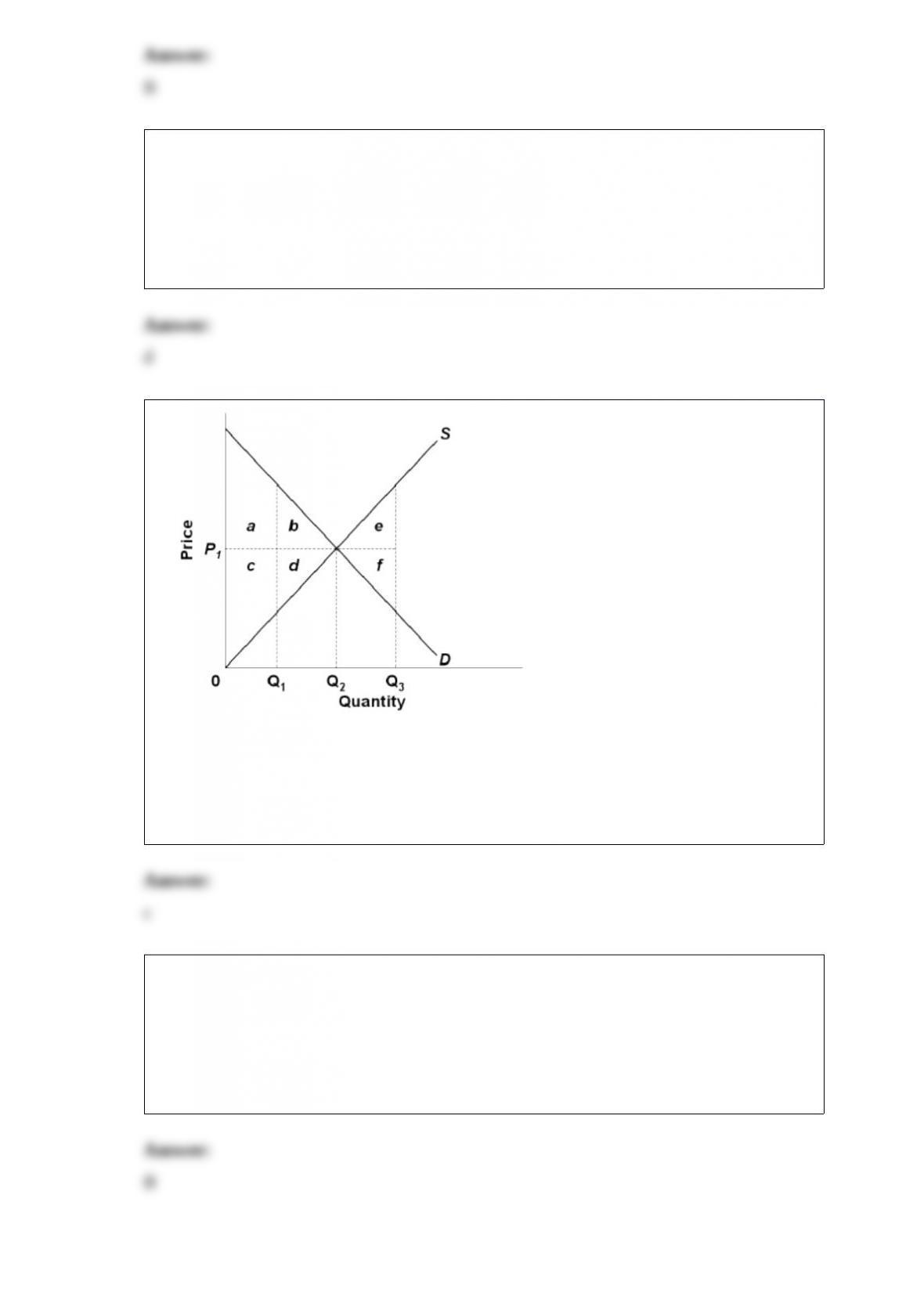
7)
refer to the above diagram. at quantity q3:
a.maximum willingness to pay exceeds minimum acceptable price.
b.the sum of consumer and producer surplus is maximized.
c.minimum acceptable price exceeds maximum willingness to pay.
d.an efficiency loss (or deadweight loss) of a + b occurs.
8) If farm state legislators support the food-stamp program to aid the urban poor and
urban state legislators in turn support farm subsidies, this is an example of:
A.the special-interest effect.
B.political logrolling.
C.the paradox of voting.
D.cost-benefit analysis.
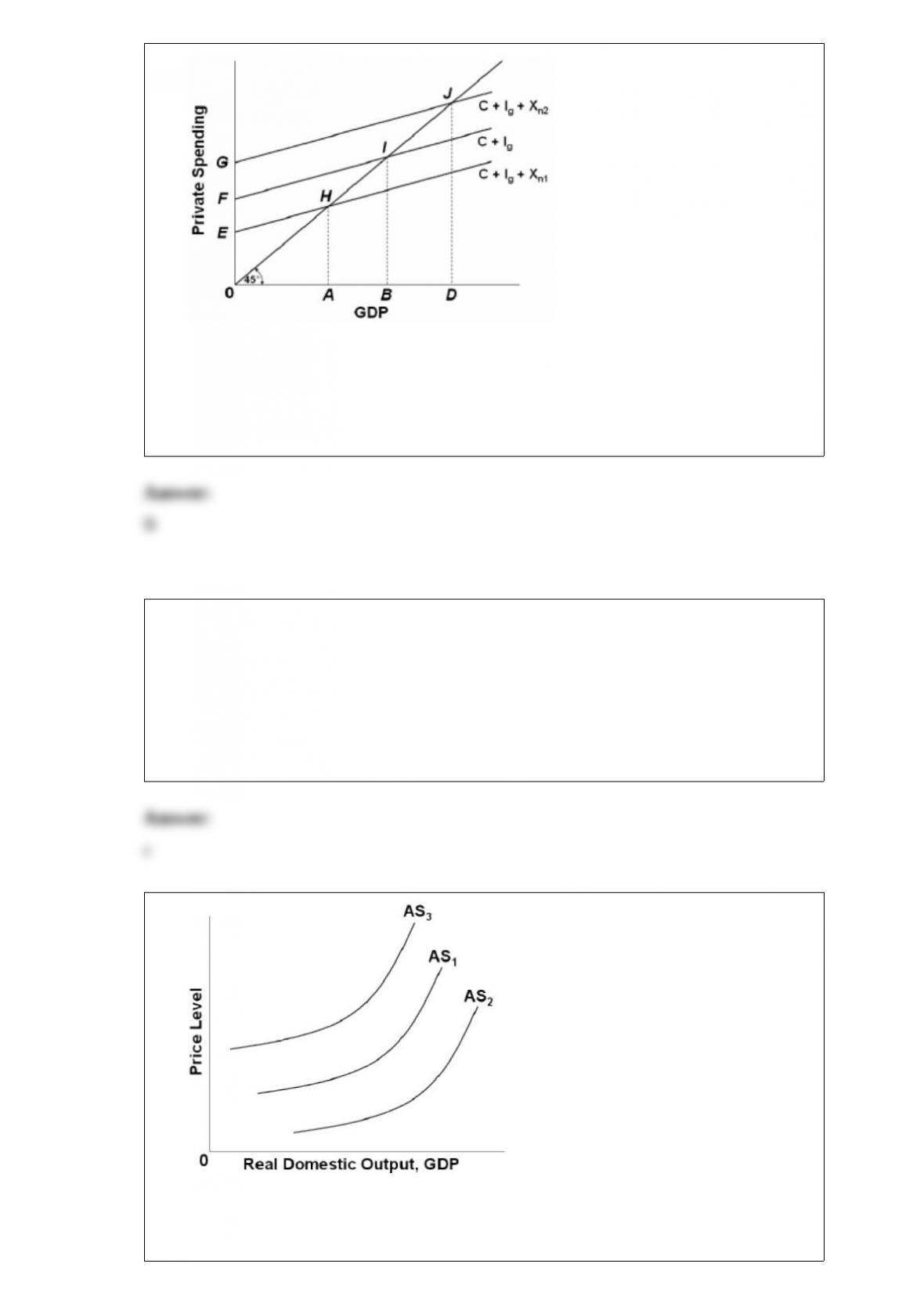
9)
Refer to the above diagram. The multiplier in this economy is:
A.0E/0A.
B.BD/FG.
C.FG/BD.
D. BD/AD
10) edith is buying products x and y with her money income. suppose her budget line
shifts rightward (outward). this might be the result of:
a.the prices of x and y increasing while her money income remains constant.
b.her money income decreasing while the prices of x and y remain constant.
c.her money income increasing more than proportionately to increases in the prices of x
and y
d.none of these.
11)
In the above diagram, a shift from AS2 to AS3might be caused by a(n):
A.decrease in interest rates.
B.increase in business taxes and costly government regulation.
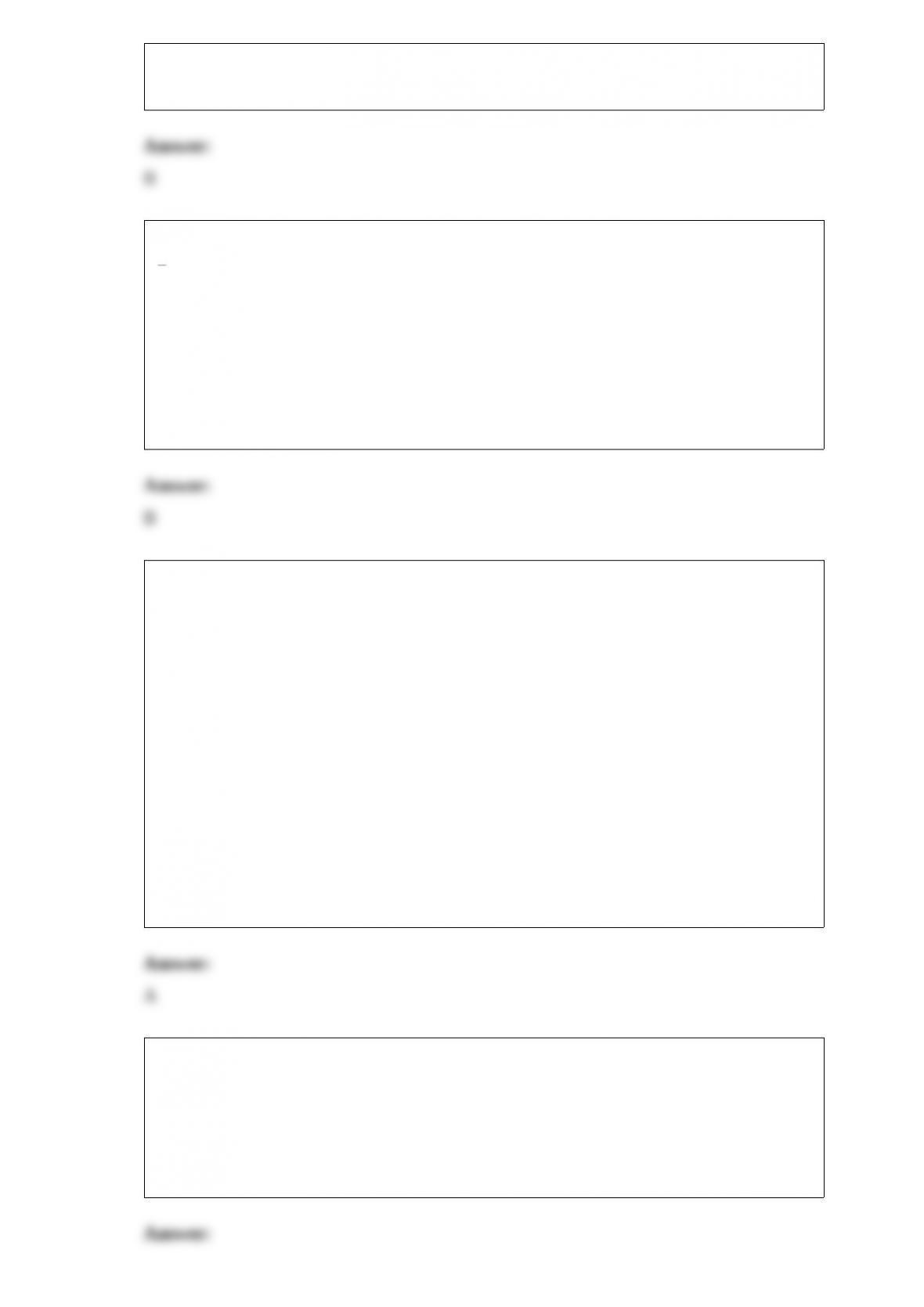
C.decrease in the prices of domestic resources.
D.decrease in the price level.
12) The equations for the demand and supply curves for a particular product are P = 10
.4Q and P = 2 + .4Q, where P is price and Q is quantity expressed in units of 100.
After an excise tax is imposed on the product the supply equation is P = 3 + .4Q.
Refer to the above information. The equilibrium quantity before the excise tax is
imposed is:
A.800 units.
B.1,000 units.
C.1,200 units.
D.1,400 units.
13) Answer the next question(s) on the basis of the following list of assets:
1> Large ($100,000 and over) time deposits
2> Noncheckable savings deposits
3> Currency (coins and paper money)
4> Small (under $100,000) time deposits
5> Stock certificates
6> Checkable deposits
7>Money market deposit accounts
8>Money market mutual fund balances held by individuals
9>Money market mutual fund balances held by businesses
Refer to the above list. The assets that are not included in either M1 or M2 are:
A.items 1, 5, and 9.
B.items 2, 5, 8, and 9.
C.items 1, 3, 5, 7, and 9.
D.all of the nine items listed.
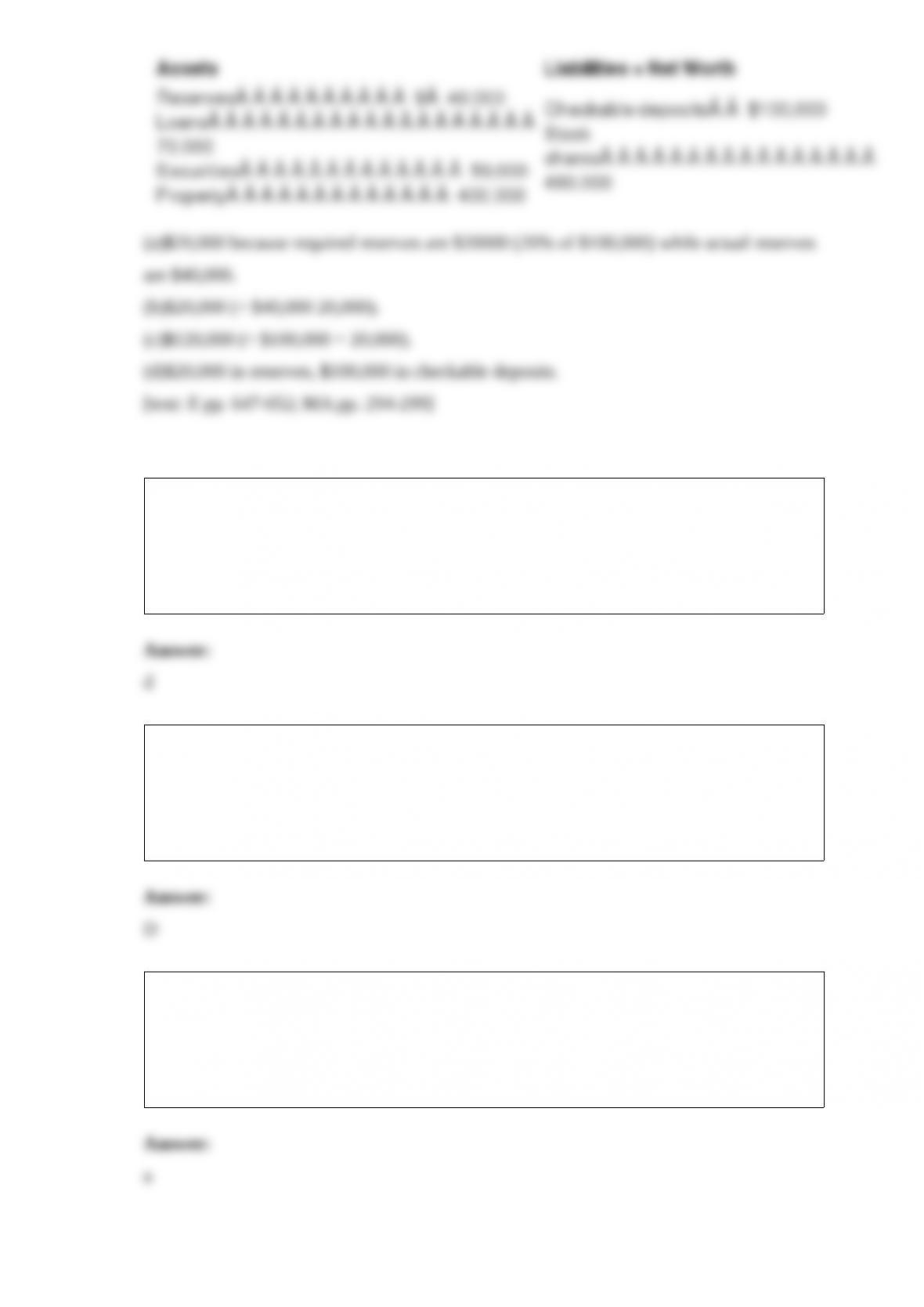
14) Using the balance sheet below and assuming a required reserve ratio of 20%,
answer the following: (a) What is the amount of excess reserves? (b) This bank can
safely expand its loans by what amount? (c) By expanding its loans by this amount in
part (b), its checkable deposits would expand to what amount (if all loans were made to
checking account customers)? (d) If checks clear against the bank equal to the amount
loaned in (b), how much would remain in reserves and in checkable deposits?
15) in the short run a pure monopolist:
a.always earns an economic profit.
b.always earns a normal profit.
c.always realizes a loss.
d.may realize an economic profit, a normal profit, or a loss.
16) Which of the following is an example of a land-intensive commodity?
A.chemicals
B.autos
C.watches
D.wool
17) an increase in money income:
a.shifts the consumer’s budget line to the right.
b.shifts the consumer’s budget line to the left.
c.increases the slope of the budget line.
d.has no effect on the budget line.
18)
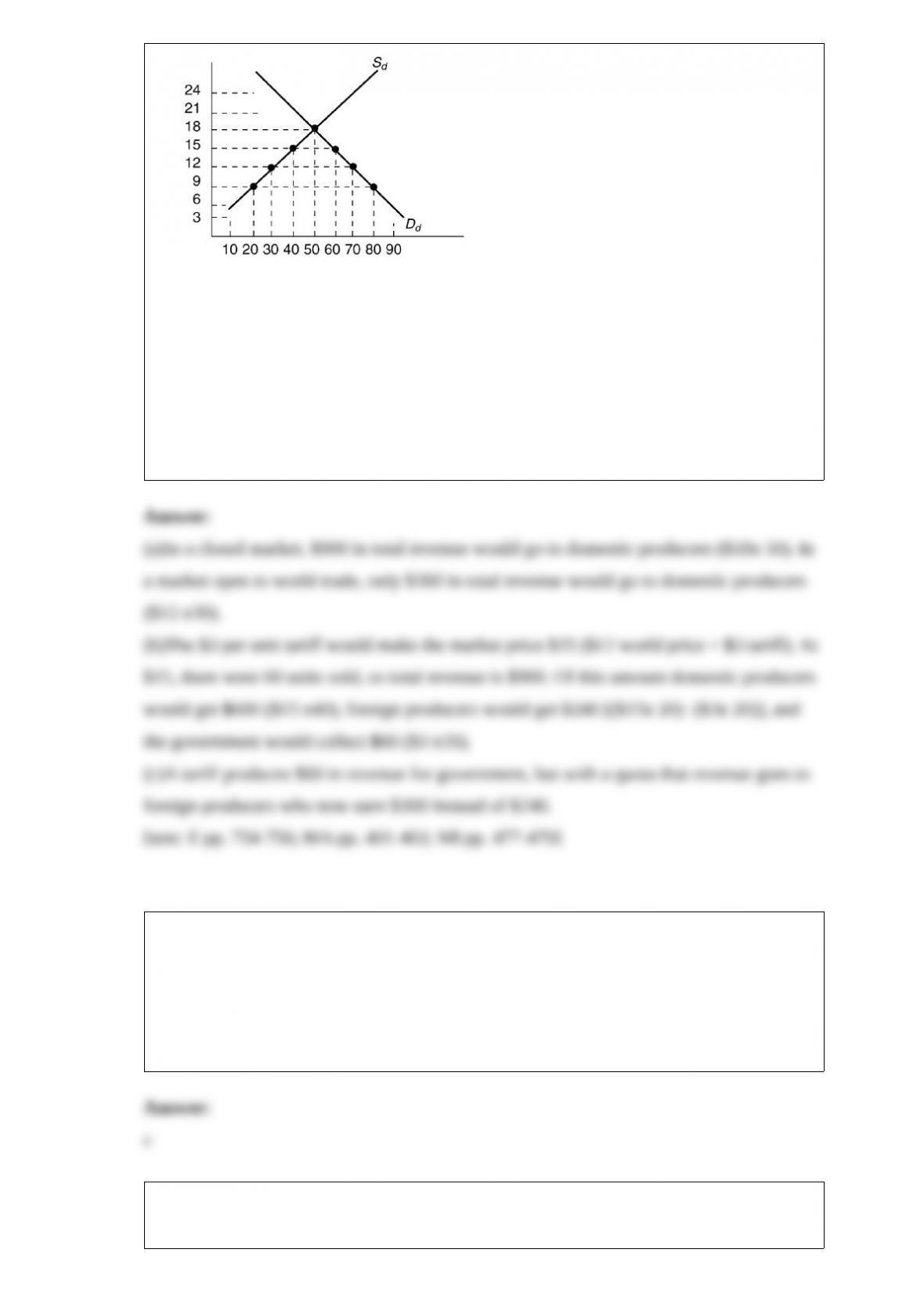
The next three questions refer to the below graph, where Sd and Dd are the domestic
supply and demand for a product. The world price of the product is $12.
(a)How much total revenue would go to domestic producers if the market were closed
to international trade compared to a market open to international trade? Explain.
(b)If the economy is open to trade, but a $3 per unit tariff were applied, what would be
the total revenue going to domestic producers, foreign producers (after-tax revenue),
and to the government? Explain.
(c)What would be the difference in revenue with a tariff of $3 per unit versus a quota of
20 units?
19) if the production of a good or service creates sizable positive externalities,
government might correct for the:
a.underallocation of resources to its production by imposing an excise tax.
b.overallocation of resources to its production by imposing an excise tax.
c.underallocation of resources to its production by granting a subsidy.
d.overallocation of resources to its production by granting a subsidy.
20) the physical import of dvd players to the united states from japan best illustrates a:
a.resource flow.

b.financial flow.
c.trade flow.
d.technology flow.