
The principal-agent problem that exists between shareholders and managers also exists
between managers and workers.
An decrease in the price level in the United States will shift the aggregate expenditure
line downward.
If economies of scale are significant, the typical firm will not reach the minimum point
on its long-run average cost curve until it has produced a large fraction of industry
sales.
In 2012, South America had a lower average GDP per capita than any other continent.

As nonunion construction workers replace a unionized work force, the average wage in
the construction sector is likely to rise.
Net exports equals the balance of trade surplus.
The marginal product of labor is the increase in output as a result of hiring an additional
worker while the marginal revenue product of labor is the increase in profit as a result
of hiring an additional worker.
A firm might prefer a commission system of compensation when the nature of the work
is repetitive and monotonous and can be performed by an individual.

A subgame-perfect equilibrium is a Nash equilibrium in which no player can make
himself better off by changing his decision at any decision node.
The National Football League has long-term leases with the stadiums in major cities.
Control of these stadiums is an entry barrier to a potential new football league.
The Walt Disney Company uses cost-plus pricing to determine the prices it charges for
admission and rides at Disneyland and Walt Disney World.
In the 1970s and 1980s, the United States lost its comparative advantage in consumer
electronics goods to Japan. What factor was most responsible for the development of
Japan’s comparative advantage in consumer electronics goods?
A) Japanese firms benefited from external economies.

B) Japan has abundant supplies of labor.
C) Japanese firms excelled in process technology.
D) Japan has abundant supplies of natural resources needed to produce electronics
goods.
Consider a used car market in which half the cars are good and half are bad (lemons). A
rational buyer in this market should
A) offer to pay a price equal to the most she would pay for a good car.
B) offer to pay a price equal to the most she would pay for a lemon.
C) offer to pay a price somewhere between the price she would pay for a good car and
the price she would pay for a lemon.
D) save up and buy a new car.
Assume that two interior design companies, Alistair and Baine, are competing for
customers and if they both advertise, they would each earn $30 million in profits. If
neither advertises, they each earn $50 million in profits. If one advertises and the other
doesn’t, the firm that advertises earns $40 million in profit while the other earns $20
million in profit.
a. Present the information above in the form of a payoff matrix. Let Baine be the row
player and Alistair the column player.
b. Does each firm have a dominant strategy and if so what is it?
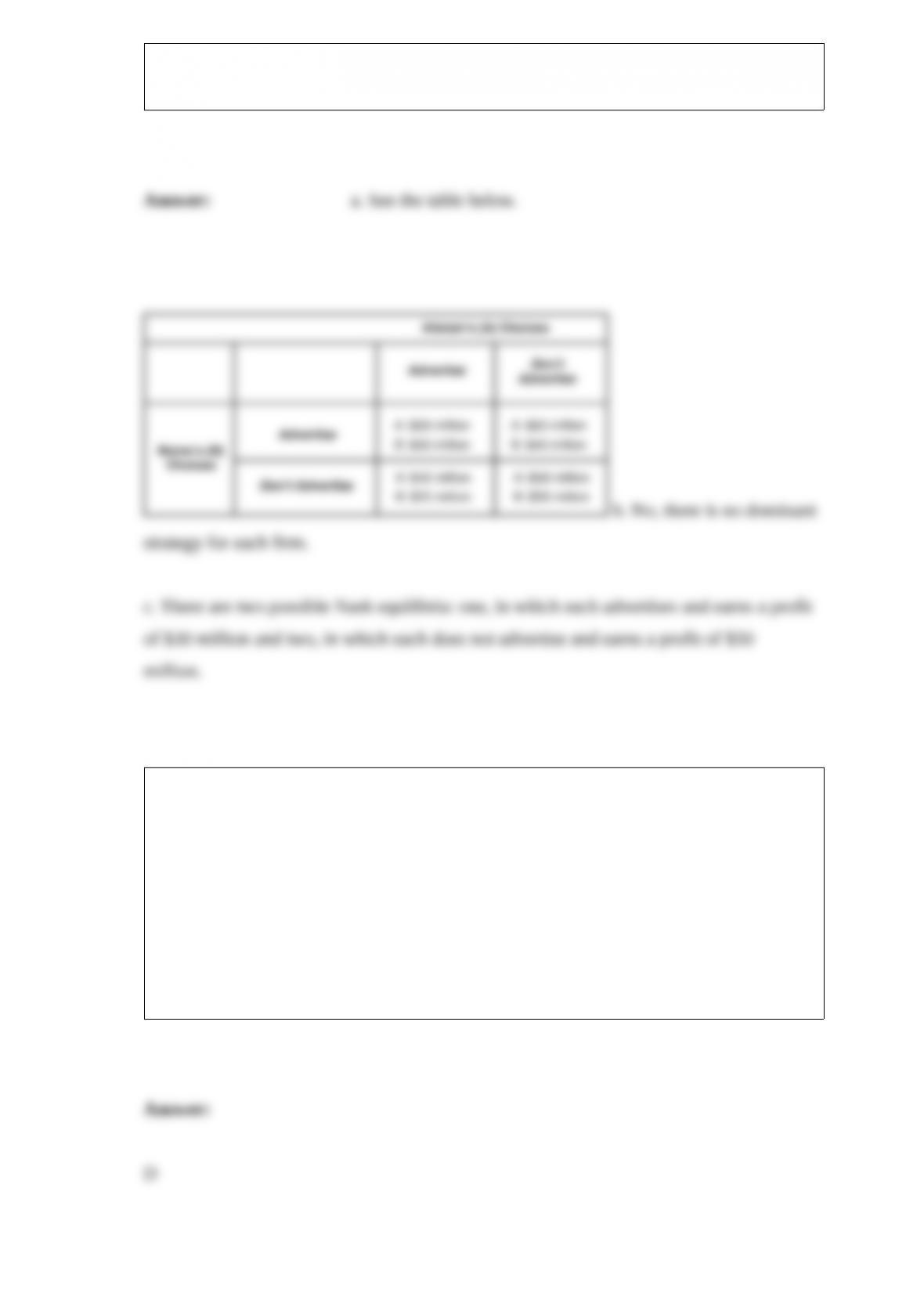
c. What is the Nash equilibrium?
In economics, the term “free rider” refers to
A) a person who evades taxes.
B) a supervisor who delegates menial time-consuming activities to others.
C) one who volunteers her services.
D) one who waits for others to produce a good and then enjoys its benefits without
paying for it.

Suppose Joe is maximizing total utility within his budget constraint. If the price of the
last pair of jeans purchased is $25 and it yields 100 units of extra satisfaction and the
price of the last shirt purchased is $20, then, using the rule of equal marginal utility per
dollar spent, the extra satisfaction received from the last shirt must be
A) 2,000 units of utility.
B) 500 units of utility.
C) 100 units of utility.
D) 80 units of utility.
The income effect due to a price decrease will result in an increase in the quantity
demanded for
A) a Giffen good.
B) an inferior good.
C) a public good.
D) a normal good.
The formula for total fixed cost is
A) TFC = TC + TVC.
B) TFC = TVC – TC.
C) TFC = TC/TVC.
D) TFC = TC – TVC.
Distinguish between a voluntary export restraint and a quota.
An increase in the real interest rate does which of the following?
A) reduces the demand for loanable funds
B) reduces saving
C) reduces consumption spending
D) increases the demand for loanable funds
The financial statement that sums up a firm’s revenues, costs, and profit over a period of
time is its
A) income statement.
B) balance sheet.
C) dividend yield statement.
D) price-earnings statement.
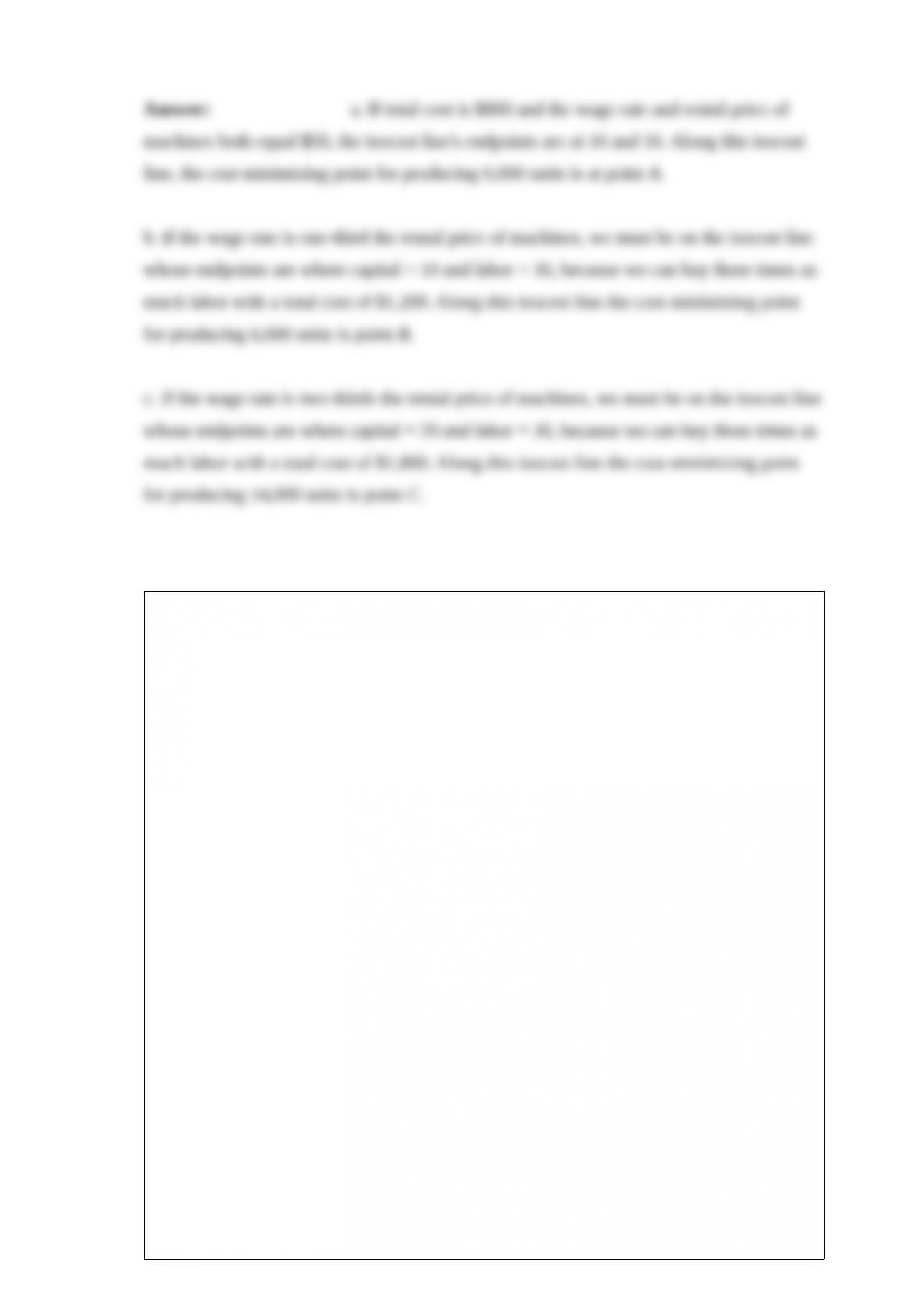
Use the following graph to answer the following questions.
a. If the wage rate and the rental
price of machines are both $50 and total cost is $800, is the cost-minimizing point A, B,
or C?
b. If the wage rate is $40, the rental price of equipment is $120, and total cost is $1,200,
is the cost-minimizing point A, B, or C?
c. If the wage rate is $60, the rental price of equipment is $90, and total cost is $1,800,
is the cost-minimizing point A, B, or C?
Article Summary. Cuba has announced its intentions to end its dual currency
system which has been in place since 1994. Presently, Cuba has two official
currencies, the national peso (CUP) and the convertible peso (CUC). The national
peso is the currency used by most businesses and citizens, and the convertible peso
was designed to be used primarily in the tourism industry and for foreign trade.
The coveted convertible peso is pegged to the U.S. dollar and is worth 25 times the
national peso, despite the government treating them as having equal value in
official accounts, trading on a one-for-one basis for official state entities. Few
Cubans other than those with government ties have access to convertible pesos,
which allows them to enjoy a much improved lifestyle due to the currency’s
relative value. One exception is people working in the tourist-centered hospitality
industries, such as waiters and hotel staff, who receive convertible pesos as tips,
often earning them more than medical and legal professionals who are paid in
national pesos. The currency unification is expected to be a gradual process, taking
up to 18 months, and could involve both a devaluing of the convertible peso and a
revaluing of the national peso. Source: Hannah Strange, “Cuba to end dual
currency as part of Castro’s economic reforms,” Telegraph, October 22, 2013.
The convertible peso (CUC), which is pegged to the U.S. dollar, is worth 25 times the
national peso, yet Cuban officials treat the convertible peso and the national peso as
being of equal value. This indicates that the national peso is ________ compared to the
convertible peso, and would need to be ________ to for the two currencies have equal
value in the marketplace.
A) undervalued; revalued
B) undervalued; devalued
C) overvalued; revalued
D) overvalued; devalued
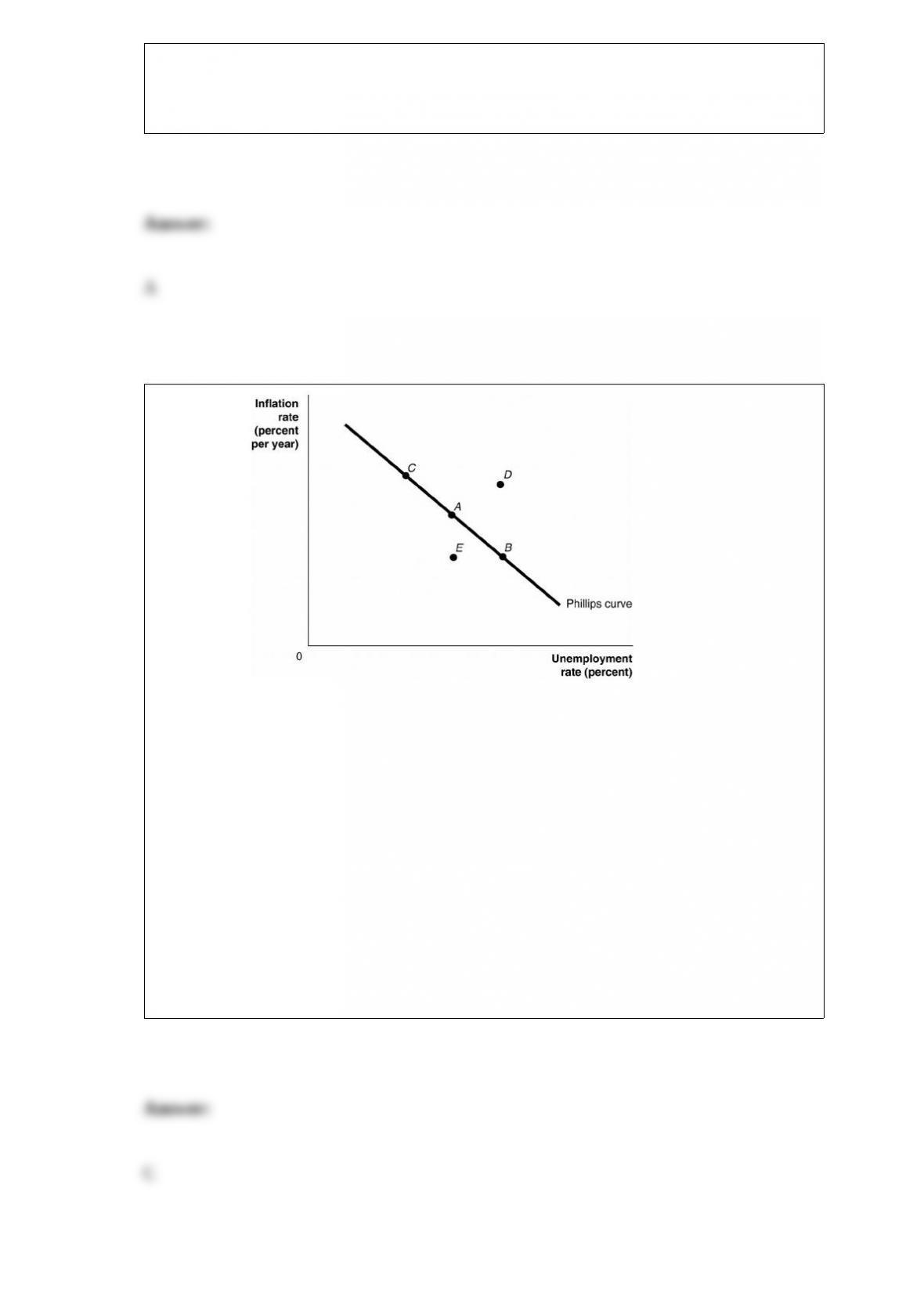
Figure 28-1
Suppose that the economy is currently at point A on the short-run Phillips curve in the
figure above, and the unemployment rate at A is the natural rate. If the economy was to
move to point C, which of the following must be true?
A) The economy is producing a level of GDP equal to potential GDP.
B) Aggregate demand must have decreased.
C) Equilibrium GDP at point C must be above potential GDP.
D) The Fed conducted contractionary policy to cause the move.
E) The Fed sold treasury bills to cause the move.
A firm has an incentive to decrease supply now and increase supply in the future if it
expects that
A) more firms will enter the market in the future.
B) the prices of inputs used to produce the product will rise in the future.
C) the price of its product will be lower in the future than it is today.
D) the price of its product will be higher in the future than it is today.
Describe the four determinants of exchange rates in the long run.
If the federal budget goes from a budget deficit in Year 1 to a budget surplus in Year 2,
does it follow that the federal government acted to raise taxes or cut government
spending in Year 2?
What is the difference between a fixed exchange rate system and a managed float
exchange rate system?
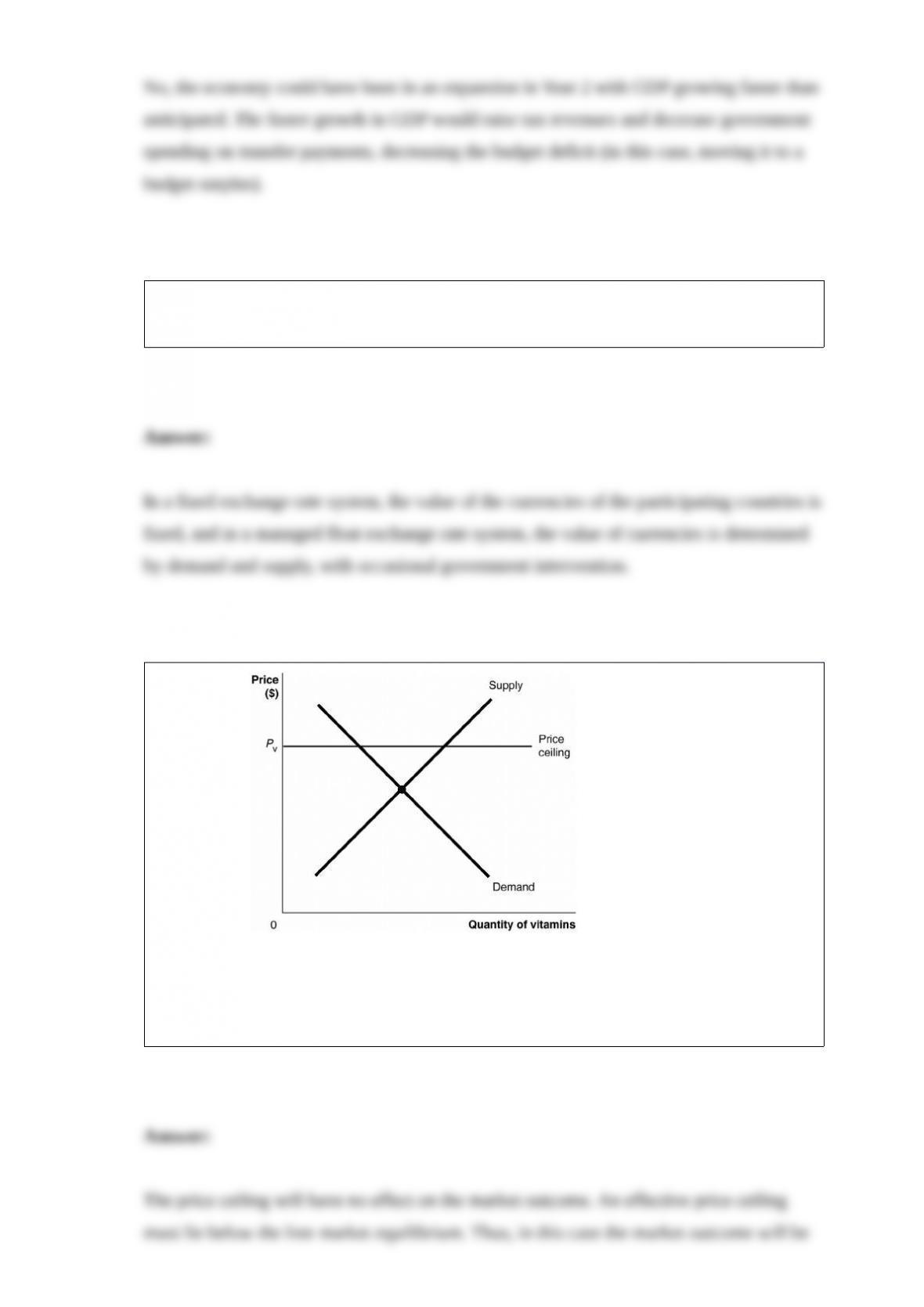
Figure 4-13
which shows the market for vitamins. Suppose the government imposes a price ceiling
of Pv. How will the price ceiling affect the quantity supplied, quantity demanded and
quantity exchanged?
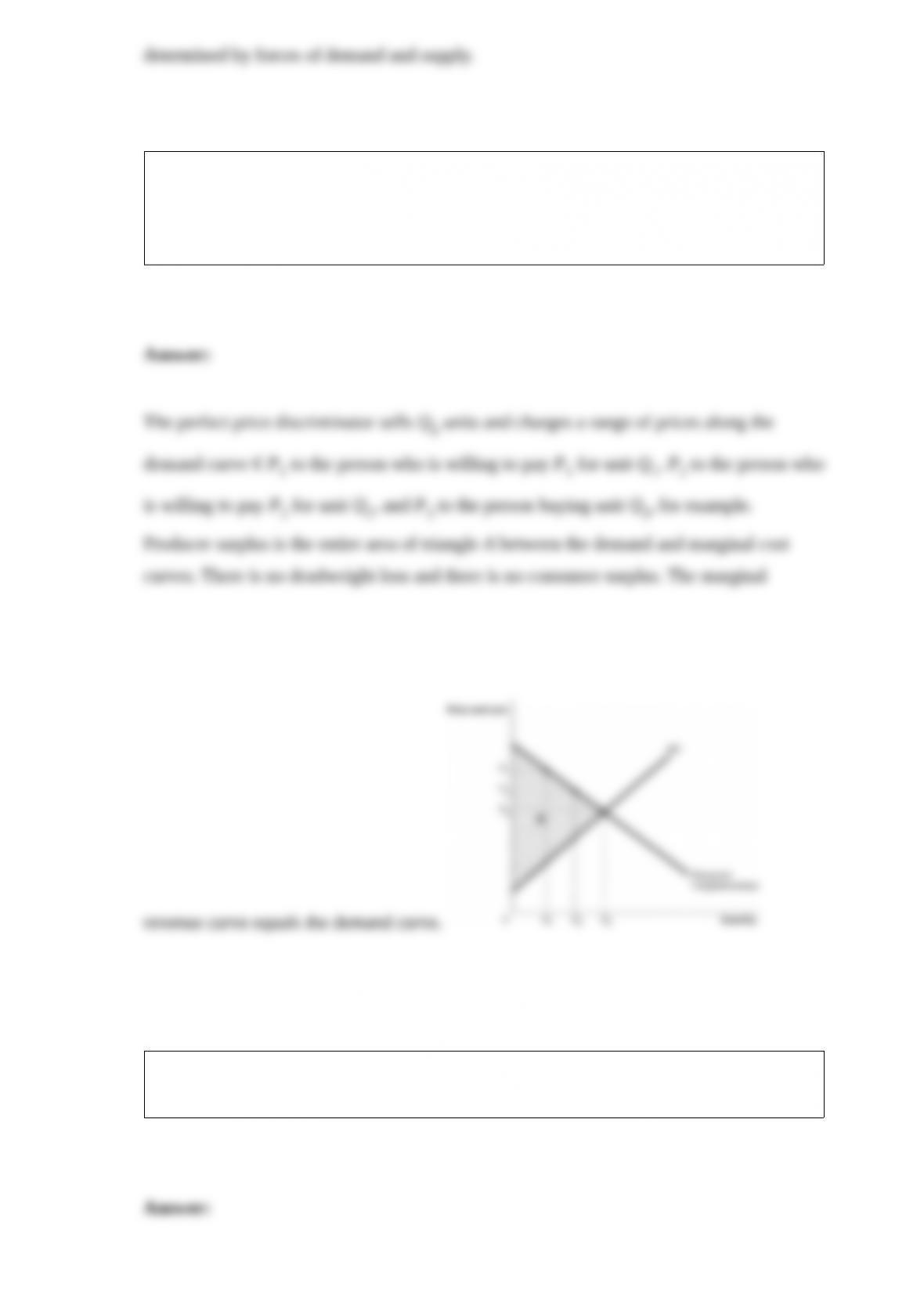
Draw a graph that shows producer surplus, consumer surplus, and deadweight loss in a
market where the seller practices perfect price discrimination. Be sure to identify the
demand curve, the marginal revenue curve, the marginal cost curve, and the profit
maximizing quantity on the graph.
How can a corporation’s board of directors and its managers try to reduce the
principal-agent problem?