1) Which of the following is an example of a welfare program?
a.Temporary Assistance for Needy Families (TANF).
b.Capital Gains Tax (CGT).
c.Life Cycle Transfers (LCT).
d.North American Free Trade Agreement (NAFTA).
2) along a linear, downward-sloping demand curve decreases as price falls.
a.True
b.False
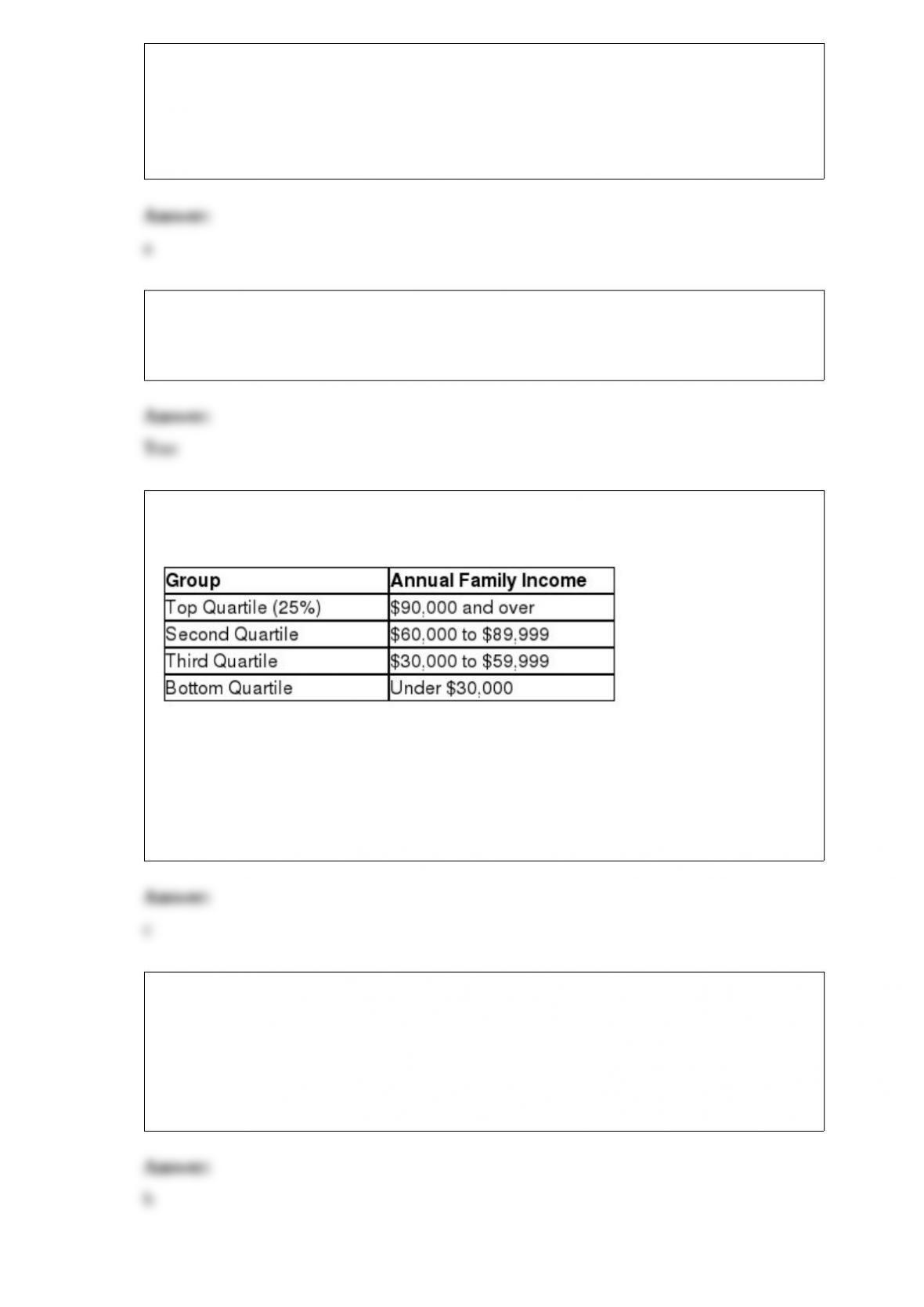
3) Table 20-1
The following table shows the distribution of income in Marysville.
Refer to Table 20-1. Seventy-five percent of all families have incomes below what
level?
a.$30,000
b.$60,000
c.$90,000
d.There is insufficient information to answer this question.
4) A family on a trip budgets $800 for meals and gasoline. If the price of a meal for the
family is $50, how many meals can the family buy if they do not buy any gasoline?
a.8
b.16
c.24
d.32
5) Which of the following is an example of a Giffen good?
a.fish in Japan
b.rice in the Chinese province of Hunan
c.pork in India
d.Both a and b are correct.
6) Scenario 12-1
Ken places a $20 value on a cigar, and Mark places a $17 value on it. The equilibrium
price for this brand of cigar is $15.
Suppose the government levies a tax of $3 on each cigar, and the equilibrium price of a
cigar increases to $18. Because total consumer surplus has
a.fallen by more than the tax revenue, the tax has a deadweight loss
b.fallen by less than the tax revenue, the tax has no dead weight loss.
c.fallen by exactly the amount of the tax revenue, the tax has no deadweight loss.
d.increased by less than the tax revenue, the tax has a deadweight loss.
7) Which of the following would be considered human capital?
a.the financial capital a person earns over a lifetime of investing
b.the machinery a worker uses to produce a product
c.the training a worker receives when starting a new job
d.the break room in a factory where employees go to have coffee
8) Table 17-4
The table shows the town of Mauston’s demand schedule for gasoline. For simplicity,
assume the town’s gasoline seller(s) incur no costs in selling gasoline.
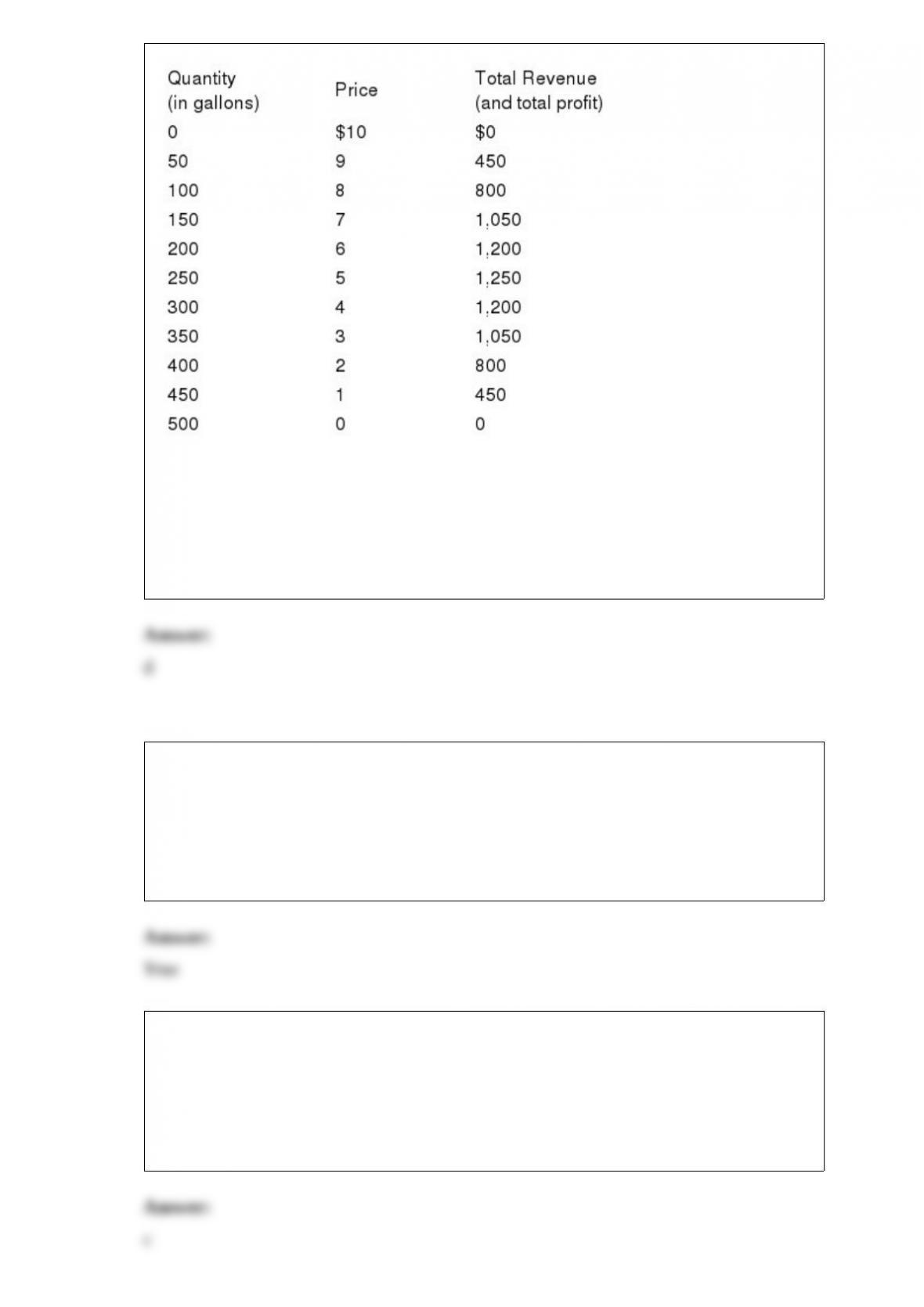
Refer to Table 17-4. If there are exactly two sellers of gasoline in Mauston and if they
collude, then which of the following outcomes is most likely?
a.Each seller will sell 250 gallons and charge a price of $5.
b.Each seller will sell 175 gallons and charge a price of $3.
c.Each seller will sell 125 gallons and charge a price of $2.5.
d.Each seller will sell 125 gallons and charge a price of $5.
9) Traci is a nurse, and she gets paid an additional $1.00 per hour for agreeing to work
the night shift. Carol is also a nurse, but she works the day shift and does not get paid
this extra dollar per hour. This difference in pay is an example of a compensating
differential.
a.True
b.False
10) People interpret evidence to confirm beliefs they already hold. This statement is an
example of which of the following systematic mistakes that people make?
a.people are overconfident
b.people give too much weight to a small number of vivid observations
c.people are reluctant to change their minds
d.All of the above are correct.
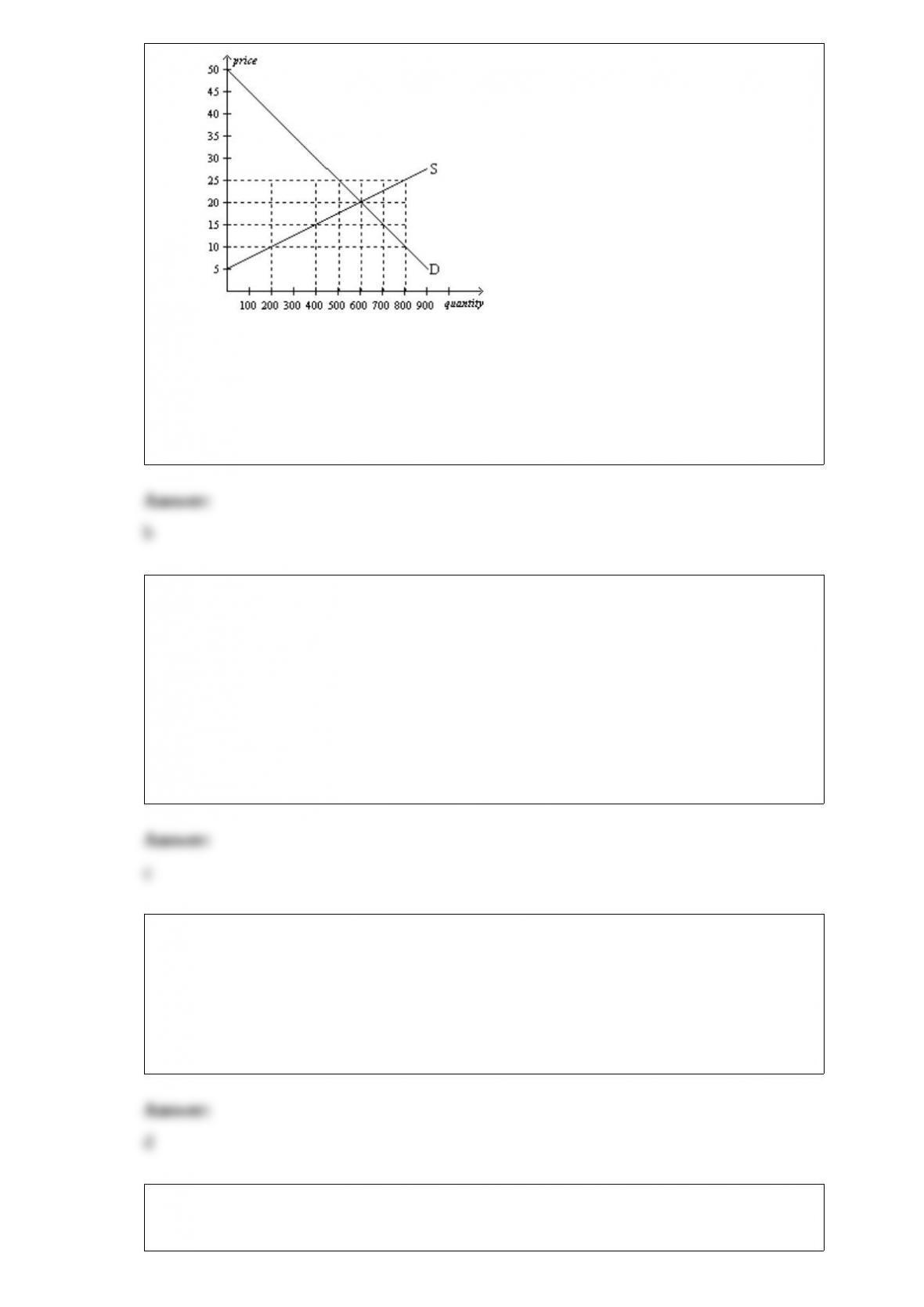
11) In this market, equilibrium price and
quantity, respectively, are
a.$15 and 400 units.
b.$20 and 600 units.
c.$25 and 500 units.
d.$25 and 800 units.
12) Taylor spends all of her income on tank tops and running shoes, and the price of a
pair of running shoes is four times the price of a tank top. In order to maximize total
utility, Taylor should buy
a.four times as many tank tops as pairs of running shoes.
b.four times as many pairs of running shoes as tank tops.
c.both items until the marginal utility of a pair of running shoes is four times the
marginal utility of a tank top.
d.both items until the marginal utility of a tank top is four times the marginal utility of a
pair of running shoes.
13) In the prisoners’ dilemma game, self-interest leads
a.each prisoner to confess.
b.to a breakdown of any agreement that the prisoners might have made before being
questioned.
c.to an outcome that is not particularly good for either prisoner.
d.All of the above are correct.
14) A lighthouse is typically considered to be a public good because
a.the owner of the lighthouse is able to exclude beneficiaries from enjoying the
lighthouse.
b.there is rarely another lighthouse nearby to provide competition.
c.a nearby port authority cannot avoid paying fees to the lighthouse owner.
d.all passing ships are able to enjoy the benefits of the lighthouse without paying.
15) At the equilibrium price, buyers have bought all they want to buy, but sellers have
not sold all they want to sell.
a.True
b.False
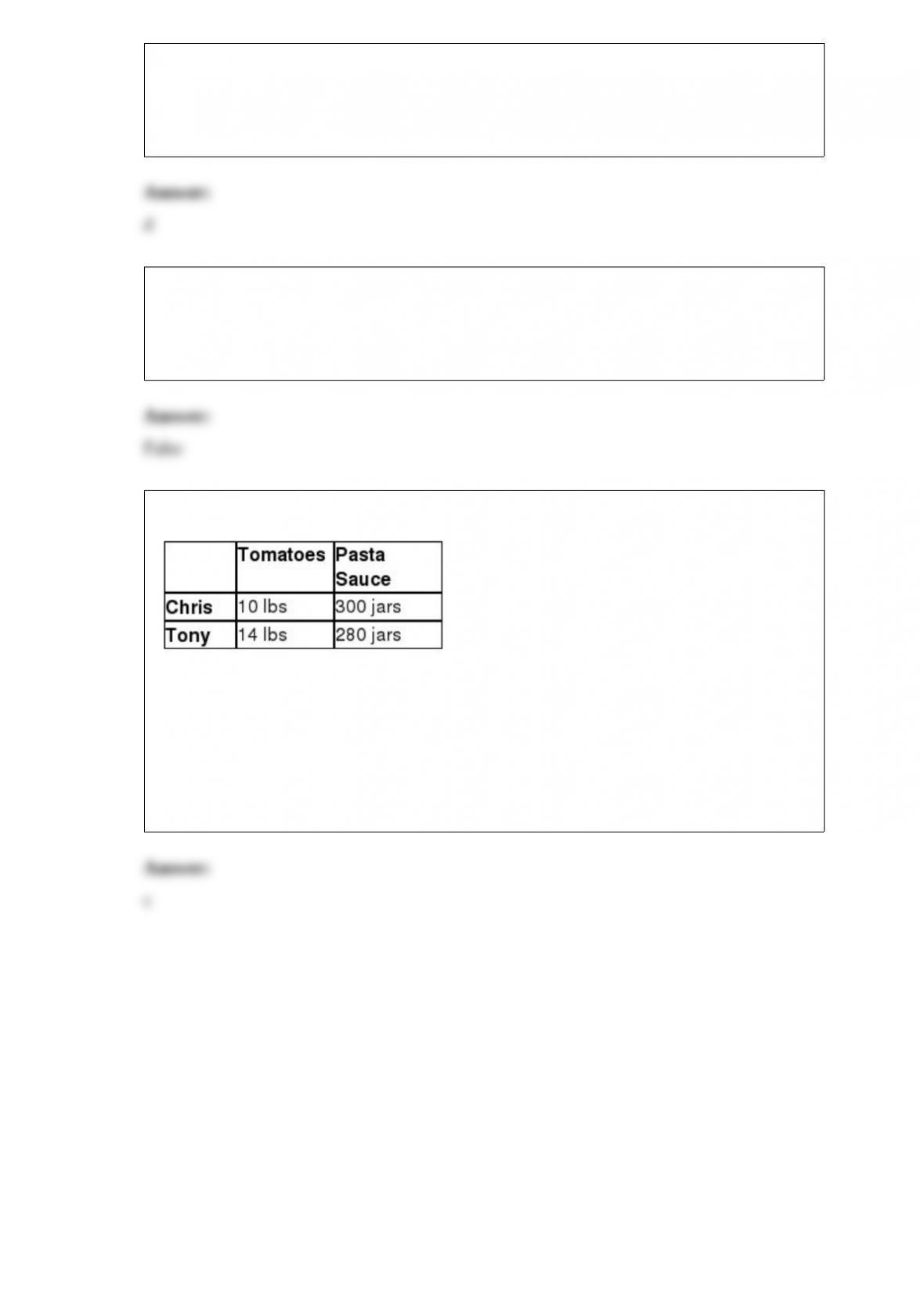
16) Chris and Tony’s Production Opportunities
Chris and Tony both produce tomatoes and pasta sauce. The table shows their possible
production per month if both work the same number of 8 hour days. Which of the
following statements is correct?
a.Tony has a comparative advantage in the production of sauce.
b.Chris has a comparative advantage in the production of tomatoes.
c.Tony has an absolute advantage in the production of tomatoes.
d.Chris has an absolute advantage in the production of tomatoes.