
Suppose the price elasticity of supply for poker chips is .7 and the price decreases by
30%. The quantity supplied will decrease by ________ %.
A) 25
B) 30
C) 15
D) 21
Which of the following trade policies raises prices for domestic consumers?
A) import quotas
B) tariffs
C) voluntary export restraints
D) all of the above
When a firm is experiencing diminishing returns:
A) average cost is always increasing.
B) average cost is always decreasing.

C) marginal costs are always less than average costs.
D) none of the above
In the long run:
A) all factors of production are fixed.
B) all factors of production are variable.
C) some factors of production are variable, while at least one factor of production is
fixed.
D) None of the above are correct.
An increase in demand will cause a relatively small increase in price when:
A) the increase in demand is large.
B) demand is highly elastic.
C) supply is highly inelastic.
D) all of the above

Additional Application
From 1992 to 2003 the number of milk producers in Florida has fallen from 300 to 190.
In those same 10 years the number of dairy farms nationwide has decreased by more
than 44,000. Why? The market price in a perfectly competitive industry is not
determined by the individual sellers, but rather the market supply and demand. While
the Florida dairy industry might not be “perfectly” competitive due to the certain USDA
policies, its behavior does approximate one. If prices are not high enough to maintain
some level of normal profit, firms will leave the industry. And this is what has been
happening in the dairy industry. In the months after September 11, 2001 the demand for
milk fell, causing the price of 100 pounds of milk to decrease from about $19 to about
$14, a 25-year low. In addition to falling prices, the costs of operating dairy farms have
risen. Increased property taxes and environmental compliance permits have made dairy
farming less viable. The average dairy farm in Florida is small with only about 700
cows. This further prevents a single supplier from being able to influence the market
price. Many farmers view this business as a family operation and one they would like to
pass on to their children. But continued low milk prices and profits make the likelihood
of such an inheritance unlikely.
Greg C. Bruno. “Milk Industry Turns Sour,” The Gainesville Sun, January 22, 2004, pp.
1, 4.
Why can’t the milk farmers just increase their prices to insure higher profits?
A) Each farmer is too large to charge a higher price.
B) Each farmer has too many cows and does not know the market price.
C) The average farm is too small to influence the market price.
D) The government will not allow the farmers to raise their prices.
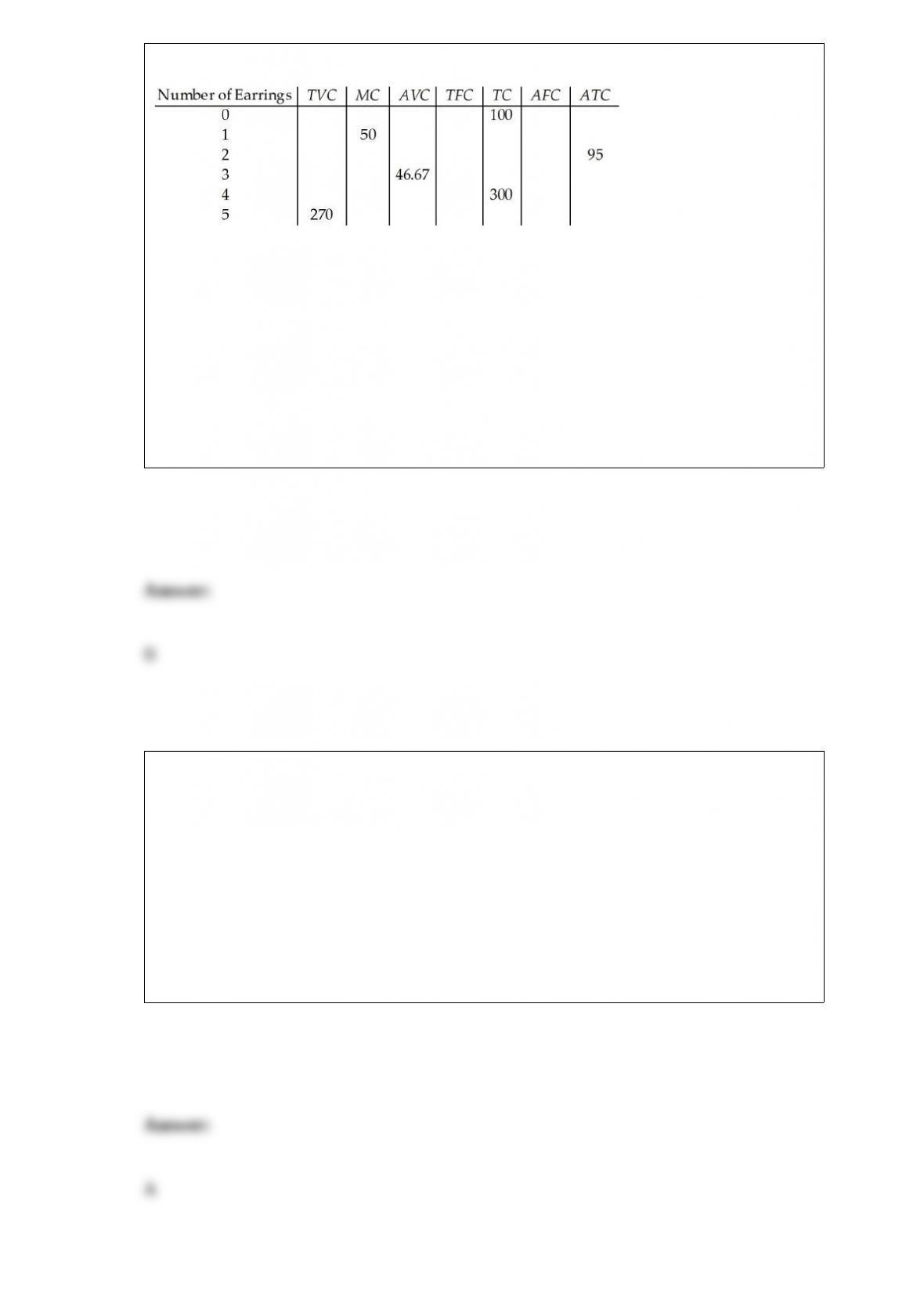
Refer to Table 8.5. If Sherry produces three pair of earrings, her total variable costs are:
Table 8.5
A) $26.67.
B) $140.
C) $175.
D) $225.
Recall the Application. In most cases where satellite TV service is introduced in an area
with cable TV service, if the price of cable TV decreases, then consumer surplus:
A) increases.
B) decreases.
C) drops to zero.
D) becomes negative.

At a price of $4, a gas station. sold 100 gallons of gasoline per week. When the price
rose to $4.5, only 80 gallons were sold per week. Using the initial-value method, the
price elasticity of demand for gasoline at Greedy Inc. Gas Station is:
A) 0.2.
B) 0.16.
C) 2.
D) 1.6.
The price elasticity of supply is a measure of the responsiveness of:
A) the change in price to the quantity supplied.
B) the suppliers with respect to the change in price.
C) the quantity supplied to the change in income.
D) the quantity supplied to the changes in price.
The key region of the brain for principal decision-making is the:
A) insular cortex.
B) amygdala.

C) Nucleus Accumbens (NAcc).
D) prefrontal cortex (PFC).
Recall the Application. Suppose the price elasticity of demand for gasoline is 0.20 and
the price elasticity of supply for gasoline is 0.55. If supply decreases by 50 percent, the
equilibrium price will increase by:
A) 67 percent.
B) 70 percent.
C) 143 percent.
D) 150 percent.
The market demand curve:
A) shows the relationship between the price of a good and the quantity that all
consumers together are willing to buy.
B) is drawn assuming that variables such as income and tastes are fixed.
C) is drawn assuming that the number of consumers is fixed.
D) all of the above

When the price of hamburger went from $3 to $4 a pound, the quantity demanded of
buns changed from 30 to 25 packages a day. The cross-price elasticity of demand for
hamburger (using the initial value formula) is:
A) 1.4.
B) 0.6.
C) -0.6.
D) Not enough information to answer this question.
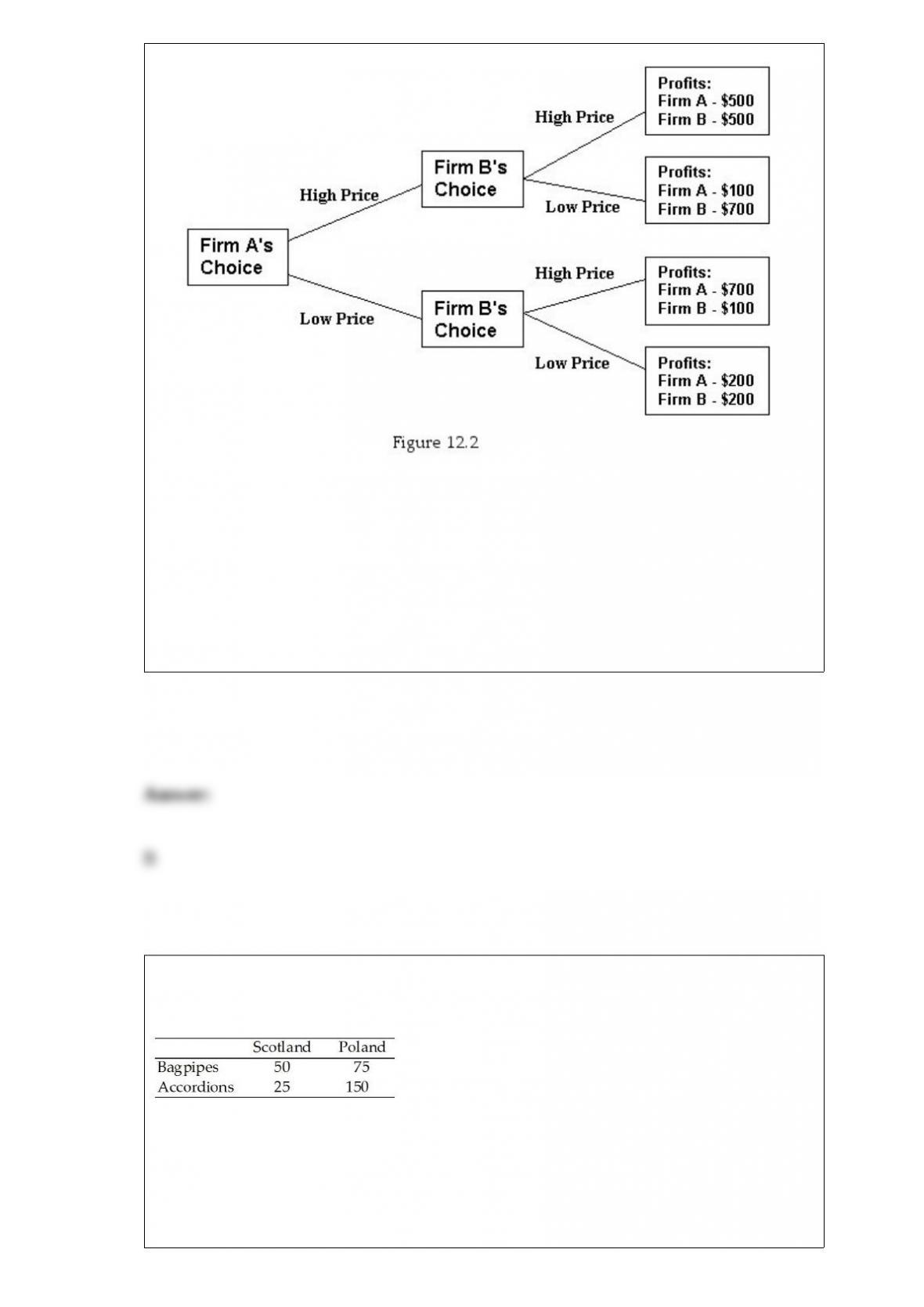
Figure 12.2 shows the decision tree for setting price for the only two firms in a market.
How many dominant strategies are there for firm A?
A) 0
B) 1
C) 2
D) It cannot be determined without knowing what firm B does.
Daily Output of Scotland and Poland
Table 18.1
Refer to Table 18.1. Possible terms of trade between Scotland and Poland are:
A) 1 accordion for 1/4 bagpipe.

B) 1 bagpipe for 2 accordions.
C) 1 bagpipe for 1/3 accordion.
D) 1 accordion for 1 bagpipe.
Suppose that the only input used in the generation of solar energy is sunlight and has a
zero cost. The average total cost of producing electricity is:
A) zero.
B) equal to the marginal cost.
C) equal to the average fixed cost.
D) immeasurably high.
Reading Consumer Reports before buying a used car:
A) helps buyers increase their chances of avoiding a lemon, or low-quality car.
B) does not help buyers because magazines only cover new car sales, not used car sales.
C) makes warranties on used cars unnecessary.
D) is irrational because the cost of the magazine is greater than the benefit of the
information.

Examples of monopolistically competitive industries in which firms differentiate their
products by offering them at more locations include all of the following EXCEPT:
A) restaurants.
B) video rental stores.
C) retail clothing stores.
D) wheat farms.
An import quota:
A) limits the amount of a good that can be imported, thus decreasing prices.
B) limits the amount of a good that can be imported, thus increasing prices.
C) increases the amount of a good imported, thus decreasing prices.
D) increases the amount of a good imported, thus increasing prices.

Which of the following is an example of natural monopoly?
A) a market for cable TV services
B) a market for breakfast cereals
C) a market for cold medicines
D) a market for cigarettes
Suppose an insurance company determines that the average annual malpractice cost is
$10,000 for reckless lawyers and $500 for careful lawyers. If 10% of the lawyers
insured by the company are reckless, the company will earn zero economic profit if the
price of insurance is:
A) $500.
B) $1,450.
C) $5,250.
D) $10,000.
Market failure occurs when:
A) markets have perfect information.
B) markets do not produce the most efficient outcome.
C) companies merge to increase efficiency.
D) companies are too efficient.
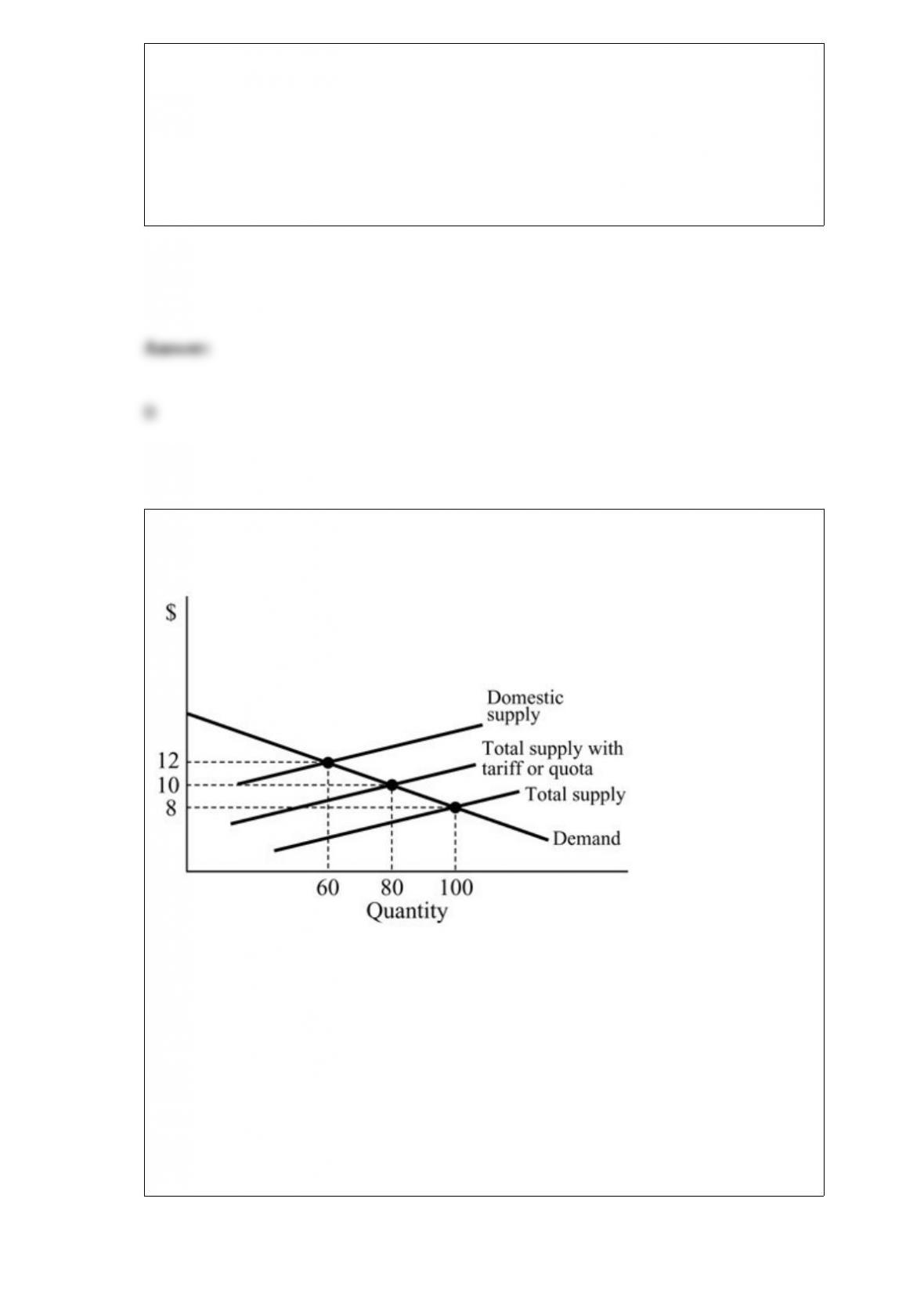
Figure 18.3
Refer to Figure 18.3. With a tariff or quota, the equilibrium price is:
A) $2.
B) $12.
C) $8.
D) $10.

If the consumer gets 40 utils from consuming four CDs, 45 utils from consuming five
CDs and 48 utils from consuming six CDs, then the consumer’s marginal utility is:
A) increasing.
B) decreasing.
C) constant.
D) increasing at an increasing rate.
European nations are currently deregulating many markets. They are expecting:
A) the price of goods sold in these markets to increase.
B) the quality of goods sold in these markets to decrease.
C) the price of goods sold in these markets to decrease.
D) the profits of firms selling in these markets to increase.

Predatory pricing is best exemplified when a firm:
A) cuts its prices in order to increase competition in the market.
B) exercises its monopoly power by raising price.
C) cuts its prices temporarily in order to drive out any competition.
D) requires consumers to purchase products together rather than separately.
Dan is consuming coffee and bagels so that / = 15 and / = 9. Using the
equimarginal rule, Richard should:
A) continue to consume the same amount of coffee and bagels, as he is already
maximizing utility.
B) consume less of both coffee and bagels.
C) consume more coffee and less bagels.
D) consume less coffee and more bagels.
Figure 4.5 illustrates the supply of guitars. An increase in the number of guitar
manufacturers would most likely cause a movement from:
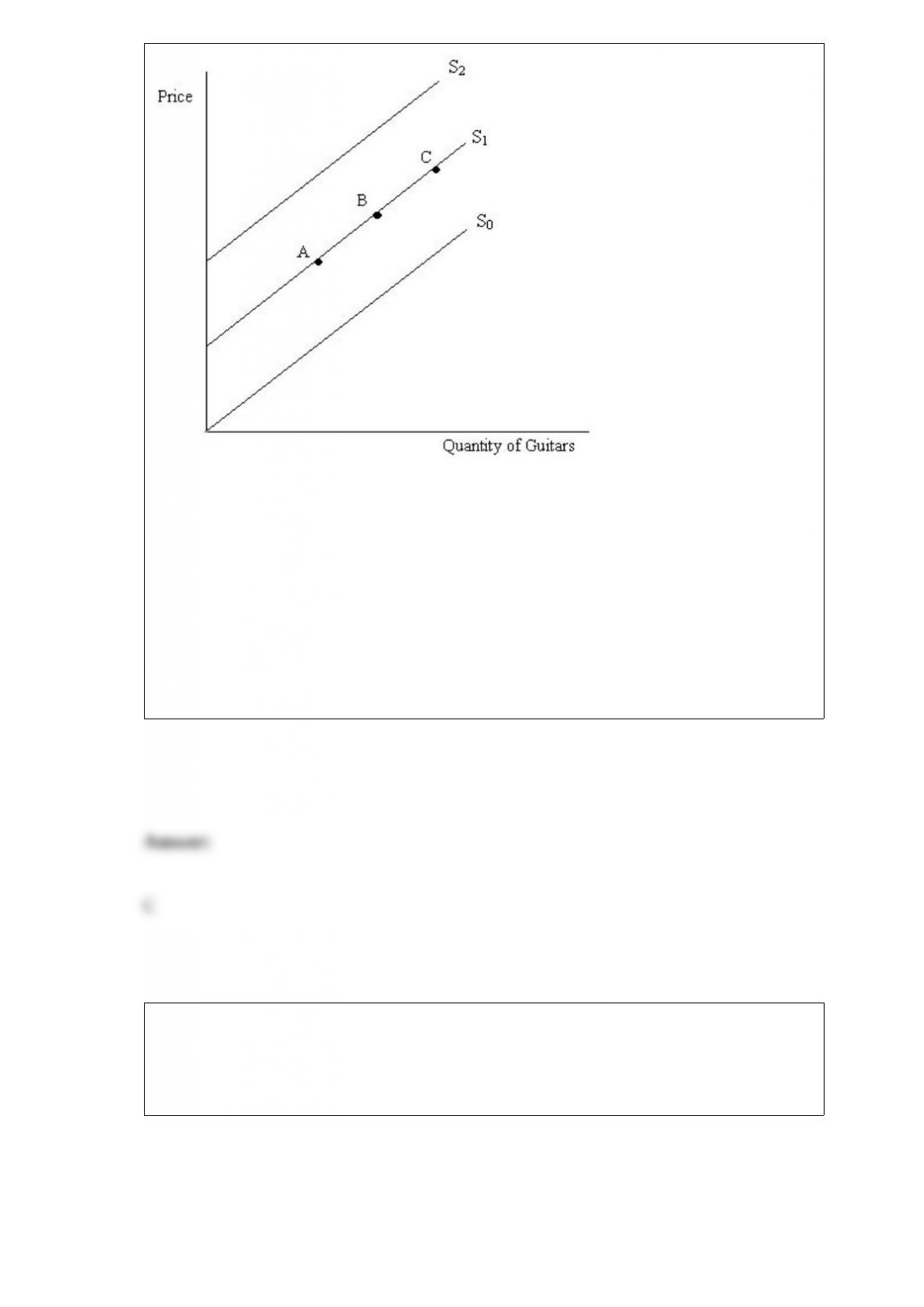
Figure 4.5
A) point B to point C.
B) point B to point A.
C) S1 to S0.
D) S1 to S2.
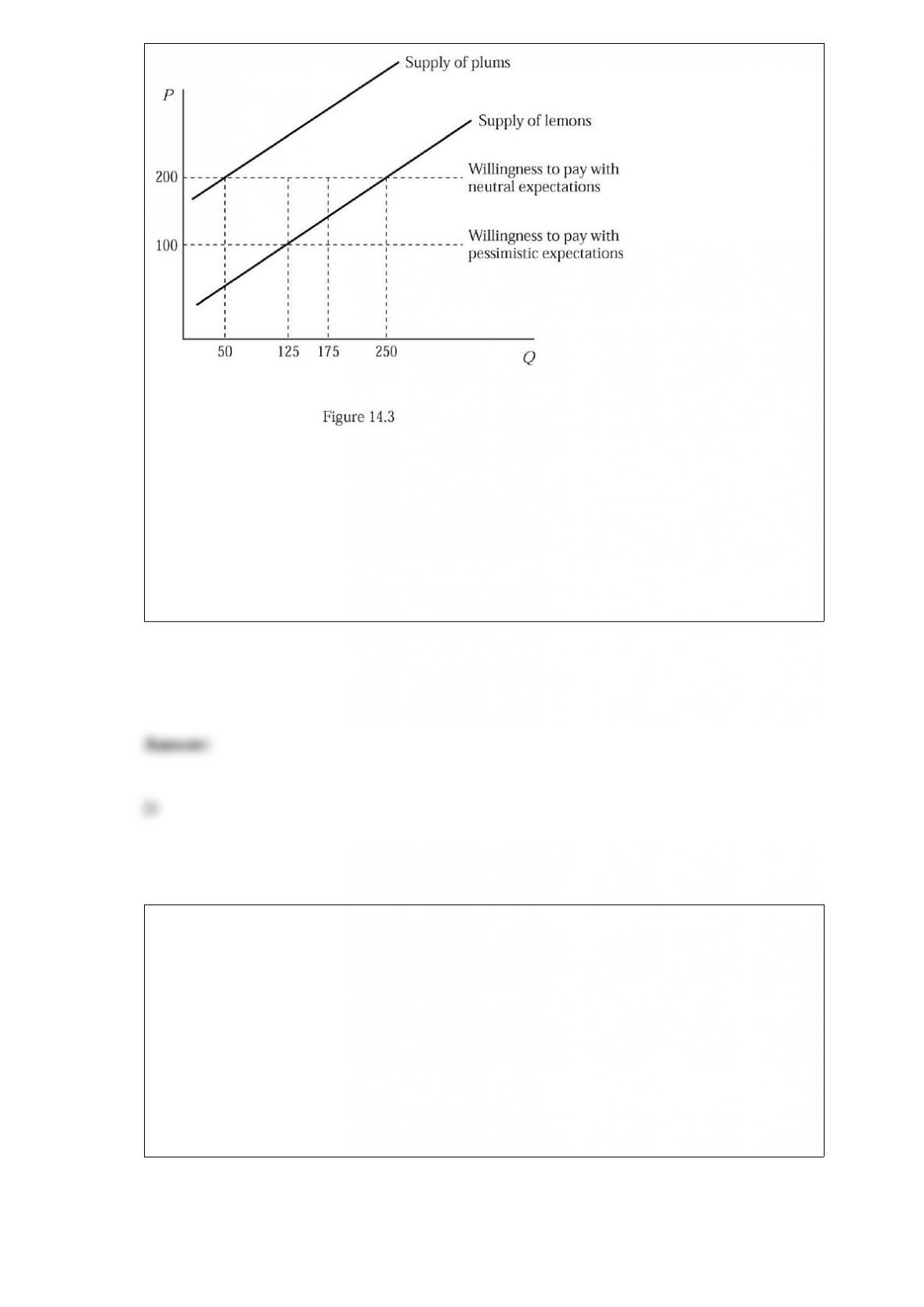
Figure 14.3 represents the market for used refrigerators. Suppose buyers are willing to
pay $300 for a plum (high-quality) used refrigerator and $100 for a lemon (low-quality)
used refrigerator. If buyers believe that 50% of used refrigerators in the market are
lemons (low quality), how many lemons (low quality) will be supplied by sellers?
A) 50
B) 125
C) 175
D) 250
Deciding how a society’s products are distributed among its citizens answers the
economic question of:
A) who consumes the products produced.
B) what products will be produced.
C) where will the products be consumed.
D) how will the products be produced.
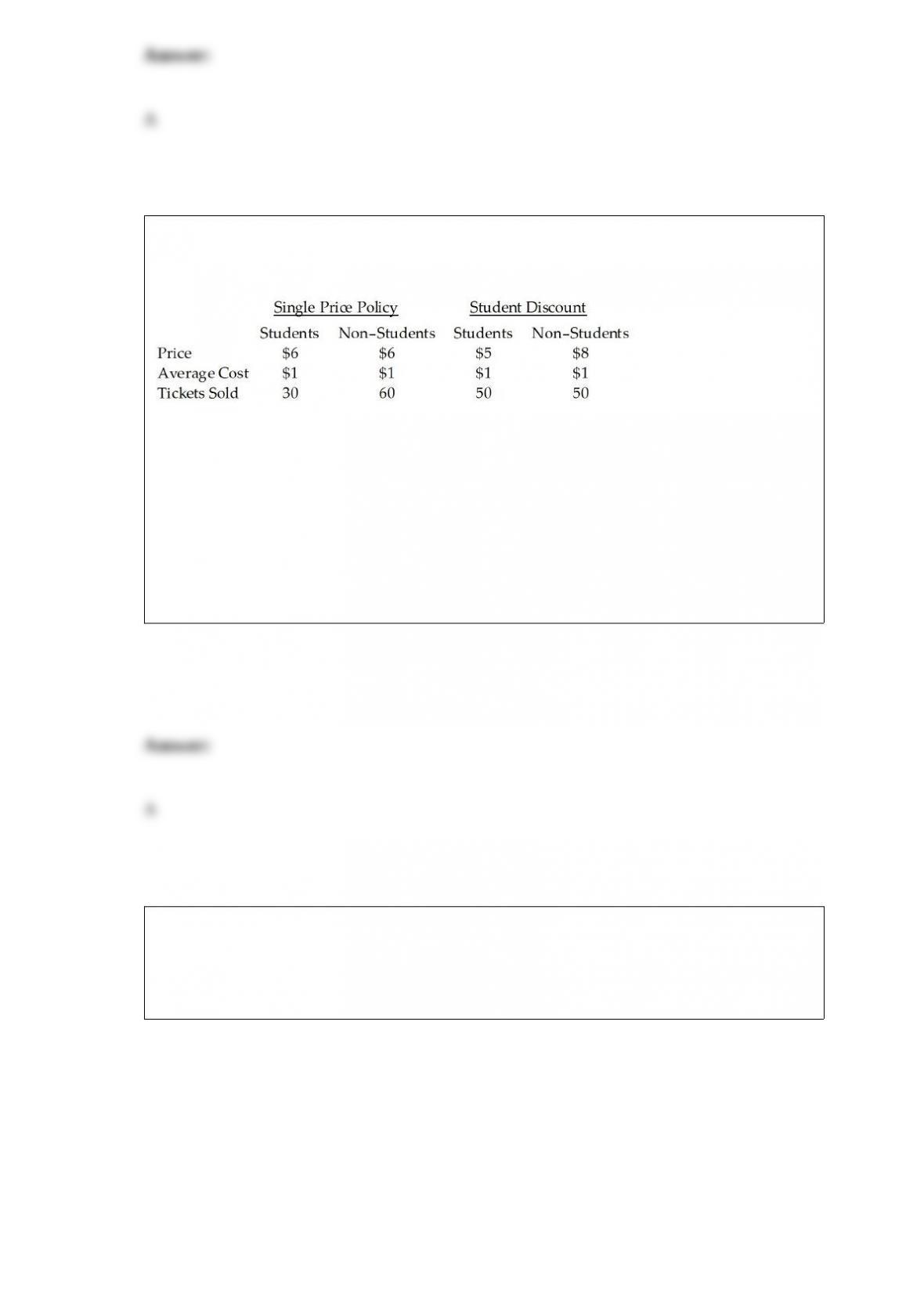
Table 10.2 contains price, demand, and cost data for the Capri Theater, the only first-run
movie theater in a small town. What is its profit from non-students under the single
price policy?
Table 10.2
A) $300
B) $360
C) $450
D) $540
Refer to Figure 4.6, which shows David’s and Celeste’s individual supply curves for
flower arrangements per week. Assuming David and Celeste are the only producers in
the market, what is the market quantity supplied at a price of $30?
Figure 4.6
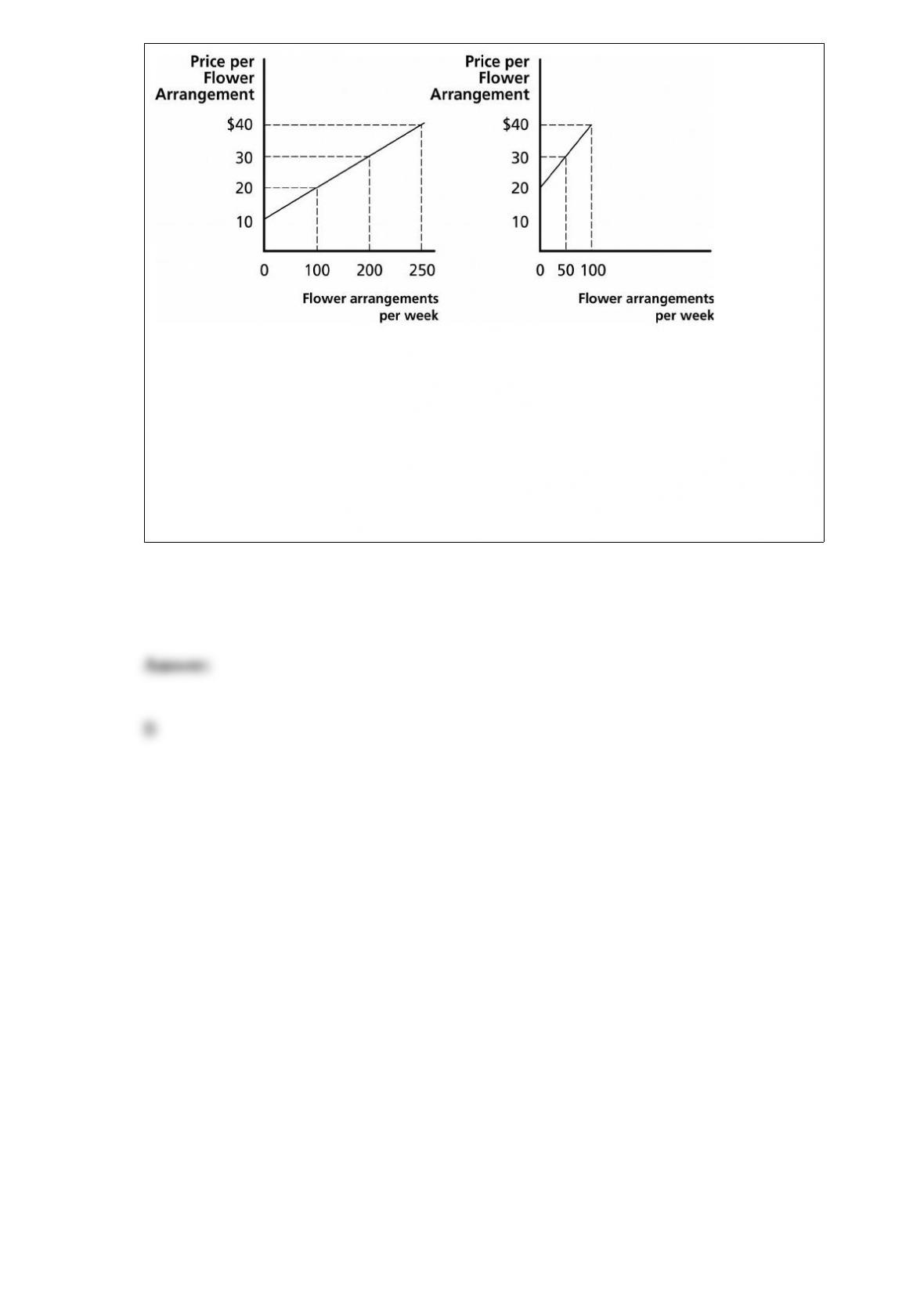
David’s Supply Schedule Celeste’s Supply Schedule
A) 200
B) 250
C) 300
D) 350