1) The use of price support programs in agriculture has hastened the exodus of
resources from agriculture.
2) The nation that has a comparative advantage in a particular product will be the only
world exporter of that product.
3)
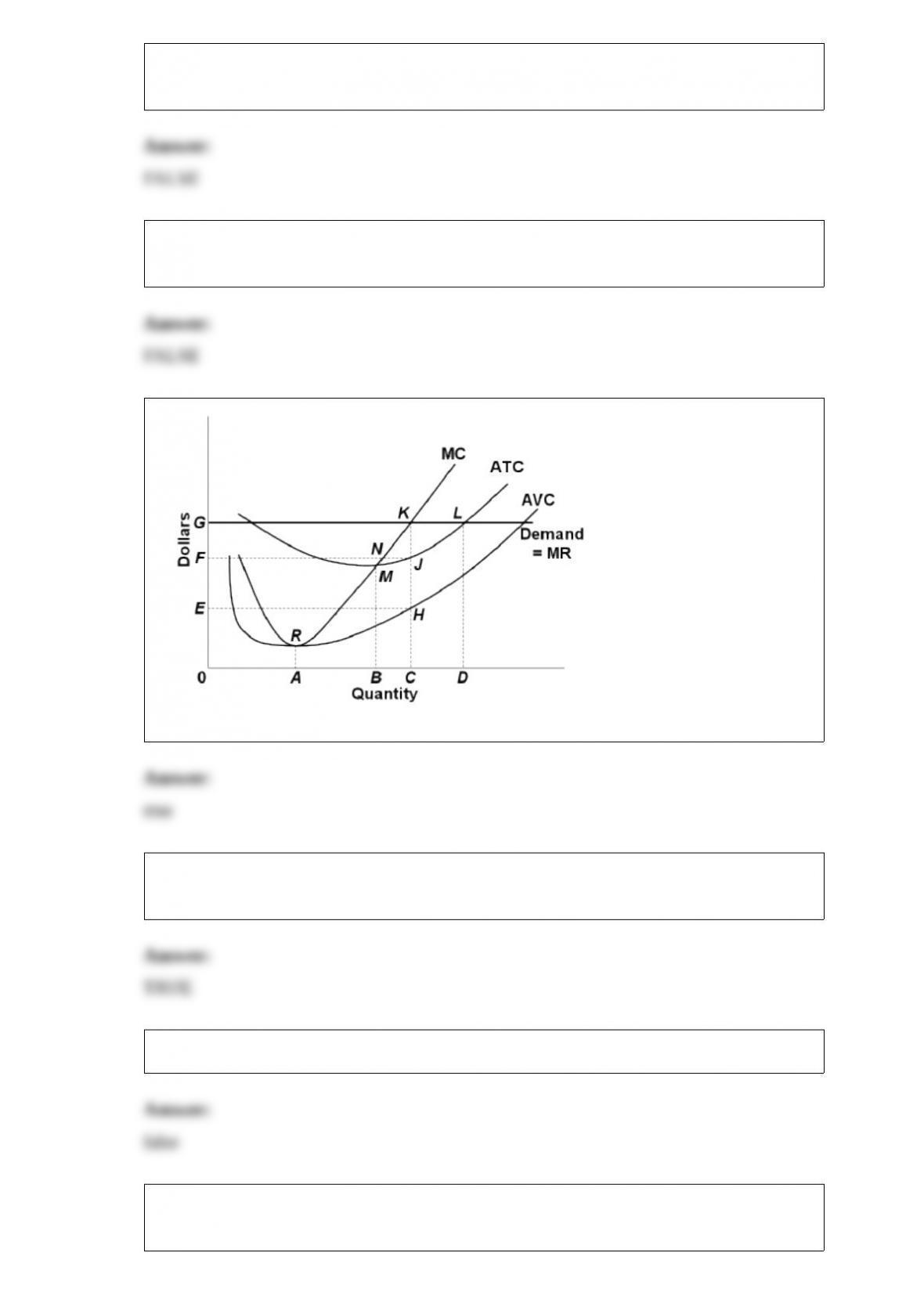
refer to the above diagram. at output c production will result in an economic profit.
4) The principal-agent problem in labor markets arises because of the possibility of
shirking by workers.
5) the lower the consumer’s income, the higher his or her budget line.
6) Increases in incomes usually result in more than proportionate increases in the
demand for agricultural products in a growing economy.

7) Human beings consume more both in absolute terms and on a per capita basis than
they did 200 years ago.
8) Fiscal policy is complicated by political considerations and political motivations.
9) (Consider This) Brinley puts on an art show in a public space, asking for donations
based on how much people enjoy his work. Economists would expect that:
A.people will understate their enjoyment of the art in order to “free ride.”
B.people will overstate their enjoyment of the art, attempting to substitute praise for
money.
C.people will accurately state their level of enjoyment and pay accordingly.
D.Brinley will reap significant economic profits from the event.
10) Assume that you pay $10,000 of tax on a taxable income of $50,000. If your taxable
income were $150,000, your tax payment would be $25,000. This suggests the tax is:
A.progressive.
B.proportional.
C.regressive.
D.discriminatory.
11) The fact that monopoly and monopsony exist in resource markets means that:
A.the marginal productivity theory of income distribution is valid.
B.resource prices need not accurately measure contributions to output.
C.the resulting income distribution is ethically correct.
D.income shares do not exhaust the total output.
12) If the quantity of money demanded exceeds the quantity supplied:
A.the supply-of-money curve will shift to the left.
B.the demand-for-money curve will shift to the right.
C.the interest rate will rise.
D.the interest rate will fall.
13)
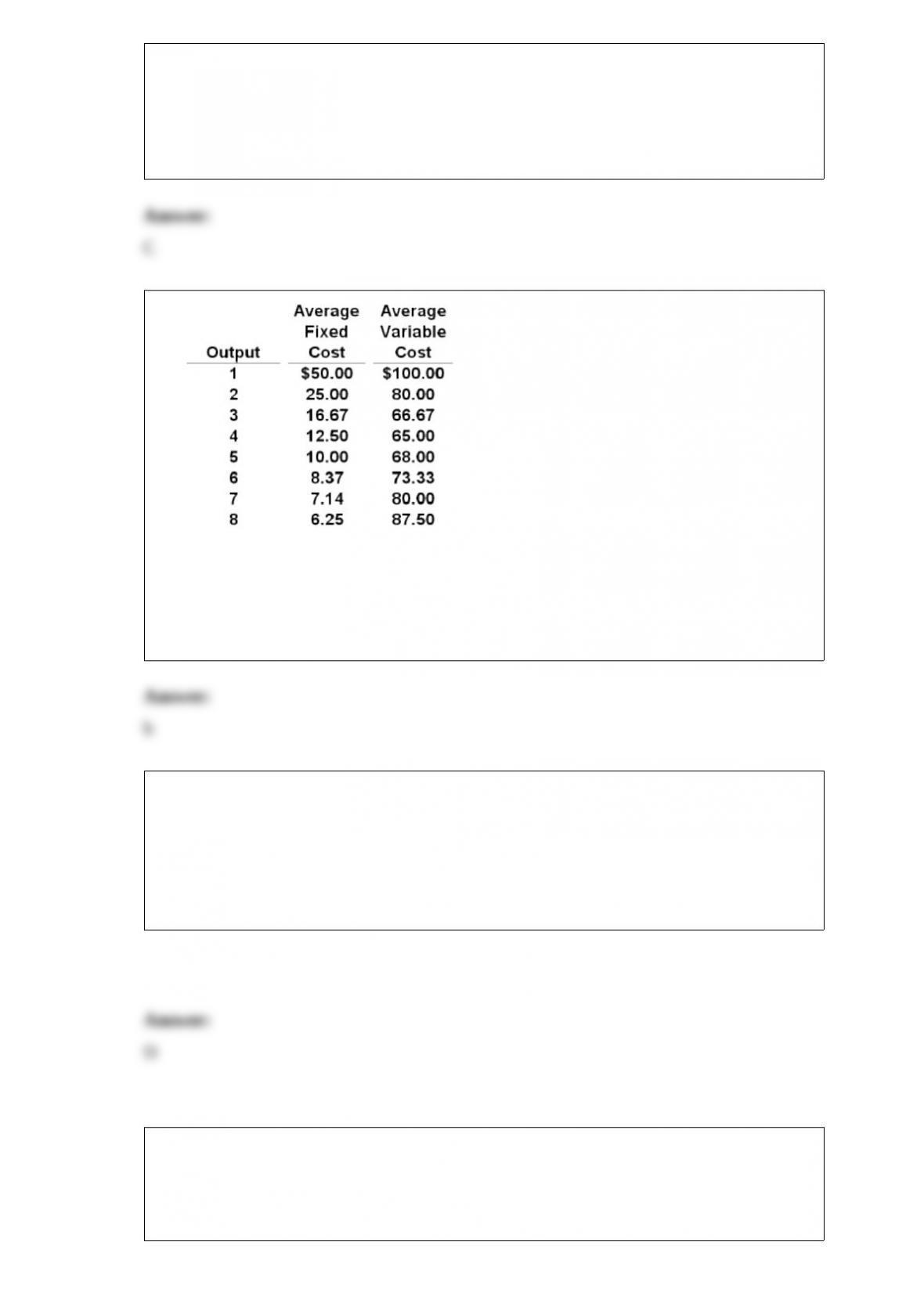
refer to the above data. the average total cost of five units of output is:
a.$69.
b.$78.
c.$3.
d.$10.
14)
The demand for airline pilots results from the demand for air travel. This fact is an
example of:
A.resource substitutability.
B.rising marginal resource cost.
C.elasticity of resource demand.
D.the derived demand for labor.
15) Industry A has a 60 percent concentration ratio, while industry B has a 40 percent
concentration ratio. According to the inverted-U theory, all else equal, we can conclude
that:
A.Industry A will be more technologically progressive than B.
B.Industry C with a 10 percent concentration ratio will be more technologically
progressive than either industry A or B.
C.Industry D with a 80 percent concentration ratio will be more technologically
progressive than either industry A or B.
D.none of these are necessarily true.
16) for a purely competitive seller, price equals:
a.average revenue.
b.marginal revenue.
c.total revenue divided by output.
d.all of these.
17)
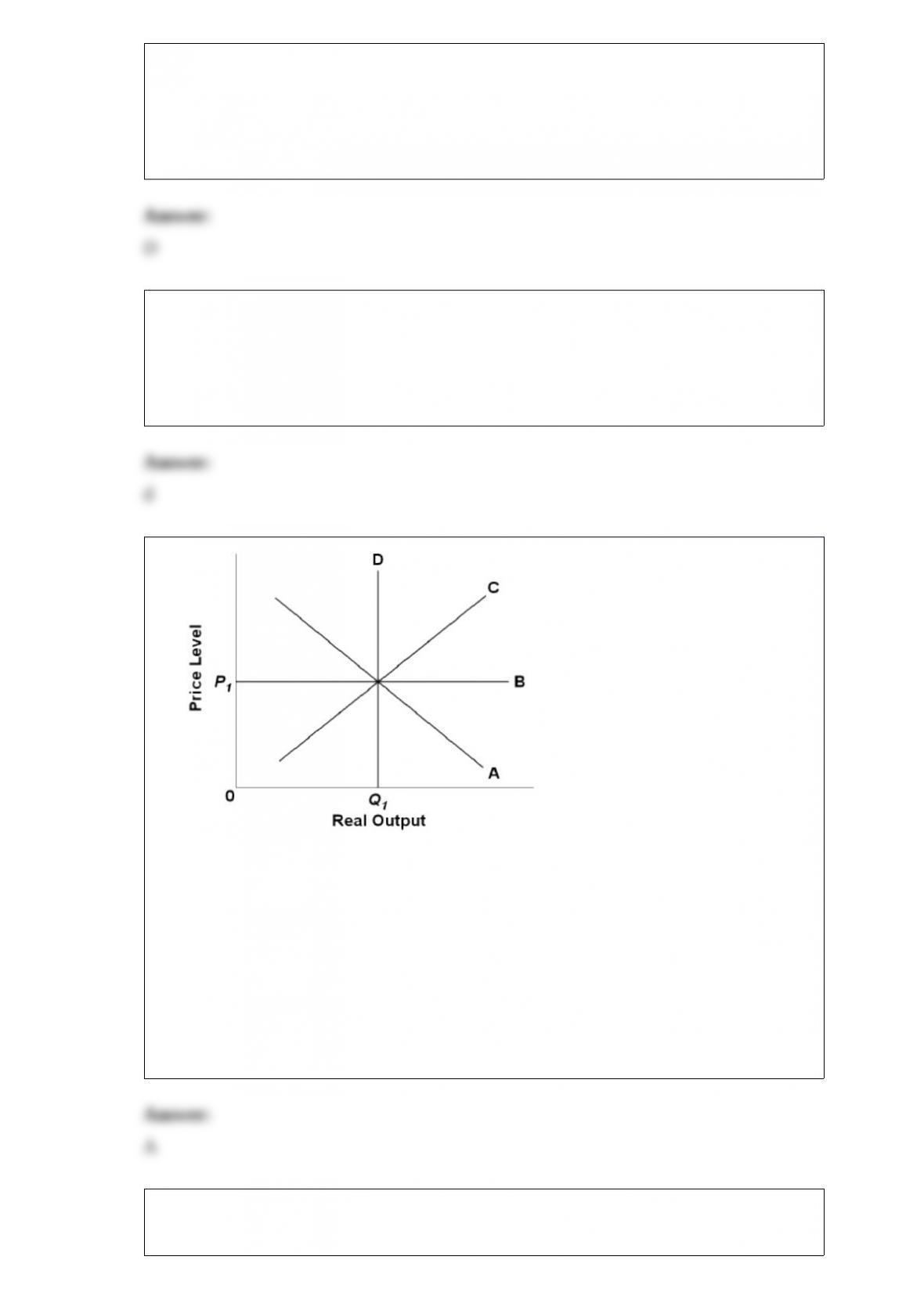
Refer to the above diagram and assume that prices and wages are flexible both upward
and downward in the economy. In the extended AD-AS model:
A.demand-pull inflation would involve a rightward shift of curve A, followed by a
leftward shift of curve C
B.cost-push inflation would involve a rightward shift of curve A, followed by a leftward
shift of curve C
C.recession would involve a leftward shift of curve A, followed by a leftward shift of
curve C
D.recession would involve a rightward shift of curve D, followed by leftward shifts of
curves A and C
18) the demand for a luxury good whose purchase would exhaust a significant portion
of one’s income is:

a.perfectly inelastic.
b.perfectly elastic.
c.relatively inelastic.
d.relatively elastic.
19) “too much money chasing too few goods” best describes:
a.the gdp gap.
b.demand-pull inflation.
c.the inflation premium.
d.cost-push inflation.
20) Which of the following is a true statement?
A.The bank and thrift share of total financial assets has increased dramatically since
1980.
B.The vast bulk of investment in the major nations is financed, not from internal saving,
but from funds from abroad.
C.The world’s financial markets have become increasingly integrated.
D. International stock and bond funds cannot be sold in the United States.
21) Graphically, demand-pull inflation is shown as a:
A.rightward shift of the AD curve along an upsloping AS curve.
B.leftward shift of the AS curve along a downsloping AD curve.
C.leftward shift of AS curve along an upsloping AD curve.
D.rightward shift of the AD curve along a downsloping AS curve.
22) if a consumer chooses a combination of goods that lies inside of her budget line, the
consumer:
a.is maximizing utility.
b.is spending in excess of her current income.
c.could obtain more goods with her money income.
d.has upsloping indifference curves.
23) Resource consumption per person in the past decade has:
A.leveled off or fallen in the richest countries.
B.leveled off or fallen for the world as a whole.
C.grown in the richest countries as good and service consumption per person has risen.
D.decreased significantly as commodity prices have risen.
24) Author Joe Writer receives $2 per book sold. This payment is a(n):
A.piece rate.
B.royalty.
C.bonus.
D.example of profit-sharing.
25)
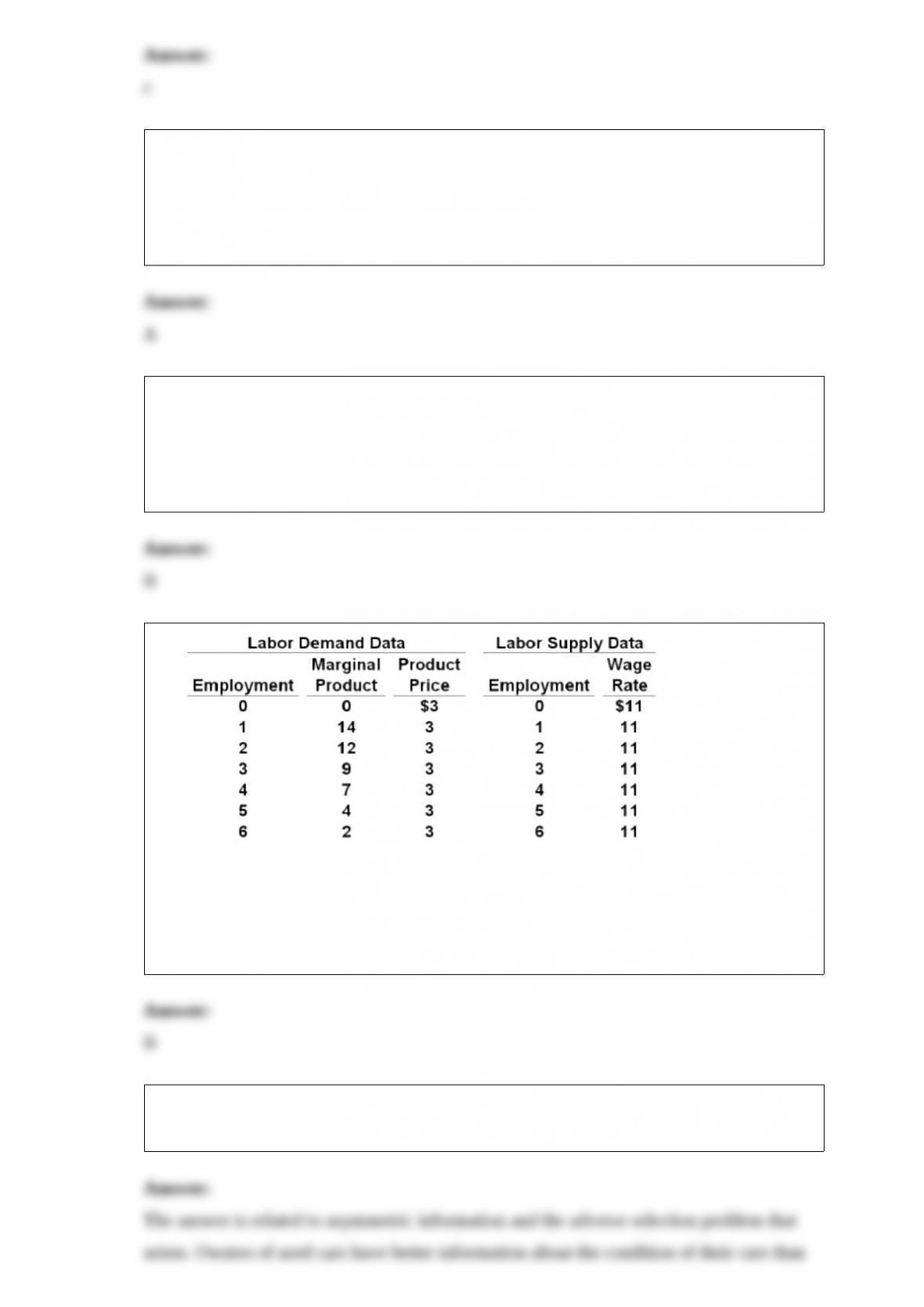
Refer to the above data. The firm is hiring labor:
A.at a wage rate that exceeds labor’s MRP.
B.under purely competitive conditions.
C.in an imperfectly competitive market.
D.as a monopsonist.
26) Why does a new car lose substantial market value when it is purchased, but a new
car left on the car dealer lot still retains its market value?

27) After looking at this years Census figures on income, your friend Eddie remarks
disgustedly, Income inequality is such a major problem in this country. How might you
use the consideration of time to temper his statement?
28) Lower prices are always good for business. Evaluate this statement.
29) What have been the principal effects of the persistent trade deficits of the 1990s?

30) In 2007 the public debt was $9.0 trillion. Put this number in perspective by relating
the debt to GDP, to other countries debt, to the amount of interest payments on the debt,
and to ownership of the debt.
31) What is the Laffer Curve? Explain the relationship that is shown in the curve.
32) Why are modern coins not made of precious metals?

33) Someone says to you: Inflation benefits the rich and hurts the poor and asks for
your assessment as an economist. What would be your response?
34) Explain the reasoning behind the shape of the short-run aggregate supply curve.
35) How are flexible exchange rates used to eliminate a balance-of-payments deficit or
surplus?