1)
All of the following are transfer payments except
a.welfare payments.
b.unemployment compensation.
c.personal income taxes.
d.Social Security.
2) An increase in the overall level of prices in an economy is referred to as
a.the income effect.
b.inflation.
c.deflation.
d.the substitution effect.
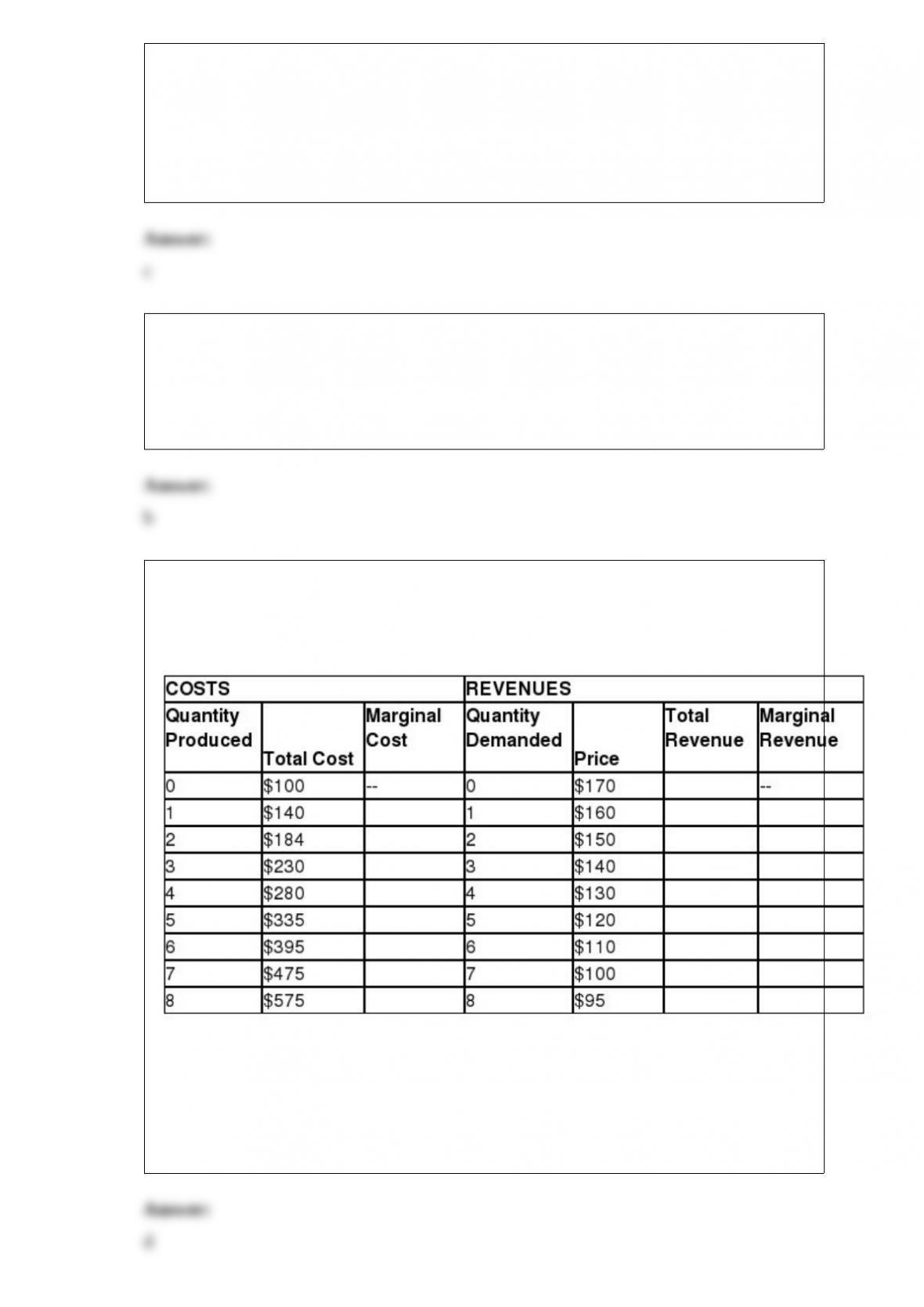
3) Table 15-21
Tommy’s Tie Company, a monopolist, has the following cost and revenue information.
Assume that Tommy’s is able to engage in perfect price discrimination.
If the monopolist can engage in perfect price discrimination, what is the marginal
revenue from selling the 5th tie?
a.$80
b.$100
c.$110
d.$120

4) The largest category of federal spending is national defense.
a.True
b.False
5) Christy and Claudia are aspiring models. Talent scouts consider them to be similarly
beautiful. Both enter a talent show. Claudia contracts food poisoning the night before
the competition and withdraws. Christy wins the competition and signs a multi-million
dollar contract. The differences in their earnings likely reflect
a.discrimination.
b.differences in human capital.
c.differences in signaling.
d.chance.
6) When calculating a firm’s profit, an economist will subtract only
a.explicit costs from total revenue because these are the only costs that can be measured
explicitly.
b.implicit costs from total revenue because these include both the costs that can be
directly measured as well as the costs that can be indirectly measured.
c.the opportunity costs from total revenue because these include both the implicit and
explicit costs of the firm.
d.the marginal cost because the cost of the next unit is the only relevant cost.
7) Moving production from a high-cost producer to a low-cost producer will
a.lower total surplus.
b.raise total surplus.
c.lower producer surplus.
d.raise producer surplus but lower consumer surplus.
8) The three largest categories of spending by the Federal government in order from
first to third would be
a.income security, net interest, and national defense
b.national defense, net interest, and income security
c.income security, health, and national defense
d.health, income security, and national defense
9) A corrective tax places a price on the right to pollute.
a.True
b.False
10) In the circular-flow diagram, factors of production are the goods and services
produced by firms.
a.True
b.False
11) Which of the following variables related to a worker’s wage are the most difficult to
measure?
a.ability, effort, and chance
b.job characteristics, gender, and race
c.gender, race, and geographic location
d.years of schooling, age, and years of experience
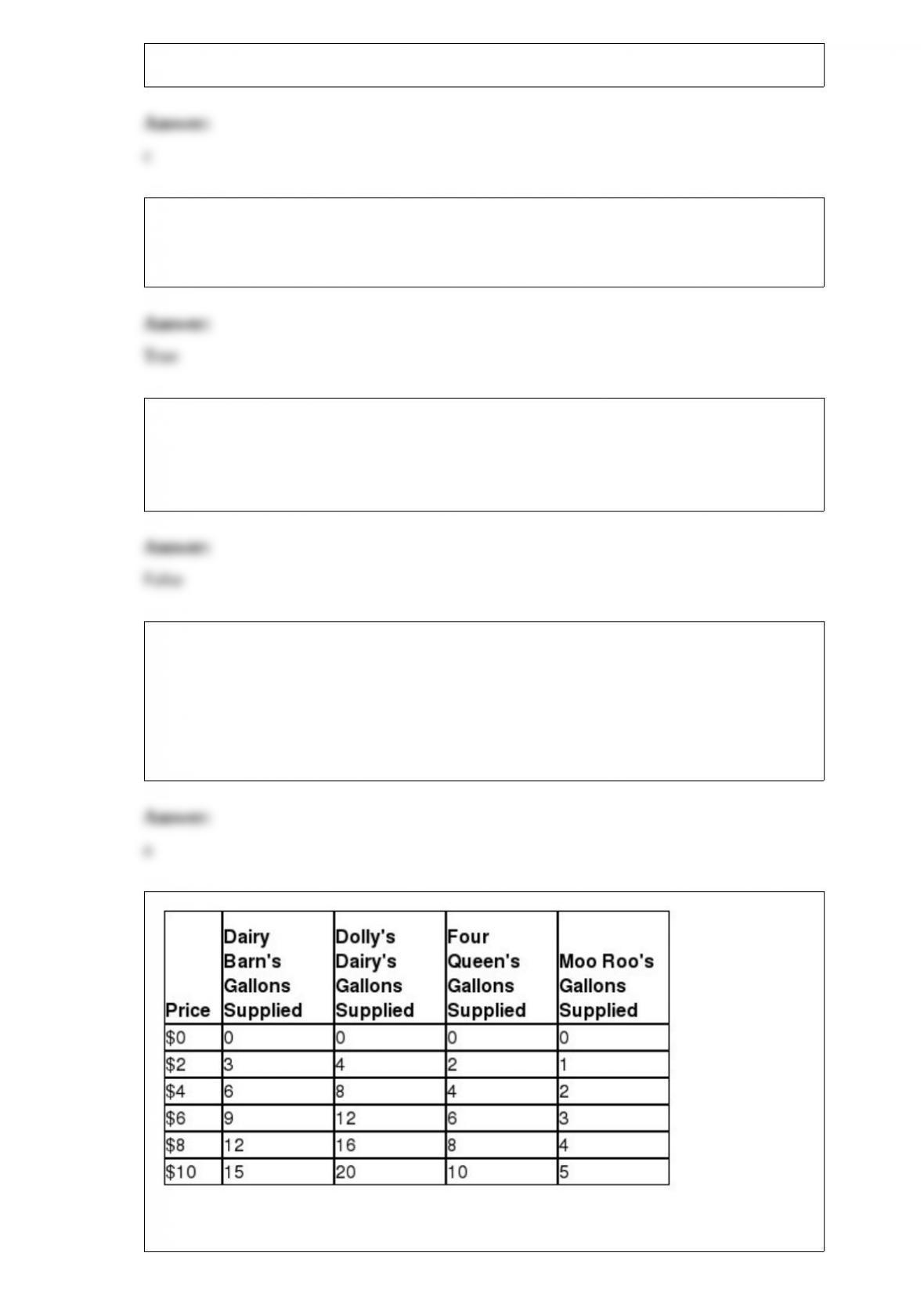
12) If these are the only four sellers in the market for ice cream, then when the price
increases from $4 to $6, the market quantity supplied

a.decreases by 10 gallons.
b.decreases by 20 gallons.
c.increases by 10 gallons.
d.increases by 20 gallons.
13) A firm operating in a perfectly competitive industry will continue to operate in the
short run but earn losses if the market price is less than that firm‘s average variable cost
but greater than the firm‘s average fixed cost.
a.True
b.False
14) Perfect price discrimination
a.eliminates deadweight loss.
b.reduces profits to the monopolist.
c.decreases the total quantity sold by the monopolist.
d.requires arbitrage in order for the monopolist to maximize profits.
15) Some time ago, the nation of Republica opened up its paper market to international
trade. Which of the following results of this policy change is consistent with the notion
that Republica has a comparative advantage over other countries in producing paper?
a.The price of paper in Republica decreased as a result of the policy change.
b.Republica began exporting paper as a result of the policy change.
c.The domestic demand curve for paper shifted to the right as a result of the policy
change.
d.The domestic quantity of paper demanded increased as a result of the policy change.
16) Despite the appealing logic of the Coase theorem, private actors often fail to resolve
on their own the problems caused by externalities.
a.True
b.False
17) In the case of perfectly inelastic demand,
a.the change in quantity demanded equals the change in price.
b.the percentage change in quantity demanded equals the percentage change in price.
c.infinitely-large changes in quantity demanded result from very small changes in the
price.
d.quantity demanded stays the same whenever price changes.
18) Entry of new firms in monopolistically competitive industries can convey a
negative externality on producers because firms lose customers and profits from the
entry of new competitors. This externality is called the
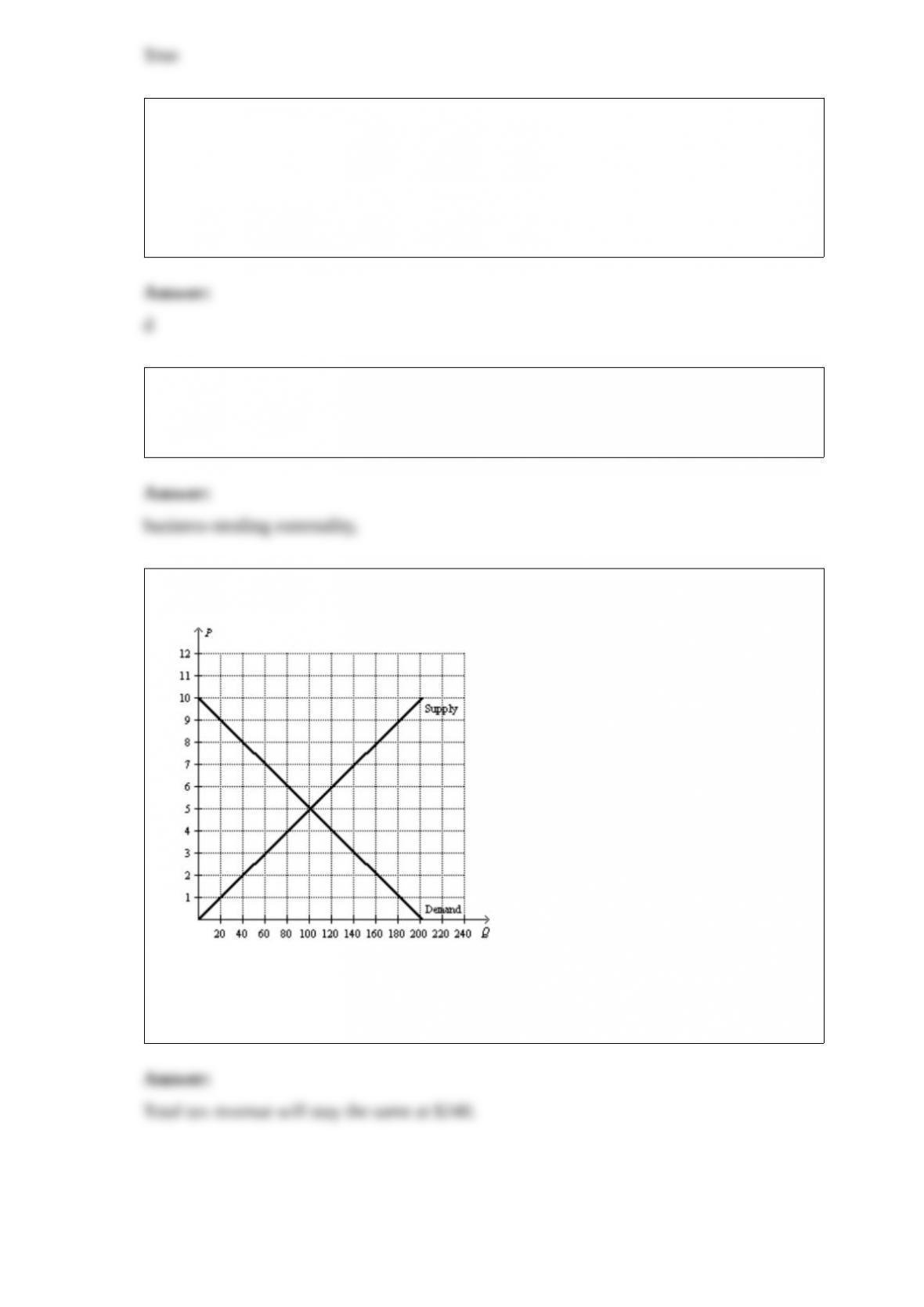
19) Figure 8-25
Suppose the government increases the size of the tax on this good from $4 per unit to
$6 per unit. Will the tax revenue collected from the tax increase, decrease, or stay the
same?
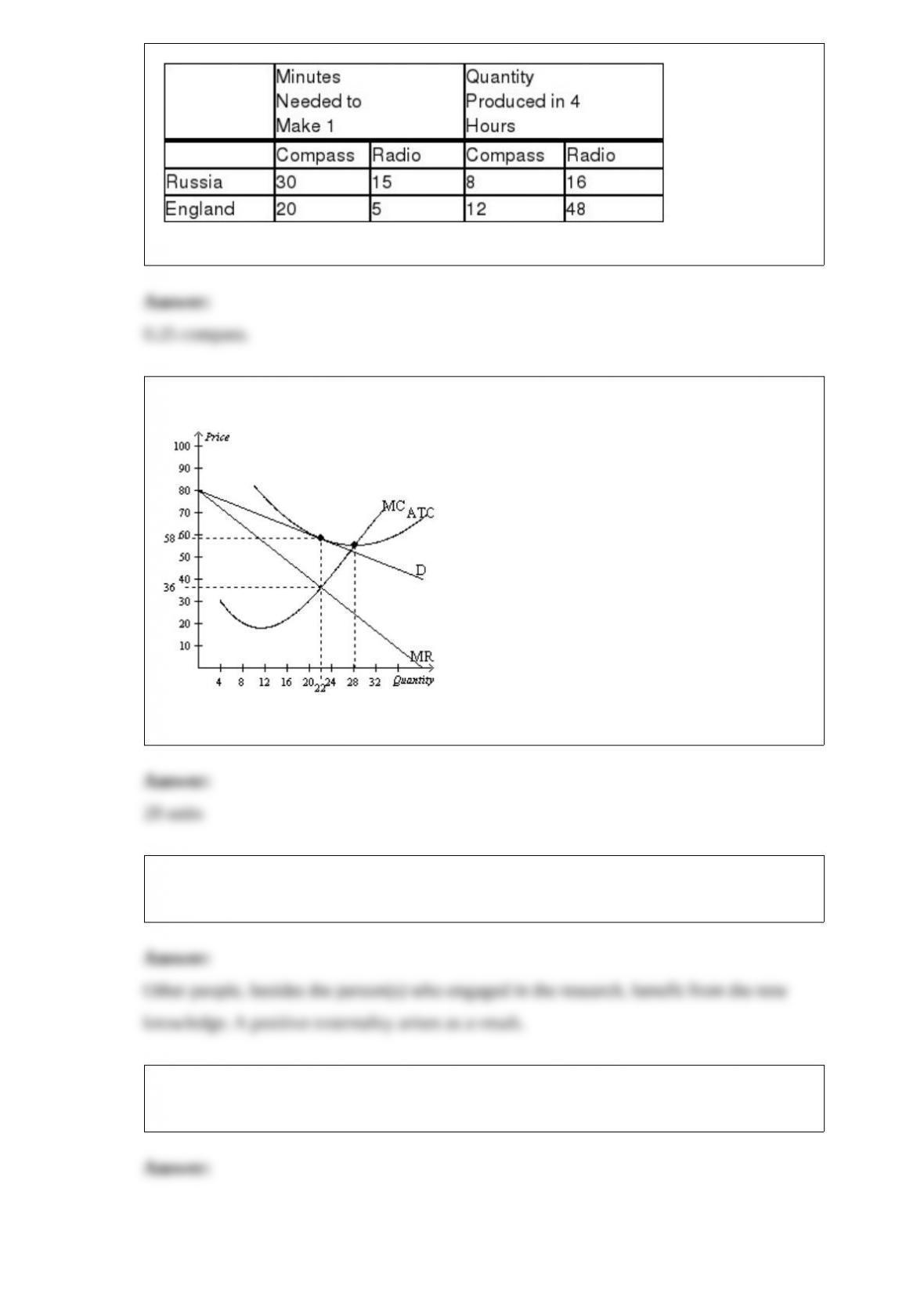
20) What is England’s opportunity cost of one radio?
21) Figure 16-12
If this firm minimized cost, how much output will it produce?
22) Identify the externality that arises when basic research leads to new general
knowledge. Is the externality positive or negative?
23) Assume that Huang and Min can switch between producing parasols and producing
porcelain plates at a constant rate.
24) Scenario 10-2
The demand curve for restored historic buildings slopes downward and the supply
curve for restored historic buildings slopes upward. The production of the 50th restored
historic building entails the following:
♦ private cost of $800,000;
♦ private value of $650,000;
♦ social value of $800,000.
Is the socially optimal quantity of restored historic buildings less than, equal to, or
greater than 50?
25) The government often intervenes when private markets fail to provide an optimal
level of certain goods and services.
For example, the government imposes an excise tax on gasoline to account for the
negative externality that drivers impose on one another. Why might the private market
not reach the socially optimal level of traffic without the help of government?