
The marginal propensity to consume is the
a. fraction of an extra dollar of GDP that becomes disposable income.
b. share of GDP spent by households and businesses.
c. proportion of an extra dollar of disposable income that is spent on consumption.
d. reciprocal of the average propensity to consume.
e. fraction of disposable income that is consumed.
In their study on the resurgence of growth in the late 1990s, Oliner and Sichel identified
the following three sources of growth that were more than twice as important in the late
1990s as in the 1970s:
a. money supply, labor hours, and output.
b. information technology capital, labor quality, and greater efficiency.
c. population growth, research and development, and other capital.
d. foreign imports, the federal budget deficit, and technological change.
e. new products, tax-rate reductions, and labor hours.
Prior to the Great Depression, estimates of the level of economic well-being in the

United States were based on
a. measures of GDP, the same as it is now.
b. the measured economic welfare scale of Nordhaus and Tobin.
c. government statistics based on census and average net income.
d. consumers’ personal sense of well-being.
e. deflating after-tax incomes received by households.
The price system determines the level and composition of output because it relies on
firms’ acting in accord with
a. altruistic concerns.
b. government mandates.
c. the profit motive.
d. the market supply curve.
e. the predictions of economists.
Under the gold standard, when a country increases the price of gold, it is said to have
________ its currency.

a. appreciated
b. devalued
c. accredited
d. releveraged
e. prefabricated
Which of the following does not result in a change in demand but leads to a change in
the quantity demanded?
a. an increase in population
b. a change in taxes
c. an increase or decrease in the price of a substitute or complement
d. a change in income
e. a shift in the supply curve
When foreign trade is permitted, the eventual price of a given item will reflect the level
where

a. maximum resources are utilized.
b. worldwide demand cannot go higher.
c. the exporting country’s demand curve is the same as its supply curve.
d. the amount one country wants to export equals the amount the other wants to import.
e. the importing country’s demand equals that of the exporting country.
Inflation occurs whenever
a. aggregate demand rises.
b. the price of any given commodity rises.
c. the money supply increases more rapidly than output.
d. the tax rate is lower than the government spending rate.
e. the money supply falls.
For a perfectly competitive firm, at any output rate
a. total cost equals total revenue.
b. price and total revenue are the same.

c. marginal cost and price are the same.
d. total cost equals supply.
e. price and marginal revenue are the same.
The components of gross private domestic investment include
a. net exports.
b. consumer durable goods.
c. the net change in total inventories.
d. government purchases of goods and services.
e. corporate income taxes.
Many economists today agree that many of the recessions of the twentieth century can
be traced to
a. significant reductions in the rate of growth of the money supply.
b. consumers’ efforts to save more money than their incomes would allow.
c. faulty investments by both firms and consumers.
d. falling interest rates.
e. increases in aggregate demand and supply.
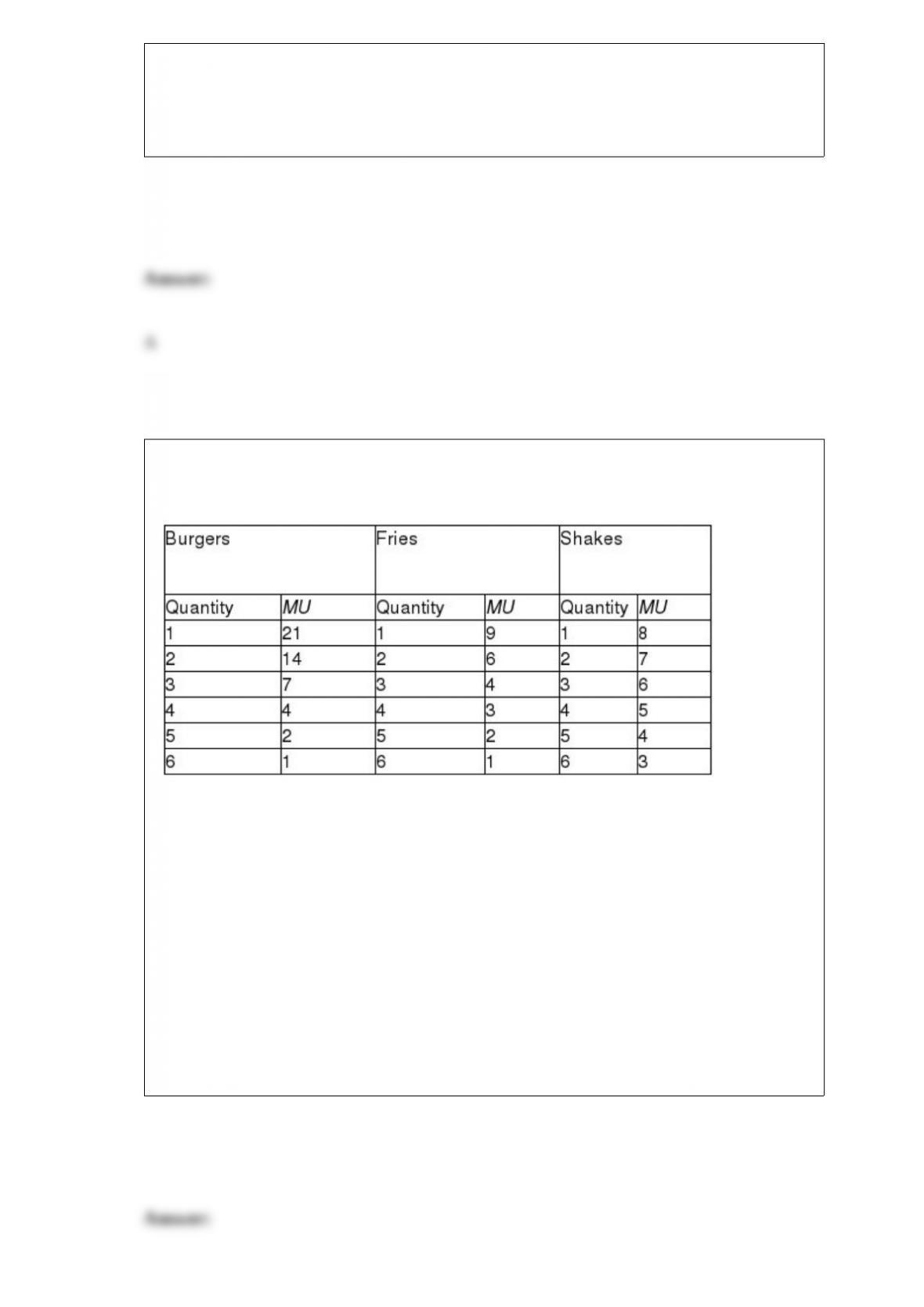
The next question is based on the typical teenager’s lunch preferences as depicted in the
table.
If burgers cost $1.75, fries cost $0.75, and shakes cost $1, a utility-maximizing teenager
with $6 to spend on lunch will buy
a. 0 burgers, 0 fries, and 6 shakes.
b. 0 burgers, 4 fries, and 3 shakes.
c. 1 burger, 3 fries, and 2 shakes.
d. 2 burgers, 2 fries, and 1 shake.
e. 3 burgers, 1 fries, and 0 shakes.

In the short run, increases in product prices increase firms’ ________ per unit.
a. production costs
b. employment
c. sales
d. capacity
e. profit
Oligopolists prefer to compete through advertising and product differentiation because
a. the greater the degree of product differentiation in the mind of the consumer, the
greater the degree of interdependence among rivals.
b. price wars are illegal according to existing antitrust statutes.
c. advertising and product development enable them to realize greater profits without
increasing market share.
d. rivals may find it easier to respond to a price decrease than a style change or
advertising campaign.
e. it doesn”t pay to raise price when the demand curve is highly price inelastic.

Which of the following theories might the new Keynesians use to explain wage
rigidity?
a. permanent income hypothesis
b. labor theory of value
c. law of diminishing returns
d. implicit contract theory
e. quantity theory of money
The term marginal product of labor refers to the
a. change in the average product of labor as output increases.
b. decreasing value of labor’s total output.
c. additional output that could be produced at full employment.
d. subsistence output per worker.
e. additional output resulting from an extra unit of labor.
The following questions are based on the following demand schedule for a monopolist:

If the demand curve is horizontal, marginal revenue must be the same as
a. total revenue.
b. quantity.
c. average costs.
d. price.
e. sales.
After some point, increased real wage rates that make people richer cause the supply
curve of labor to
a. become horizontal.
b. shift to the right.
c. fluctuate unpredictably.
d. remain vertical.
e. bend backward.
The addition to total cost resulting from the addition of the last unit of output is the
________ cost.
a. total variable
b. average variable
c. fixed
d. implicit
e. marginal
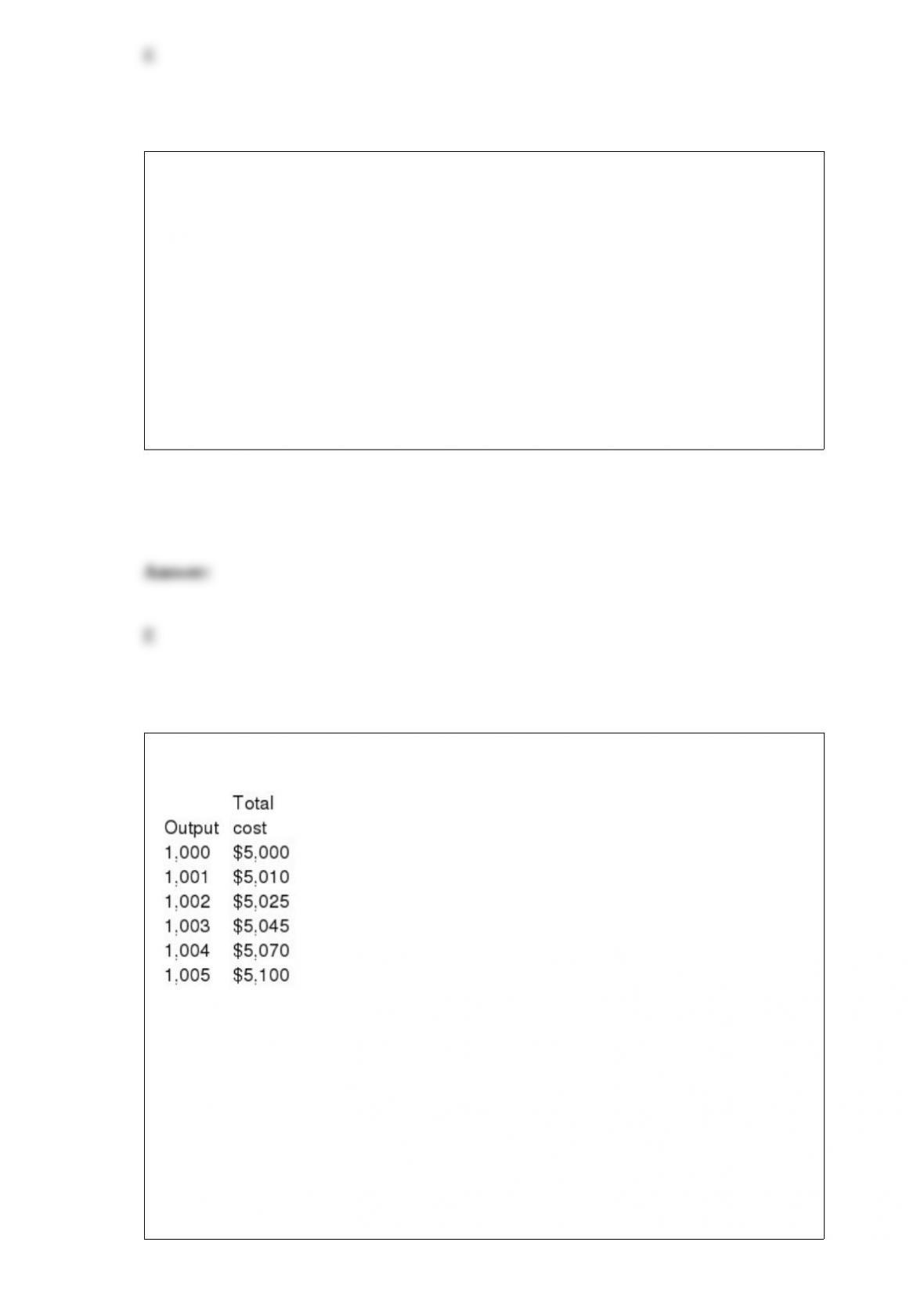
The next question is based on the following schedule:
From the schedule, it is possible to calculate
a. marginal cost.
b. average variable cost.
c. average fixed cost.
d. total variable cost.

e. profit.
The nonaccelerating inflation rate of unemployment (NAIRU) is
a. a measure of those temporarily unemployed because of a recession.
b. calculated by dividing the unemployment rate by the employment rate.
c. considered by most economists to be no greater than 1″2 percent of the labor force.
d. based on the assumption that many people will not work unless they are forced to.
e. the unemployment rate associated with a constant rate of inflation.
The velocity of circulation is equal to
a. the reciprocal of the marginal propensity to consume.
b. nominal GDP divided by the money supply.
c. real GDP times the price level.
d. the money supply divided by the price level.
e. nominal GDP divided by real GDP.

If intended spending exceeds the total value of final goods and services produced
a. GDP falls.
b. firms cut back on their production rates.
c. inventories will be depleted faster than firms desire.
d. the aggregate supply curve must be vertical.
e. depreciation exceeds investment.
From society’s viewpoint one benefit of a monopolistically competitive market is the
likelihood of
a. prices that are lower than in perfectly competitive markets.
b. less advertising and product promotion outlays.
c. significant economies of scale.
d. no economic waste or inefficiencies.
e. greater product diversity.

Unemployment can result in substantial economic costs since
a. unemployed people lose their self-esteem.
b. society’s potential output becomes more expensive to distribute.
c. employed people have to work harder to compensate for those who are not working.
d. actual output is below potential output.
e. idle machinery must have its life span lengthened.
In general, the social value of an extra unit of a good can be measured by its
a. availability.
b. labor content.
c. durability.
d. total cost.
e. price.

The process by which the use of an innovation spreads from firm to firm and use to use
is called the ________ process.
a. industrial
b. economic
c. diffusion
d. management
e. utilization
Which of the conditions listed best summarizes the following market data?
Price Quantity demanded Quantity supplied
$2.99 8,400 9,200
a. market equilibrium
b. actual price below equilibrium price
c. excess supply
d. shortage
e. demand exceeds supply

Under tight monetary policy, large amounts of government borrowing will
a. shift the demand curve for loanable funds to the left.
b. produce balance of payments surpluses.
c. contribute to further increases in interest rates.
d. lead to an increase in government bond prices.
e. be incapable of being financed.
The basic distinction between a rigid policy rule and a feedback policy rule is that a
rigid policy rule
a. specifies completely the behavior of the variable influenced by the rule; a feedback
rule allows that variable to change.
b. requires congressional action; a feedback rule is governed by the Fed.
c. targets the money supply; a feedback rule is used when controlling interest rates.
d. is advocated by the new Keynesians; traditional Keynesians favor a feedback policy
rule.
e. is used when targeting the full-employment level of real GDP; a feedback rule is used
when targeting the full-employment level of nominal GDP.

It is not just the interest rate that influences the investment function but also the
a. level of net exports.
b. distribution of income.
c. slope of the 45-degree line.
d. availability of credit.
e. phases of the moon.
Goods and services produced in the United States and sold to other countries are called
a. extracts.
b. implants.
c. exurbs.
d. imports.
e. exports.