
As long as the demand curve lies above the marginal revenue curve for a monopolist, it
will charge a price for its product that is
a. above total cost.
b. below marginal cost.
c. above marginal cost.
d. above average total cost.
e. c and d
The marginal physical product (MPP) of a variable input is
a. total output divided by the quantity of the input used.
b. the change in total output that results from changing the variable input by one unit.
c. the change in total revenue that results from changing the variable input by one unit.
d. the change in total output that results from changing the fixed input by one unit.
e. the change in total costs that results from a change in output.
Something that motivates or encourages people to take an action is referred to as a(n)
a. utility.
b. abstract.

c. market.
d. incentive.
An increase in the number of sellers of a good will, ceteris paribus,
__________________for that good.
a. increase equilibrium price and quantity
b. increase equilibrium price and decrease equilibrium quantity
c. decrease equilibrium price and increase equilibrium quantity
d. decrease equilibrium price and quantity
e. increase demand
In the case of a nonexcludable public good, the market will fail to produce the good
because of the free rider problem.
a. True
b. False
Real-world markets that approximate the four assumptions of the theory of perfect
competition include
a. some agricultural markets.
b. the soft drink market.
c. the stock market.
d. a and c
e. a, b, and c
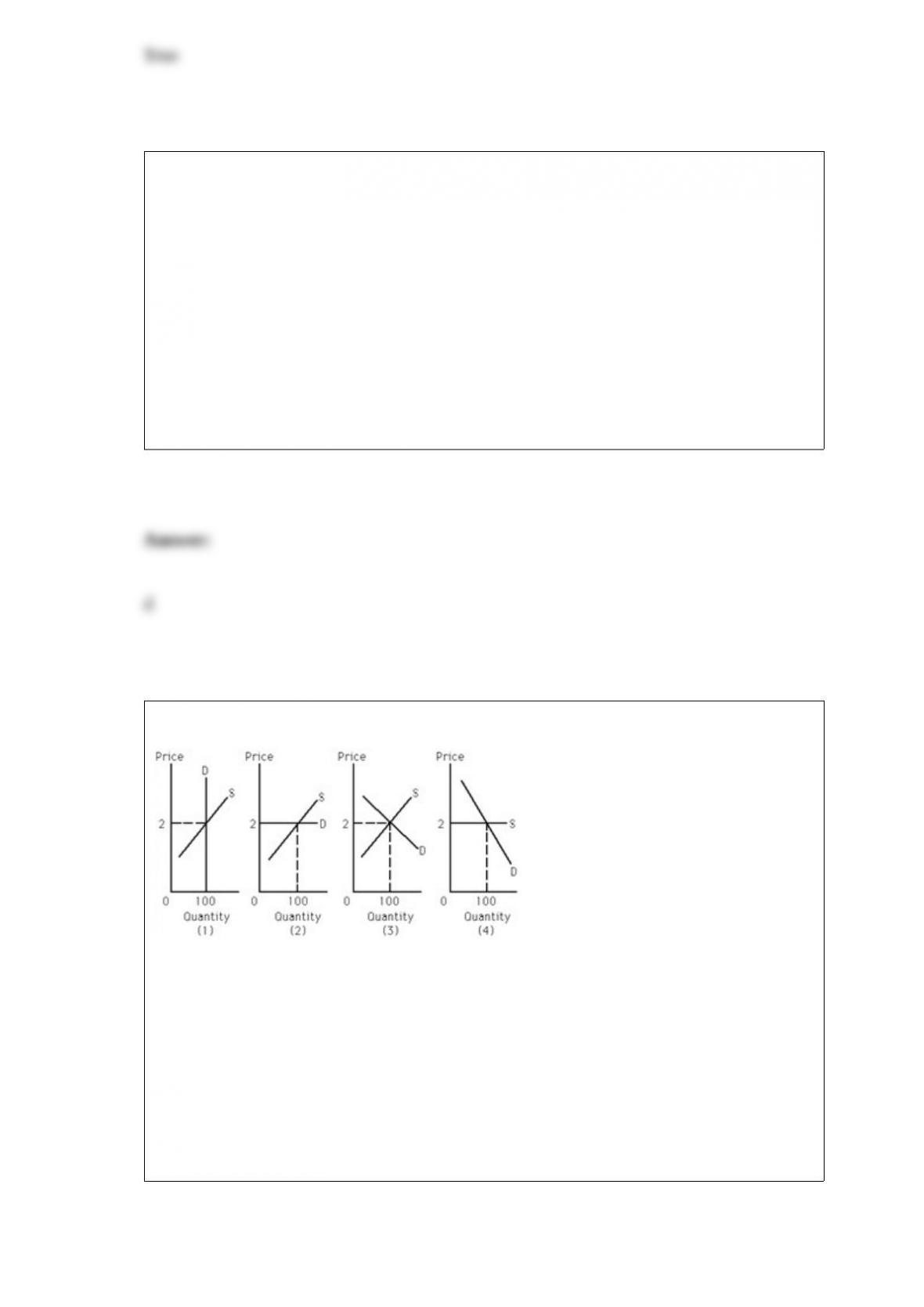
Exhibit 20-7
Which of the graphs shows a perfectly inelastic demand curve?
a. (1)
b. (2)
c. (3) and (4)
d. none of the above

Economists often evaluate a theory in terms of how consistently and accurately it
predicts what happens.Implicit in this position is the belief that
a. if the theory’s predictions are consistently accurate, then there is a fairly good chance
that the theory is a good explanation of how things work.
b. if the theory’s predictions are consistently accurate, then there is a fairly good chance
that the theory will be accepted by others.
c. if the theory’s predictions are consistently accurate, then there is a fairly good chance
thatthe theory’s assumptions (even if they initially seem unrealistic) capture something
that is essential to explaining what it is that the theory is trying to explain.
d. all of the above
When economists speak of scarcity, they are referring to the
a. condition in which society is not employing all its resources in an efficient way.
b. condition in which people’s wants outstrip the limited resources available to satisfy
those wants.
c. economic condition that exists in only very poor countries of the world.
d. condition in which society produces too many frivolous goods and not enough
socially desirable goods.

Suppose Alice receives 200 utils from consuming one hamburger and 80 utils from
consuming a second hamburger. What is the marginal utility of the second hamburger?
a. 280 utils
b. 120 utils
c. 80 utils
d. 0 utils
e. none of the above
If the workers of a firm successfully negotiate an increase in wages, which of the
following is most likely to happen?
a. The demand curve for the product the firm produces shifts rightward.
b. The demand curve for the product the firm produces shifts leftward.
c. The supply curve of the product the firm produces shifts rightward.
d. The supply curve of the product the firm produces shifts leftward.
If the nominal interest rate is 4.2 percent and expected inflation rate is 3 percent, the
real interest rate equals

a. 7.2 percent.
b. 1.2 percent.
c. 3.6 percent.
d. 12.6 percent.
e. none of the above
Another term for excess supply is shortage.
a. True
b. False
Labor unions try to meet their objectives by influencing the elasticity of demand for
labor and the demand for labor. To influence these factors, they try to do all of the
following except
a. reduce the availability of substitutes for the product they produce.
b. reduce the availability of substitute factors.
c. increase demand for the product they produce.
d. increase substitute factor prices.

e. reduce the nonmoney benefits of substitute factors.
The excess capacity theorem states that in equilibrium a monopolistic competitor will
produce an output level larger than the one that would minimize its unit costs.
a. True
b. False
If the cross elasticity of demand for good A with respect to good B is +2.7, then good A
is
a. an inferior good.
b. a normal good.
c. a substitute for good B.
d. a complement to good B.

A cartel is an organization of firms
a. dominated by one firm, which is usually referred to as the price leader.
b. that attempts to increase total (or industry) demand for their product.
c. that reduces output and increases price in an effort to increase joint profits.
d. that deliberately attempts to disrupt the market for political reasons.
A perfectly competitive market is initially in long-run competitive equilibrium. Then,
market demand falls. By the time all adjustments have been made, price will be
__________ its original level if the industry is a(n) __________ costs industry.
a. above; decreasing
b. at; constant
c. at; increasing
d. below; increasing
e. a and d