
When a monopolistically competitive firm breaks even in the long run, this is
equivalent to earning a zero accounting profit.
Answer:
The private cost of a good or service is the cost borne by the producer.
Answer:
Accounting profit is the Difference between a firm’s revenue and its opportunity costs.
Answer:
The additional cost to a producer of hiring an additional unit of labor is called the
marginal cost.
Answer:

The Fed can directly lower the inflation rate.
Answer:
Ceteris paribus, in the short run following a decrease in the rate of growth in Aggregate
Demand, we would expect to see an increase in the rate of unemployment and a
decrease in the rate of inflation.
Answer:
The income effect of a price change refers to the change in the quantity demanded of a
good that results from a change in purchasing power as a result of the price change.
Answer:
Changes in interest rates affect all four components of aggregate demand.
Answer:
The key to sustained economic growth is increasing labor productivity.
Answer:
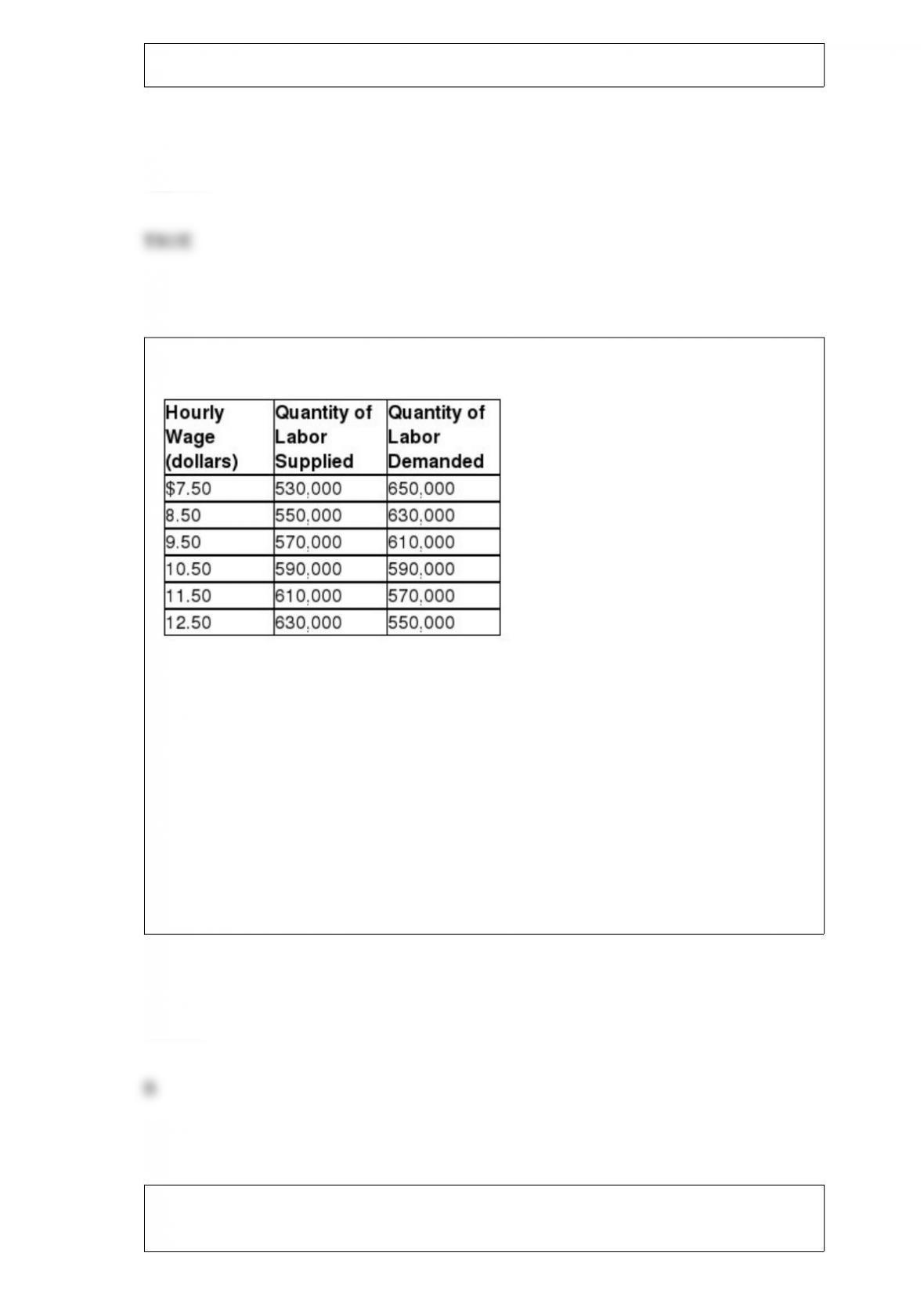
Table 4-7
Table 4-7 shows the demand and supply schedules for labor market in the city of Pixley.
If a minimum wage of $11.50 an hour is mandated, what is the quantity of labor
demanded?
A) 40,000
B) 570,000
C) 610,000
D) 1,180,000
Answer:
The relationship between the inputs employed by a firm and the maximum output that it
can produce with those inputs is the firm’s

A) production function.
B) supply curve, or supply schedule.
C) marginal product of labor.
D) average product of labor.
Answer:
What is one difference between stocks and bonds?
A) Bonds earn a higher rate of return than stocks.
B) Stocks earn a higher rate of return than bonds.
C) Bonds are purchased at a bank, while stocks are purchased through the federal
government.
D) Stocks represent partial ownership in a firm, while bonds do not.
Answer:
The international trade effect states that a(n) ________ in the price level will ________
net exports.
A) increase; increase
B) increase; decrease
C) decrease; decrease
D) decrease; not affect

Answer:
A corporation’s board of directors
A) hire the managers of the corporation.
B) control the day-to-day activities of the corporation.
C) are personally liable for the debts of the corporation.
D) are the sole owners of the corporation.
Answer:
Cutting taxes
A) will lower disposable income and lower spending.
B) will raise disposable income and lower spending.
C) will lower disposable income and raise spending.
D) will raise disposable income and raise spending.
Answer:

In an open economy, the government purchases multiplier will be larger the
A) smaller the marginal propensity to import.
B) smaller the marginal income tax rate.
C) larger the marginal propensity to consume.
D) All of the above are correct.
Answer:
Which of the following explains why many European countries have unemployment
rates that are higher than in the United States?
A) Technological change occurs at a faster rate in Europe, so structural unemployment
is higher in Europe.
B) European countries offer higher unemployment benefits than the United States.
C) Firms in European countries offer employees higher wages and higher benefits than
do firms in the United States.
D) The minimum wage in Europe is lower than it is in the United States.
Answer:
Consider the market for nurses in a given city. In each of the following cases, explain
what happens to the equilibrium wage rate and the quantity of nurses hired.
a. One of the major hospitals in the city closes.
b. A record number of students graduate with bachelor’s degrees in nursing.

c. Traditionally, nursing is a field that attracts women. However, changes in access to
education and to the labor force participation rate by women have led to a greater
demand for the services of women in a wide range of occupations. The demand for
nurses, however, does not change.
d. Advances in medical technology reduce the amount of time physicians must spend
with patients in intensive care and increase the time that nurses spend with patients.
Answer:
As a business type, corporations ________ in the United States.
A) earn the majority of revenues
B) are the most common
C) are the least common
D) are subject to the fewest taxes
Answer:
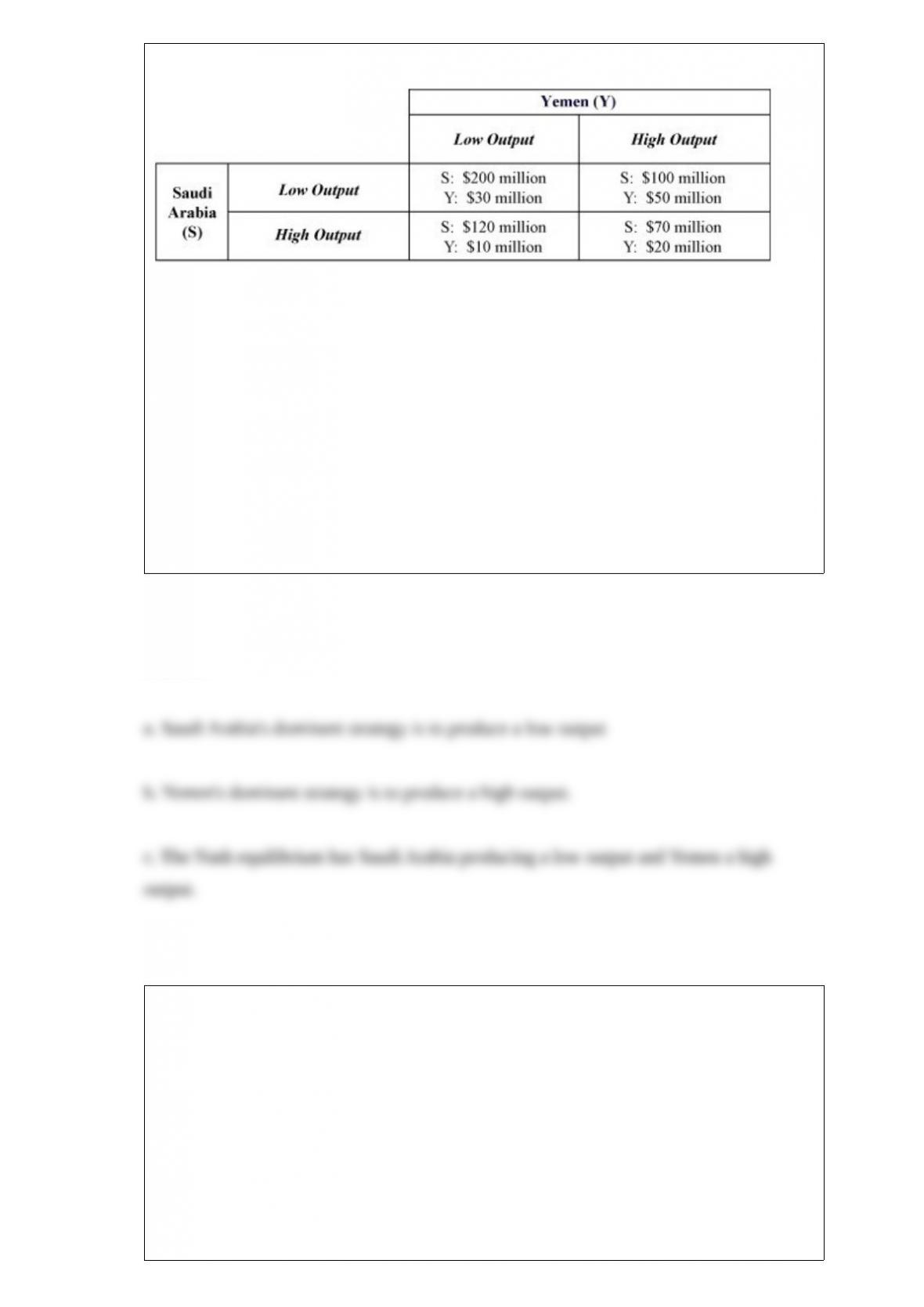
Table 14-9
Saudi Arabia and Yemen must decide how much oil to produce. Since the demand for
oil is inelastic, relatively low production rates drive up prices and profits. Saudi Arabia,
the world’s largest and lowest cost producer, is able to influence market price; it has an
incentive to keep output low. Yemen, on the other hand, is a relatively high cost
producer with much smaller reserves. Use the payoff matrix in Table 14-9 to answer the
following questions.
a. What is the dominant strategy for Saudi Arabia?
b. What is the dominant strategy for Yemen?
c. What is the Nash equilibrium?
Answer:
Holding all other personal characteristics-such as age, gender, and income-constant,
economists would expect that
A) people with health insurance will be less likely to be overweight than people without
health insurance.
B) people with health insurance will be more likely to be overweight than people
without health insurance.
C) people with health insurance will be equally likely to be overweight as people
without health insurance.

D) there is no correlation between having health insurance and being overweight.
Answer:
Competition forces firms to produce and sell products as long as the ________ to
consumers exceeds the ________ of production.
A) marginal benefit; marginal cost
B) marginal benefit; marginal benefit
C) marginal cost; marginal cost
D) marginal cost; marginal benefit
Answer:
Contractionary monetary policy to prevent real GDP from rising above potential real
GDP would cause the inflation rate to be ________ and real GDP to be ________.
A) higher; higher
B) higher; lower
C) lower; higher
D) lower; lower
Answer:
Buyers will bear the entire burden of a unit tax if the demand curve for a product is
A) horizontal.
B) vertical.
C) downward sloping.
D) upward sloping.
Answer:
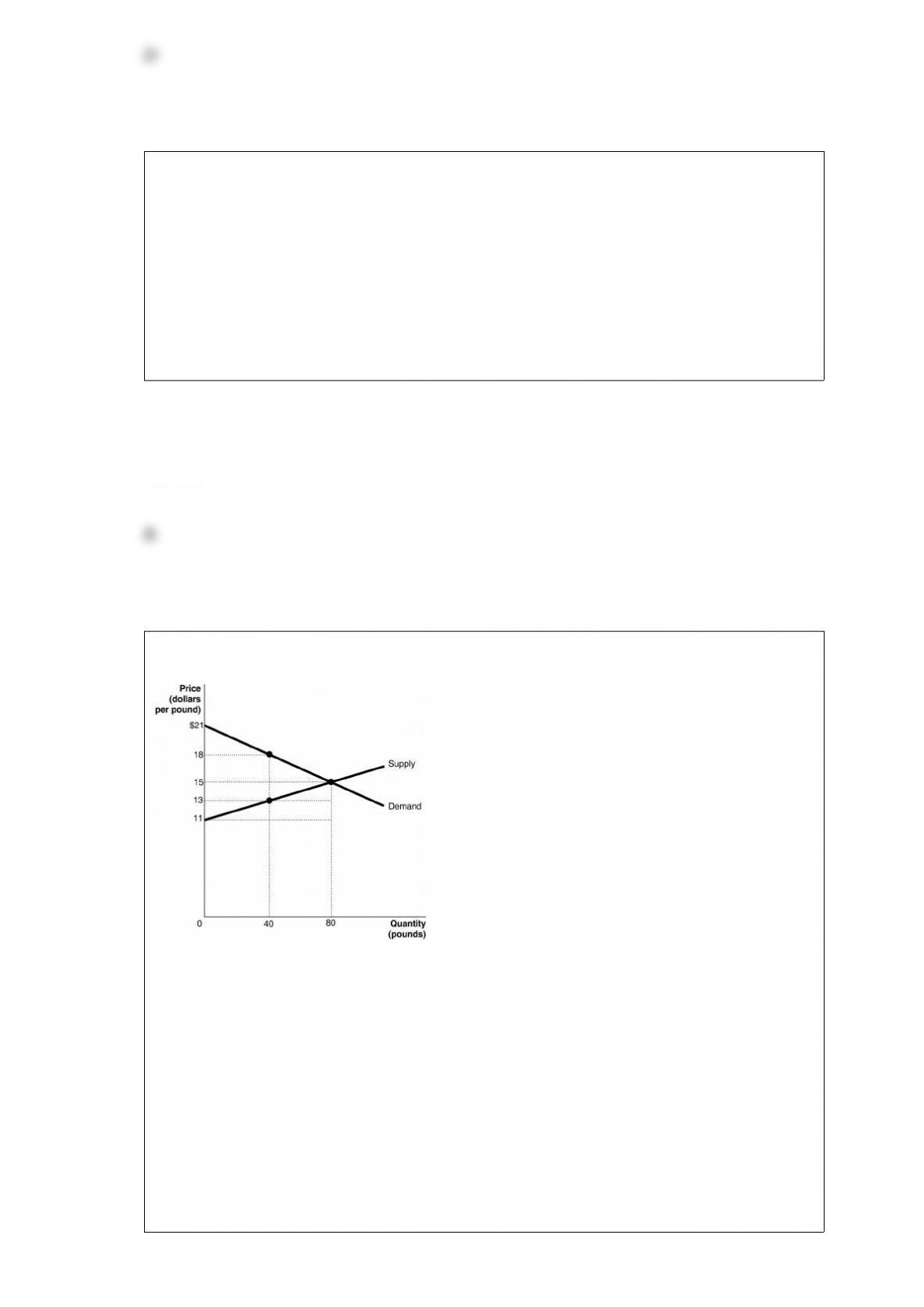
Figure 4-3
Figure 4-3 shows the market for tiger shrimp. The
market is initially in equilibrium at a price of $15 and a quantity of 80. Now suppose
producers decide to cut output to 40in order to raise the price to $18.
What is the value of producer surplus at a price of $18?
A) $240
B) $300
C) $340
D) $720
Answer:
Explain, in detail, how the adjustment to macroeconomic equilibrium occurs when
spending is less than production. Be sure to discuss how inventories play a crucial role
in the adjustment process. State what happens to GDP and employment during the
adjustment process.
Answer:
Is there a difference between the “true burden” of a tax and who is legally required to
pay a tax? Briefly explain.
Answer:

Book publishers often use price discrimination across time to increase profits. Toni
Morrison’s book, A Mercy, was published as a hardcover edition in November 2008 at a
price of $23.95. In August 2009, the paperback version was published at a price of
$15.00. Assume that 100,000 hardcover books were sold to hard-core Toni Morrison
fans in November 2008, and 400,000 paperback books were sold to casual readers in
August 2009. Illustrate each of these situations graphically. Assume that the marginal
cost of the hardcover version is $2.00 and the marginal cost of the paperback version is
$0.75.
Answer:
Draw a graph that shows producer surplus, consumer surplus, and deadweight loss in a
market where the seller practices perfect price discrimination. Be sure to identify the
demand curve, the marginal revenue curve, the marginal cost curve, and the profit
maximizing quantity on the graph.
Answer:
Suppose you are an advisor to the Business Cycle Dating Committee. You are asked to
look at macroeconomic data to evaluate whether the economy has entered a recession
this year. Which data do you look at? How does the economy behave at the onset of a
recession?
Answer:
What causes a production possibilities frontier to shift inward?
Answer:
Suppose 180,000 people are employed, 20,000 people are unemployed, the
working-age population is 250,000, and 50,000 people are out of the labor force.
Calculate the unemployment rate.
Answer: