
What are earnings per share equal to?
A) the last dividend payment made
B) total dividend payments plus retained earnings divided by outstanding stock shares
C) the amount by which the stock’s market price has increased in the last year
D) revenues divided by the number of stockholders
In 2008, the Treasury and Federal Reserve took several actions in response to the
deepening financial crisis. One action was the creation of the Term Securities Lending
Facility, under which the Fed will loan up to $200 billion of treasury securities in
exchange for
A) stock.
B) mortgage-backed securities.
C) corporate bonds.
D) required bank reserves.
Foreign investment can give a low-income country
A) access to funds for investment and access to technology.
B) the means to slow down growth.
C) a path to dependency and low growth.

D) no hope to break the vicious cycle of poverty.
If workers and firms expect that inflation will be 5 percent next year, and real wages are
not changing over time, by how much will nominal wages increase?
A) 5 percent
B) more than 5 percent
C) less than 5 percent
D) depends on actual inflation for next year
When the economy reaches a trough in a business cycle, which of the following will
occur?
A) Income, production, and employment will continue to fall.
B) Income, production, and employment will begin to rise.
C) Income and production will rise, but employment will continue to fall.
D) Employment rises, but income and production will continue to fall.

Which of the following describes the national security argument for protectionism?
A) Nearly all industries can make some claim to strategic importance so such trade
restrictions can get out of hand.
B) Increases in economic surplus outweigh the decreases in consumer surplus that
result from protectionism.
C) Some goods should be insulated from foreign competition to ensure an adequate
supply of these goods in the event of an international conflict.
D) Private companies (for example, Coca-Cola) should not be forced to reveal their
trade secrets to foreign companies.
GDP is not a perfect measure of well-being because
A) the value of leisure is included in GDP.
B) GDP is not adjusted for pollution.
C) GDP is adjusted for changes in crime rates.
D) GDP is adjusted for increases in drug addiction.
Figure 2-10
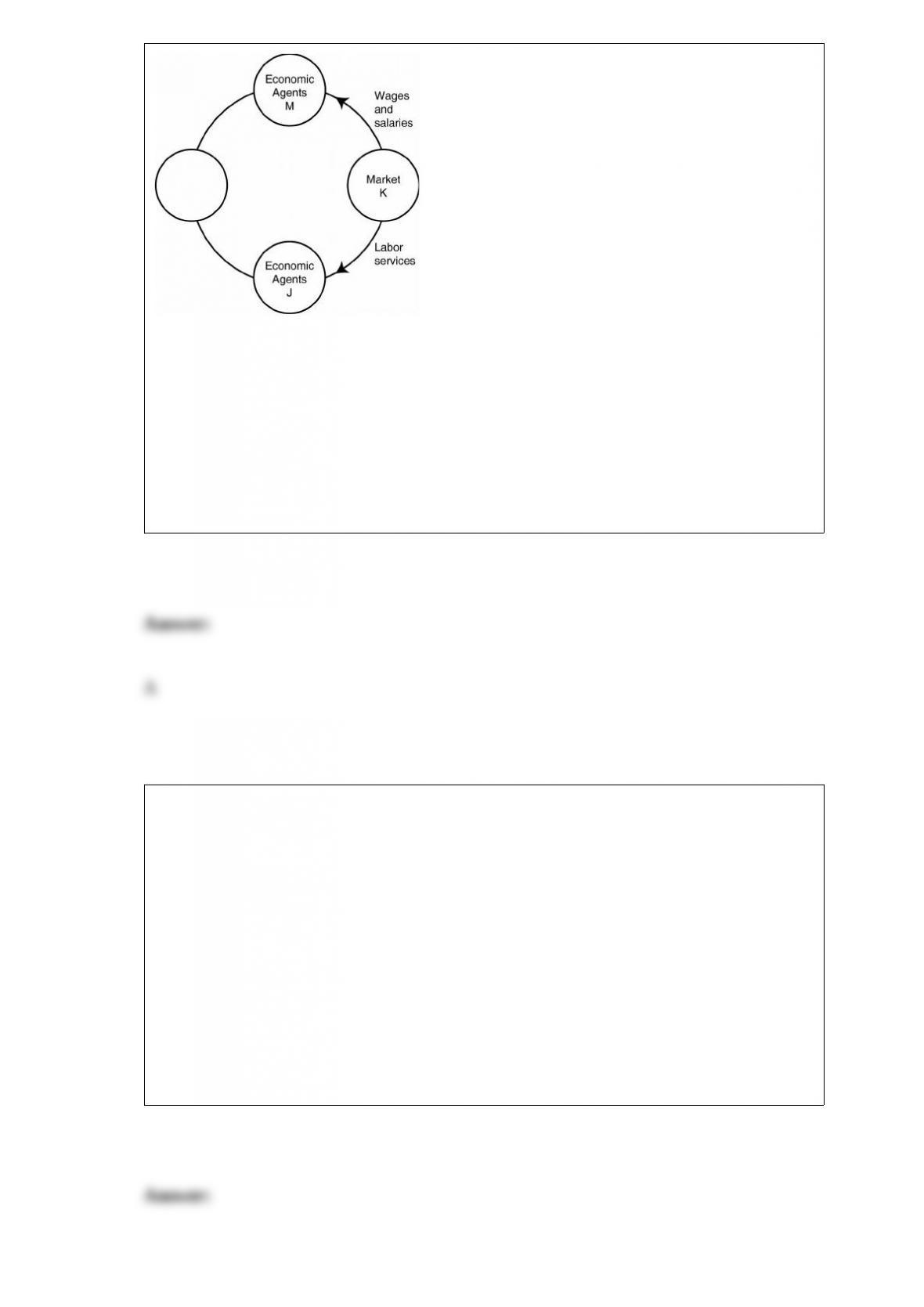
Refer to Figure 2-10. In the circular flow diagram, economic agents M represent
A) households.
B) product markets.
C) firms.
D) factor markets.
In early 2008, the housing crisis and rising oil prices increased the risk of recession in
the United States. What fiscal policy action was taken by Congress and the president to
counter these events?
A) The Federal Reserve cut its target for the federal funds rate.
B) There was an increase in government spending on defense and unemployment
compensation.
C) Taxpayers were given rebates on taxes they already paid.
D) Income taxes were raised to reduce the federal budget deficit and reduce interest
rates.

As the economy nears the end of an expansion, which of the following do we typically
see?
A) rising firm profits
B) rising levels of firm investment
C) rising interest rates
D) falling wages relative to output prices
In recent economic history, the U.S. federal budget was in surplus during
A) 2001 through 2005.
B) 1998 through 2001.
C) 1990 through 1997.
D) 1980 through 1989.
Suppose a bank has $100 million in checking account deposits with no excess reserves
and the required reserve ratio is 20 percent. If the Federal Reserve reduces the required
reserve ratio to 15 percent, then the bank will now have excess reserves of

A) $0.
B) $5 million.
C) $15 million.
D) $20 million.
The main tool that the Federal Reserve uses to conduct monetary policy is
A) open market operations.
B) discount policy.
C) setting reserve requirements.
D) acting as the lender of last resort.
E) check clearing.
Lower personal income taxes
A) increase aggregate demand.
B) decrease disposable income.
C) decrease aggregate demand.
D) increase transfer payments.

Recessions cause the unemployment rate to ________ and the inflation rate to
________.
A) rise; rise
B) rise; fall
C) fall; rise
D) fall; fall
Which of the following is not a reason why the Industrial Revolution occurred when
and where it did?
A) The British government was committed to upholding private property rights.
B) The British government was able to eliminate arbitrary increases in taxes.
C) The British government was able to more easily seize wealth.
D) Institutional changes by the British government helped protect wealth.

Which of the following can explain why some countries have not experienced relatively
high growth rates in real GDP per capita despite relatively low initial levels of real GDP
per capita?
A) Many of these developing countries do not have a functioning court system that can
enforce laws.
B) Countries that are relatively poor are more likely to experience wars and revolutions.
C) Countries that are relatively poor are likely to have a lower quality of health care.
D) all of the above
If the per-worker production function shifts down,
A) it now takes more capital per hour worked to get the same amount of real GDP per
hour worked.
B) an economy can increase its real GDP per hour worked without changing the level of
capital per hour worked.
C) the per-worker production function becomes steeper.
D) positive technological change has occurred in the economy.
Figure 11-4
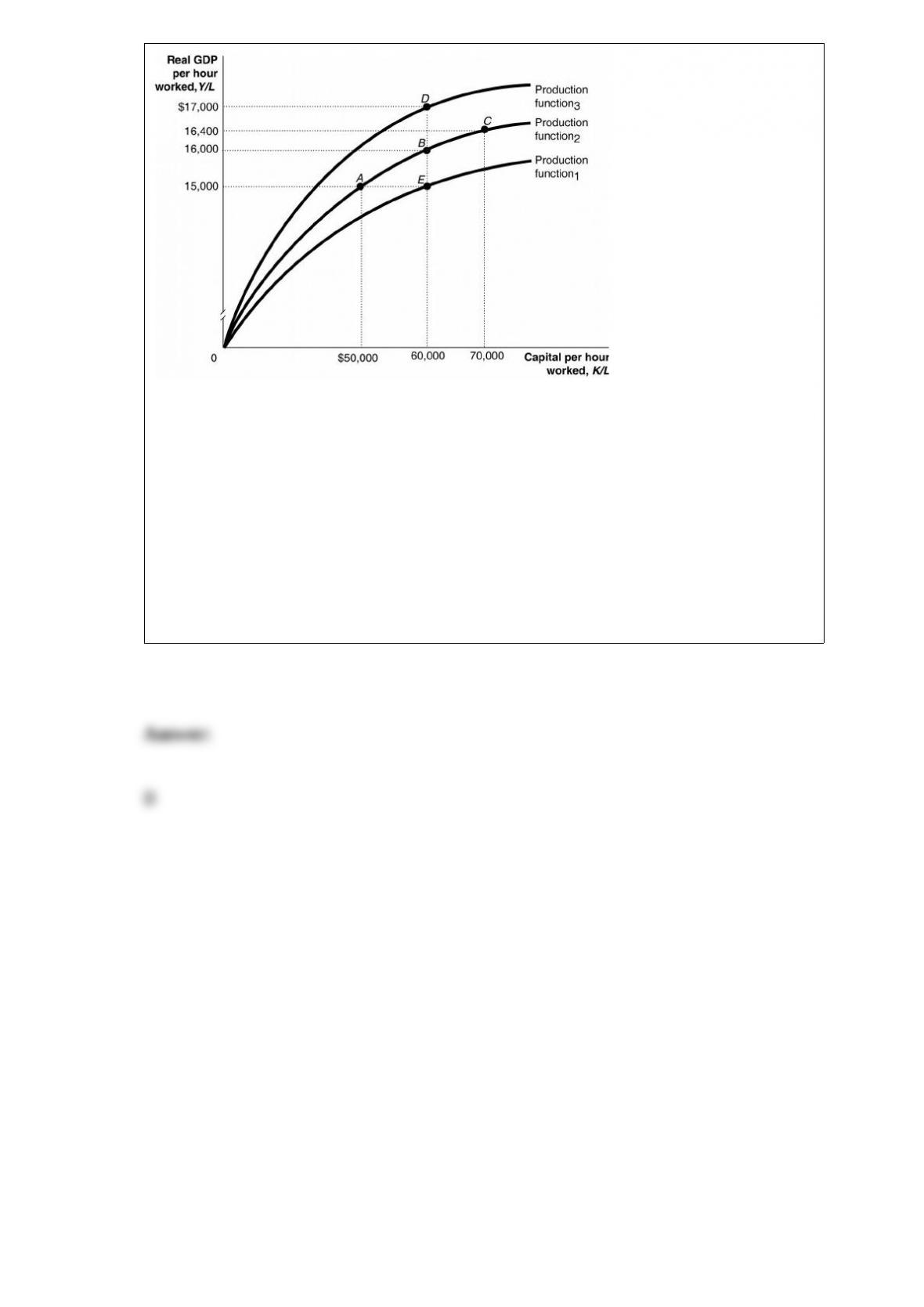
Refer to Figure 11-4. Many countries in Africa strongly discouraged and prohibited
foreign direct investment in the 1950s and 1960s. By doing so, these countries were
essentially preventing a moment from
A) B to A.
B) E to B.
C) A to E.
D) D to B.