
1) what percentage of the u.s. adult population has at least a high school education (as
of 2007)?
a.41 percent
b.75 percent
c.86 percent
d.95 percent
2) the primary motivation for economic immigration is:
a.the prospect of paying lower prices for goods and services.
b.to flee political oppression.
c.the opportunity to increase earnings.
d.to reunite with family members.
3) When economists refer to capital flight, they are speaking of an:
A.outflow of financial capital from a certain country.
B.outflow of real capital from a certain country.
C.outflow of financial and real capital from a certain country.
D.outflow of human capital from a certain country.
4) at the point where the demand and supply curves for a product intersect:
a.the selling price and the buying price need not be equal.
b.the market may, or may not, be in equilibrium.
c.either a shortage or a surplus of the product might exist, depending on the degree of
competition.
d.the quantity that consumers want to purchase and the amount producers choose to sell
are the same.
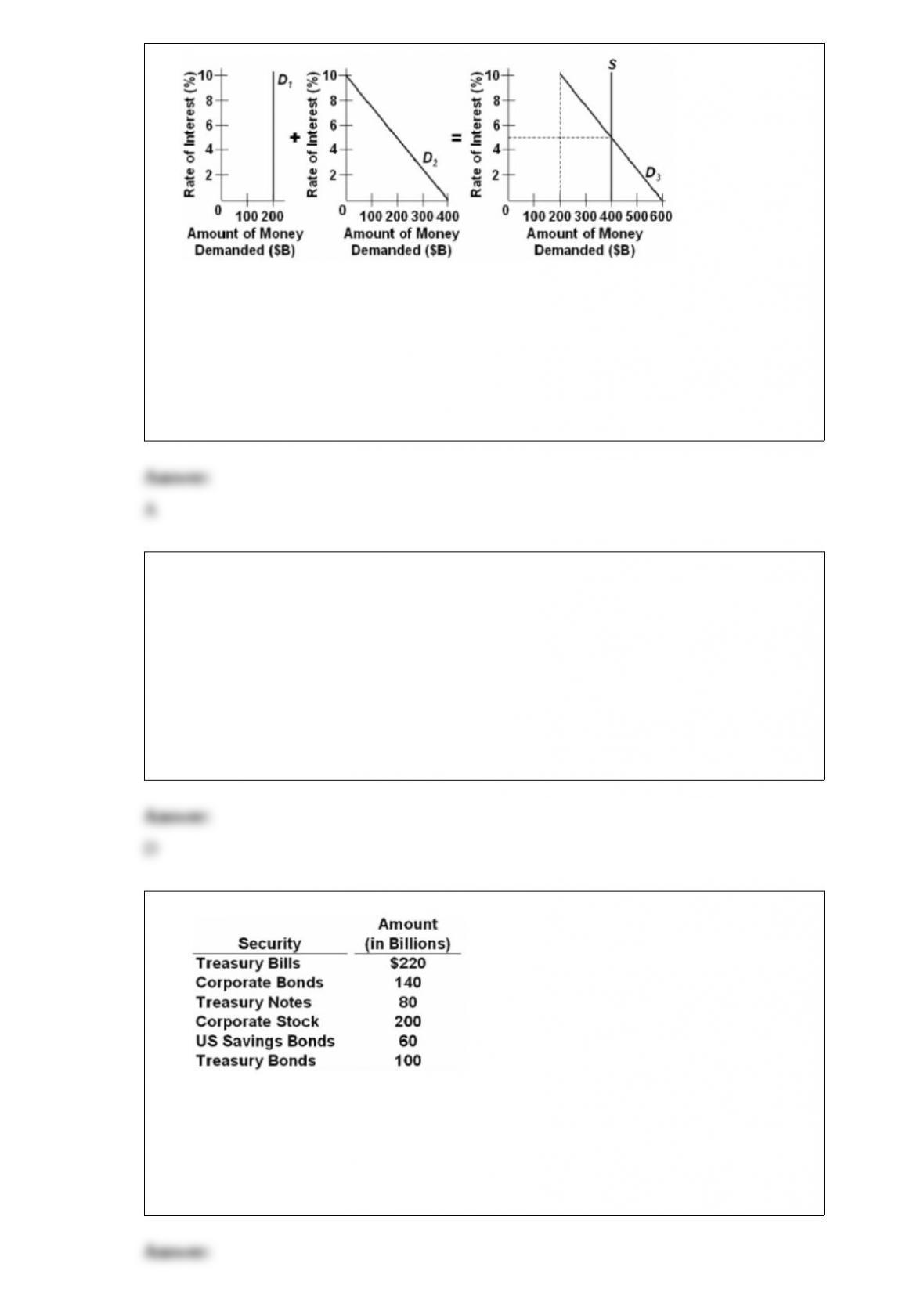
5)
Refer to the above market for money diagrams. If the interest rate was at 3 percent,
people would:
A.sell bonds, which would cause bond prices to fall and the interest rate to rise.
B.buy bonds, which would cause bond prices to fall and the interest rate to rise.
C.sell bonds, which would cause bond prices to rise and the interest rate to rise.
D.buy bonds, which would cause bond prices to rise but have an uncertain effect upon
the interest rate.
6) Some nations are increasing the amount of land covered by forests, while others are
experiencing rapid deforestation. According to economists, this is largely because:
A.different nations have different ethical views regarding treatment of the environment.
B.nations with increasing forest cover have poorly enforced or non-existent property
rights.
C.nations with declining forest cover treat forests as private property or strictly
regulated government property.
D.nations with increasing forest cover treat forests as private property or strictly
regulated government property.
7)
The public debt for the above economy is:
A.$540 billion.
B.$400 billion.
C.$580 billion.
D.$460 billion.
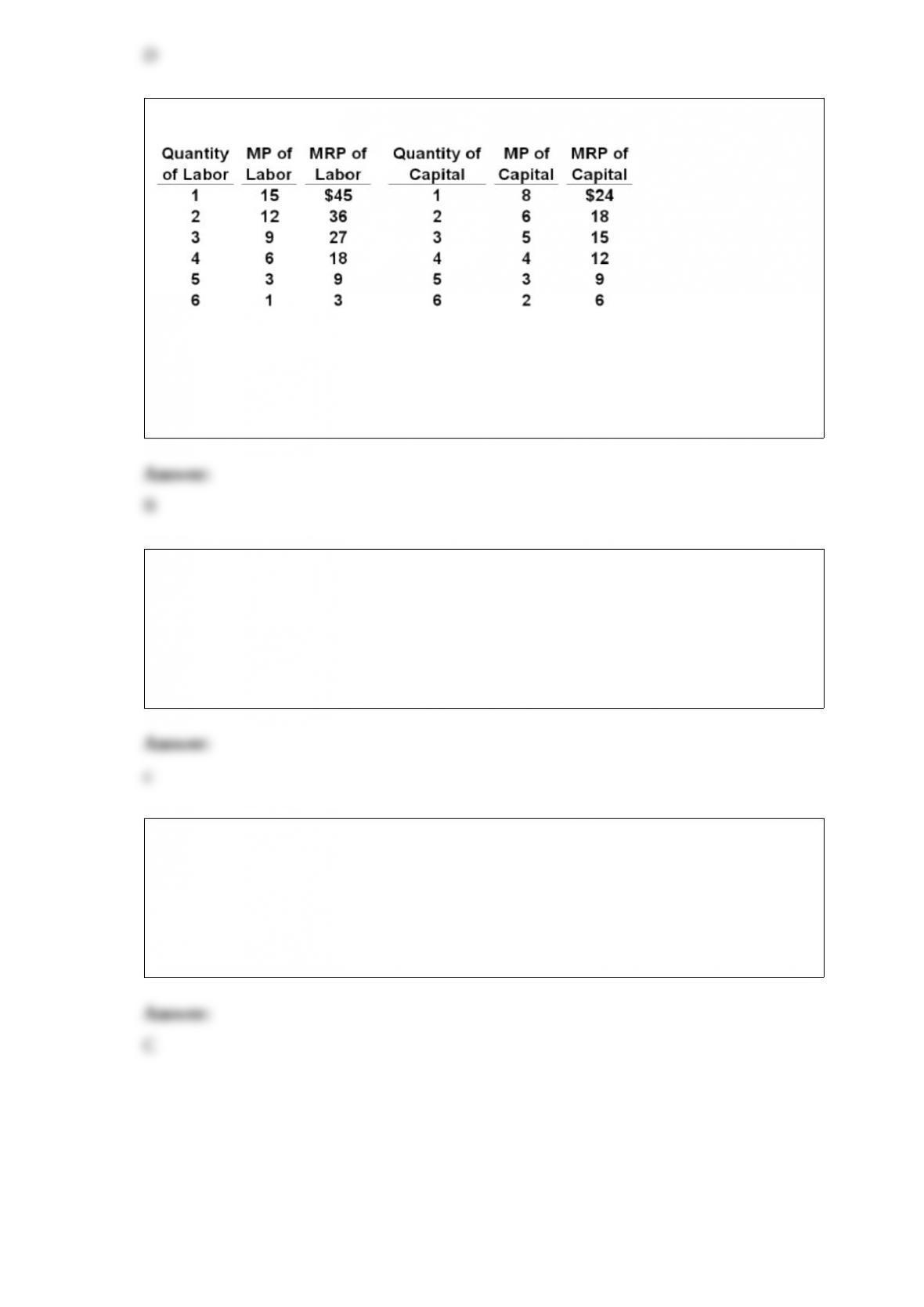
8)
Refer to the above data. This firm is selling its product in:
A.an imperfectly competitive market at prices that decline as sales increase.
B.a purely competitive market at $3 per unit.
C.a purely competitive market at $2 per unit.
D.an imperfectly competitive market at $3 per unit.
9) other things equal, the voluntary relocation of employable migrants from low-paying
nations to high-paying nations will:
a.increase business or capitalist incomes in the low-paying nations.
b.reduce real output in the world.
c.increase business or capitalist incomes in the high-paying nations.
d.reduce wage rates in the low-paying nations.
10) Which one of the following would increase per unit production cost and therefore
shift the aggregate supply curve to the left?
A.a reduction in business taxes
B.production bottlenecks occurring when producers near full plant capacity
C.an increase in the price of imported resources
D.deregulation of industry
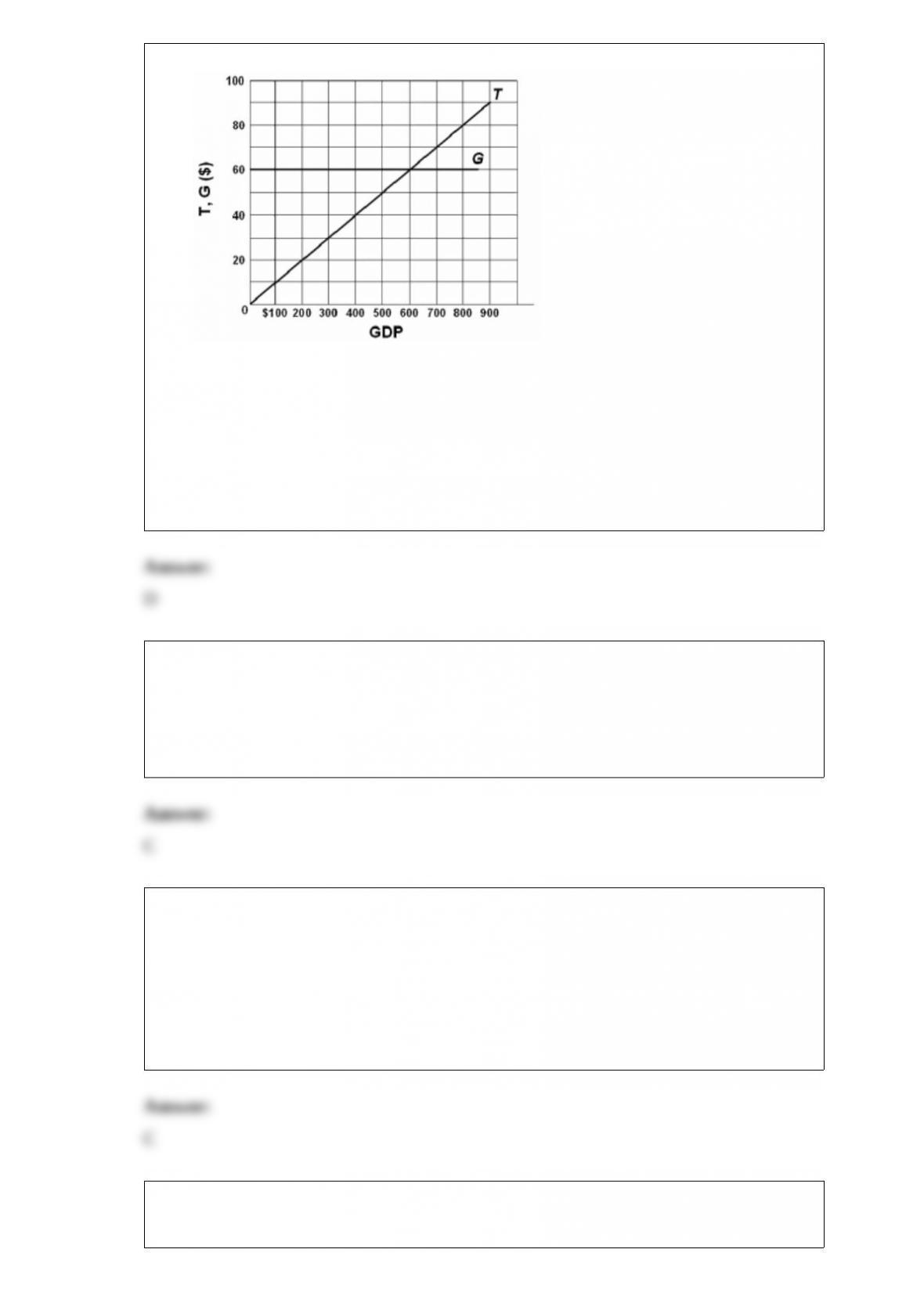
11)
Refer to the above diagram where T is tax revenues and G is government expenditures.
All figures are in billions of dollars. If the full-employment GDP is $400 billion while
the actual GDP is $200 billion, the standardized budget deficit is:
A.$40 billion.
B.zero.
C.$60 billion.
D.$20 billion.
12) The near-money components of M2 are:
A.equally liquid as the M1 components of M2.
B.more liquid than the M1 components of M2.
C.less liquid than the M1 components of M2
D.highly illiquid.
13) The basic argument for income inequality is that:
A.the very rich establish consumption patterns that are desirable for the rest of society
to emulate.
B.the rich buy luxury goods that soon become affordable to everyone else because of
economies of scale.
C.income inequality is essential to maintain incentives to produce.
D.inequality undermines incentives and tends to reduce the size of the national income.
14) which of the following terms implies the greatest degree of confidence in an
economic generalization?

a.a hypothesis.
b.a theory.
c.a principle.
d.an anomaly.
15) Which of the following measurement issues make interpretation of U.S. poverty
rates difficult?
A.Poverty statistics measure income rather than consumption, and some families may
be able to consume above the official poverty line.
B.The high cost of living in rural areas tends to result in the understatement of poverty.
C.Most people below the poverty line have substantial unreported income.
D.The poverty rate is adjusted for every urban and rural area, so people’s poverty status
changes whenever they move.