
1) which of the following is most likely to be a variable cost?
a.fuel and power payments
b.interest on business loans
c.rental payments on ibm equipment
d.real estate taxes
2) the main purpose of hmos and ppos is to:
a.reduce health care costs for employers and their employees.
b.reduce medical malpractice suits.
c.enable groups of physicians to increase their fees.
d.direct patients to specialists rather than to more expensive primary-care physicians.
3) Increases in the productivity of labor result partly from:
A.the law of diminishing returns.
B.improvements in technology.
C.reductions in wage rates.
D.increases in the quantity of labor.
4) (Advanced analysis) Answer the next question(s) on the basis of the following
information for a private open economy. The letters Y, C, Ig, X, and M stand for GDP,
consumption, gross investment, exports, and imports respectively. Figures are in
billions of dollars.
The multiplier for the above economy is:
A.4.60.
B.3.33.
C.5.00.
D.4.00.
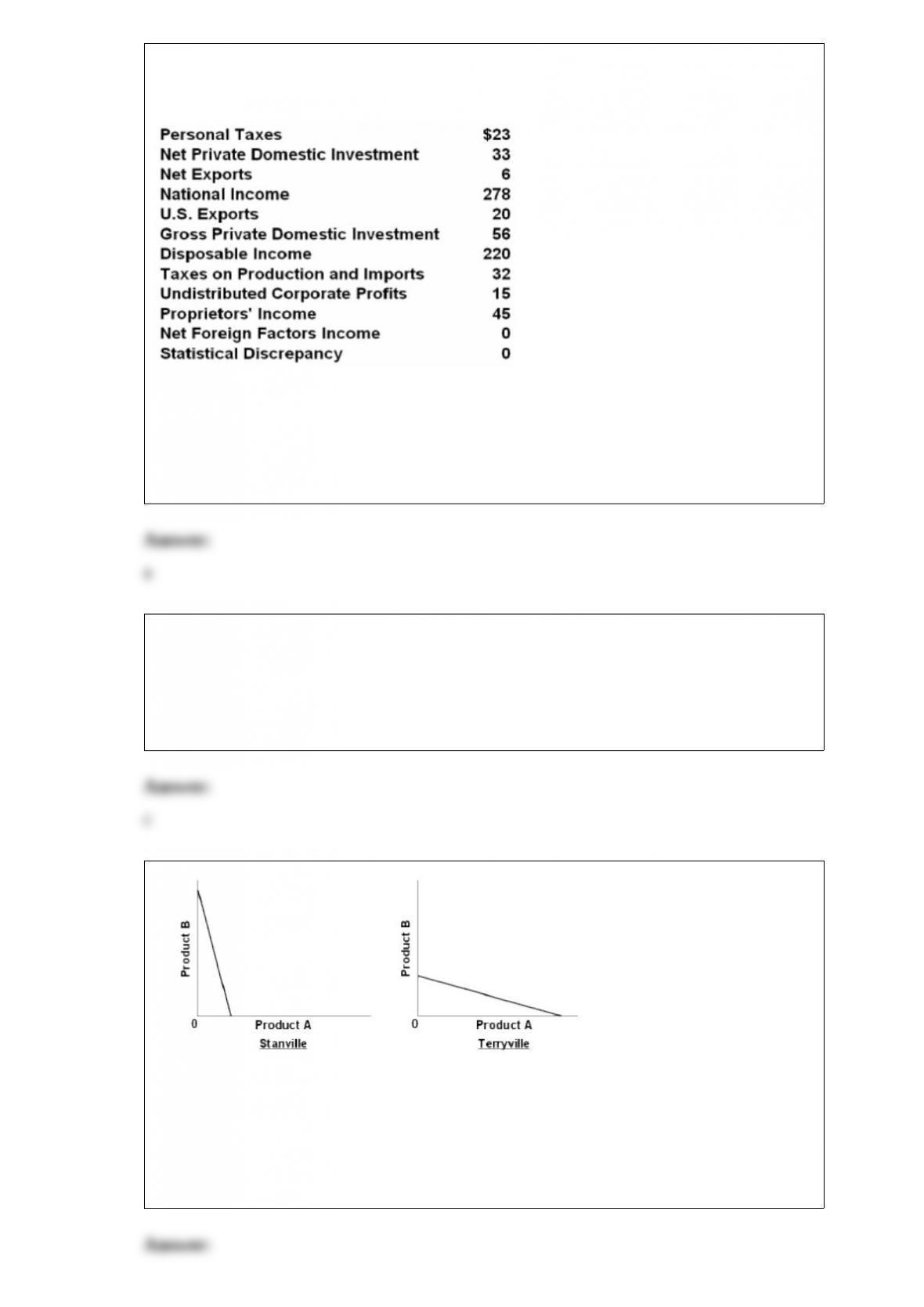
5) answer the next question(s) on the basis of the following national income data. all
figures are in billions of dollars.
refer to the above data. consumption of fixed capital (private sector) is:
a.$23.
b.$14.
c.$32.
d.$26.
6) a tax subsidy is involved in employer-financed health insurance because:
a.all working adults are covered by medicare.
b.all working adults are covered by medicaid.
c.employer payments for health insurance are not subject to income or payroll taxes.
d.corporations that provide health insurance pay lower corporate income tax rates.
7)
Refer to the above graphs. These production possibilities curves:
A.demonstrate that there can be gains from specialization and trade between the two
nations.
B.reflect the law of increasing opportunity costs.
C.reflect the law of diminishing marginal utility.
D.imply that specialization will be incomplete.
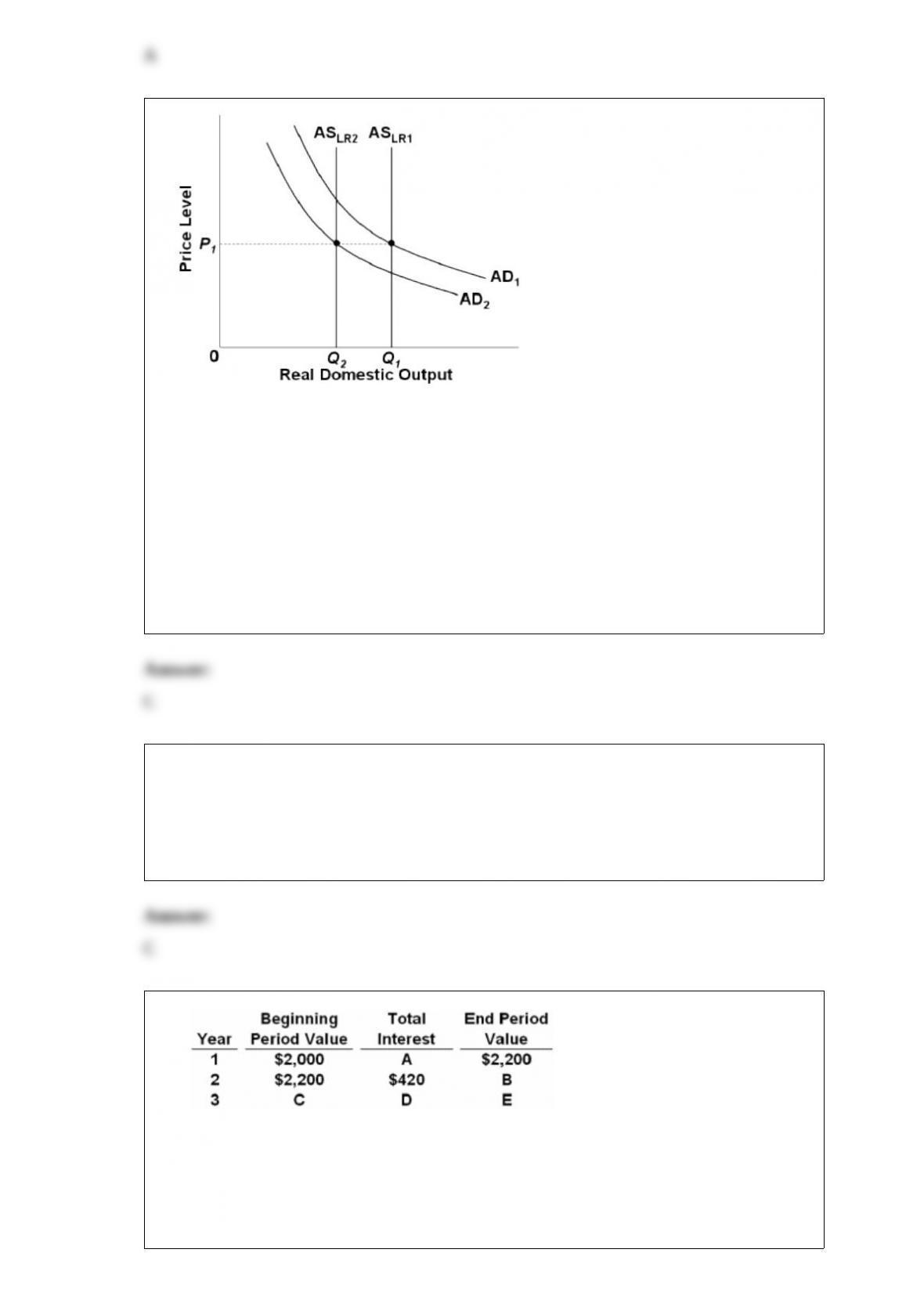
8)
Refer to the above diagram. The real-business cycle view of recession would best be
described by:
A.a decrease of aggregate demand from AD1 to AD2, followed by a decrease in
aggregate supply from ASLR1 to ASLR2.
B.an increase in aggregate demand from AD1 to AD2, which in turn caused a decrease
in aggregate supply from ASLR1 to ASLR2.
C.a decrease in aggregate supply from ASLR1 to ASLR2, followed by a decrease in
aggregate demand from AD1 to AD2.
D.a decrease in aggregate supply from ASLR1 to ASLR2, followed by an increase in
aggregate demand from AD2 to AD1.
9) The near-money components of M2 are:
A.equally liquid as the M1 components of M2.
B.more liquid than the M1 components of M2.
C.less liquid than the M1 components of M2
D.highly illiquid.
10)
Refer to the above table representing Kara’s bank account. Assuming that $2000 was
deposited into her account at the beginning of year 1, and no further deposits or
withdrawals were made, the value for cell E:
A.cannot be determined.
B.is $2,662.

C.is $2,600.
D.is $2,200.
11) Which of the following would most likely reduce aggregate demand (shift the AD
curve to the left)?
A.A reduced amount of excess capacity.
B.Increased government spending on military equipment.
C.An appreciation of the U.S. dollar.
D.Increased consumer optimism regarding future economic conditions.
12) If a U.S. importer can purchase 10,000 pounds for $20,000, the rate of exchange is:
A.$1 = 2 pounds in the United States.
B.$2 = 1 pound in the United States.
C.$1 = 2 pounds in Great Britain.
D.$.5 = 1 pound in Great Britain.
13) Approximately what percentage of the world’s income is received by the richest
one-fifth of the world’s population?
A.20 percent
B.30 percent
C.60 percent
D.80 percent