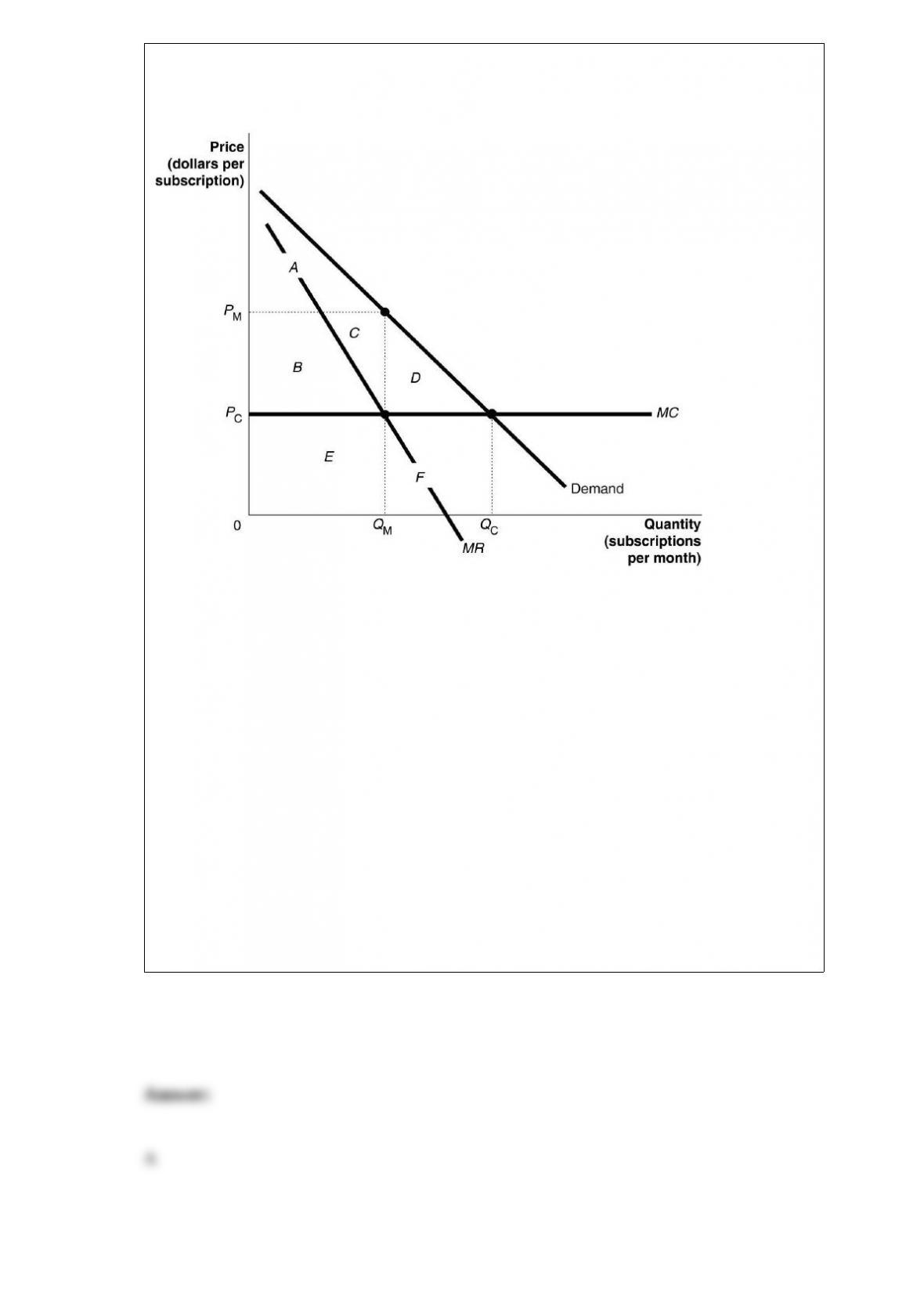
Figure 15-11
In 2011, Verizon was granted permission to enter the market for cable TV in Upstate
New York, ending the virtual monopoly that Time Warner Cable had in most local
communities in the region. Figure 15-11 shows the cable television market in Upstate
New York.
Refer to Figure 15-11. What is the size of the deadweight loss prior to Verizon entering
the market and what happens to this deadweight loss after Verizon does enter the
market?
A) The deadweight loss of area D is converted to consumer surplus.
B) The deadweight loss of area C+D is converted to consumer surplus.
C) The deadweight loss of area D is converted to producer surplus.
D) The total deadweight loss is the area D+F; D is converted to consumer surplus and
F to producer surplus.
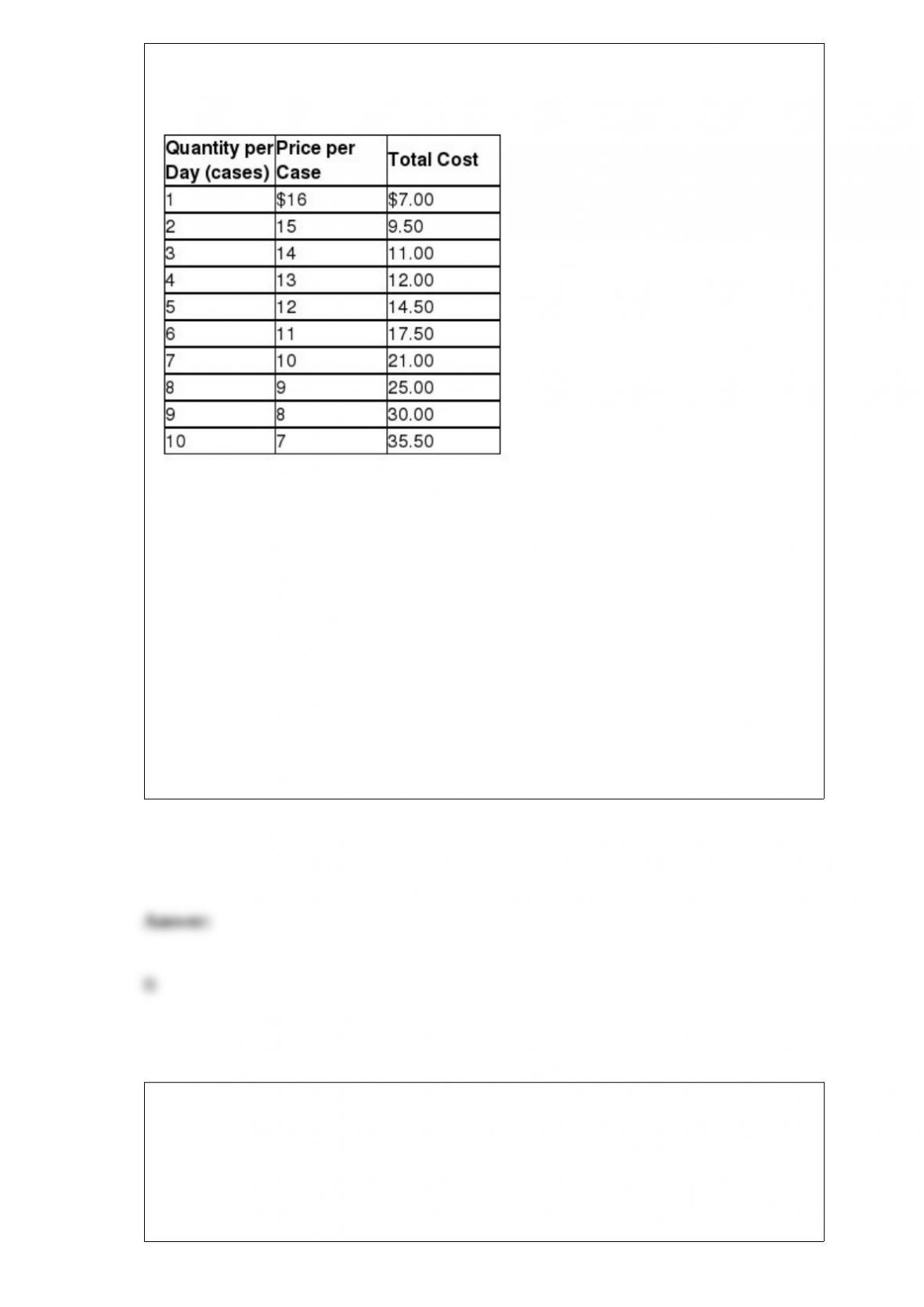
Table 15-2
The government of a small developing country has granted exclusive rights to Linden
Enterprises for the production of plastic syringes. Table 15-2 shows the cost and
demand data for this government-protected monopolist.
Refer to Table 15-2. What is the profit-maximizing quantity and price for the
monopolist?
A) Quantity = 8 cases, Price = $9
B) Quantity = 7 cases, Price = $10
C) Quantity = 9 cases, Price = $8
D) Quantity = 10 cases, Price = $7
What is the common feature displayed by the following items?
a. eating in a newly opened “fusion” cuisine restaurant
b. attending a Red Sox game in Fenway Park

c. wearing Lucky Brand designer jeans
A) They are all highly inelastic goods.
B) The consumption of these goods takes place privately.
C) The consumption of these goods takes place publicly.
D) They tend to be consumed by better educated people.
Assume that the market for barley is in equilibrium and the demand for barley is
inelastic. Predict what happens to the revenue of barley farmers if a prolonged drought
reduces the supply of barley. The drought will cause farm revenue to
A) rise because there will be a shortage of barley.
B) rise because the percentage decrease in quantity sold is less than the percentage
increase in price.
C) rise because the percentage increase in quantity sold is greater than the percentage
increase in price.
D) fall because of the decrease in the quantity of barley sold.
A corporation’s board of directors
A) hire the managers of the corporation.
B) control the day-to-day activities of the corporation.
C) are personally liable for the debts of the corporation.
D) are the sole owners of the corporation.
In long-run competitive equilibrium, the perfectly competitive firm produces where
price equals minimum average total cost.
a. What is this efficiency criterion called?
b. How does it benefit consumers?
One reason why, in the short run, the marginal product of labor might increase initially
as more workers are hired is that
A) the first workers hired get to use the best equipment.
B) specialization allows a worker to focus on one task, thereby increasing her
proficiency at that task.

C) the best workers are hired first and later hires are not as skillful.
D) beyond some point, a firm has hired too many workers.
The price of a factor of production that is in fixed supply is called
A) economic rent.
B) economic profit.
C) a compensating differential.
D) opportunity cost.
One result of the public choice model is that most economists believe that
A) when market failure occurs, government intervention will always lead to a more
efficient outcome.
B) government intervention will always result in a reduction in economic efficiency in
regulated markets.
C) policymakers may have incentives to intervene in the economy in ways that do not
promote economic efficiency.
D) the voting paradox will prevent voters from selecting the best person for public

office.
The International Nickel Company of Canada is often cited as an example of monopoly.
What was the source of the barrier to entry that gave this firm monopoly power?
A) It was a public enterprise; therefore, the Canadian government blocked entry into the
market for nickel.
B) There were important network externalities in the production of nickel.
C) Economies of scale resulted in the company becoming a natural monopoly.
D) control of a key resource
Which of the following would shift a nation’s production possibilities frontier outward?
A) discovering a cheap way to convert sunshine into electricity
B) an increase in demand for the nation’s products
C) a decrease in the unemployment rate
D) a law requiring workers to retire at age 50
Which of the following statements is false?
A) When marginal cost equals average total cost, average total cost is at its highest
value.
B) The marginal cost curve intersects the average variable cost curve and the average
total cost curve at their minimum points.
C) The difference between average total cost and average fixed cost is average variable
cost.
D) Firms often refer to the process of lowering average fixed cost as ‘spreading the
overhead.”
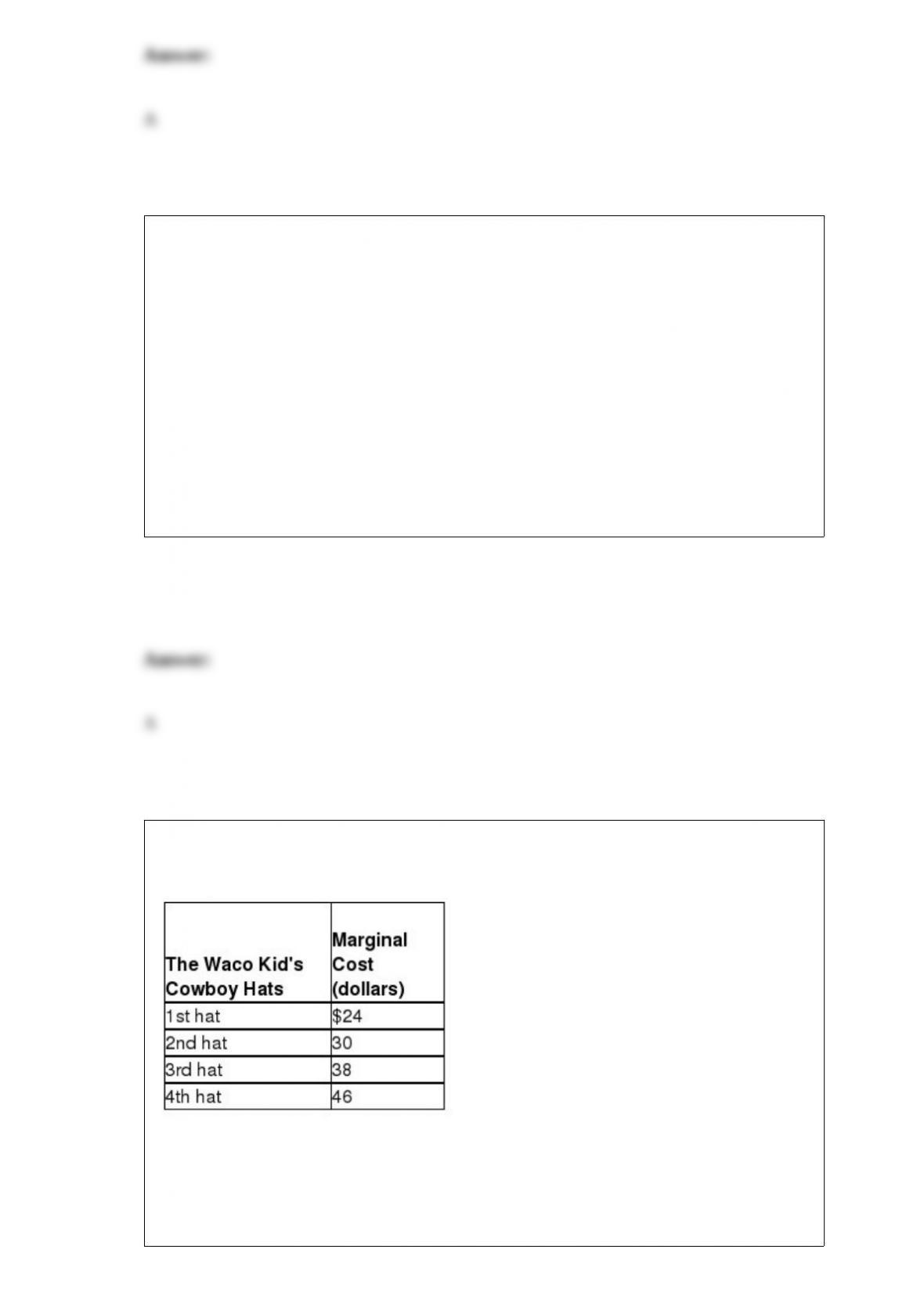
Table 4-3
Refer to Table 4-3. The table above lists the marginal cost of cowboy hats by The Waco
Kid, a firm that specializes in producing western wear. If the market price of cowboy
hats is $35, The Waco Kid will produce
A) 1 hat.

B) 2 hats.
C) 3 hats.
D) 4 hats.
Compared to monopoly pricing, an optimal two-part tariff
A) reduces economic efficiency.
B) eliminates the deadweight loss.
C) equates marginal revenue and average revenue.
D) increases consumer surplus.
A patent or copyright is a barrier to entry based on
A) ownership of a key necessary raw material.
B) large economies of scale as output increases.
C) government action to protect a producer.
D) widespread network externalities.
You wish to buy only one CD. Use the rule of equal marginal utility per dollar to
determine which one to purchase: (a) Drake’s latest CD for $15 which gives you 75
units of utility, or (b) Bob Dylan’s “Shadows in the Night” for $10 that gives you 100
units of utility?
Applying Coase’s theorem, if the cost to you from having the airplane seat in front of
you reclined is ________ the benefit to the reclining passenger, you should ________.
A) less than; make a payment to the reclining passenger
B) greater than; make a payment to the reclining passenger
C) less than; request a payment from the reclining passenger
D) greater than; request a payment from the reclining passenger

Which of the following statements about an entrepreneur is false?
A) organizes the other factors of production into a working unit
B) develops the vision for the firm and funds the producing unit
C) sells his entrepreneurial services in the output market
D) risks the personal funds provided
All of the following are examples of explicit cost a firm might incur except
A) the out-of-pocket expense to hire employees.
B) taxes owed to the state government.
C) the rental value of the warehouse space the company owns and uses for itself.
D) the revenue a firm generates in using its resources.
Table 15-4
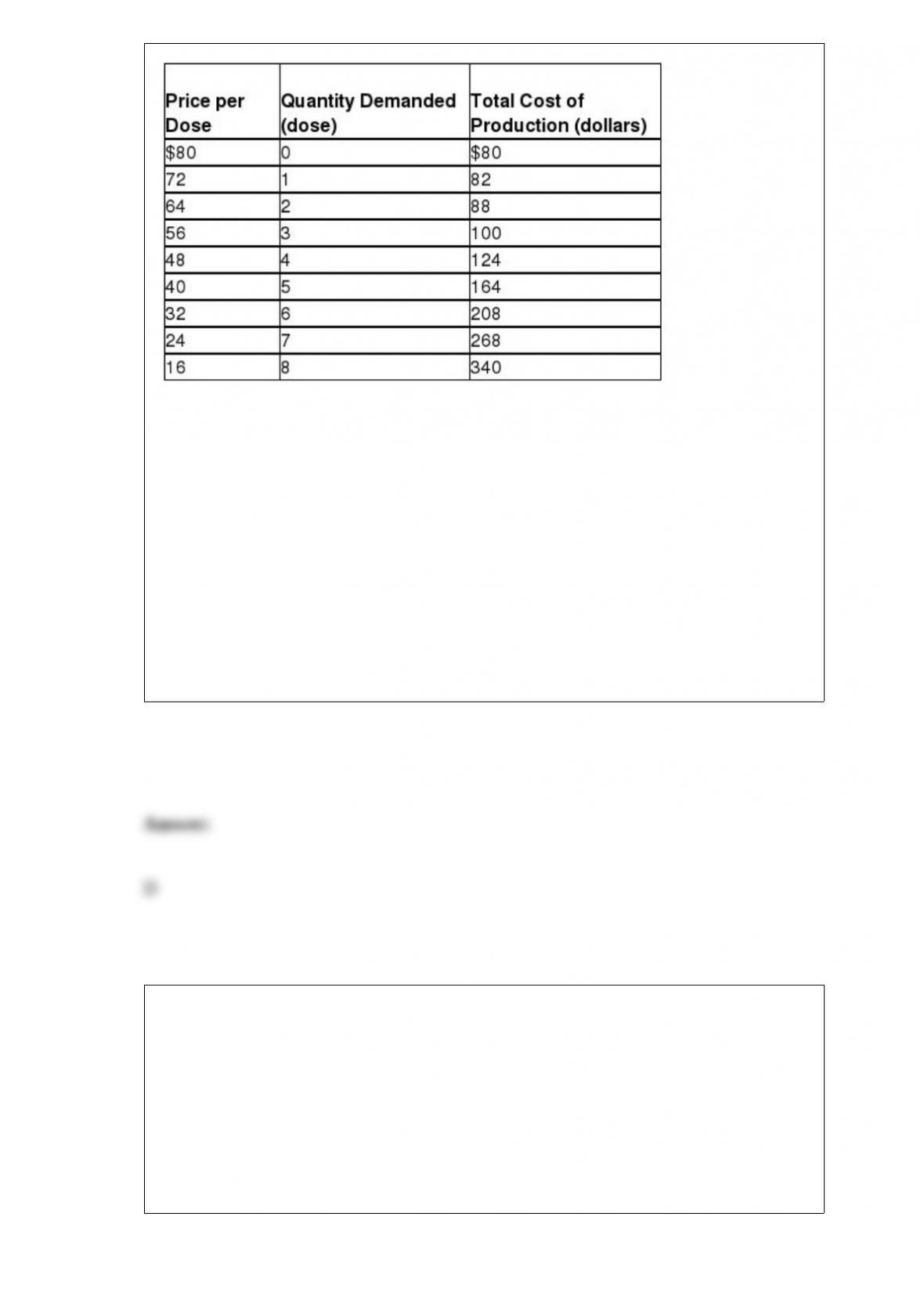
Shakti Inc. has been granted a patent for its Arnica toothache balm. Table 15-4 shows
the demand and the total cost schedule for the firm.
Refer to Table 15-4. What is the amount of the deadweight loss generated by Shakti
when it produces the monopoly output?
A) $124
B) $42
C) $36
D) $12
The minimum point on the average variable cost curve is called
A) the shutdown point.
B) the break-even point.
C) the loss-minimizing point.
D) the point of diminishing returns.

What does limited liability mean?
A) The owners of the business are personally responsible for paying expenses incurred
by the business.
B) Only employees can have a claim on the assets of the business.
C) The personal assets of the owners cannot be claimed if the business is bankrupt.
D) Anybody with a liability against a firm can claim only what their liability refers to.
The area ________ the market supply curve and ________ the market price is equal to
the total amount of producer surplus in a market.
A) above; above
B) above; below
C) below; above
D) below; below

As output increases
A) average variable cost becomes smaller and smaller.
B) the difference between average total cost and average variable cost decreases.
C) marginal cost increases continuously.
D) the difference between average total cost and average variable cost becomes greater
and greater.
What are the two types of taxes that working individuals pay on their earnings?
A) individual income tax and sales tax
B) payroll tax and sales tax
C) individual income tax and social insurance taxes
D) property tax and payroll tax
Danielle Ocean pays for monthly pool maintenance for her home swimming pool. Last
week the owner of the pool service informed Danielle that he will have to raise his
monthly service fee because of increases in the price of pool chemicals. How is the
market for pool maintenance services affected by this?

A) There is an increase in the supply of pool maintenance services.
B) There is a decrease in the demand for pool maintenance services.
C) There is a decrease in the quantity of pool maintenance services supplied.
D) There is a decrease in the supply of pool maintenance services.
The revenue received from the sale of ________ of a product is a marginal benefit to
the firm.
A) an additional unit
B) the total number of units
C) no units
D) only profitable units
Ford Motor Company started producing the Model A at plants scattered around the
United States
A) to save on transport costs.
B) because diseconomies of scale at its initial River Rouge plant resulted in high
production costs.
C) to locate its production centers closer to its customers.
D) because it was not able to attract skilled workers in Michigan (where its first plant
was located).
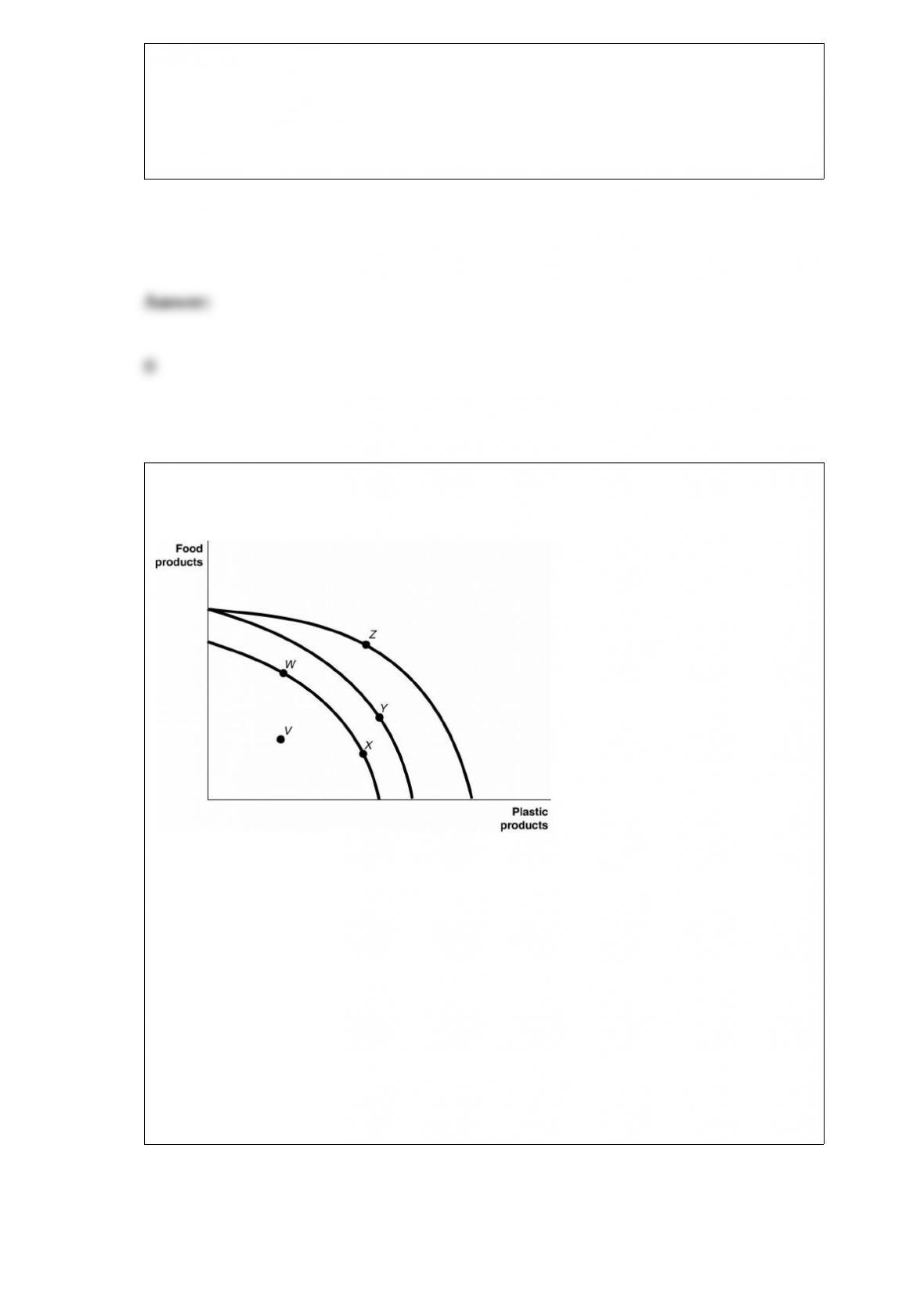
Figure 2-4
Figure 2-4 shows various points on three different production possibilities frontiers for
a nation.
Refer to Figure 2-4. A movement from ________ could occur because of an influx of
immigrant labor.
A) W to V
B) X to W
C) W to Z
D) Y to W

If a typical monopolistically competitive firm is making short-run losses, then
A) other more competitive firms will enter the market.
B) as some firms leave, the remaining firms will experience an increase in the demand
for their products.
C) as some firms leave, the demand for the products of the remaining firms will become
more elastic.
D) the industry will eventually cease to exist.
Joss is a marketing consultant. Iris and Daphne are potential customers interested in
commissioning Joss to undertake a market survey and compile the findings in a report.
Iris is willing to pay $500 for the service while Daphne is willing to pay $800. Suppose
that the opportunity cost of Joss’s time is $1,200. Assume that Iris and Daphne do not
know each other. If Joss charges the same price per copy of the report to both Iris and
Daphne
A) the report will not get written.
B) only Daphne will commission the job and the report will be written.
C) both Iris and Daphne will commission the job and the report will be written.
D) no conclusion can be drawn without information on the price.

Molly Sharp is producing a documentary about the plight of the six-toed ferrets of Sri
Lanka. Molly has spent $125,000 of her own money on this project and the
documentary is now complete. Molly just found out that no studio is willing to release
her documentary and she must now shop it to cable television networks, where she
knows she will not be able to recoup her investment. Which of the following statements
regarding Molly Sharp’s documentary is true?
A) She should not try to have her documentary aired on television because she cannot
recoup her $125,000 investment.
B) Since the $125,000 is a sunk cost, she should still try to have her documentary aired
on television even though she will not see a profit.
C) The $125,000 is a variable cost, so will not be incurred if she chooses not to have her
documentary aired.
D) The $125,000 investment is an economic cost, and she will still make an accounting
profit even if the television network willing to air her documentary pays her less than
$125,000.
The possibility that the economy may benefit from having market power, rather than
being very competitive, is closely identified with which famous economist?
A) Arnold Harberger
B) Joseph Schumpeter
C) Sergey Brin
D) Donald Turner