
1) according to the principle of absolute advantage, international trade is beneficial to
the world if one nation has an absolute cost advantage in the production of one good
while the other nation has an absolute cost advantage in the other good.
a.true
b.false
2) the u.s. dollar, japanese yen, british pound, and mexican peso are the major reserve
currencies of the international monetary system.
a.true
b.false
3) the effect of workers migrating from low-wage mexico to high-wage united states is
to redistribute income from capital to labor in the united states and from labor to capital
in mexico.
a.true
b.false
4) when a nation is in autarky and maximizes its living standard, its consumption and
production points are:
a.along the production possibilities schedule
b.above the production possibilities schedule
c.beneath the production possibilities schedule
d.any of the above
5) if the swiss demand for dollars is elastic, a depreciation of the dollar against the franc
will lead to a greater quantity of francs being supplied to the foreign exchange market
to obtain dollars.
a.true
b.false

6) the trading principle formulated by adam smith maintained that:
a.international prices are determined from the demand side of the market
b.differences in resource endowments determine comparative advantage
c.differences in income levels govern world trade patterns
d.absolute cost differences determine the immediate basis for trade
7) the first wave of globalization was brought to an end by
a.the great depression
b.the second world war
c.the first world war
d.the smoot-hawley act
8) if import licenses are auctioned off to domestic importers in a competitive market,
their scarcity value (revenue effect) accrues to:
a.foreign corporations
b.foreign workers
c.domestic corporations
d.the domestic government
9) adam smith contended that gold, silver, and other precious metals constituted the
wealth of a nation.
a.true
b.false
10) under the gold standard, each participating nation defined the mint price of gold in
terms of its national currency was prepared to buy and sell gold at that price.
a.true
b.false
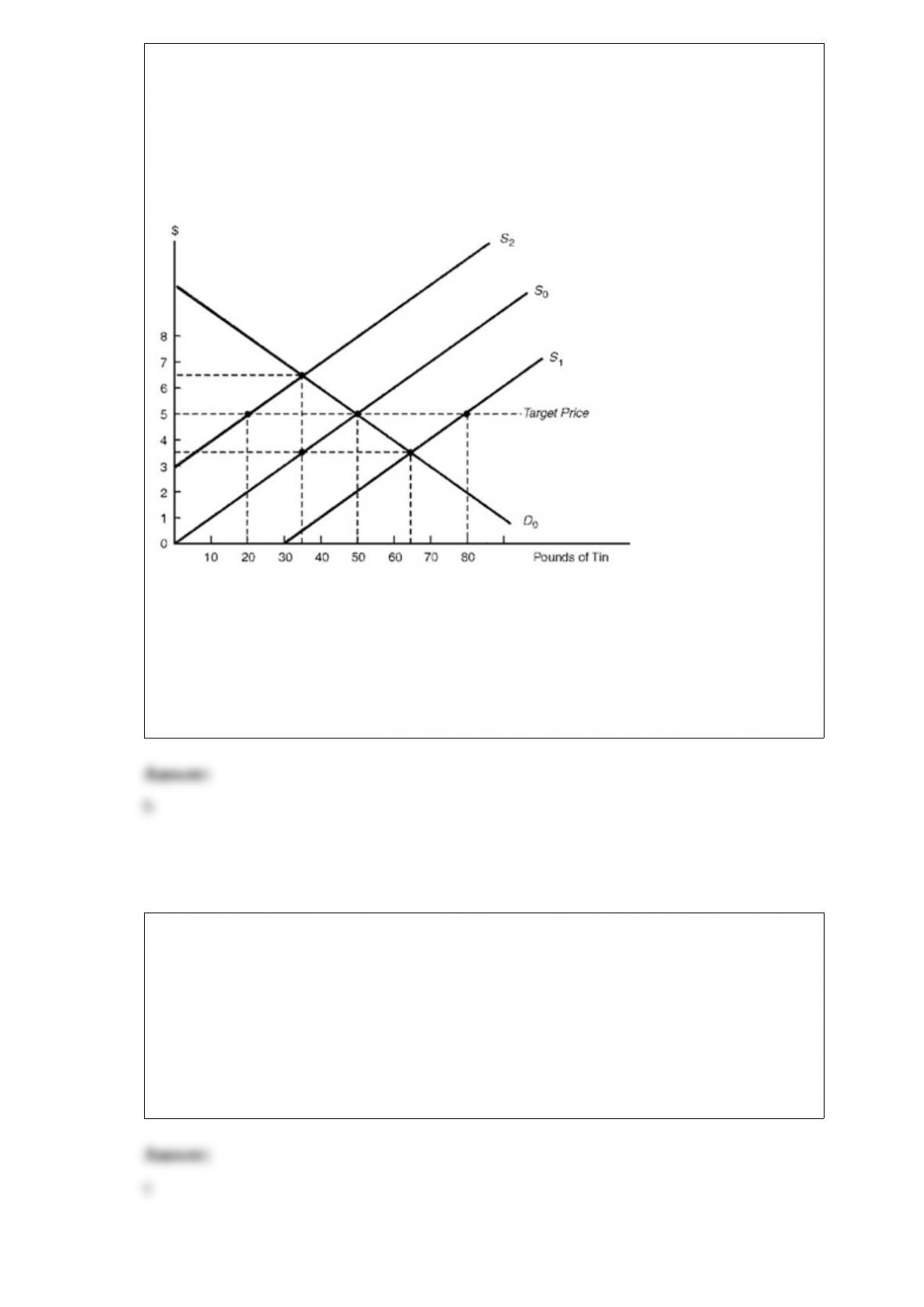
11) the diagram below illustrates the international tin market. assume that the producing
and consuming countries establish an international commodity agreement under which
the target price of tin is $5 per pound.
figure 7.2. defending the target price in face of changing supply conditions
consider figure 7.2. assume there exists a cartel of several producers that is maximizing
total profit. if one producer cheats on the cartel agreement by decreasing its price and
increasing its output, rational action of the other producers is to:
a.increase their price in order to regain sacrificed profits
b.decrease their price as well
c.keep on selling at the agreed-upon price
d.give the product away for free
12) hong kong is relatively abundant in labor, while canada is relatively abundant in
capital. in both countries the production of shirts is relatively more labor intensive than
the production of computers. according to the factor endowment theory, hong kong will
have a(n):
a.absolute advantage in the production of shirts and computers
b.absolute advantage in the production of computers
c.comparative advantage in the production of shirts
d.comparative advantage in the production of computers

13) opening the economy to international trade tends to lessen inflationary pressures at
home.
a.true
b.false
14) a term-of-trade index that equals 90 indicates that compared to the base year:
a.it requires a greater output of domestic goods to obtain the same amount of foreign
goods
b.it requires a lesser amount of domestic goods to obtain the same amount of foreign
goods
c.the price of exports has fallen from $100 to $90
d.the price of imports has fallen from $100 to $90
15) refer to figure 13.3. as u.s. interest rates rise relative to foreign interest rates, the u.s.
slides upward along schedule ca0, thus moving towards capital and financial account
surplus.
a.true
b.false
16) following world war ii, the u.s.:
a.became less open
b.negotiated reductions in trade barriers with other countries
c.passed a number of protective tariffs
d.concentrated on armament production
17) under managed-floating exchange rates, market forces are allowed to determine
exchange rates in the short run while central bank intervention is used to stabilize
exchange rates in the long run.
a.true
b.false

18) international trade leads to increased welfare if a nation can achieve a post-trade
consumption point lying inside of its production-possibilities schedule.
a.true
b.false