
Situation 32-1
In the early 1980s, the U.S. automobile industry managed to influence the government
to negotiate a voluntary export restraint agreement with Japan that was in effect from
1981 until 1985. The predictable result was an average increase in the price of Japanese
cars by about $1,000 and of U.S. cars by about $370. Also, as a result of the import
quotas, 26,000 new jobs were “created” in the U.S. automobile industry.
At the time the total yearly salary (including all the benefits) of the average auto worker
was no more than $50,000 per year, and the cost per job saved was estimated at
$160,000 per worker per year. We can conclude that
a. import quotas are a cost-efficient way of saving jobs.
b. the U.S. auto industry, through its lobbying efforts, managed to promote the general
public interest.
c. the net social benefits of import quotas were positive.
d. all of the above
e. none of the above
People who buy houses in good-weather locations receive this benefit absolutely for
free.
a. True
b. False

Suppose Smith wants one iPhone no matter what the price is between $0 and $350,
Jones wants one iPhone no matter what the price is between $0 and $200, and Griffith
wants one iPhone no matter what the price is between $0 and $450.In this case, each
individual buyer’s demand curve will be __________________ and the market demand
curve will be __________________.
a. downward sloping; vertical
b. vertical; downward sloping
c. vertical; vertical
d. downward sloping; downward sloping
The profit-maximizing oligopolist produces where
a. price equals marginal cost.
b. marginal revenue equals marginal cost.
c. price is greater than average total cost.
d. a and b
e. b and c
Exhibit 34-8
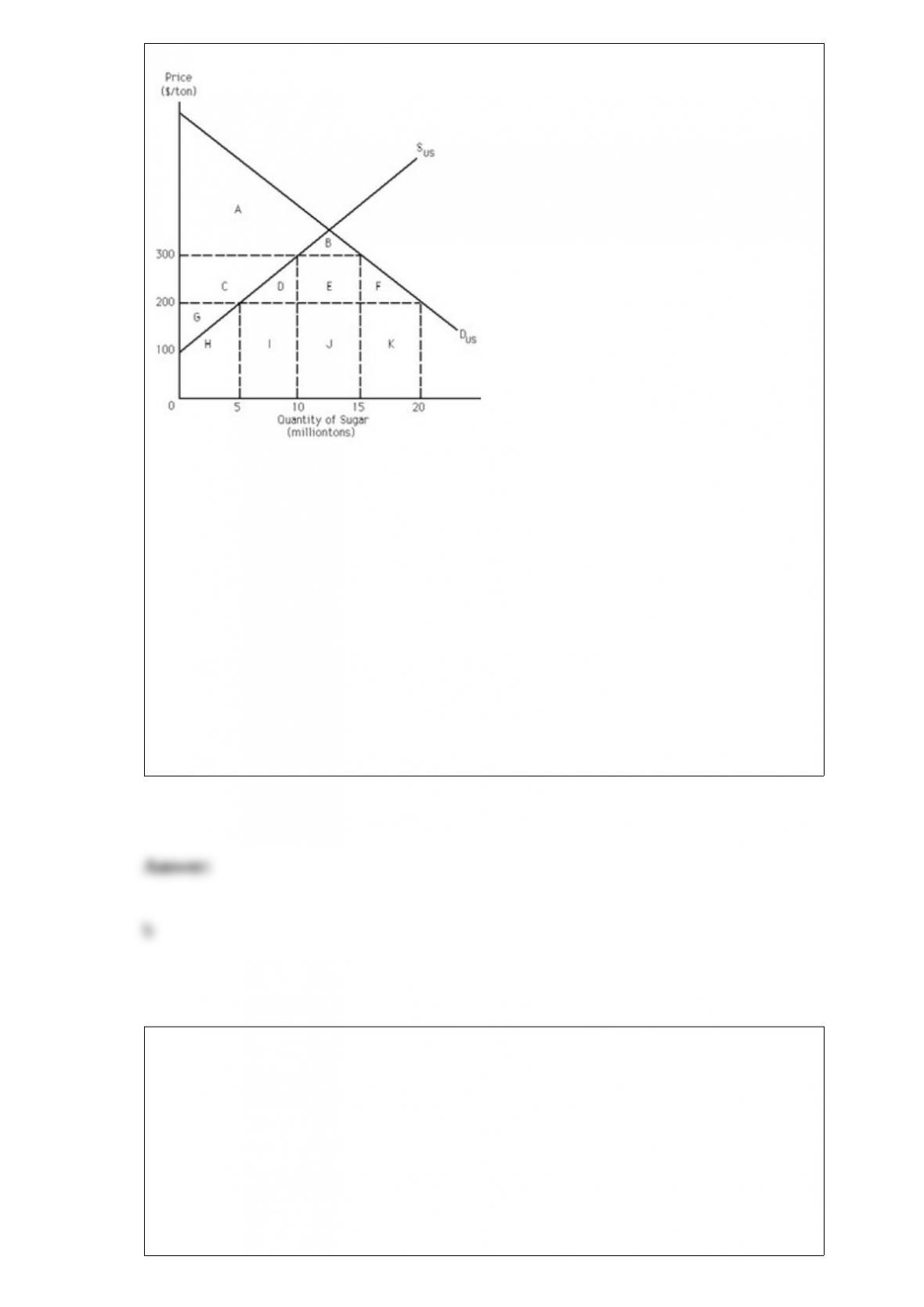
Assume that the current price of sugar in the United States is $300 per ton (which
includes a $100 per ton tariff on sugar imports). The removal of the $100 per ton tariff
would cause a(n) __________ in imports of __________ million tons.
a. increase; 5
b. increase; 10
c. increase; 15
d. decrease; 5
e. decrease; 10
If an international currency speculator expects that country A will soon be forced to
devalue its currency, the speculator will
a. buy as much of that currency as possible.
b. sell all of his holdings of that currency.
c. not be concerned because the devaluation will affect only the domestic prices of
goods within country A’s borders, not international prices.

d. not be concerned because only a revaluation will affect his or her profits.
The present value of $10,000 one year in the future at a 5 percent interest rate is
approximately
a. $4,762.
b. $9,524.
c. $2,000.
d. $10,500.
Residents of cities with a reputation for good weather, ceteris paribus,
a. pay a higher price for housing because the demand for housing is higher.
b. pay a higher price for housing because the supply of housing is higher.
c. pay a higher price for housing because the supply and demand for housing is higher.
d. pay the same for housing as they would in cities with a reputation for bad weather.
Which of the following statements is false?
a. When the value of a country€s imports is greater than the value of its exports, the
country€s net exports will be a positive value.
b. A country is running a trade deficit when the value of its imports is greater than the
value of its exports.
c. A country is running a trade surplus when the value of its exports is greater than the
value of its imports.
d. Net exports are sometimes referred to as the balance of trade.
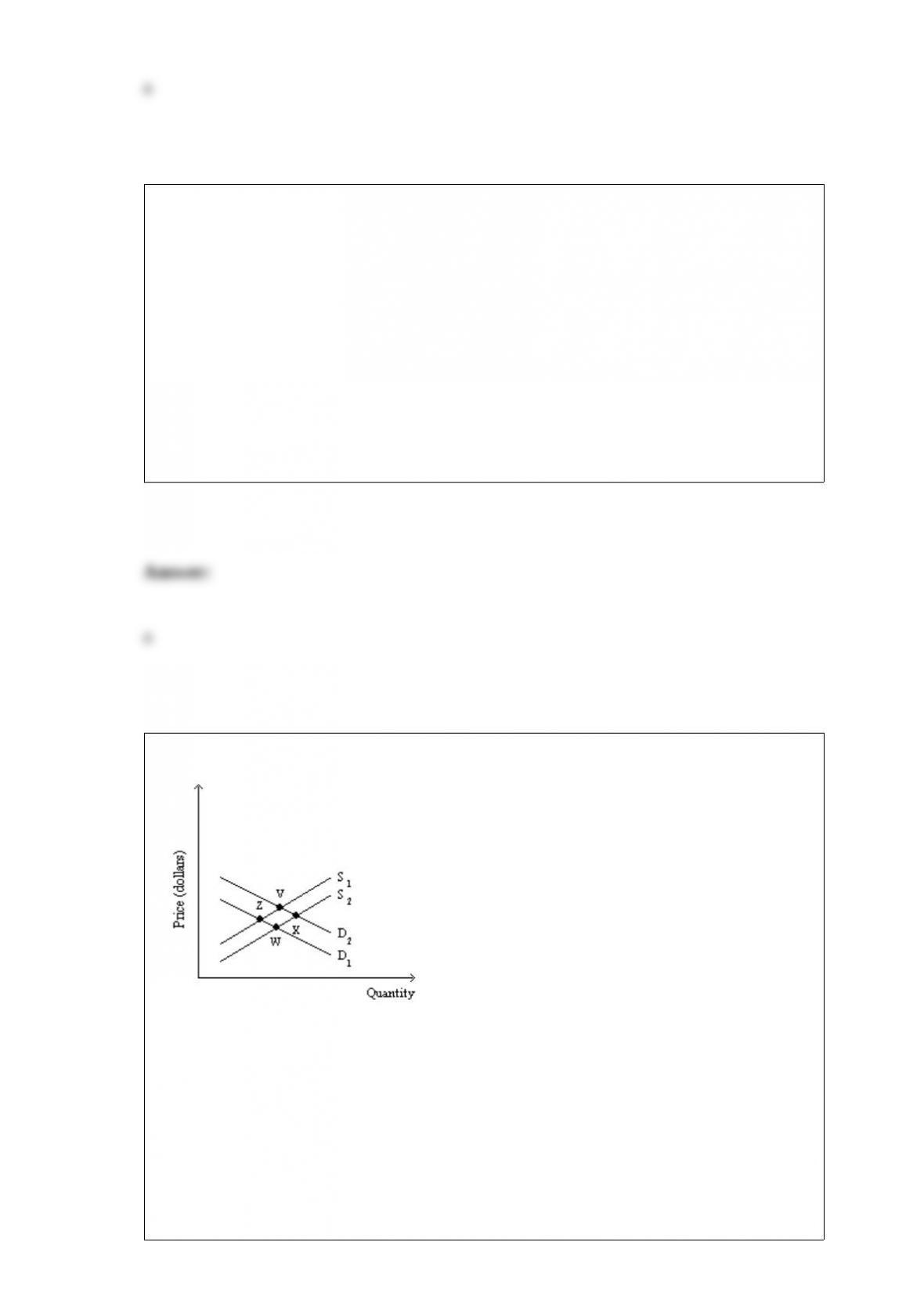
Exhibit 3-5
In the market shown, if equilibrium was originally at point V and is now at point Z, the
new equilibrium price is __________ it was originally and the new equilibrium quantity
is ____________ it was originally.
a. greater than; greater than
b. less than; greater than

c. greater than; less than
d. less than; less than
Which of the following statements is false?
a. The Wilshire 5000 is a stock index that consists of the stocks of about 6,500 firms.
b. Instead of buying a mutual fund that consists of various stocks picked by a fund
manager you can buy a mutual fund that consists of the stocks that make up a particular
stock index.
c. The term Sypders stands for €Standard& Poors Direct Receipts.€
d. When an investor buys Spyders they are said to €buy the market.€
If the cross elasticity of demand for two goods is negative,
a. one of the goods is necessarily a normal good, and the other good is necessarily an
inferior good.
b. both goods are normal goods.
c. the goods are substitutes.
d. the goods are complements.

Exhibit 4-8
Suppose that wheat producerslobby the government for a price floor and receive
one.This price floor is set at PF.What is the size of the consumers’ surplus at PF?
a. area 5
b. area 6
c. area 1 + 2 + 4
d. area 1
Exhibit 27-8
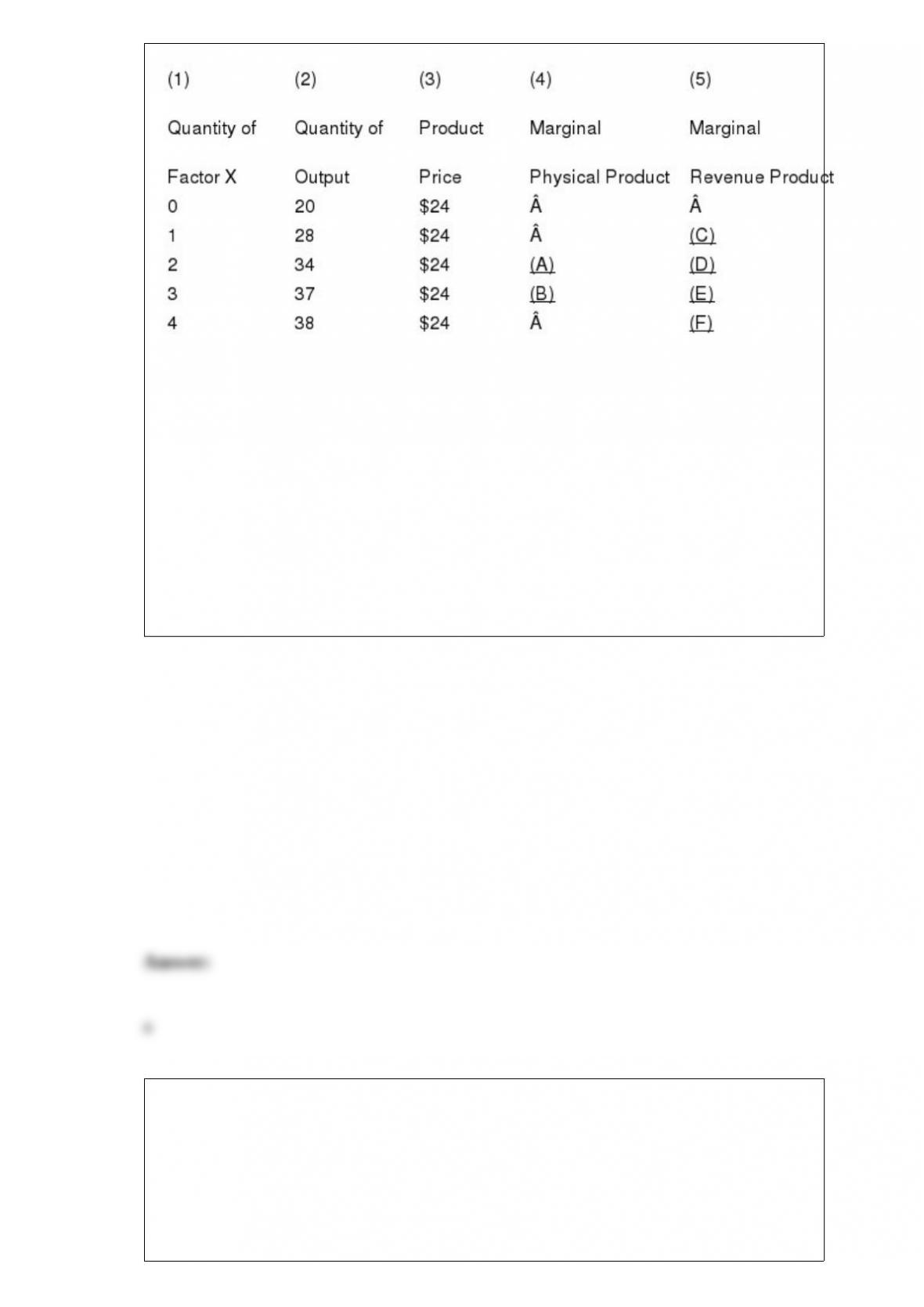
The dollar amounts that go in blanks (C) and (D) are, respectively,
a. $192 and $144.
b. $8 and $8.
c. $190 and $270.
d. $90 and $80.
e. There is not enough information to answer the question.
If the U.S. dollar depreciates in the foreign exchange market, U.S. exports will be
__________ and U.S. imports will be __________.
a. relatively less expensive; relatively less expensive
b. relatively less expensive; relatively more expensive

c. relatively more expensive; relatively more expensive
d. relatively more expensive; relatively less expensive
e. unaffected; relatively less expensive
A firm operating in a perfectly competitive market finds itself producing a level of
output for which marginal revenue is less than marginal cost. In order to maximize
profits (or minimize losses), the firm should
a. increase its level of output.
b. decrease its level of output.
c. shut down operations.
d. lower its price.
e. raise its price.
Pure economic rent can exist only when the factor under consideration
a. is something other than land.
b. has a supply curve that is perfectly elastic.
c. has a demand curve that is perfectly elastic.
d. has a supply curve that is perfectly inelastic.
e. a and d

A negative externality exists when
a. marginal social costs are less than marginal private costs.
b. marginal social costs are greater than marginal private costs.
c. marginal social benefits are less than marginal private benefits.
d. marginal social benefits are greater than marginal private benefits.
e. b and c
If you have a high rate of time preference, then you are
a. willing to wait a longer time to consume a good than someone with a low rate of time
preference.
b. not willing to wait a long time to consume a good.
c. willing to save your earnings so that you can buy more goods in the future.
d. not acting rationally, because it means that you are willing to delay consumption of
goods and services until a later date (but you might not be around to do so).
e. a and c