
During Thanksgiving you participated in a pumpkin-pie eating contest. You really
enjoyed the first two pies, the third one was okay, but as soon as you ate the fourth one
you became ill and lost the contest. You got ______ utility from eating the fourth pie
than from eating the second pie.
A. less
B. more
C. the same amount of
D. less variable
Regular interest payments made to bondholders are called ______ payments.
A. diversification
B. reserve
C. coupon
D. dividend
The responsiveness of the quantity demanded of one good to a change in the price of a
different good is measured by the:
A. price elasticity of demand.
B. income elasticity of demand.
C. price elasticity of supply.
D. cross-price elasticity of demand.
The payoff matrix below shows the payoffs (in millions of dollars) for two firms, A and
B, for two different strategies, investing in new capital or not investing in new capital.
An industry spy comes to firm B and claims to know what firm A has decided. Given
that each firm already knows the payoff matrix, how much would this information be
worth to firm B?
A. $0.
B. $50 million.
C. $30 million.
D. $70 million.
The allocative function of price cannot operate unless there is:
A. a significant barrier to entry.
B. both free entry and free exit.
C. either free entry or free exit.
D. neither free entry nor free exit.
Perfect competition is socially efficient and monopoly is not because under perfect
competition price is ______ while under monopoly price is ______.
A. equal to MC; greater than MC
B. less than MR; equal to MR
C. equal to MR; less than MR
D. equal to MC; less than MC

Pat has just graduated from college and has two job offers. One pays $45,000 and
requires that Pat supervise employees doing construction work on a busy highway. The
other is an office job that pays $40,000. Chris has received the same offers from the
same firms. Pat values the added safety of the office job at $6,000 per year, and Chris
values the added safety of the office job at $3,000 per year. Pat will be better off taking
the ______ job and Chris will be better off taking the ______ job.
A. office; office
B. office; highway
C. highway; office
D. highway; highway
Refer to the figure below. The socially optimal quantity in this market is ______ units
per day.
A. T
B. U
C. V
D. W

For a given inflation rate, if a resolution of international disputes leads to a cutback in
government military spending, then the ______ shifts _____.
A. aggregate demand curve; right
B. aggregate demand curve; left
C. aggregate supply curve; left
D. aggregate supply curve; right
According to the textbook, the union wage premium for workers with the same amount
of human capital is about ______.
A. 40 percent
B. 30 percent
C. 20 percent
D. 10 percent
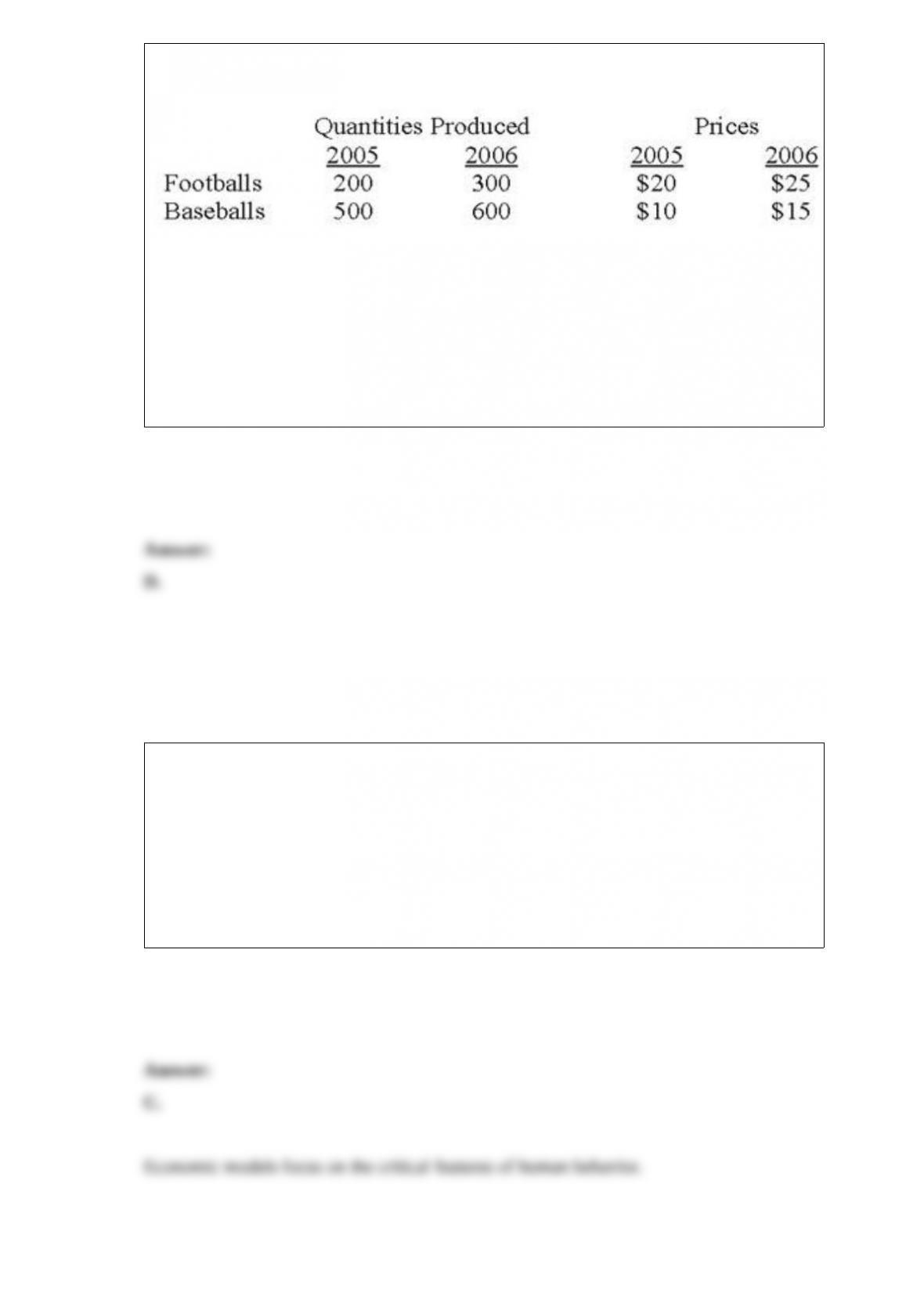
Assume an economy produces only footballs and baseballs and the base year is 2005.
Given the data in the table above, what is the value of nominal GDP in 2006?
A. $10,000
B. $12,000
C. $12,500
D. $16,500
Economists use abstract models because:
A. every economic situation is unique, so it is impossible to make generalizations.
B. every economic situation is essentially the same, so specific details are unnecessary.
C. they are useful for describing general patterns of behavior.
D. computers have allowed economists to develop abstract models.

One family earned an income of $28,000 in 1990. Over the next five years, their
income increased by 15%, while the CPI increased by 15%. After five years, this
family’s nominal income ______, and their real income ______.
A. decreased; also decreased
B. decreased; increased
C. increased; did not change
D. increased; also increased
The value of marginal product curve is downward sloping because
A. firms must lower price to sell more.
B. at lower wages, only less qualified workers are available.
C. of the law of diminishing returns.
D. profits decline as more workers are hired.
The gold standard is an example of a ______ exchange rate system.
A. fixed
B. flexible
C. nominal
D. dollarized
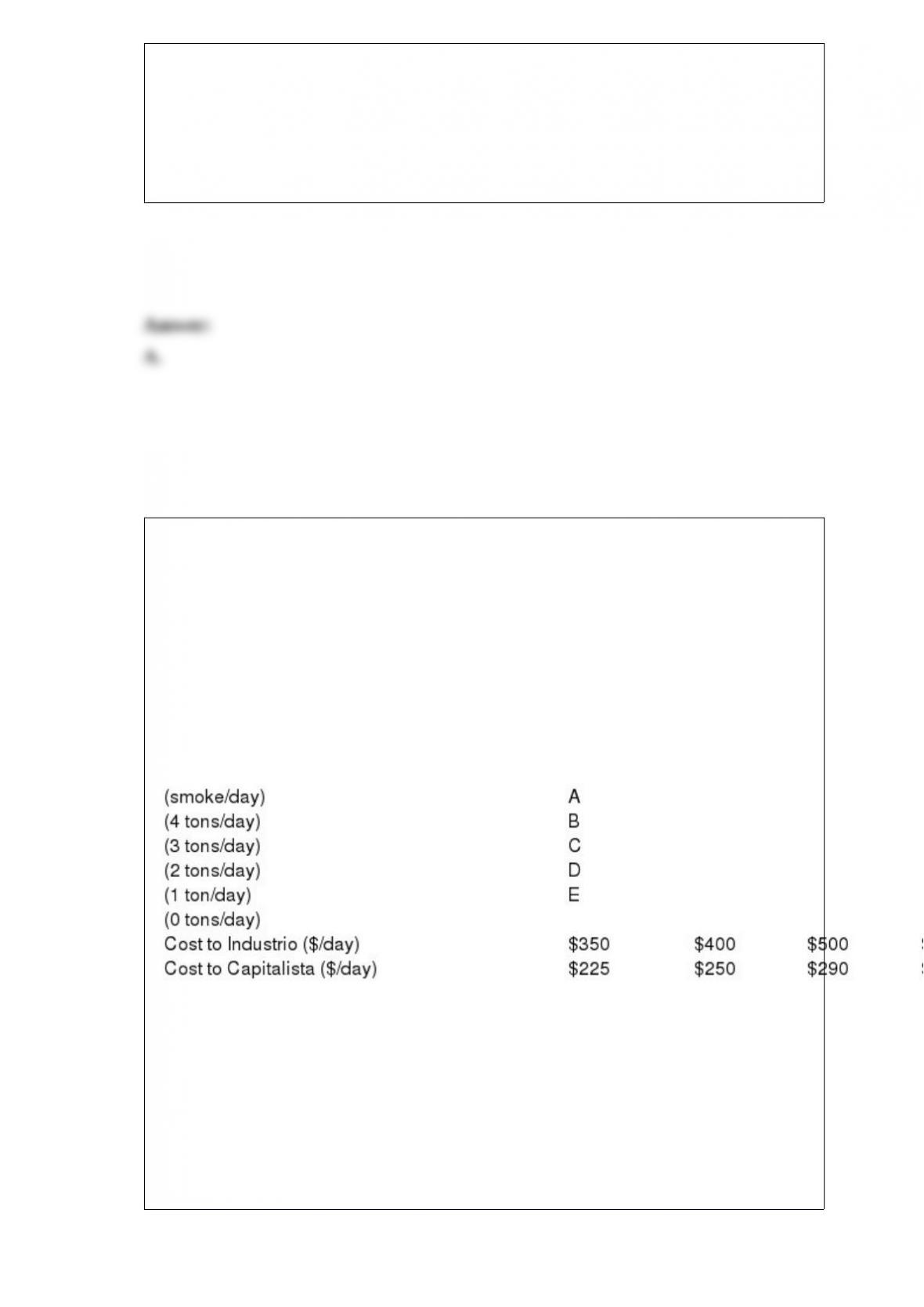
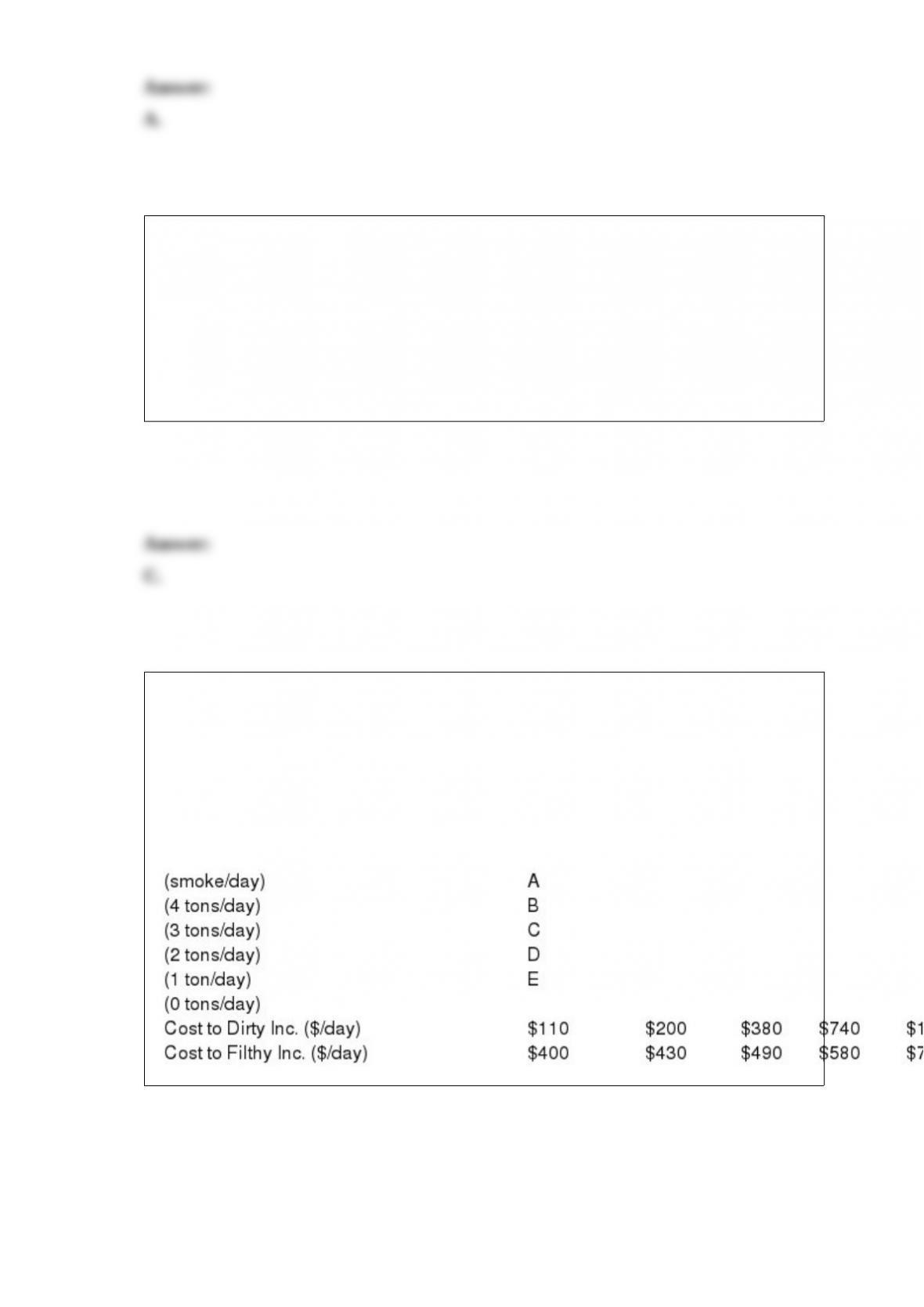
Two firms, Industrio and Capitalista, have access to five production processes, each of
which has a different cost and gives off a different amount of pollution. The daily costs
of the processes and the corresponding number of tons of smoke emitted are shown in
the table below. Both firms currently use process A, and each emits 4 tons of smoke per
day. The government is considering two plans to reduce pollution: requiring both firms
to reduce pollution by 25 percent or auctioning pollution permits. Each permit would
entitle the owner to emit one ton of smoke per day. Without a permit, no smoke can be
emitted.
process
Given that both firms are currently using process A, the cost of requiring the firms to
reduce pollution by 25 percent is ______ per day.
A. $75
B. $375
C. $215
D. $790
First-dollar health insurance reduces the:
A. equilibrium amount of medical care received by the insured.
B. marginal benefit of medical care to the insured.
C. marginal cost of medical care to the insured.
D. total cost of providing medical care.
Two companies, Dirty Inc. and Filthy Inc., each of which has access to 5 different
production processes, each of which has a different cost and produces a different
amount of pollution. The daily costs of the processes and the number of tons of smoke
emitted are shown in the table below.
Process
If pollution is unregulated, then a total of ______ tons of smoke will be emitted each day.
A. 1
B. 2

C. 4
D. 8
Suppose a market is in equilibrium. The area below the market price and above the
supply curve is:
A. the loss in total economic surplus.
B. producer surplus.
C. consumer surplus.
D. total economic surplus.
The cross-price elasticity of demand between bread and potatoes is estimated to be 0.5.
This implies bread and potatoes are:
A. normal goods.
B. substitutes.
C. unrelated.
D. complements.

Bob’s Barber Shop cut 3,000 heads of hair in 2014and 3,100 in 2015. The price of a hair
cut was $7 in 2014and $8 in 2015. If 2014is the base year, what was Bob’s contribution
to nominal GDP in the year 2014?
A. $21,000
B. $21,700
C. $24,000
D. $24,800
The price elasticity of demand for a good measures the responsiveness of:
A. demand to a one percent change in price of that good.
B. price to a one percent change in the demand for that good.
C. quantity demanded to a one percent change in price of that good.
D. price to a one percent change in the quantity demanded of that good.
Assume that Dusty has $30 in income, the price of a loaf of bread is $1.50, and the
price of a jar of peanut butter is $3. At the original income of $30, if the price of a loaf
of bread decreased to $1 and the price of a jar of peanut butter increased to $5, then
Dusty could buy a maximum of ______ loaves of bread or a maximum of ______ jars
of peanut butter.
A. 20; 5
B. 5; 20
C. 30; 6
D. 6; 30
The primary objective of an imperfectly competitive firm is to:
A. charge the highest possible price.
B. maximize total revenue.
C. minimize total cost.
D. maximize profit.

Cal has a choice between two gambles. The first gamble offers a 50 percent chance of
winning $20 and a 50 percent chance of losing $20. The second gamble offers a 20
percent chance of winning $100 and an 80% chance of losing $20. Which choice has
the higher expected value?
A. The expected value of both gambles is the same, so Cal would be indifferent
between the two.
B. The expected value of the first gamble is higher.
C. The expected value of both gambles is the same, but Cal would prefer the first
gamble since the chances of winning are higher.
D. The expected value of the second gamble is higher.
Summing the value added of all firms yields the value of final goods and services
produced because both measures:
A. exclude the value of capital goods.
B. exclude the value of intermediate goods and services.
C. use constant prices.
D. are adjusted for population growth.

Mel is thinking of going on a cruise. Mel values a cruise in nice weather at $2,000 and
values a cruise in bad weather at $50. The probability of nice weather is 60% and the
probability of bad weather is 40%. Trip insurance is sometimes available. If purchased,
it allows travelers to delay the cruise until the weather is nice. The amount of money
that Mel is willing to pay for trip insurance will be:
A. higher if she is risk-averse instead of risk-neutral.
B. lower if she is risk-averse instead of risk-neutral.
C. the same regardless of whether she is risk-averse or risk-neutral.
D. positive if she is risk-neutral and negative if she is risk-averse.
Automatic stabilizers are provisions in the law which create automatic ______ in
government spending or ______ in taxes when real output declines.
A. increases; increases
B. increases; decreases
C. no change; no change
D. decreases; decreases

Each of the following would increase the demand for U.S. dollars, shifting the demand
curve for dollars to the right, except:
A. an increased preference for U.S.-made goods.
B. an increase in real GDP abroad.
C. an increase in the real interest rate on U.S. assets.
D. an appreciation of foreign currencies relative to the U.S. dollar.
In exchange for a share of the revenues earned on campus, State U has granted
CheapFizz the exclusive right to sell soft drinks in the student union and in vending
machines on campus. Prior to the deal, three soft drink companies sold beverages on
campus; now no other soft drink company is allowed to sell its products on campus.
Prior to the deal, a 12-ounce can of CheapFizz sold for 75 cents. After the deal you
would expect a 12-ounce can of CheapFizz to sell for:
A. 75 cents because that is the market price.
B. less than 75 cents because CheapFizz will have greater volume and so can lower its
price.
C. more than 75 cents because the demand curve for CheapFizz soda will shift to the
left.
D. more than 75 cents because CheapFizz is the only company that can sell soda on
campus.
Suppose that the equilibrium price of apples falls and the equilibrium quantity
increases. Which of the following best fits the observed data?
A. An increase in demand with supply constant.
B. A decrease in supply with demand constant.
C. An increase in demand coupled with an increase in supply.
D. An increase in supply with demand constant.
In many cities in the United States, a single firm provides electricity. Those firms are:
A. monopolists.
B. oligopolists.
C. monopolistic competitors.
D. perfect competitors.