
If the long-run average total cost curve is downward sloping, then the firm is
experiencing decreasing returns to scale.
Answer:
In a decreasing-cost industry, the entry of new firms lowers average cost at each level of
output.
Answer:
The budget deficit increases during wars and recessions.
Answer:
The payment received by suppliers of entrepreneurial skills is called interest.
Answer:

Suppose real GDP is $13 trillion and potential real GDP is $13.5 trillion. If Congress
and the president increase government purchases by $500 billion, then the economy
will be brought to equilibrium at potential real GDP.
Answer:
Which of the following would decrease the balance on the current account?
A) a decrease in foreign direct investment
B) a decrease in the amount of aid money the government sends abroad
C) a decrease in imports
D) None of the above will increase the balance on the current account.
Answer:
Suppose a firm uses labor and capital to produce output. The last unit of labor hired has
a marginal product of 12 units of output, and the last unit of capital employed has a
marginal product of 20 units. Use the optimal combination of inputs rule to calculate
the price of capital if the price of labor is $6 per unit. The price of capital is
A) $2.
B) $10.
C) $20.
D) impossible to determine with the information given.
Answer:

Rayburn Reed is a highly talented photographer. He has chosen to specialize in
photography because of all of the followingexcept
A) he obviously has a comparative advantage in photography.
B) his opportunity cost of pursuing another career is very low.
C) for him, this is the most lucrative way to purchase the products that he wants to
consume.
D) his photographs are highly esteemed by art lovers who are willing to pay very high
prices.
Answer:
If nominal GDP is $5 trillion and real GDP is $4 trillion, the GDP deflator is
A) 12.5.
B) 80.
C) 125.
D) 800.
Answer:
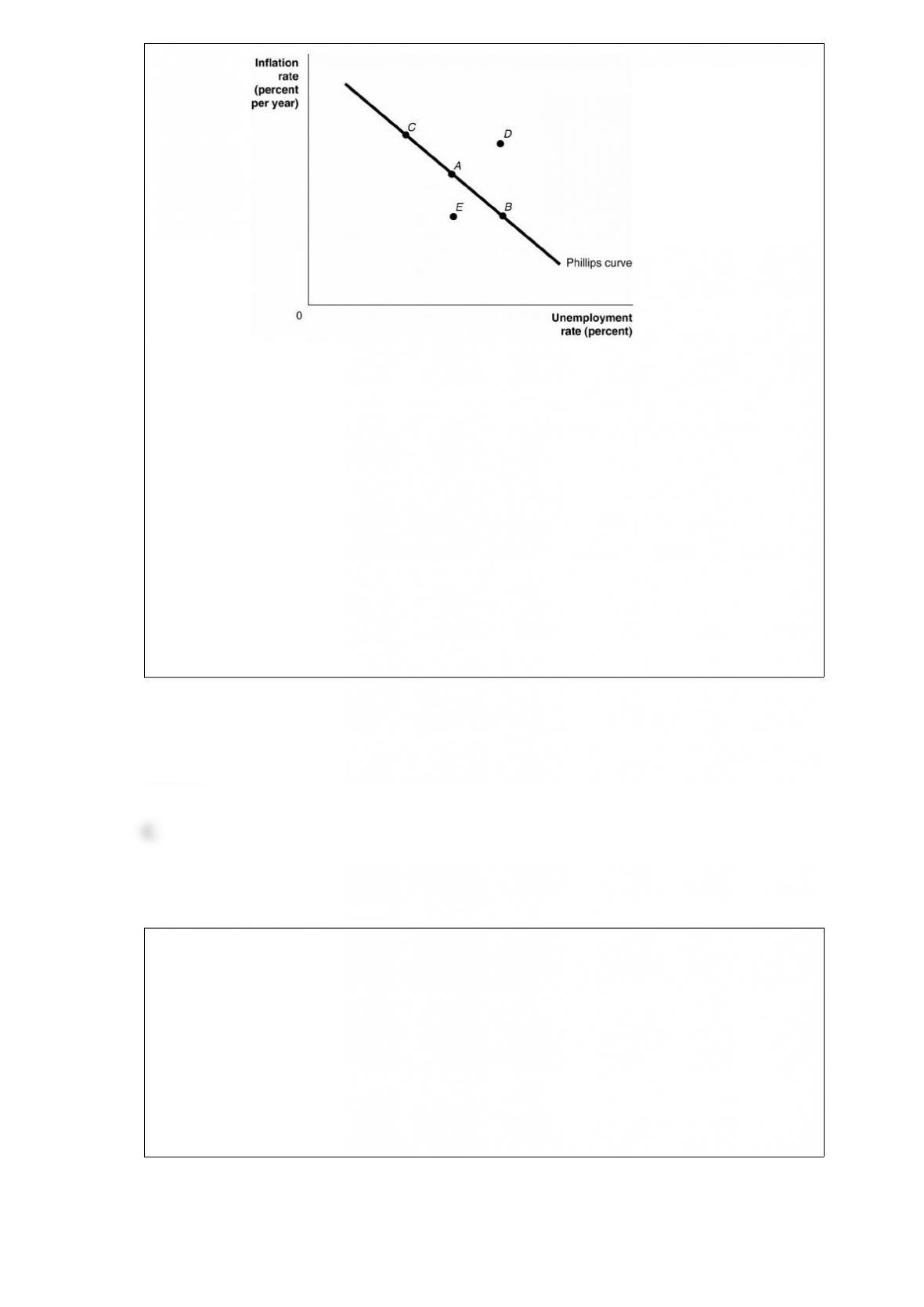
Figure 17-1
Suppose that the economy is currently at point A on the short-run Phillips curve in the
figure above, and the unemployment rate at A is the natural rate. If the economy was to
move to point C, which of the following must be true?
A) The economy is producing a level of GDP equal to potential GDP.
B) Aggregate demand must have decreased.
C) Equilibrium GDP at point C must be above potential GDP.
D) The Fed conducted contractionary policy to cause the move.
E) The Fed sold treasury bills to cause the move.
Answer:
Adverse selection occurs in the market for used cars because used car buyers
A) have more information than used car sellers.
B) have less information than used car sellers.
C) have less incentive to maintain the value of their cars than new car buyers.
D) tend to have more accidents than new car buyers.
Answer:

Article Summary. According to a study by the Center for Neighborhood
Technology, homes located within one-half mile of frequently-used public
transportation held their value much better during the recent housing market
downturn than did those without easy access to public transportation, and the
greater home values reflect greater demand for neighborhoods in close proximity
to public transportation. In addition to higher home values, the study found that
close proximity to public transportation offers lower transportation costs, a wider
variety of travel options, and access to more employment opportunities. Source:
Meg Handley, “Study: Proximity to Public Transit Boosts Home Values,” U.S.
News & World Report, March 22, 2013.
Higher home values which result from close proximity to public transportation are an
example of a ________ due to the public transportation.
A) positive externality.
B) negative externality.
C) private cost.
D) social cost.
Answer:
Which of the following will shift the demand for the euro to the right?
A) an increase in interest rates in the European Union
B) an increase in incomes in countries that buy goods from the European Union
C) expectations among speculators that the price of the euro will rise in the future
D) All of the above will shift the demand for the euro to the right.

Answer:
According to new growth theory,
A) technological change is influenced by economic incentives.
B) centrally-planned economies are the most efficient.
C) growth in real GDP per capita occurs only if there are increasing returns.
D) economic growth is determined by forces outside the control of the market system.
Answer:
To examine how the total production of an economy has changed over time, it would be
better to examine
A) real GDP.
B) nominal GDP.
C) GDP at current prices.
D) the GDP deflator.
Answer:
If the consumption function is defined as C = 5,500 + 0.9Y, what is the autonomous

level of consumption expenditure?
A) $4,950
B) $5,500
C) $6,050
D) $6,111
Answer:
The shape of the average total cost curve is determined by the shape of
A) the marginal cost curve.
B) the average fixed cost curve.
C) the average product curve.
D) the firm’s production function.
Answer:
Why does the short-run aggregate supply curve slope upward?
Answer:
What is an entrepreneur?
Answer:
How might have the educational system of the United States contributed to the
productivity slowdown of the mid-1970s to the mid-1990s?
Answer:
How will the purchase of $100 million of government securities by the Federal Reserve
change bank reserves and total checking account deposits in the banking system as a
whole? Assume that banks do not hold any excess reserves, that households and firms
do not change the amount of currency they hold, and that the required reserve ratio is 20
percent.

Answer:
What is an isoquant? What is the slope of an isoquant?
Answer:
Discuss the role of product differentiation and advertising in monopolistic competition.
Answer:

Describe the pattern of growth rates in real GDP per hour worked in the United States
since the early nineteenth century. Has output per hour worked consistently increased at
the same rate? Explain.
Answer:
Ceteris paribus, how does an expansion in the United States affect U.S. net exports?
Answer:
What is the difference between federal purchases and federal expenditures?
Answer: