
Society faces a trade-off in all of the following situations except
A) when deciding who will receive the goods and services produced.
B) when deciding what goods and services will be produced.
C) when deciding how goods and services will be produced.
D) when some previously unemployed workers find jobs.
That some talented people may not enter an occupation because they have heard that
people with their personal characteristics do not get hired in that occupation is known
as
A) economic discrimination.
B) a compensating difference.
C) a negative feedback loop.
D) worker discrimination.
Planned aggregate expenditure is equal to
A) consumption spending only.
B) consumption spending plus planned investment spending.
C) planned investment spending only.
D) consumption spending plus planned investment spending plus government purchases
plus net exports.
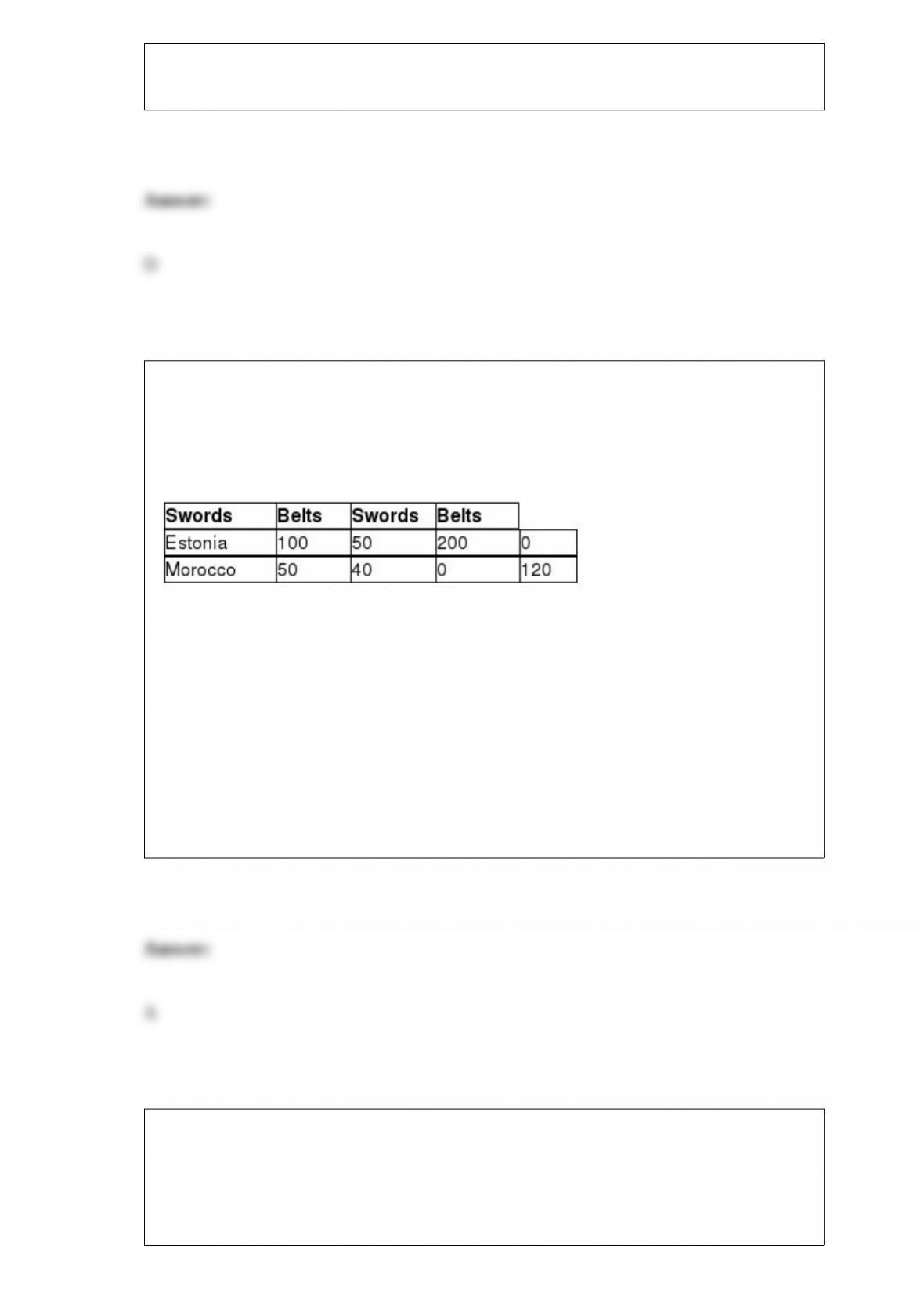
Table 7-6 Production and
Consumption Production
Without Trade With Trade
Estonia and Morocco can produce both swords and belts. Table 7-6 shows the
production and consumption quantities without trade, and the production numbers with
trade. Which country has an absolute advantage in producing swords?
A) Estonia
B) Morocco
C) both countries
D) neither country
Fiona shares an office with her ex-husband. Her share of the rent and utilities are $625
per month. She is considering moving to a home office which she will not have to share
with anyone. The home office will not cost her anything as far as extra rent or utilities.
Recently, you ran into Fiona at the gym and she tells you that she has moved into her
home office. Fiona is as rational as any other person. As an economics major, you

rightly conclude that
A) Fiona did not have a choice; her ex-husband was a jerk.
B) Fiona figures that the additional benefit of having her own office (as opposed to
sharing) is at least $625.
C) Fiona figures that the benefit of having her own office (as opposed to sharing) is
zero, since she is no longer paying rent and utilities.
D) The cost of having one’s own space outweighs the benefits.
Which of the following is an example of foreign direct investment in China?
A) U.S. auto entrepreneur Elon Musk buys stock in Tata Motors of Mumbai, India.
B) Chinese Shenzen Airlines company buys a small U.S. midwest airline company, Air
Chicago.
C) The U.S. company Wal-Mart buys a warehouse in Shanghai.
D) The bank of China purchases U.S. Treasury bonds.
E) A U.S. foreign exchange speculator buys $200,000 worth of the Chinese currency
the yuan.
Table 2-1 Production Choices for Dina’s Diner
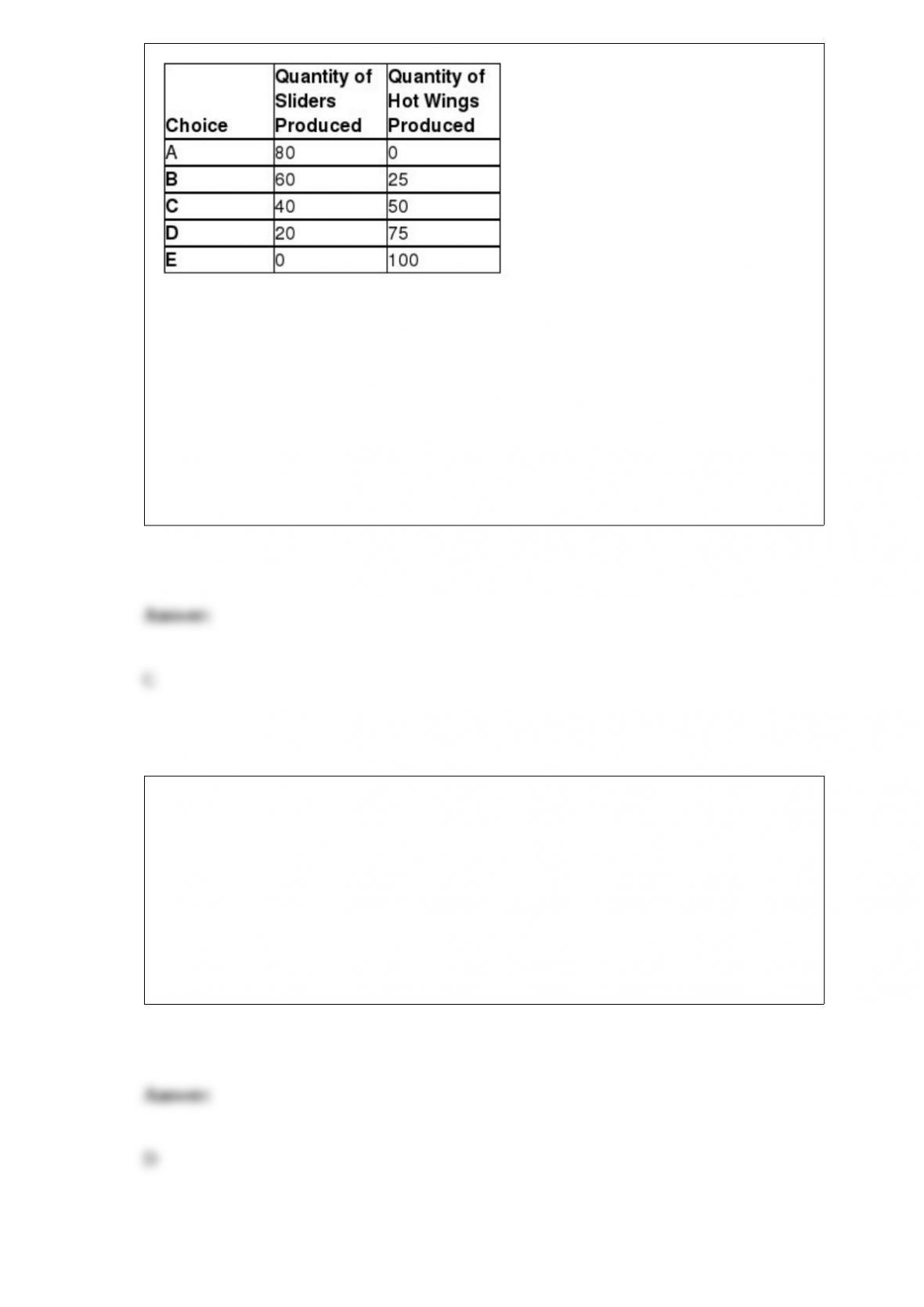
Assume Dina’s Diner only produces sliders and hot wings. A combination of 50 sliders
and 50 hot wings would appear
A) along Dina’s production possibilities frontier.
B) inside Dina’s production possibilities frontier.
C) outside Dina’s production possibilities frontier.
D) at the vertical intercept of Dina’s production possibilities frontier.
The points outside the production possibilities frontier are
A) efficient.
B) attainable.
C) inefficient.
D) unattainable.

Table 2-12
Table 2-12 shows the number of labor hours required to produce a canoe and a sailboat
in Guatemala and Honduras.
What is Honduras’s opportunity cost of producing one canoe?
A) 1/5 of a sailboat
B) 1.5 sailboats
C) 5 sailboats
D) 6 sailboats
Which of the following is not one of the four main categories of spending identified by
John Maynard Keynes?
A) consumption
B) planned investment
C) government purchases
D) transfer payments

Which of the following is an example of an implicit cost a firm might incur?
A) the out-of-pocket expense to hire resources
B) taxes owed to the state and Federal governments
C) the rental value of the office space the company owns and uses for itself
D) the revenue a firm generates in using its resources
The ________ system of currency exchange was set up in 1944.
A) gold standard
B) Bretton Woods
C) managed float
D) flexible
On the 45-degree line diagram, for points that lie above the 45-degree line,
A) planned aggregate expenditure is greater than GDP.
B) planned aggregate expenditure is less than GDP.
C) planned aggregate expenditure is equal to GDP.
D) planned aggregate expenditure is less than aggregate income.

Suppose that when the price of hamburgers increases, the Ruiz family increases their
purchases of hot dogs. To the Ruiz family,
A) hamburgers and hot dogs are complements.
B) hamburgers and hot dogs are inferior goods.
C) hamburgers and hot dogs are normal goods.
D) hamburgers and hot dogs are substitutes.
Buyers rush to purchase stocks in California vineyards following a forecast of a 30
percent decline in this year’s grape harvest. What happens in the California wine market
as a result of this announcement?
A) The demand curve for California wine shifts to the left in anticipation of higher
prices in the future.
B) The demand curve for California wine shifts to the right in anticipation of higher
prices in the future.
C) The supply curve for California wine shifts to the right in anticipation of higher
prices in the future.
D) The supply curve for California wine shifts to the left in anticipation of lower
quantities in the future.

Between 1970 and 2006, the poverty rate in East Asia declined dramatically from about
60 percent to less than 2 percent, while the poverty rate in Sub-Saharan Africa
decreased from 40 percent to only 32 percent. The main reason for this is that
A) the population growth rate decreased in East Asia and increased in Sub-Saharan
Africa.
B) governments in East Asia increased transfer payments to poor families over this
period of time. The governments of Sub-Saharan Africa had practically no transfer
payment programs from 1970 to 2006.
C) the countries of East Asia have progressive income tax systems. The countries of
Sub-Saharan Africa all have regressive income tax systems.
D) East Asia experienced higher economic growth than Sub-Saharan Africa.
In an open economy, the government purchases multiplier will be
A) larger as the marginal propensity to import increases.
B) smaller as the marginal propensity to import increases.
C) larger as the marginal propensity to tax increases.
D) smaller as the marginal propensity to consume increases.