
Figure 5-1 Figure 5-1 represents the market
for vaccinations. Vaccinations are considered a benefit to society, and the figure shows
both the marginal private benefit and the marginal social benefit from vaccinations. At
the market equilibrium,
A) the marginal cost is equal to the marginal benefit.
B) the marginal cost is greater than the marginal benefit.
C) the marginal cost is less than the marginal benefit.
D) the marginal cost is zero.
Lucas and Sargent argue that the short-run trade-off between unemployment and
inflation is caused by
A) workers and firms using Fed policy to predict inflation.
B) workers and firms using all the information available to predict inflation.
C) workers and firms rapidly adjusting wages and prices in response to changes in
expectations.
D) workers and firms being fooled by unexpected changes in monetary policy.

Figure 5-6 Figure 5-6 shows the market for
measles vaccinations, a product whose use generates positive externalities.What does
D1 represent?
A) the demand curve reflecting social benefit
B) the positive externalities curve
C) the demand curve reflecting private benefit
D) the social welfare curve
Globalization refers to
A) the process of establishing a common world currency.
B) the willingness of individuals within a given country to share knowledge with one
another.
C) the process of countries becoming more open to foreign trade and investment.
D) the reduction in growth rates of real GDP per capita as a result of trade with foreign
countries.
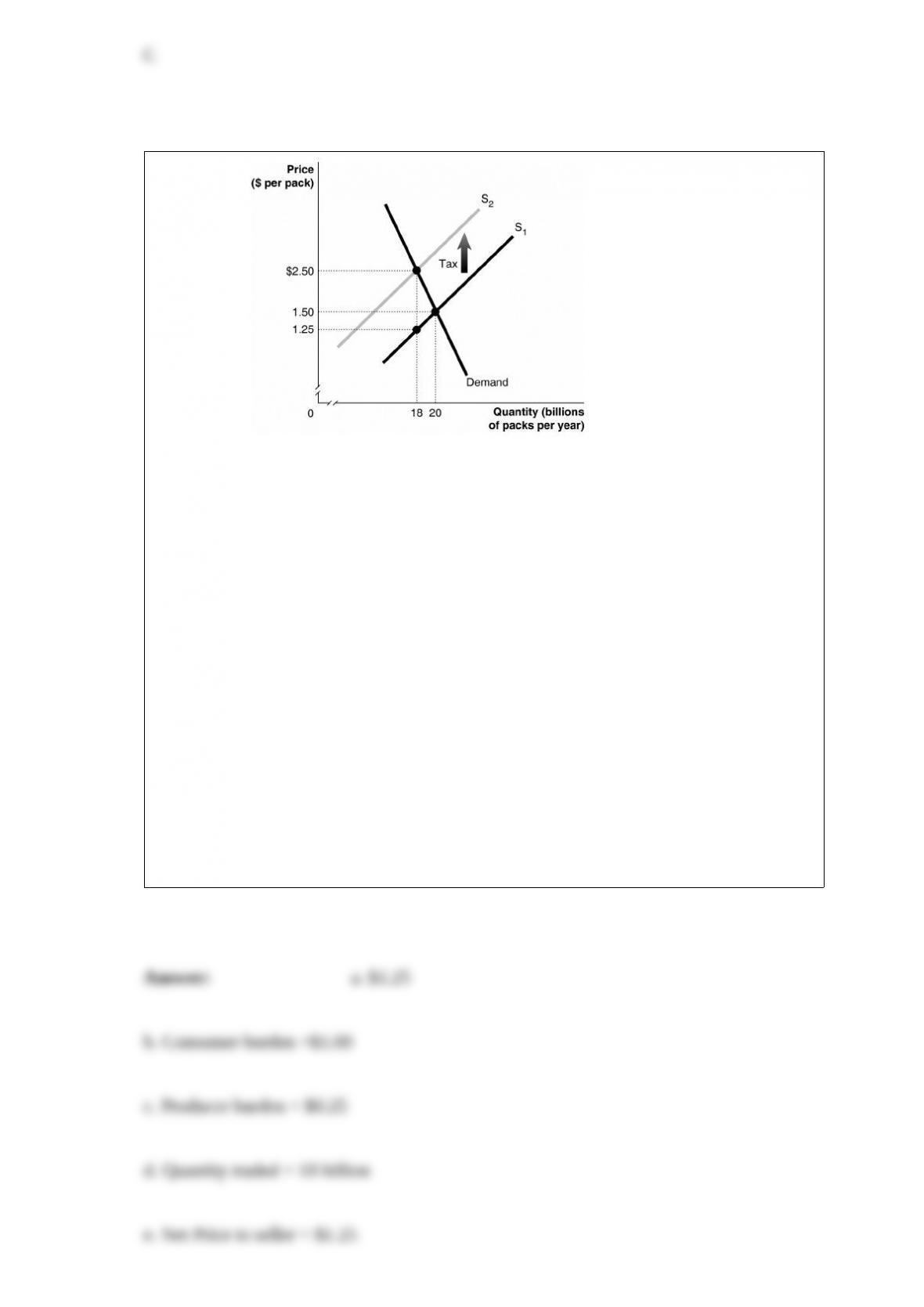
Figure 4-12
The figure above represents demand and supply in the market for cigarettes. Use the
diagram to answer the following questions.
a. How much is the government tax on each pack of cigarettes?
b. What portion of the unit tax is paid by consumers?
c. What portion of the unit tax is paid by producers?
d. What is the quantity sold after the imposition of the tax?
e. What is the after-tax revenue per pack received by producers?
f. What is the total tax revenue collected by the government?
g. What is the value of the excess burden of the tax?
h. Is this cigarette tax efficient?
During a deflationary period,
A) the nominal interest rate is less than the real interest rate.
B) the real interest rate is less than the nominal interest rate.
C) the price level rises.
D) the nominal interest rate does not change.
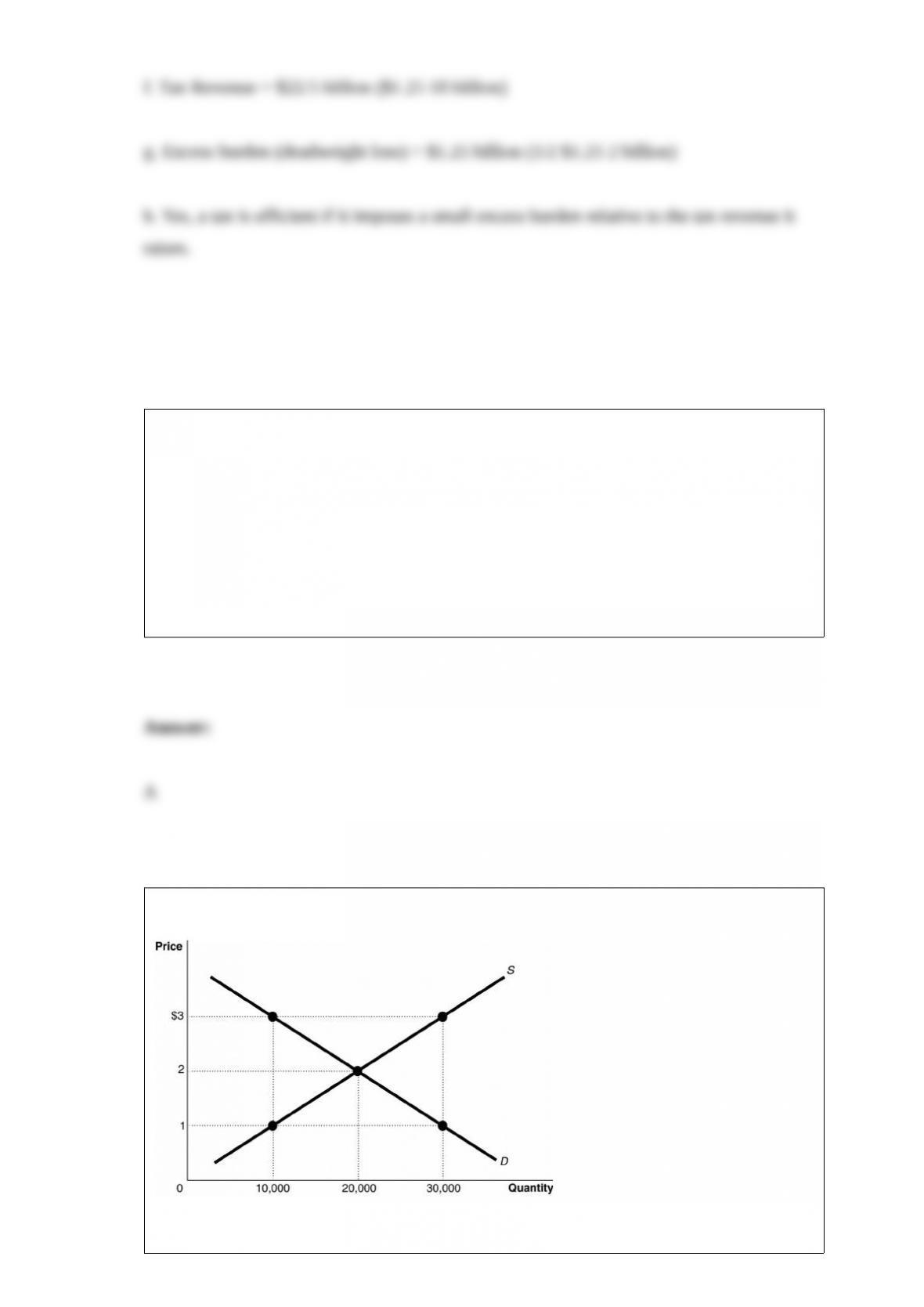
Figure 4-4
The figure above represents the market for iced tea. Assume that this is a competitive

market. If 10,000 units of iced tea are sold
A) the deadweight loss is equal to economic surplus.
B) producer surplus equals consumer surplus.
C) the marginal benefit of each of the 10,000 units of iced tea equals $3.
D) marginal benefit is less than marginal cost.
Stan owns a software design business. He does not have time to expand his office space
or redesign the layout of his office. He can increase the amount of work he does by
working more hours, asking his current employees to work more hours, or hiring more
employees. The relationship between Stan’s inputs and the maximum output his firm
can produce is called his
A) long-run production function.
B) production possibilities frontier.
C) short-run production function.
D) cost function.
Table 4-11

The equations above describe the demand and supply for Chef Ernie’s Sushi-on-a-Stick.
The equilibrium price and quantity for Chef Ernie’s sushi are $60 and 20 thousand units.
What is the value of producer surplus?
A) $100 thousand
B) $200 thousand
C) $600 thousand
D) $800 thousand
If the Apple iPhone and the Samsung Galaxy are considered substitutes, then, other
things equal, an increase in the price of the iPhone will
A) decrease the demand for the iPhone.
B) increase the demand for the Galaxy.
C) increase the quantity demanded for the Galaxy.
D) increase the quantity demanded for the iPhone.