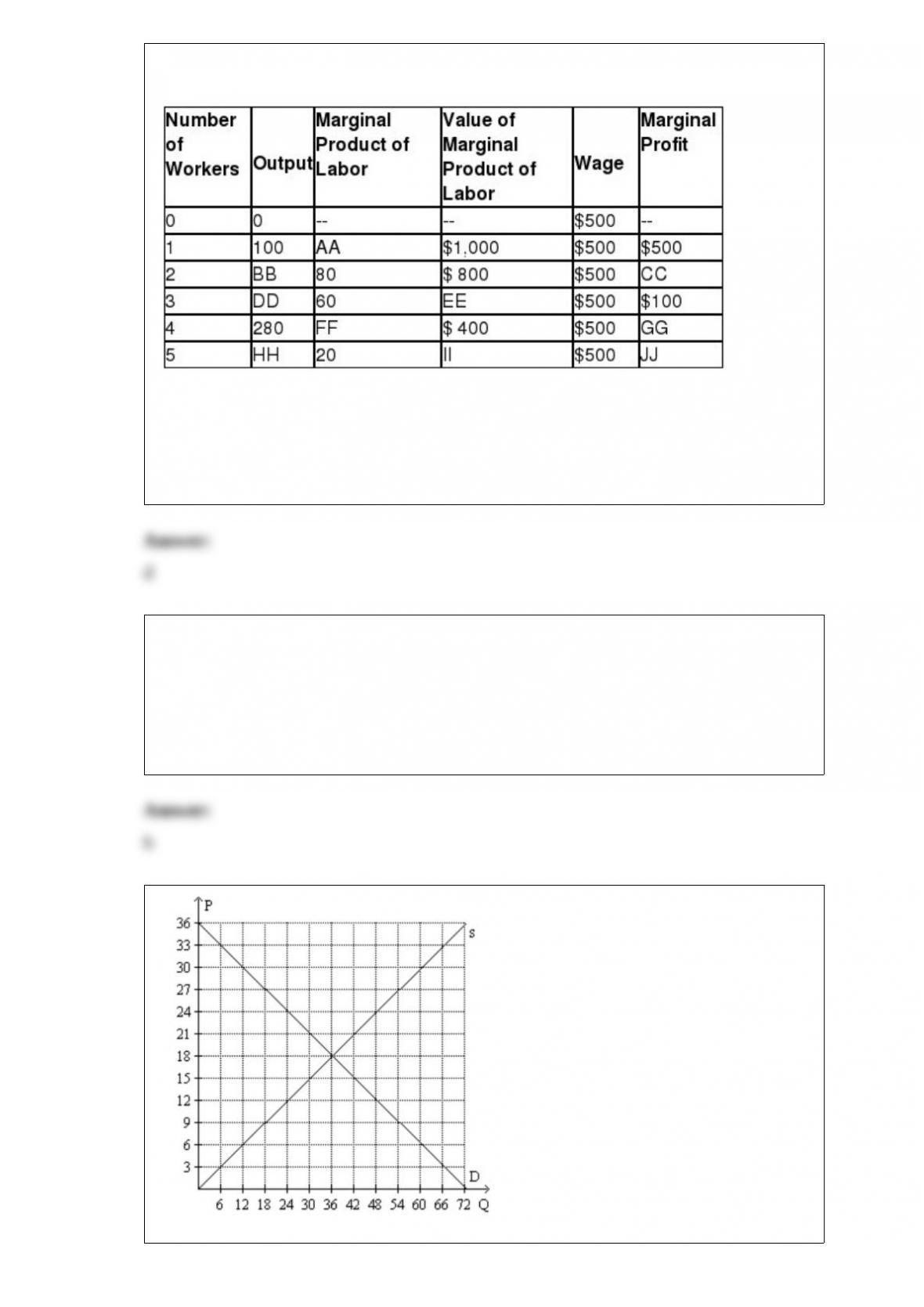
1) Table 18-7
Refer to Table 18-7. It is apparent from this table that increasing marginal product
a.occurs only after the first worker is hired.
b.occurs only after the second worker is hired.
c.occurs only after the third worker is hired.
d.never occurs.
2) The payroll tax differs from the individual income tax because the payroll tax is
primarily earmarked to pay for
a.employer-provided pensions.
b.Social Security and Medicare.
c.employer-provided health benefits.
d.job loss and training programs.
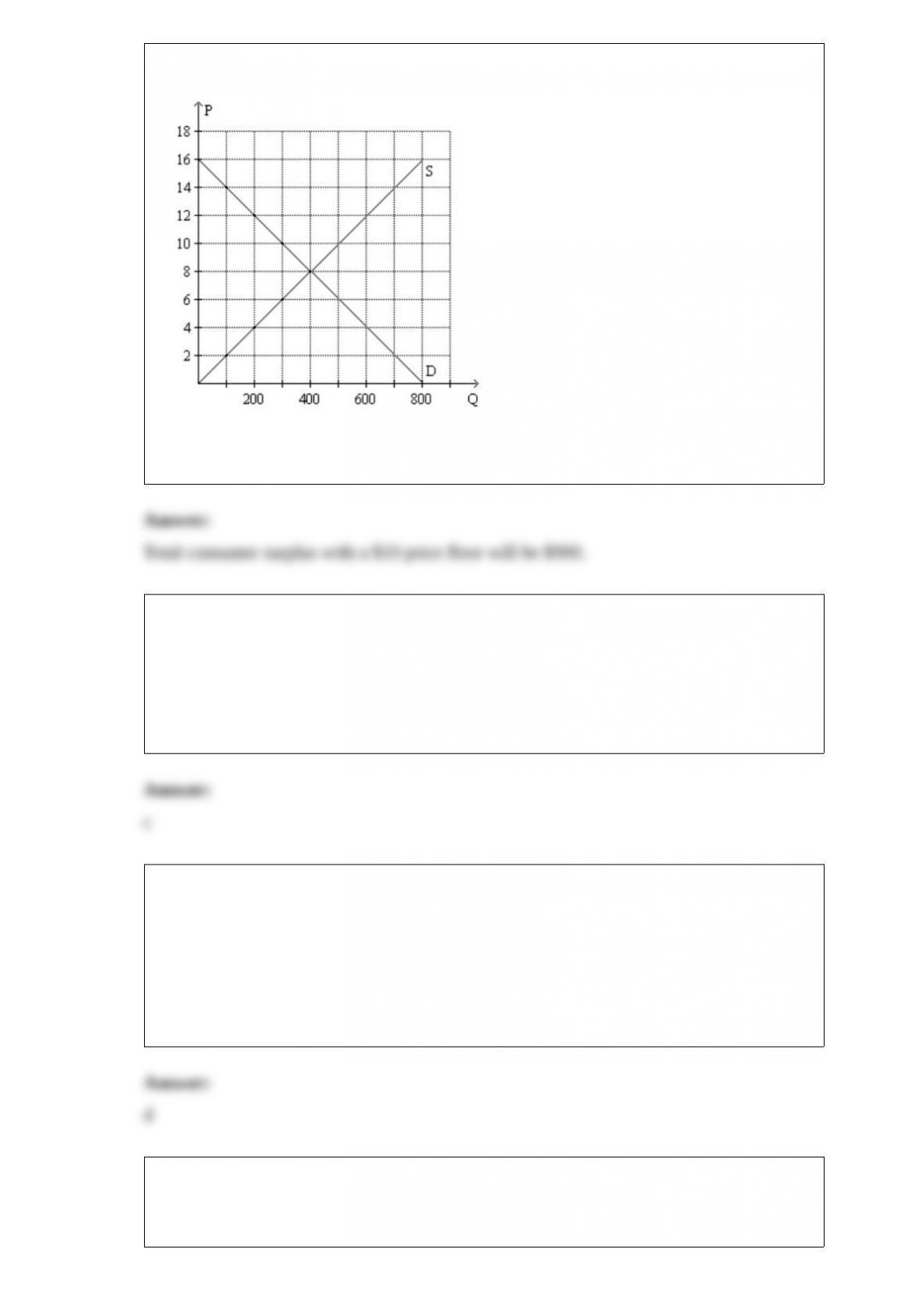
3) Figure 7-34
Refer to Figure 7-34. Suppose the government imposes a price floor at $10 per unit in
this market. With the price floor, how much is total consumer surplus?
4) If hiring more workers results in each additional worker contributing successively
smaller amounts of output, then which of the following is present?
a.diminishing profitability
b.diminishing total product
c.diminishing marginal product
d.Both b and c are correct.
5) Suppose the cost of flying a 200-seat plane for an airline is $100,000 and there are 10
empty seats on a flight. The airline should sell a ticket to a standby passenger only if the
passenger is willing to pay
a.more than $200.
b.more than $300.
c.more than $500.
d.This cannot be determined from the information given.
6) A market supply curve shows how the total quantity supplied of a good varies as
a.production technology varies.
b.price varies.

c.input prices vary.
d.demand varies.
7) When the government prevents prices from adjusting naturally to supply and
demand,
a.it equates the amount buyers want to buy with the amount sellers want to sell.
b.it adversely affects the allocation of resources.
c.it improves equality and efficiency.
d.it improves efficiency but reduces equality.
8) Suppose that a worker in Freedonia can produce either 6 units of corn or 2 units of
wheat per year, and a worker in Sylvania can produce either 2 units of corn or 6 units of
wheat per year. Each nation has 10 workers. Without trade, Freedonia produces and
consumes 30 units of corn and 10 units of wheat per year. Sylvania produces and
consumes 10 units of corn and 30 units of wheat. Suppose that trade is then initiated
between the two countries, and Freedonia sends 30 units of corn to Sylvania in
exchange for 30 units of wheat. Sylvania will now be able to consume a maximum of
a.30 units of corn and 30 units of wheat.
b.40 units of corn and 30 units of wheat.
c.40 units of corn and 20 units of wheat.
d.10 units of corn and 40 units of wheat.
9) The calculation of the poverty line includes adjustments for
a.energy costs.
b.child care costs.
c.the level of prices.
d.the Earned Income Tax Credit.
10)
The marginal tax rate for an unmarried taxpayer in the highest taxable income category
for 2013 is approximately
a.80 percent.
b.50 percent.

c.40 percent.
d.20 percent.
11) The supply curve for a good is a line that relates
a.profit and quantity supplied.
b.quantity supplied and quantity demanded.
c.price and quantity supplied.
d.price and profit.
12) Bubba is a shrimp fisherman who catches 4,000 pounds of shrimp per year. He can
sell the shrimp for $5 per pound. His average total cost of catching shrimp is $3 per
pound. Bubba’s annual total revenue is
a. $8,000.
b. $12,000.
c. $20,000.
d. $32,000.
13) “In a long-run equilibrium, price is equal to average total cost.” This statement
applies to
a.competitive markets, but not to monopolistically competitive markets or monopolies.
b.competitive and monopolistically competitive markets, but not to monopolies.
c.competitive markets, monopolistically competitive markets, and monopolies.
d.None of the above is correct.
14) Superstars earn high incomes due to their ability to satisfy the demands of millions
of people at once.
a.True
b.False

15) The world price of a ton of steel is $1,000. Before Russia allowed trade in steel, the
price of a ton of steel there was $650. Once Russia allowed trade in steel with other
countries, Russia began
a.exporting steel and the price per ton in Russia remained at $650.
b.exporting steel and the price per ton in Russia increased to $1,000.
c.importing steel and the price per ton in Russia remained at $650.
d.importing steel and the price per ton in Russia increased to $1,000.
16) Some firms eventually experience problems with their capacity to produce output as
their output levels increase. For these firms,
a.market power is substantial.
b.supply is perfectly inelastic.
c.supply is more elastic at low levels of output and less elastic at high levels of output.
d.supply is less elastic at low levels of output and more elastic at high levels of output.
17) A tax levied on the buyers of a good shifts the
a.supply curve upward (or to the left).
b.supply curve downward (or to the right).
c.demand curve downward (or to the left).
d.demand curve upward (or to the right).