
Because leisure is a normal good, an increase in the wage rate will result in
A) an increase in the quantity of labor supplied because of both the substitution effect
and the income effect.
B) a decrease in the quantity of labor supplied because of the substitution effect and an
increase in the quantity of labor supplied because of the income effect.
C) an increase in the quantity of labor supplied because of the substitution effect and a
decrease in the quantity of labor supplied because of the income effect.
D) an increase in the quantity of labor supplied because of the substitution effect. At
low wages the income effect causes an increase in the quantity of labor supplied, but at
high wages the income effect causes a decrease in the quantity of labor supplied as the
wage rises.
The public choice model
A) examines the degree of market power that the public exerts in a market economy.
B) examines the public’s role in appointing politicians and ensuring that elected officials
act in ways to reflect the public’s preferences.
C) applies economic analysis to government decision making.
D) applies economic analysis to the collective decision making of consumers.
Which of the following is a key determinant of the price elasticity of supply?
A) the slope of the supply curve
B) the availability of substitutes in production
C) the available technology
D) the time it takes to change output in response to a change in price
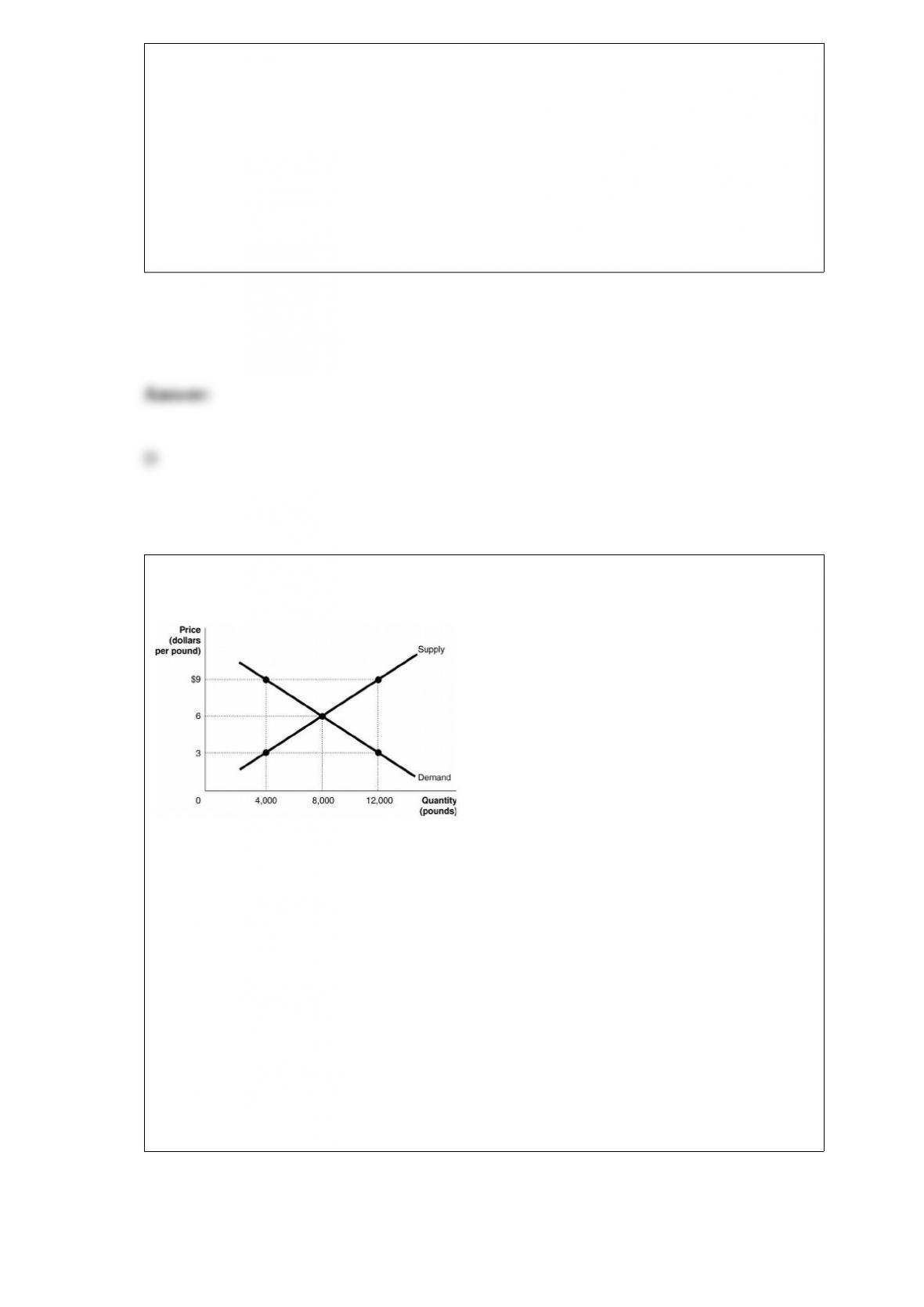
Figure 4-4
Refer to Figure 4-4. The figure above represents the market for pecans. Assume that
this is a competitive market. At a price of $9
A) the marginal cost of pecans is greater than the marginal benefit; therefore, output is
inefficiently low.
B) producers should lower the price to $3 in order to sell the quantity demanded of
4,000.
C) the marginal benefit of pecans is greater than the marginal cost; therefore, output is
inefficiently high.
D) the marginal benefit of pecans is greater than the marginal cost; therefore, output is
inefficiently low.
If Marlowe obtains 9 units of utility per dollar spent on apples and 6 units of utility per
dollar spent on oranges, then Marlowe
A) is maximizing total utility.
B) should buy more apples and fewer oranges.
C) should buy more oranges and fewer apples.
D) should buy fewer oranges and fewer apples.
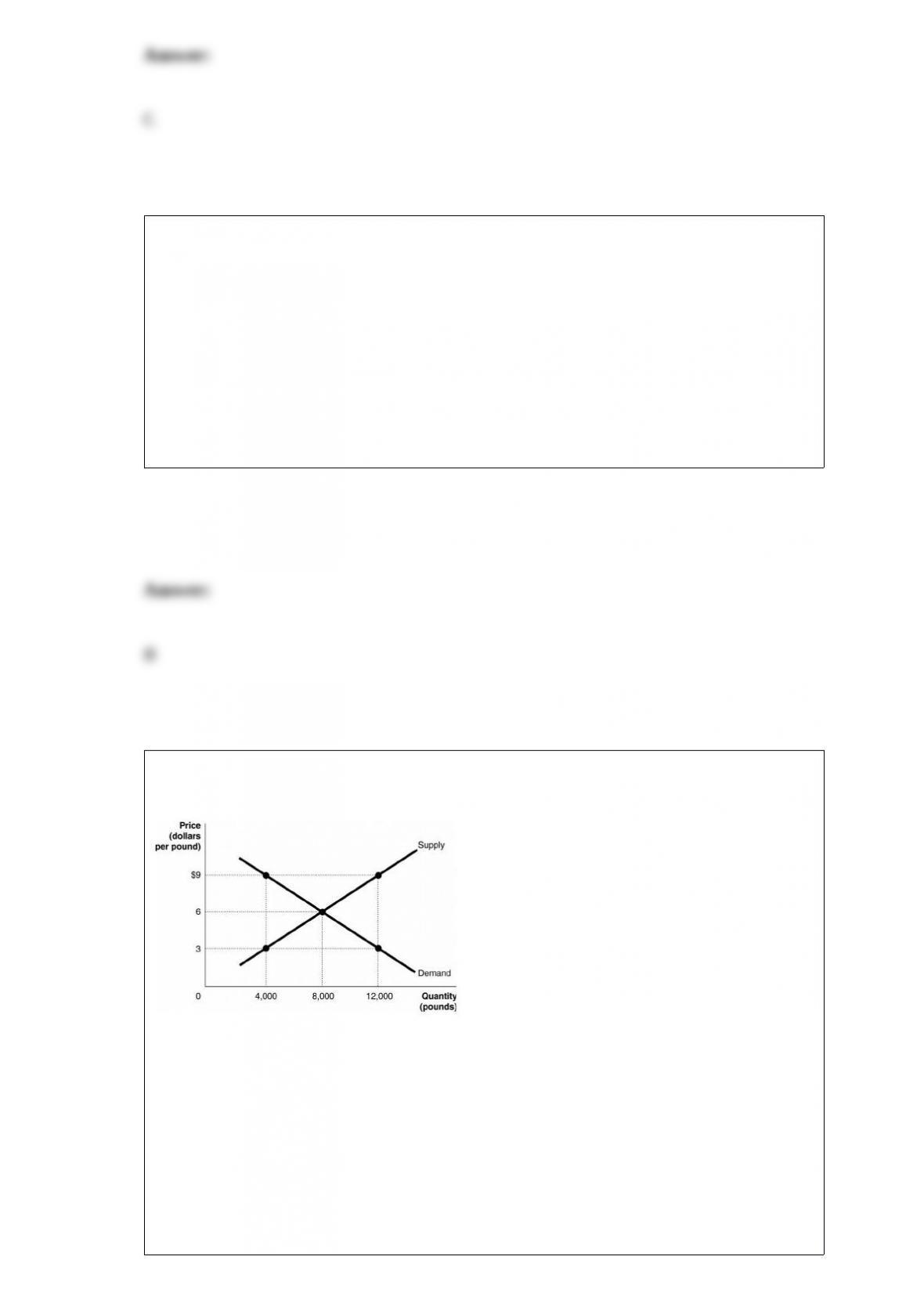
Figure 4-4
Refer to Figure 4-4. The figure above represents the market for pecans. Assume that
this is a competitive market. Which of the following is true?
A) If the price of pecans is $3 the output will be economically efficient but there will be
a deadweight loss.
B) If the price of pecans is $9 consumers will purchase more than the economically
efficient output.
C) Both 4,000 pounds and 12,000 pounds are economically inefficient rates of output.
D) If the price of pecans is $3 producers will sell 12,000 pounds of pecans but this
output will be economically inefficient.
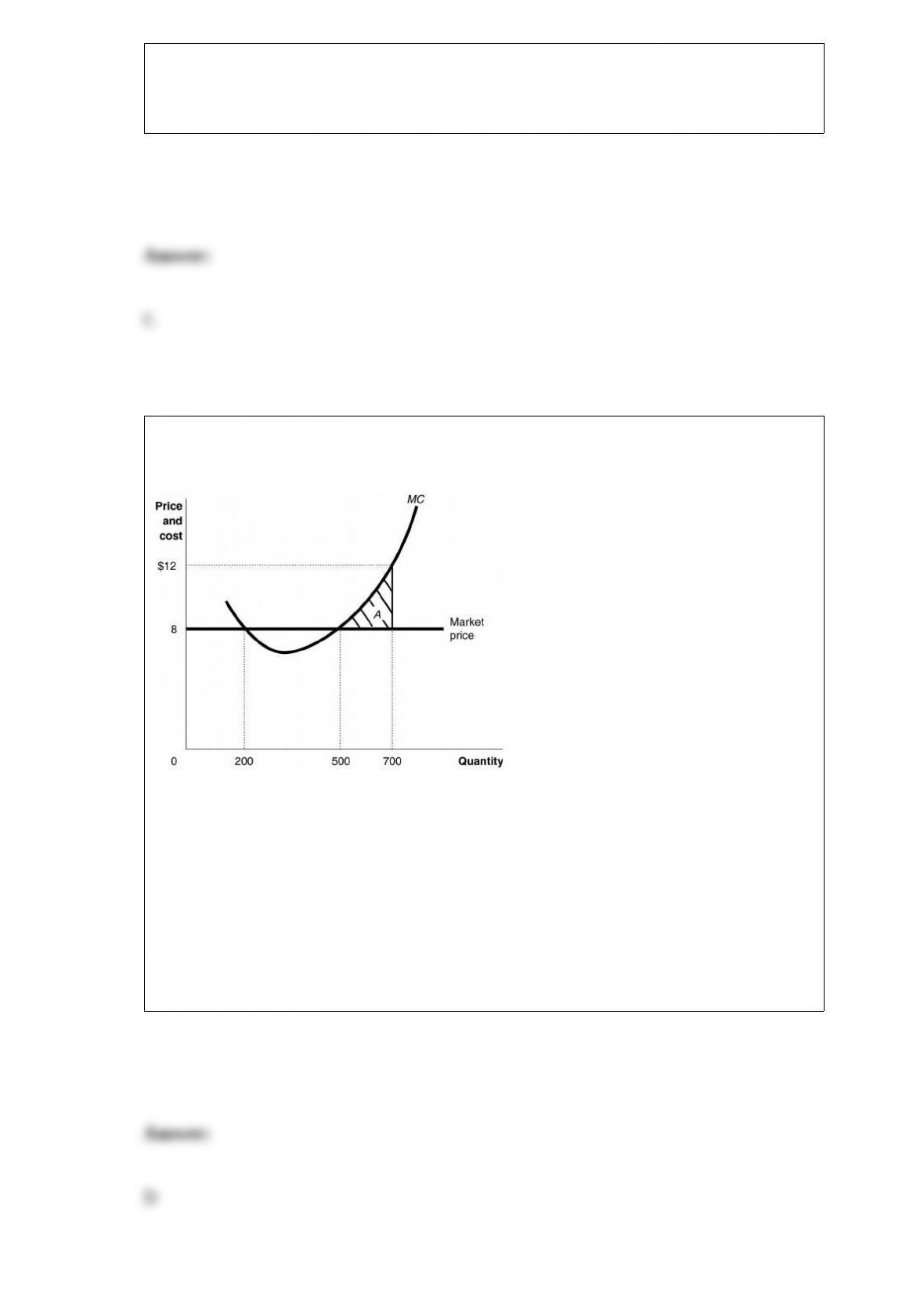
Figure 12-1
Refer to Figure 12-3. If the firm is producing 500 units, what is the amount of its profit
or loss?
A) profit of $280
B) loss equivalent to the area A
C) profit equivalent to the area A
D) There is insufficient information to answer the question.

The number of people receiving Medicare is expected to ________ by the year 2030.
A) reach 5 million by
B) stabilize
C) decline by 10 percent
D) grow to 80 million
Technological advancements have led to lower prices and an increase in the sale of
digital cameras. How does this affect the digital photo printing paper market?
A) The demand curve for digital photo printing paper shifts to the right.
B) The demand curve for digital photo printing paper shifts to the left.
C) The supply curve for digital photo printing paper shifts to the right.
D) The supply curve for digital photo printing paper shifts to the left.
At a price of $100, Beachside Canoe Rentals rented 11 canoes. When it increased its
rental price to $125, 9 canoes were rented. Calculate the absolute value of the price
elasticity of demand for canoe rentals, using the midpoint formula.
A) 2

B) 1.25
C) 0.9
D) 0.75
The market demand for a public good can be determined by
A) adding up the total private benefits and external benefits that each quantity provides
the citizens of a country.
B) adding up how much each citizen expects to consume at each possible price.
C) adding up how much each consumer is willing to pay for each unit of the public
good.
D) estimating the value of the benefit that each unit provides and multiplying that by
the number of consumers.
The cost of group health insurance is lower than if an individual buys a policy on his
own because
A) the problem of adverse selection is reduced.
B) moral hazard costs of a group tend to move to a low average.
C) it is easier for the company to deny claims from a large group.

D) insuring a group eliminates the problem of buyers having more information than the
seller.
For each bottle of wine that Italy produces, it gives up the opportunity to make 10
pounds of cheese. France can produce 1 bottle of wine for every 25 pounds of cheese it
produces. Which of the following is true about the comparative advantage between the
two countries?
A) Italy has the comparative advantage in cheese.
B) Italy has the comparative advantage in wine.
C) France has the comparative advantage in wine and cheese.
D) France has the comparative advantage in wine.
A price maker is
A) a person who actively seeks out the best price for a product that he or she wishes to
buy.
B) a firm that has some control over the price of the product it sells.
C) a firm that is able to sell any quantity at the highest possible price.
D) a consumer who participates in an auction where she announces her willingness to
pay for a product.
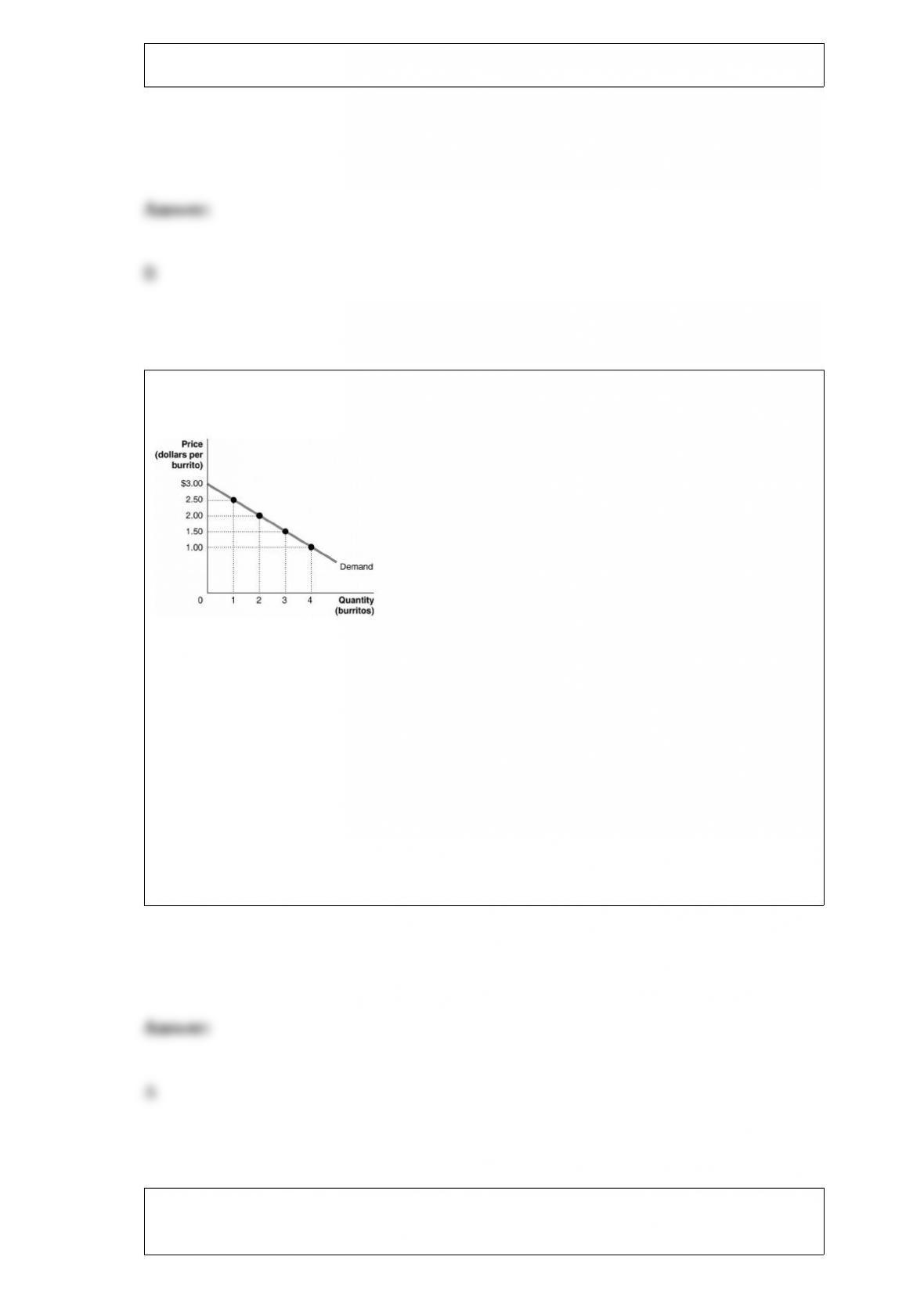
Figure 4-1
Figure 4-1 shows Arnold’s demand curve for burritos.
Refer to Figure 4-1. If the market price is $1.00, what is the consumer surplus on the
third burrito?
A) $0.50
B) $1.00
C) $1.50
D) $7.50
How does the decreasing use of traditional cameras affect the market for traditional
camera film?

A) The demand curve for traditional camera film shifts to the right.
B) The quantity of traditional camera film demanded decreases.
C) The quantity of traditional camera film demanded increases.
D) The demand curve for traditional camera film shifts to the left.
Measures of poverty (for example, the poverty line) and the distribution of income (for
example, the Lorenz curve and the Gini coefficient) are misleading for which of the
following two reasons?
A) First, these measures do not take into account income mobility over time. Second,
these measures ignore the effects of government programs meant to reduce poverty.
B) First, none of these measures are adjusted for inflation. Second, they do not measure
income on a per capita basis.
C) First, these measures fail to include the income U.S. citizens earn working for
foreign firms that have operations located in the United States. Second, these measures
fail to include income foreign citizens earn working for U.S. firms that have operations
in foreign countries.
D) First, these measures fail to include dividend and interest income earned on stocks
and bonds. Second, these measures fail to include the value of goods and services
citizens make for their own consumption that are not sold in markets.
How would the elimination of a sales tax affect the market for a product that had been
subject to the tax?
A) The demand for the product would rise and the equilibrium price would fall by the
amount of the tax.
B) The equilibrium price for the product would fall by less than the amount of the tax.
C) The reduction in government revenue from the tax would be made up by an increase
in property taxes.
D) The supply of the product would become more elastic.
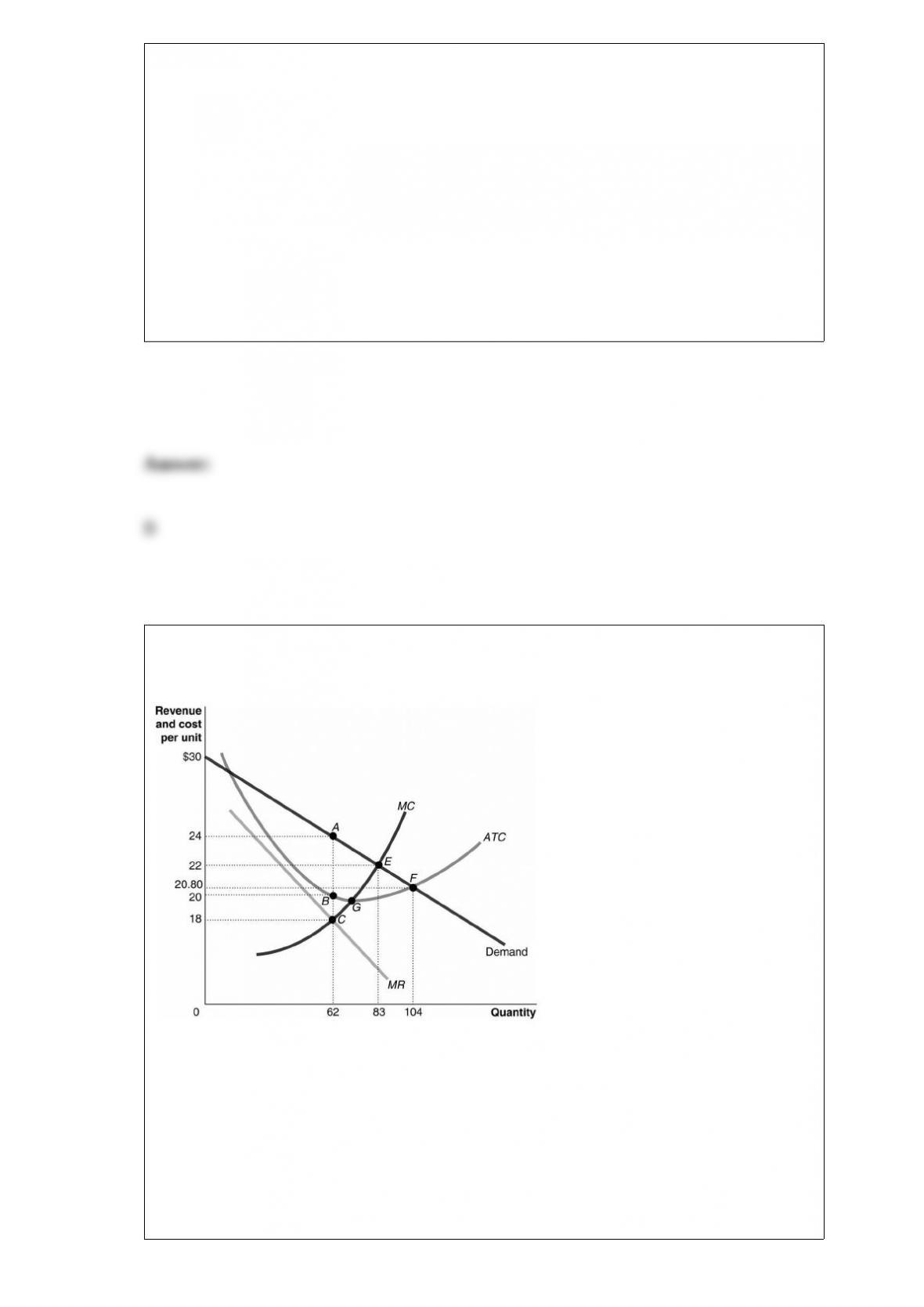
Figure 15-6
Figure 15-6 shows the cost and demand curves for a monopolist.
Refer to Figure 15-6. The profit-maximizing output and price for the monopolist are
A) output = 62; price = $24.
B) output = 62; price = $18.
C) output = 83; price = $22.

D) output = 104; price = $20.80.
Unlike a perfectly competitive firm, for a monopolistically competitive firm
A) price ≠ marginal cost for all output levels.
B) price ≠ marginal revenue for all output levels.
C) price ≠ average revenue for all output levels.
D) marginal revenue = marginal cost at the profit-maximizing output.
Most economists agree that some of the burden of the corporate income tax
A) is reduced because the tax is progressive.
B) is shared by the federal government.
C) is reduced because the tax is used to attain a social objective.
D) is passed on to consumers in the form of higher prices.

Which of the following is the best example of a quota?
A) a limit imposed on the number of sport utility vehicles that the United States can
import from Japan
B) a subsidy granted by the U.S. government to domestic garment manufacturers so
they can compete more effectively with foreign garment manufacturers
C) a tax placed on all sport utility vehicles sold in the domestic market
D) a $5,000 per-car fee imposed on all sport utility vehicles imported into the United
States
A major difference between monopolistic competition and perfect competition is
A) the number of sellers in the markets.
B) the degree by which the market demand curves slope downwards.
C) that products are not standardized in monopolistic competition unlike in perfect
competition.
D) the barriers to entry in the two markets.
When Zynga, the company behind the social games CityVille and Words With Friends,
sold stock to the public for the first time in December 2011, funds were being raised in
a ________ market, and when those newly issued shares are resold to other buyers, the
sales take place in a ________ market.
A) primary; primary
B) primary; secondary
C) secondary; primary
D) secondary; secondary
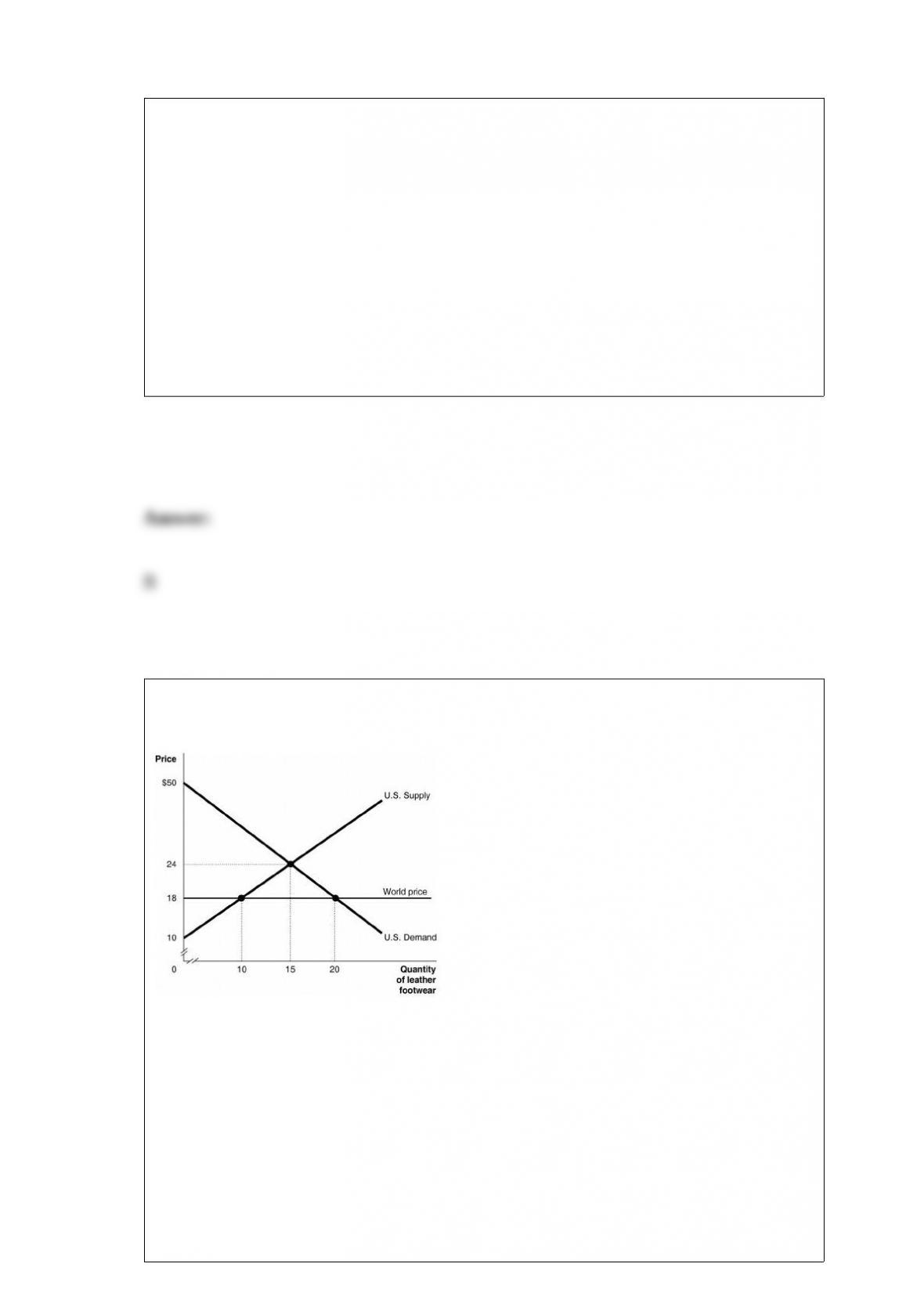
Figure 9-1
Figure 9-1 shows the U.S. demand and supply for leather footwear.
Refer to Figure 9-1. Suppose the government allows imports of leather footwear into
the United States. What will be the quantity demanded?
A) 5 units
B) 10units
C) 15 units

D) 20 units
In order to be binding, a price ceiling
A) must lie above the free market equilibrium price.
B) must lie below the free market equilibrium price.
C) must coincide with the free market equilibrium price.
D) must be high enough for firms to earn a profit.
The federal corporate income tax is
A) regressive.
B) proportional.
C) progressive.
D) unfair.

Some economists have proposed making the tax treatment of employer-provided health
insurance the same as the tax treatment of individually purchased health insurance and
out-of-pocket health care spending. Such changes would make it more likely that
A) consumers would pay prices closer to the actual costs for routine medical care.
B) employers would provide more generous medical coverage to their employees.
C) insurance deductibles would decrease.
D) the quantity of medical services demanded would increase.
The three fundamental questions that any economy must address are
A) What will be the prices of goods and services; how will these goods and services be
produced; and who will receive them?
B) What goods and services to produce; how will these goods and services be produced;
and who receives them?
C) Who gets jobs; what wages do workers earn; and who owns what property?
D) How much will be saved; what will be produced; and how can these goods and
services be fairly distributed?

Sefronia and Bella share an apartment and they are deciding whether or not to purchase
a weekly housecleaning service. The value of the service to each of them is $50 and it
costs $80 to hire a housecleaner. Should they hire a housecleaner?
A) Yes, if each contributes $50, then each stands to gain a consumer surplus.
B) No, because each will wait for the other to hire the housecleaner.
C) Yes, but only if a housecleaner will accept $50 so that each can take turns to pay the
housecleaner.
D) No, because it will be difficult for them to agree on which housecleaning service to
use.
Walt Disney began planning for Disneyland in the early 1950s. When he began to
consider how the amusement park would be funded
A) he decided to use the profits earned from his company’s cartoons and motion
pictures.
B) he had trouble raising the required funds. Eventually, he convinced a television
network to fund the amusement park in exchange for providing a weekly television
program.
C) he decided to borrow money from Hollywood banks. The banks quickly agreed to
loan Disney the money because of Disney’s reputation and previous success.
D) he had trouble raising the required funds from banks, so he decided to issue “Disney
bonds.” He had no trouble paying the interest and principal on the bonds with profits
from Disneyland.

A nonmonetary opportunity cost is called a(n) ________, while a cost that involves
spending money is called a(n) ________.
A) accounting cost; explicit cost
B) implicit cost; explicit cost
C) accounting profit; economic profit
D) normal rate of return; asset