
Historically, most industrial loan companies have operated to:
a. accept deposits.
b. assist their parent company in some facet of the firm’s core business.
c. exclusively make commercial loans.
d. increase the safety and soundness of the parent company.
e. purchase municipal securities.
Answer:
The _________ established to Public Company Oversight Board to regulate public
accounting firms that audit publicly-traded companies.
a. Riegle-Neal Interstate Banking and Branching Efficiency Act
b. Competitive Equality Banking Act
c. Financial Institutions Reform, Recovery and Enforcement Act
d. Sarbanes-Oxley Act
e. Depository Institutions Deregulation and Monetary Control Act
Answer:

During the underwriting process, the investment bank receives payment for all of the
following except:
a. flotation costs.
b. legal costs.
c. Federal Reserve costs.
d. accounting costs.
e. marketing costs.
Answer:
Use the following bank information.
What is the bank’s expected economic net interest income?
a. $14.75
b. $32.25
c. $44.00
d. $76.25
e. $120.25
Answer:

Use the following bank information.
What is the weighted average duration of assets?
a. 2.56 years
b. 3.75 years
c. 4.85 years
d. 5.00 years
e. 7.50 years
Answer:
Which of the following is not considered a cash asset?
a. Marketable securities
b. Cash items in process of collection
c. Demand deposits at private financial institutions
d. Demand deposits at the Federal Reserve
e. Vault cash

Answer:
In the CAMELS ratings, which reflects the bank’s off-balance sheet activities?
a. Capital adequacy
b. Asset quality
c. Earnings quality
d. Liquidity
e. Sensitivity to market risk
Answer:
Use the following information on Dylan Enterprises.
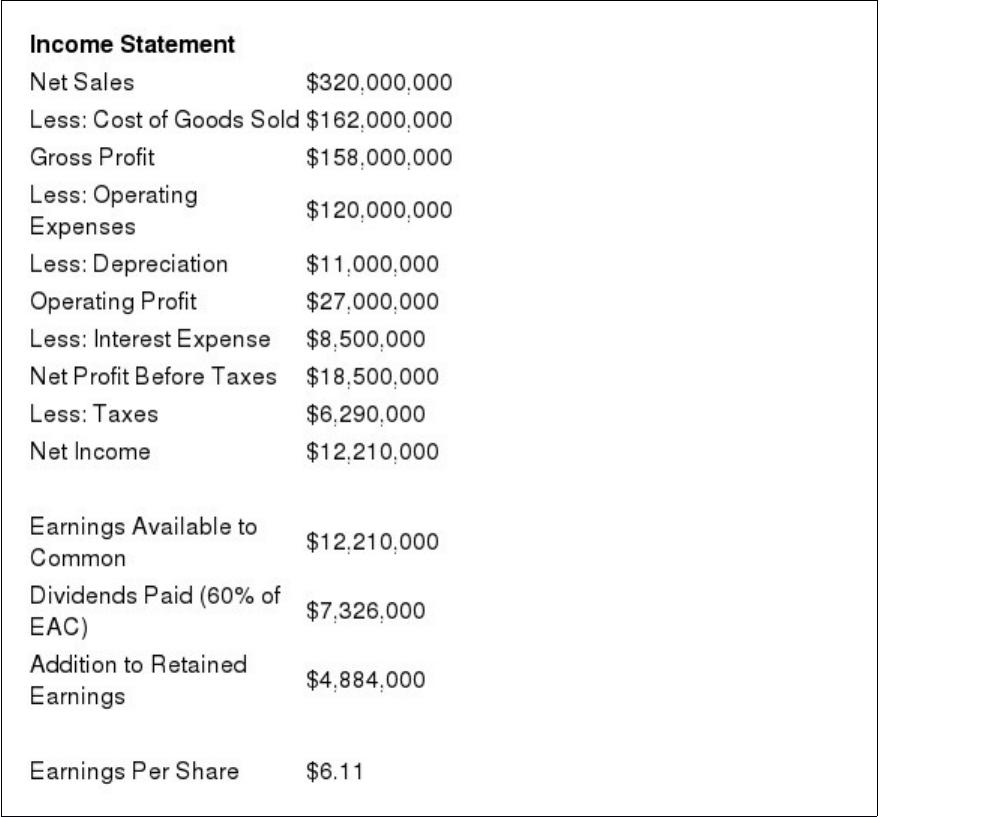
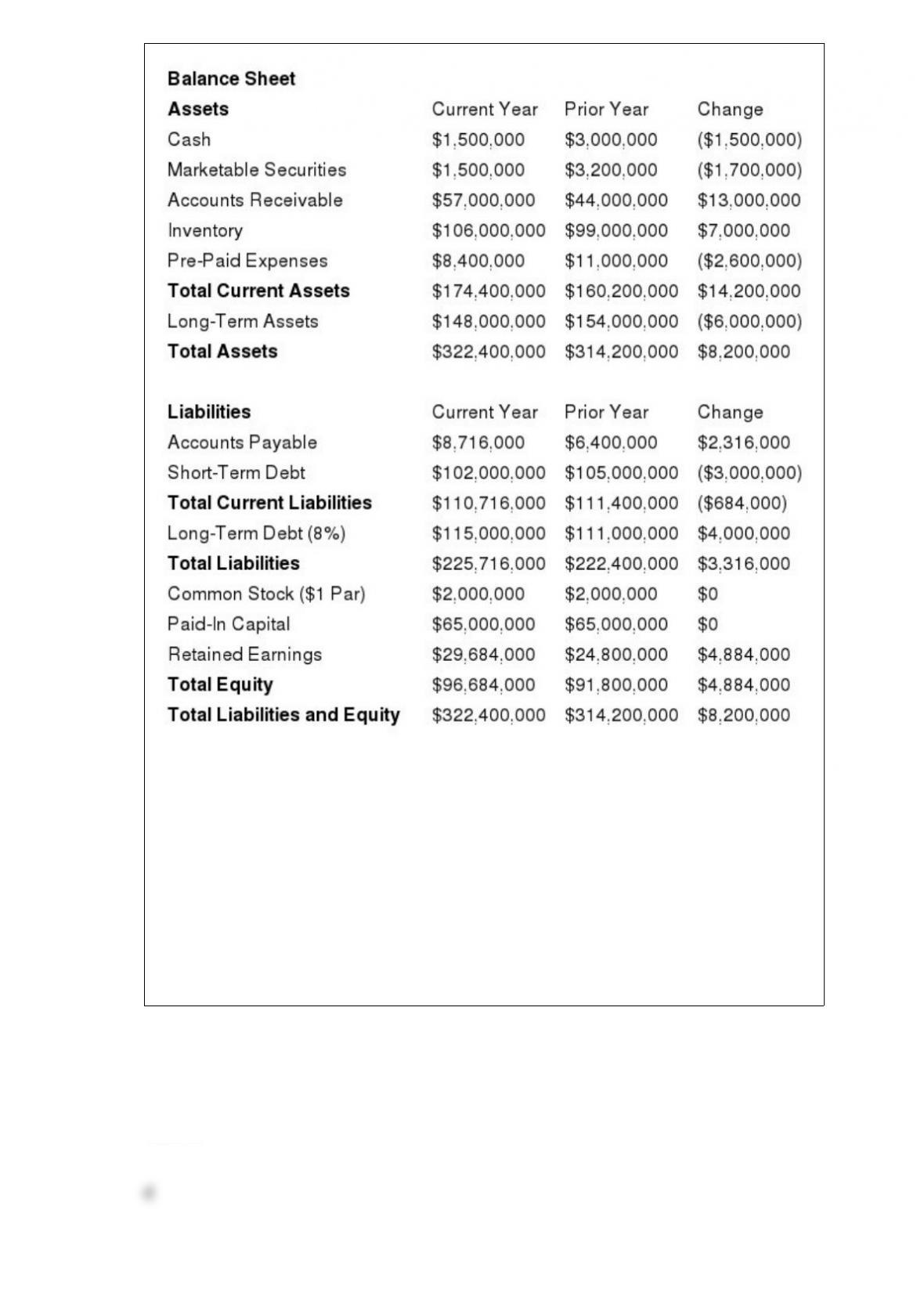
What is Dylan’s return on equity for the current year?
a. 3.8%
b. 5.1%
c. 5.4%
d. 12.6%
e. 13.3%
Answer:

The daily change in the value due to the marking-to-market process is know as the:
a. maintenance margin.
b. variation margin.
c. market margin.
d. initial margin.
e. marked margin.
Answer:
A bank anticipates it will need to borrow funds in the Eurodollar market in the future. It
hedges by selling futures contracts. If rates decline, which of the following is true?
a. The bank will profit on the futures contract.
b. The bank will profit in the cash market.
c. The bank will have locked in a low cost of borrowing.
d. The bank will lose in the cash market.
e. Both a. and d. are true.

Answer:
Which of the following is not a purpose of bank regulation?
a. Guarantee minimal profitability of the banking system.
b. Provide monetary stability.
c. Ensure safety and soundness of banks.
d. Provide a competitive financial system.
e. Protect consumers from abuses by banks.
Answer:
Which of the following is not a disadvantage of static GAP analysis?
a. Static GAP analysis depends on the forecasted interest rates.
b. Static GAP analysis often considers demand deposits as non-rate sensitive.
c. Static GAP analysis does not consider the cumulative impact of interest rate changes
on the bank’s position.
d. Static GAP analysis does not consider a depositor’s early withdrawal option.
e. All of the above are disadvantages of static GAP analysis.

Answer:
When it comes to Federal Reserve Banks, primary credit:
a. The majority of depository institutions do not qualify for this program.
b. Primary credit has an allowable maturity of up to 90 days.
c. Primary credit use should be viewed by bank examiners as exceptional.
d. All of the above.
e. None of the above.
Answer:
Today, the primary motivation behind forming a bank holding company is:
a. to reduce competition.
b. the ability to circumvent restrictions on branching.
c. to broaden the scope of products the bank can offer.
d. to increase deposit concentration.
e. All of the above are motivating factors today for forming a bank holding company.

Answer:
If a bank pays 62 cents in non-interest expense per dollar of income, its _______ is
equal to 62.
a. burden
b. net non-interest margin
c. efficiency ratio
d. overhead ratio
e. noninterest expense ratio
Answer:
Large depositors
a. receive the highest interest rates.
b. pay the lowest fees.
c. often get free checking.
d. all of the above.
e. a. and c. only

Answer:
If a firm already has stock outstanding that is publically traded, additional offerings are
called:
a. initial public offering.
b. second time equity offering.
c. primary offering.
d. secondary offering.
e. flavored offering.
Answer:
On-us checkscashed are:
a. checks drawn on any bank other than the bank into which it was deposited.
b. the accounting transaction for selling fed funds.
c. discount window loans.
d. illegal.
e. checks drawn on a bank’s own customer’s account.

Answer:
Many insurance companies have formed __________ to operate banks as part of their
financial services efforts.
a. one-bank holding companies
b. multibank holding companies
c. retail subsidiaries
d. finance companies
e. financial holding companies
Answer:
Which of the following could be used to identify a potential increase in borrowing by
customers that might deplete a bank’s cash reserves?
a. The amount of insured versus uninsured deposits
b. Large deposits held by a single entity
c. Volume of Fed Funds sold
d. The sensitivity of deposits to changes in the level of interest rates
e. Unused commercial credit lines outstanding

Answer:
Which of the following is not one of the five Cs of (good) credit?
a. Character
b. Collateral
c. Capital
d. Capacity
e. Communication
Answer:
Use the following information.
The minimum Tier 1 capital for this bank is:
a. $348
b. $450
c. $509
d. $581
e. $696

Answer:
An investor anticipates she will have funds to invest in the T-Bill market. If she hedges
by buying futures contracts and rates decline, which of the following is true?
a. The investor will profit on the futures contract.
b. The investor will profit in the cash market.
c. The investor will have locked in a minimum 10% return.
d. The investor will lose in the cash market.
e. Both a. and d. are true.
Answer:
Individuals work out a court supervised repayment plan under:
a. Chapter 7
b. Chapter 9
c. Chapter 13
d. Chapter 17
e. Chapter 21

Answer:
A formal regulatory document that prescribes corrective action for a problem institution
is called a:
a. cease and desist order.
b. capital request.
c. memorandum of understanding.
d. quality assurance directive.
e. national bank order.
Answer:
Which of the following is not a measure of liability liquidity?
a. Total loans to total assets
b. Total deposits to total assets
c. Total equity to total assets
d. Loan losses to net loans
e. Core deposits to total assets

Answer:
Jumbo CDs that a bank obtains from a third-party broker are called:
a. money market demand accounts.
b. time deposit accounts.
c. mortgage loans.
d. brokered deposits.
e. core deposits.
Answer:
A trader buys a 90-day Eurodollar futures contract at 95.25. The next day, interest rates
fall to 5%. Which of the following is true? Assume that the initial and maintenance
margins are $5,000.
a. The trader would have to deposit an additional $5,000 into her account.
b. The trader would have to deposit an additional $2,500 into her account.
c. The trader would have to deposit an additional $625 into her account.
d. The trader could withdraw $2,500 from her margin account.
e. The trader could withdraw $625 from her margin account.

Answer:
Volatile deposits:
a. are the largest source of funds for smaller banks.
b. equal the difference between actual current deposits and the base estimate of core
deposits.
c. reduce reserve requirements.
d. are a low cost source of funds.
e. all of the above
Answer:

Venture capital financing that comes in the “later rounds” of financing may take the
form of:
a. start-up capital loans.
b. mezzanine financing.
c. automobile financing.
d. seed money.
e. staff financing.
Answer: