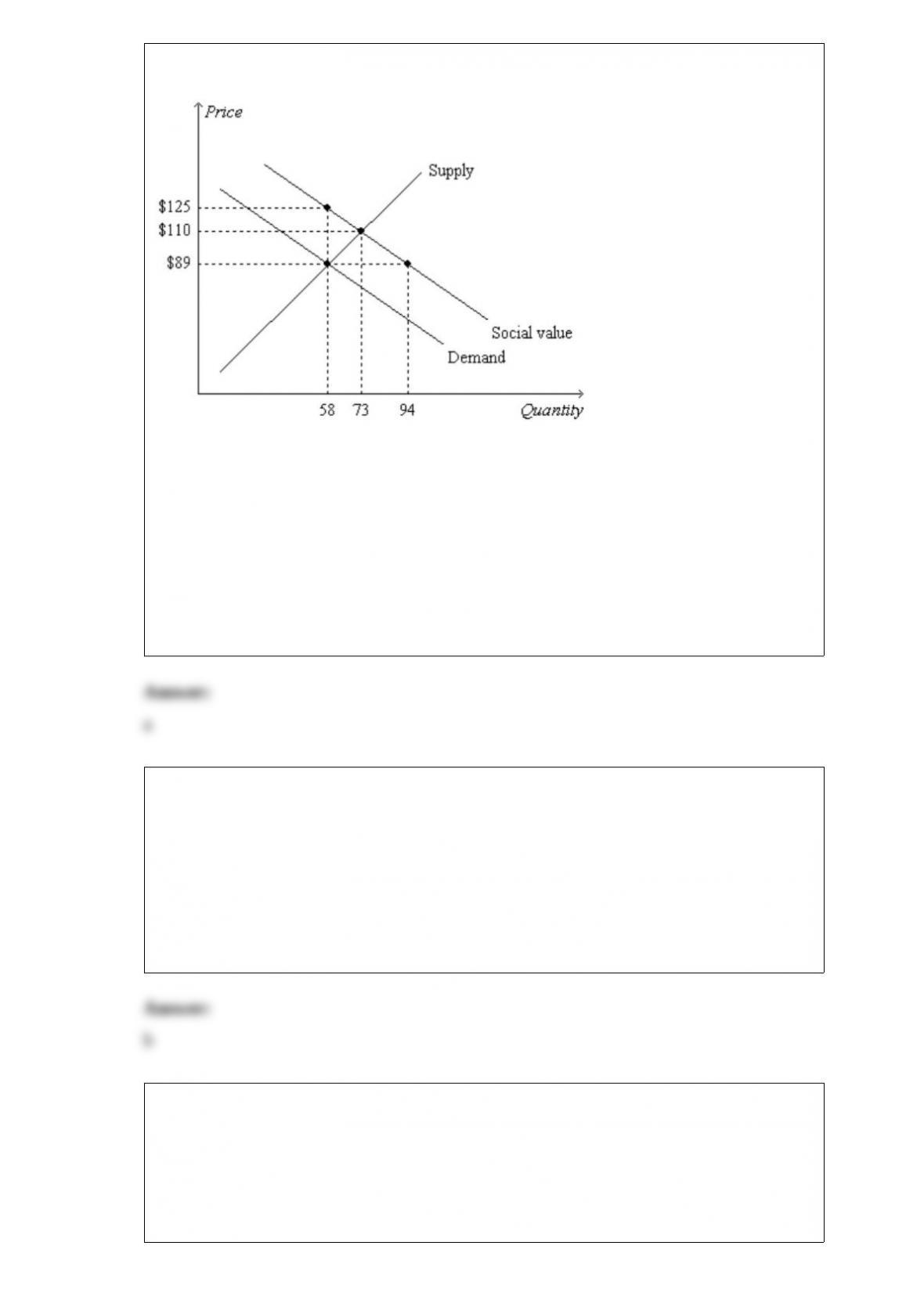
1) Figure 10-19
Note that the lines labeled €Demand€ and €Social Value€are parallel. Also, the slopes
of the lines on the graph reflect the following facts: (1) Private value and social value
decrease by $1.00 with each additional unit of the good that is consumed, and (2)
private cost increases by $1.40 with each additional unit of the good that is produced.
Thus, when the 74th unit of the good is produced and consumed, social well-being
a.decreases by $2.40.
b.decreases by $1.60.
c.increases by $1.00.
d.increases by $1.40.
2) Mark spends his weekly income on gin and cocktail olives. The price of gin has risen
from $7 to $9 per bottle, the price of cocktail olives has fallen from $6 to $5 per jar, and
Mark’s income has stayed fixed at $46 per week. If you measure gin on the vertical axis
and cocktail olives on the horizontal axis, then the budget constraint
a.is steeper after the price changes.
b.is flatter after the price changes.
c.is the same after the price changes.
d.shifts in a parallel fashion to the old budget constraint after the price changes.
3) Which of the following statements is not correct?
a.Firms in monopolistic competition and monopoly can earn economic profits in the
short run.
b.Firms in monopolistic competition and perfect competition produce the
welfare-maximizing level of output.
c.Monopolistically competitive firms price above marginal cost, whereas competitive

firms price at marginal cost.
d.Firms wishing to enter a monopolistically competitive market can do so freely,
whereas firms wishing to enter a monopoly market will face barriers.
4) When two variables have a positive correlation,
a.when the x-variable increases, the y-variable decreases.
b.when the x-variable decreases, the y-variable increases.
c.when the x-variable increases, the y-variable increases.
d.More than one of the above is correct.
5) Many economists believe that restrictions against ticket scalping result in each of the
following except
a.a smaller audience for cultural and sporting events.
b.shorter lines at cultural and sporting events.
c.less tax revenue for the state.
d.an increase in ticket prices.
6) There are four basic types of market structure.
a.True
b.False
7) A leftward shift of a demand curve is called a(n)
a.increase in demand.
b.decrease in demand.
c.decrease in quantity demanded.
d.increase in quantity demanded.
8) Figure 13-9
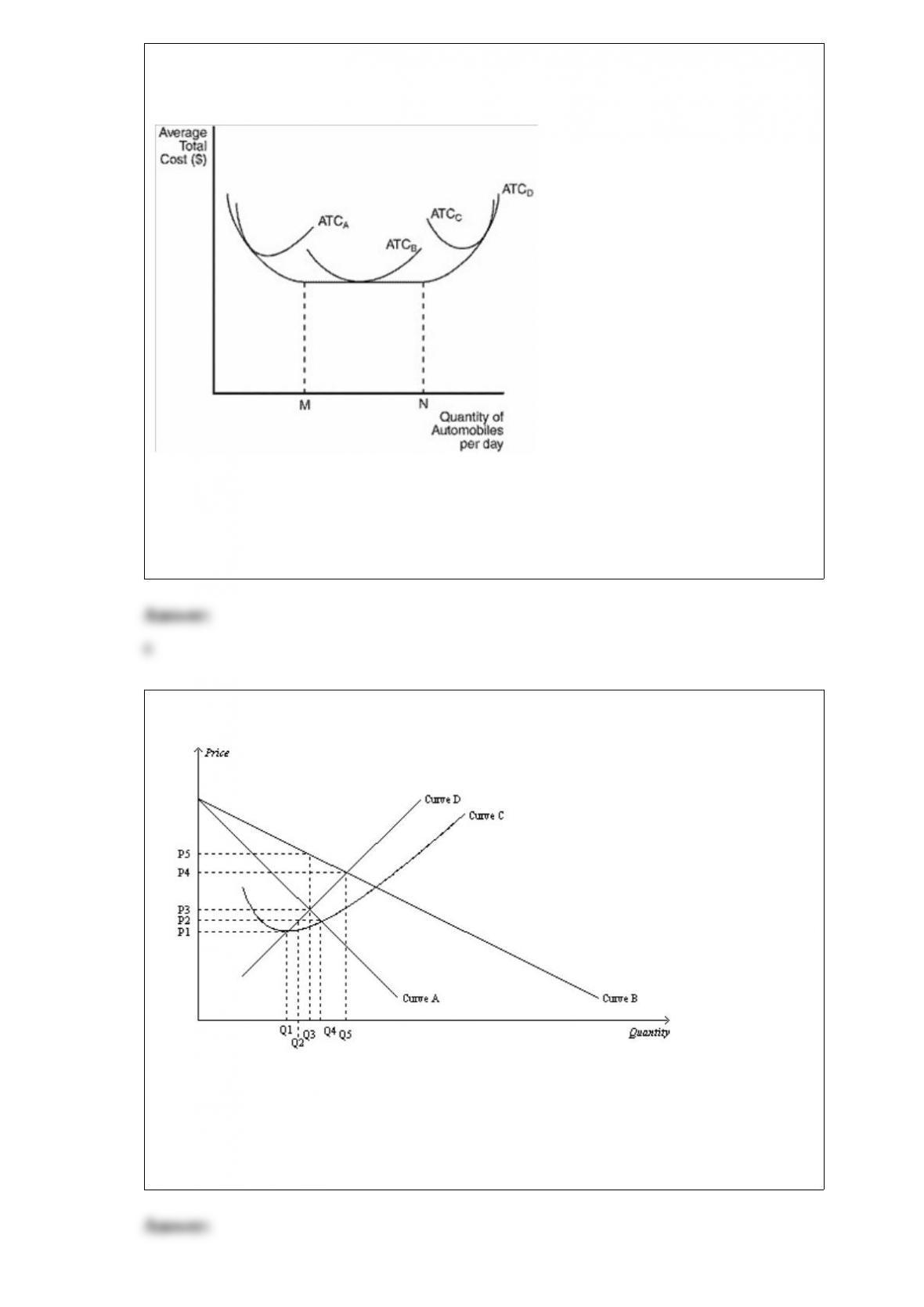
The figure below depicts average total cost functions for a firm that produces
automobiles.
This firm experiences diseconomies of scale at what output levels?
a.output levels greater than N
b.output levels between M and N
c.output levels less than M
d.All of the above are correct as long as the firm is operating in the long run.
9) Figure 15-4
The marginal cost curve for a monopoly firm is depicted by curve
a.A.
b.B.
c.C.
d.D.
10) Scenario 14-4
Victor is the recipient of $1 million from a lawsuit. Victor decides to use the money to
purchase a small business in Florida. His business operates in a perfectly competitive
industry. If Victor would have invested the $1 million in a risk-free bond fund, he could
have earned $100,000 each year. After he bought the small business, Victor quit his job
as a market analyst with Research, Inc., where he used to earn $75,000 per year.
At the end of the first year of operating his new business, Victor‘s accountant reported
an accounting profit of $150,000. What was Victor‘s economic profit?
a. -$150,000
b. -$50,000
c. -$25,000
d. $25,000
11) Price discrimination is prohibited by antitrust laws.
a.True
b.False
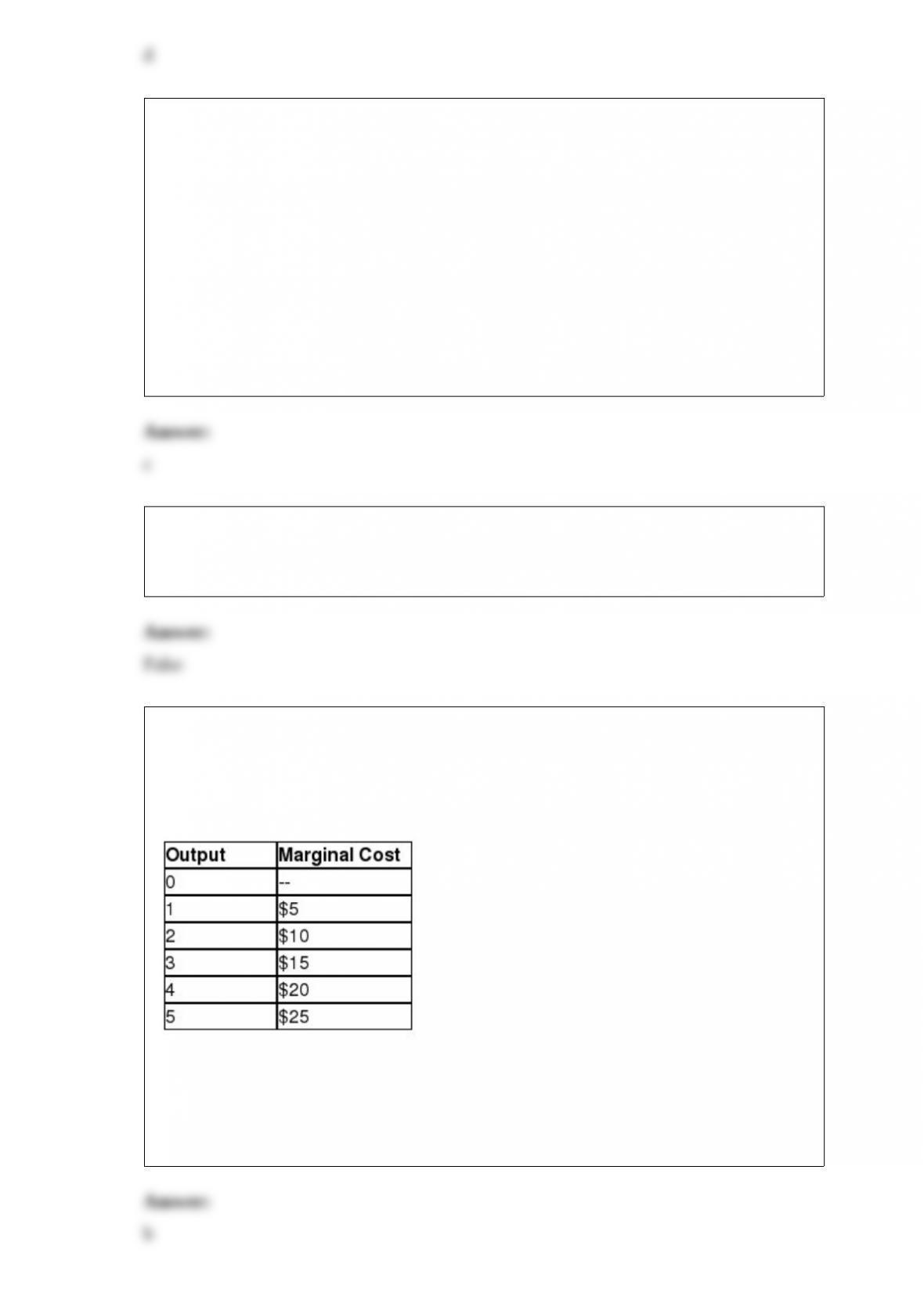
12) Consider a competitive market with 50 identical firms. Suppose the market demand
is given by the equation QD = 200 – 10P and the market supply is given by the equation
QS = 10P. In addition, suppose the following table shows the marginal cost of
production for various levels of output for firms in this market.
How many units should a firm in this market produce to maximize profit?
a.1 unit
b.2 units
c.3 units
d.4 units
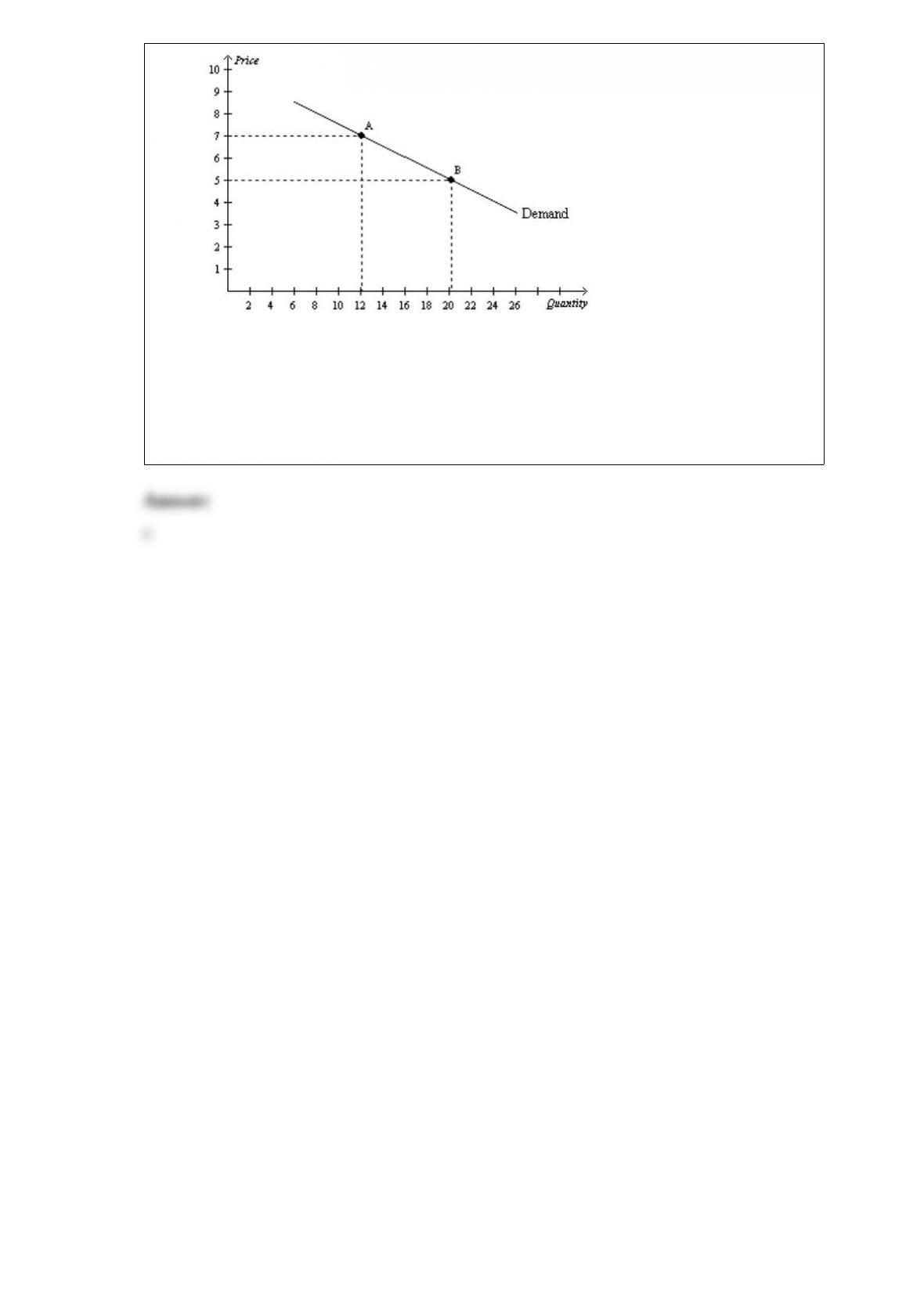
13)
Between point A and point B, is equal to
a. 0.33.
b. 0.67.
c. 1.5
d. 2.67.