Which of the following is NOT a public good?
A) Public fireworks display
B) National defense
C) Books in a public library
D) Clean air
Scenario 5.4:
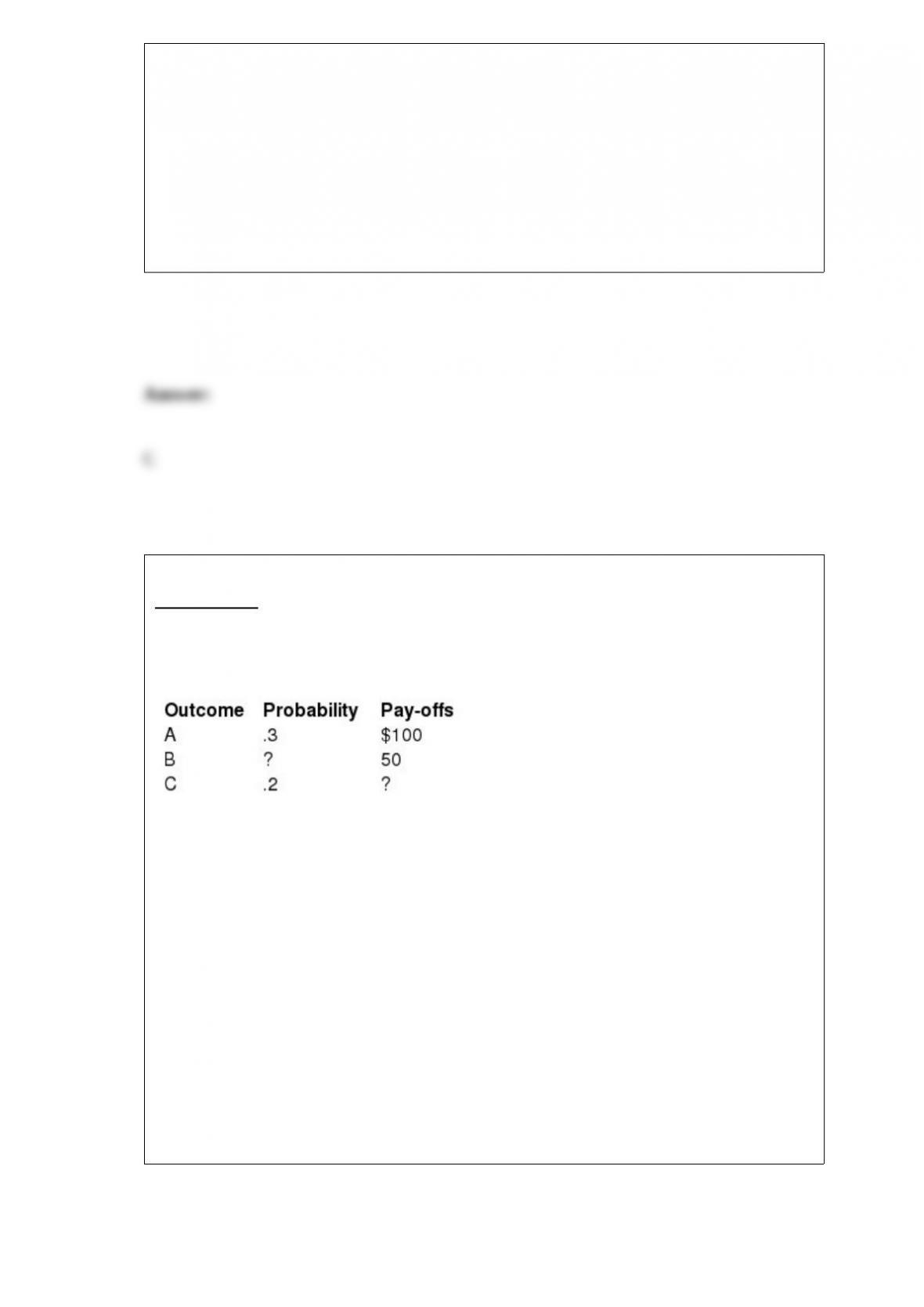
Suppose an individual is considering an investment in which there are exactly three
possible outcomes, whose probabilities and pay-offs are given below:
The expected value of the investment is $25. Although all the information is correct,
information is missing.
Refer to Scenario 5.4. What is the standard deviation of the investment?
A) 0
B) 16.58
C) 56.12
D) 90.14
E) none of the above

The interest rate R in an NPV calculation should always
A) be the return that the firm could earn on a similar investment.
B) be the riskless interest rate (e.g., U.S. Treasury bills).
C) be the rate on corporate bonds.
D) be the rate of return available in the stock market.
E) be the interest rate at which the firm has to borrow.
A monopolist has equated marginal revenue to zero. The firm has:
A) maximized profit.
B) maximized revenue.
C) minimized cost.
D) minimized profit.

The market demand for a type of carpet known as KP-7 has been estimated as:
P = 40 – 0.25Q,
where P is price ($/yard) and Q is rate of sales (hundreds of yards per month). The
market supply is expressed as:
P = 5.0 + 0.05Q.
A typical firm in this market has a total cost function given as:
C = 100 – 20.0q + 2.0q2.
a. Determine the equilibrium market output rate and price.
b. Determine the output rate for a typical firm.
c. Determine the rate of profit (or loss) earned by the typical firm.

Which of the following would cause an unambiguous decrease in the real price of DVD
players?
A) A shift to the right in the supply curve for DVD players and a shift to the right in the
demand curve for DVD players.
B) A shift to the right in the supply curve for DVD players and a shift to the left in the
demand curve for DVD players.
C) A shift to the left in the supply curve for DVD players and a shift to the right in the
demand curve for DVD players.
D) A shift to the left in the supply curve for DVD players and a shift to the left in the
demand curve for DVD players.
The cross-price elasticity of demand for peanut butter with respect to the price of jelly
is -0.3. If we expect the price of jelly to decline by 15%, what is the expected change in
the quantity demanded for peanut butter?

A) +15%
B) +45%
C) +4.5%
D) -4.5%
Bancroft Pharmaceuticals has a patent on a new medication used to treat high blood
pressure, so it is the monopoly seller of this new drug product. The marginal cost of
producing one dose of the drug is $10, and the elasticity of demand for the product is
-3. What is the profit maximizing monopoly price for this patented drug product?
A) $10
B) $12.50
C) $15
D) $30
Dante has two possible routes to travel on a business trip. One is more direct but more
exhausting, taking one day but with a probability of business success of 1/4. The second
takes three days, but has a probability of success of 2/3. If the value of Dante’s time is
$1000/day, the value of the business success is $12,000, and Dante is risk neutral,
A) it doesn’t matter which path he takes, because he doesn’t consider risk.

B) he should take the 1-day trip, because he doesn’t consider risk.
C) he should take the 1-day trip, because $11,000 is greater than $9,000.
D) he should take the 3-day trip, because it will increase his expected net revenue by
$3,000.
E) he should take the 3-day trip, because it will increase his expected net revenue by
$5,000.
Consider the information below:
For Group A the cost of attaining an educational level y is
CA(y) = $6,000y
and for Group B the cost of attaining that level is
CB (y) = $10,000y.
Employees will be offered $50,000 if they have y < y*, where y* is an education
threshold determined by the employer. They will be offered $130,000 if they have y >
y*.
The highest level of y* that can be set and still have the high-productivity people choose
to meet it is
A) 90.
B) 60.
C) 30.
D) 22.5.
E) 15.

A warranty is most valuable as a signaling device when
A) the buyer has much more information about the product than the seller does.
B) the seller has much more information about the product than the buyer does.
C) the buyer has much more information about his or her own preferences than the
seller does.
D) neither the buyer nor the seller has good information about the product.
E) neither the buyer nor the seller has good information about consumer preferences.
Scenario 5.5:
Engineers at Jalopy Automotive have discovered a safety flaw in their new model car. It
would cost $500 per car to fix the flaw, and 10,000 cars have been sold. The company
works out the following possible scenarios for what might happen if the car is not fixed,
and assigns probabilities to those events:
Scenario Probability Cost
A. No one discovers flaw .15 $0
B. Government fines firm .40 $10 million
(no lawsuits)
C. Resulting lawsuits are lost .30 $12 million
(no government fine)

D. Resulting lawsuits are won .15 $2 million
(no government fine)
Refer to Scenario 5.5. Jalopy Automotive’s executives,
A) if risk-neutral, would fix the flaw because it enables them to have a sure outcome.
B) if risk-neutral, would fix the flaw because the cost of fixing the flaw is less than the
expected cost of not fixing it.
C) if risk-loving, would fix the flaw because it enables them to have a sure outcome.
D) if risk-averse, would not fix the flaw because the cost of fixing the flaw is more than
the expected cost of not fixing it.
E) would fix the flaw regardless of their risk preference, because of the large
probability of high-cost outcomes.
A major computer software company maintains a technical support center in a rural area
and is the only employer in this region. Suppose the local labor supply curve shifts
leftward due to net migration of workers from the area. What happens to the
equilibrium outcome in this labor market?
A) Labor demand shifts rightward, equilibrium wage and employment levels decline
B) Labor demand shifts rightward, equilibrium wage and employment levels increase
C) Labor demand curve remains the same, equilibrium wage and employment levels
increase
D) Labor demand curve remains the same, equilibrium wage increases, and
employment declines

Many business professionals constantly monitor their incoming email and text
messages so they can appear to be alert and responsive, even at night and on weekends.
Alternatively, some time management consultants recommend that business
professionals should not constantly check for new messages because this practice
distracts the worker from scheduled tasks that may have higher priority. The decision to
check email or text messages less frequently may not harm the worker’s salary if it is a:
A) weak signal of worker ability.
B) weak signal of cell phone strength.
C) strong signal of worker ability.
D) strong signal of ease of distraction.
Suppose the Environmental Protection Administration (EPA) proposes a change in
automobile exhaust systems that reduces the amount of greenhouse gases (GHGs)
emitted into the atmosphere, and they estimate that the net present value (NPV) of this
policy change is worth $3 trillion dollars. To form this estimate, the EPA staff members
assumed a particular social discount rate and a particular stock dissipation rate for
GHGs. What happens to the NPV of this proposed policy if the staff members use a
smaller stock dissipation rate?
A) NPV increases
B) NPV declines
C) NPV remains unchanged
D) We do not have enough information to answer this question

The market supply function is P = 10 + Q and the market demand function is P = 70 –
2Q. What is the change in consumer surplus associated with a minimum floor price of
$40?
A) -$25
B) -$150
C) -$175
D) -$200
The markets for movie theater tickets and videocassette rentals are highly
interdependent. Suppose that a tax is imposed on movie theater tickets. The type of
analysis that examines the effects of this tax on the markets for movie theater tickets
and videocassettes simultaneously is called
A) macroeconomics.
B) general equilibrium analysis.
C) partial equilibrium analysis.
D) full market analysis.
E) psychoanalysis.

Scenario 5.10:
Hillary can invest her family savings in two assets: riskless Treasury bills or a risky
vacation home real estate project on an Arkansas river. The expected return on Treasury
bills is 4 percent with a standard deviation of zero. The expected return on the real
estate project is 30 percent with a standard deviation of 40 percent.
Refer to Scenario 5.10. If Hillary invests 30 percent of her savings in the real estate
project and remainder in Treasury bills, the standard deviation of her portfolio is:
A) 0 percent.
B) 12 percent.
C) 28 percent.
D) 30 percent.
E) 40 percent.
In figure below, what is true about the two jobs?
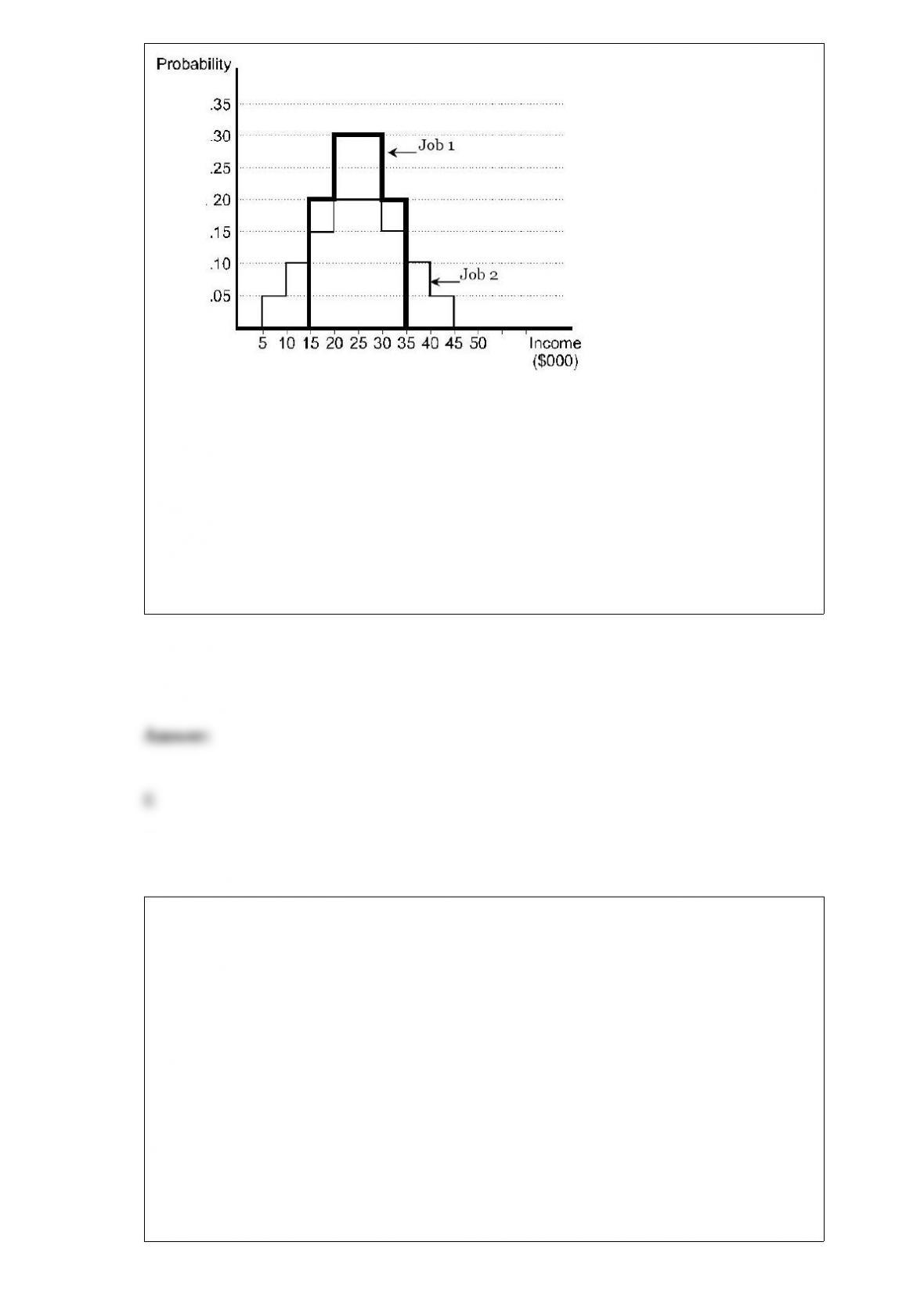
A) Job 1 has a larger standard deviation than Job 2.
B) All outcomes in both jobs have the same probability of occurrence.
C) A risk-averse person would prefer Job 2.
D) A risk-neutral person would prefer Job 1.
E) Job 1 has the same expected income as Job 2.
When emissions are measured on the horizontal axis, the marginal cost of abating
emissions is
A) downward-sloping because emissions become more and more easy to eliminate once
the firm makes the initial commitment to do so.
B) downward-sloping because a high level of emissions is cheap to attain, and a low
level of emissions is expensive to attain.
C) upward-sloping because emissions become more and more easy to eliminate once
the firm makes the initial commitment to do so.
D) upward-sloping because a high level of emissions is cheap to attain, and a low level
of emissions is expensive to attain.

E) horizontal because the technology to remove emissions is assumed constant.
When sellers have more information about products than buyers do, we would expect
A) sellers to get higher prices for their goods than they could otherwise.
B) buyers to pay lower prices for goods than they would otherwise.
C) high-quality goods to drive low-quality goods out of the market.
D) low-quality goods to drive high-quality goods out of the market.
Amy is currently spending her income to maximize her satisfaction. She is renting an
apartment for $900 per month as shown in the diagram below (Assume each dollar
spent on housing buys 1 unit of housing. H1 represents her $900 per month apartment).

a. Suppose that Amy qualifies for a government housing assistance program that will
provide her with a $600 per month apartment at no charge. If she accepts the apartment,
she cannot augment her expenditure on housing (for example, she cannot add $300 of
her income to the $600 per month provided by the government program, and rent the
$900 per month apartment), nor can she exchange the apartment for cash or other
goods. How does the government program alter Amy’s budget line?
b. Suppose that Amy is given $600 in cash instead of the $600 per month apartment.
How will this alter Amy’s budget line?
c. Is Amy indifferent between the housing assistance program and cash program, or
does she prefer one program over the other? Draw an indifference curve to illustrate
your answer.
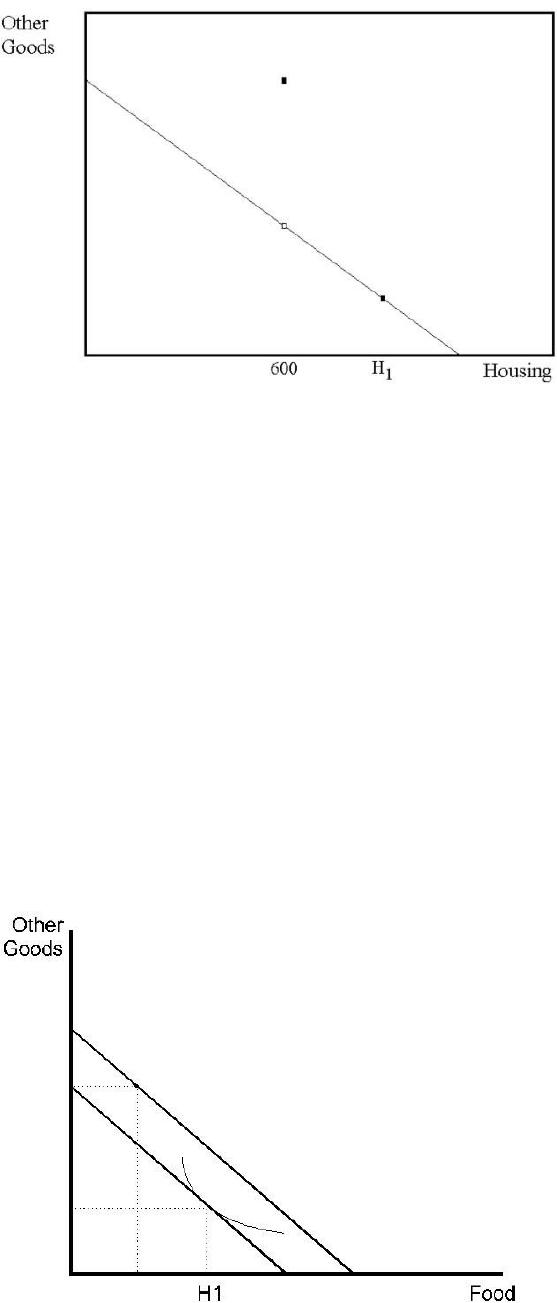
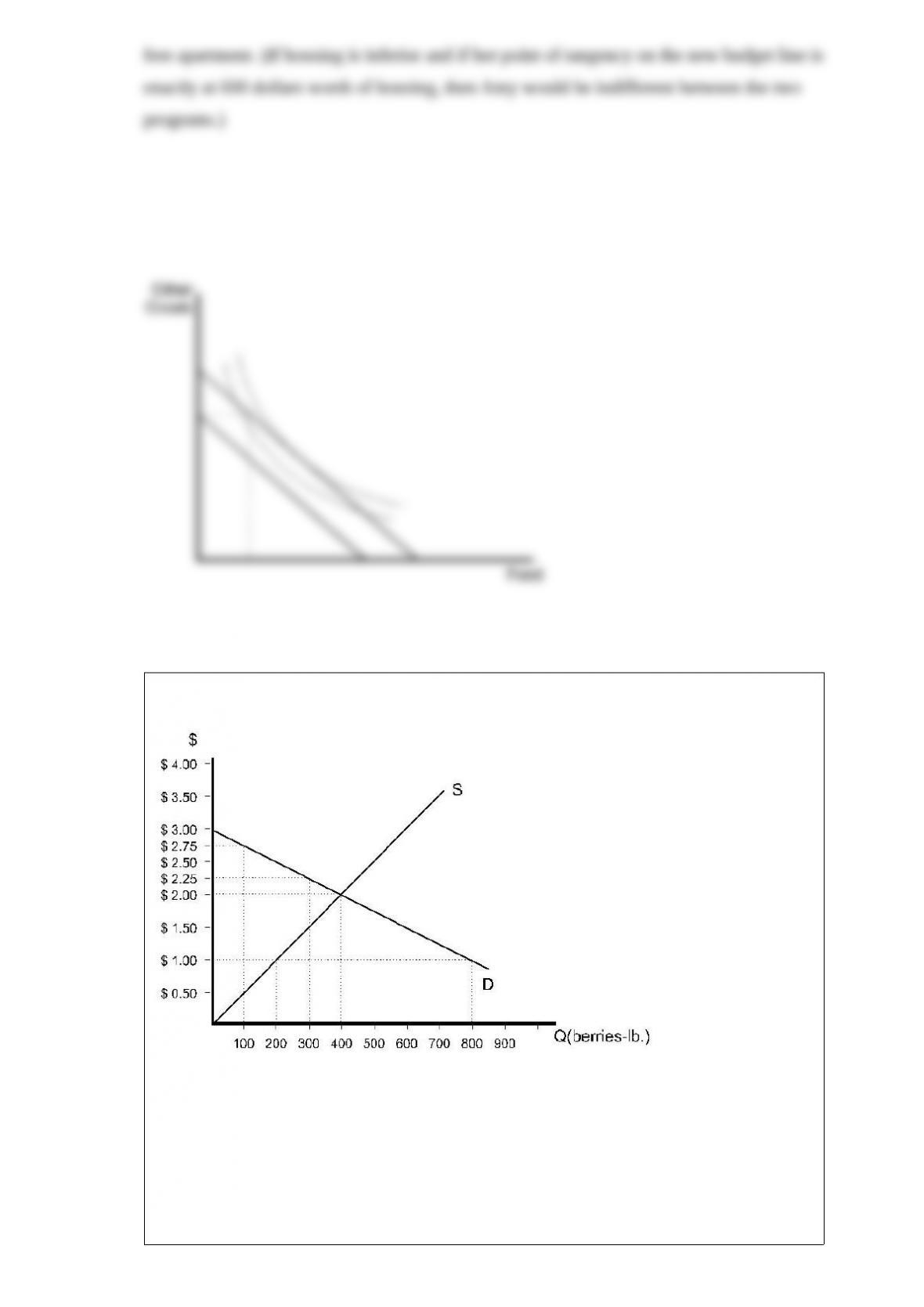
Figure 9.3
Refer to Figure 9.3. If the government establishes a price ceiling of $1.00, consumer
surplus will
A) fall by $50.
B) fall by $150.
C) remain the same.
D) rise by $50.
E) rise by $150.
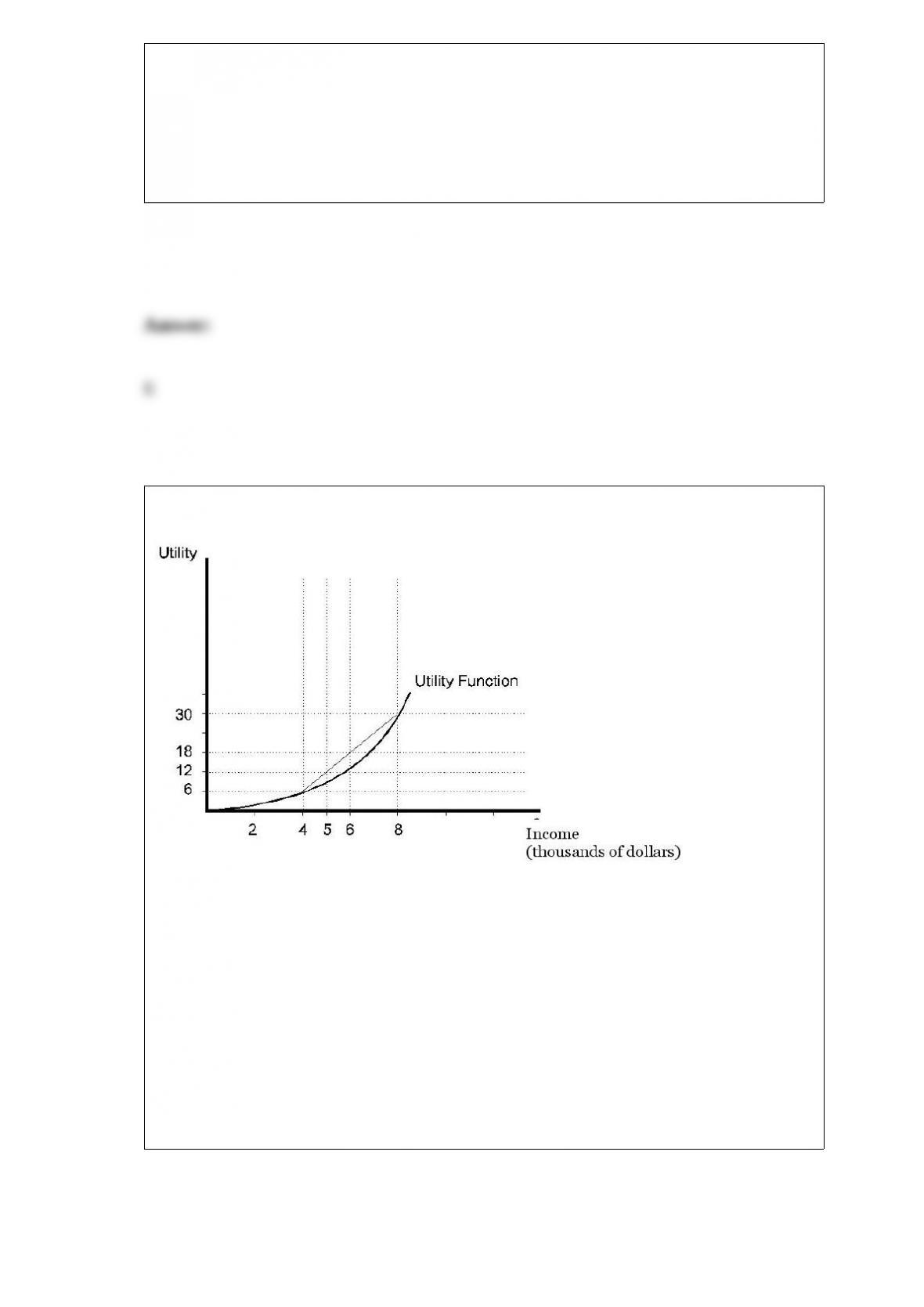
Figure 5.3
The individual pictured in Figure 5.3
A) prefers a sure $6000 to a 50% chance of $4000 and a 50% chance of $8000.
B) has an expected utility of 12 from a 50% chance of $4000 and a 50% chance of
$8000.
C) would receive a utility of 12 from a sure $6000.
D) would receive a utility of 18 from a sure $6000.

If the fringe supply curve shifts leftward in the dominant firm model, then the resulting
market equilibrium price is ________ and the dominant firm’s quantity ________.
A) lower, decreases
B) lower, increases
C) higher, decreases
D) higher, increases
Why does cooperative behavior break down in games with finite endpoints?
A) Each player has an incentive to deviate from a cooperative strategy during the last
period.
B) A Nash equilibrium in pure strategies is not possible in finite repeated games.
C) Finite games have the same outcomes as one-period games, and cooperation is not
possible in one-period games.
D) A Nash equilibrium is only possible in mixed strategies in finite repeated games, but
all of the probabilities assigned to particular strategies approach zero as the number of
finite game periods becomes large. Thus, we cannot evaluate the expected payoffs in
these games.

Supply curves for secondary supply resources (e.g., scrap metal) become:
A) Steeper in the short run
B) More elastic in the long run
C) Steeper in the long run
D) More inelastic in the short run
In many rural areas, electric generation and distribution utilities were initially set up as
cooperatives in which the electricity customers were member-owners. Like most
cooperatives, the objective of these firms was to:
A) maximize profits for the member-owners.
B) maximize total revenue that could be redistributed to the member-owners.
C) operate at zero profit in order to provide low electricity prices for the
member-owners.
D) minimize the costs of production.

Which of the following statements is NOT true?
A) Speculative demand for an asset may contribute to the formation of a bubble.
B) Some asset prices purchased during the formation of a bubble may be rational.
C) Asset price bubbles are always harmful to the general economy.
D) Speculative demand is based on the assumption that the asset price will continue to
rise.
The process by which sellers send signals to buyers conveying information about
product quality is known as:
A) asymmetric information.
B) market signaling.
C) a lemons problem.
D) moral hazard.
A $130,000 investment in new equipment this year will increase your firm’s profits by
$50,000 in each of the next 3 years. What is the net present value of this investment if
your firm’s opportunity cost of capital is 10 percent?
A) -5,657

B) 5,657
C) 124,343
D) 128,850
As a group, U.S. consumers have no income response for their consumption of ice
cream so that the income elasticity of demand for ice cream equals zero. Does this
mean that the change in ice cream consumption that results from a price increase is
entirely composed of the substitution effect?
A) Yes, the income effect associated with a price change is zero
B) No, any price change moves the point of consumption to a new indifference curve,
so there must be a non-zero income effect
C) No, the income and substitution effects in this case move in opposite directions and
completely offset one another, so it only appears that the income effect is zero
D) We need more information about the goods to answer this question