1) which of the following is correct?
a.there is no relationship between mp and mc.
b.when ap is rising mc is falling, and when ap is falling mc is rising.
c.when mp is rising mc is rising, and when mp is falling mc is falling.
d.when mp is rising mc is falling, and when mp is falling mc is rising.
2) an economist for a bicycle company predicts that, other things equal, a rise in
consumer incomes will increase the demand for bicycles. this prediction is based on the
assumption that:
a.there are many goods that are substitutes for bicycles.
b.there are many goods that are complementary to bicycles.
c.there are few goods that are substitutes for bicycles.
d.bicycles are normal goods.
3) Other things equal, if the U.S. dollar were to depreciate, the:
A.aggregate demand curve would remain fixed in place.
B.aggregate supply curve would shift to the left.
C.aggregate supply curve would shift to the right.
D.aggregate demand curve would shift to the left.
4) if yesterday $1 would buy 800 south korean won, but today $1 will only buy 790
won; the:
a.dollar has appreciated in value.
b.dollar has depreciated in value.
c.demand for dollars in the foreign exchange market has increased relative to the supply
of won.
d.won price of dollars has gone up.
5) in a competitive economy, prices:
a.influence consumers in their purchases of goods and services.
b.influence businesses in their purchases of economic resources.
c.influence workers in making occupational choices.
d.do all of these.
6) in which of the following instances will the effect on equilibrium price be dependent
on the magnitude of the shifts in supply and demand?
a.demand rises and supply rises.
b.supply falls and demand remains constant.
c.demand rises and supply falls.
d.supply rises and demand falls.
7) Other things equal, which of the following would increase the Federal funds rate?
A.a decrease in loan demand in the Federal funds market
B.a decrease in the reserve ratio
C.Fed purchases of government securities from banks
D.a decline in excess reserves in the banking system
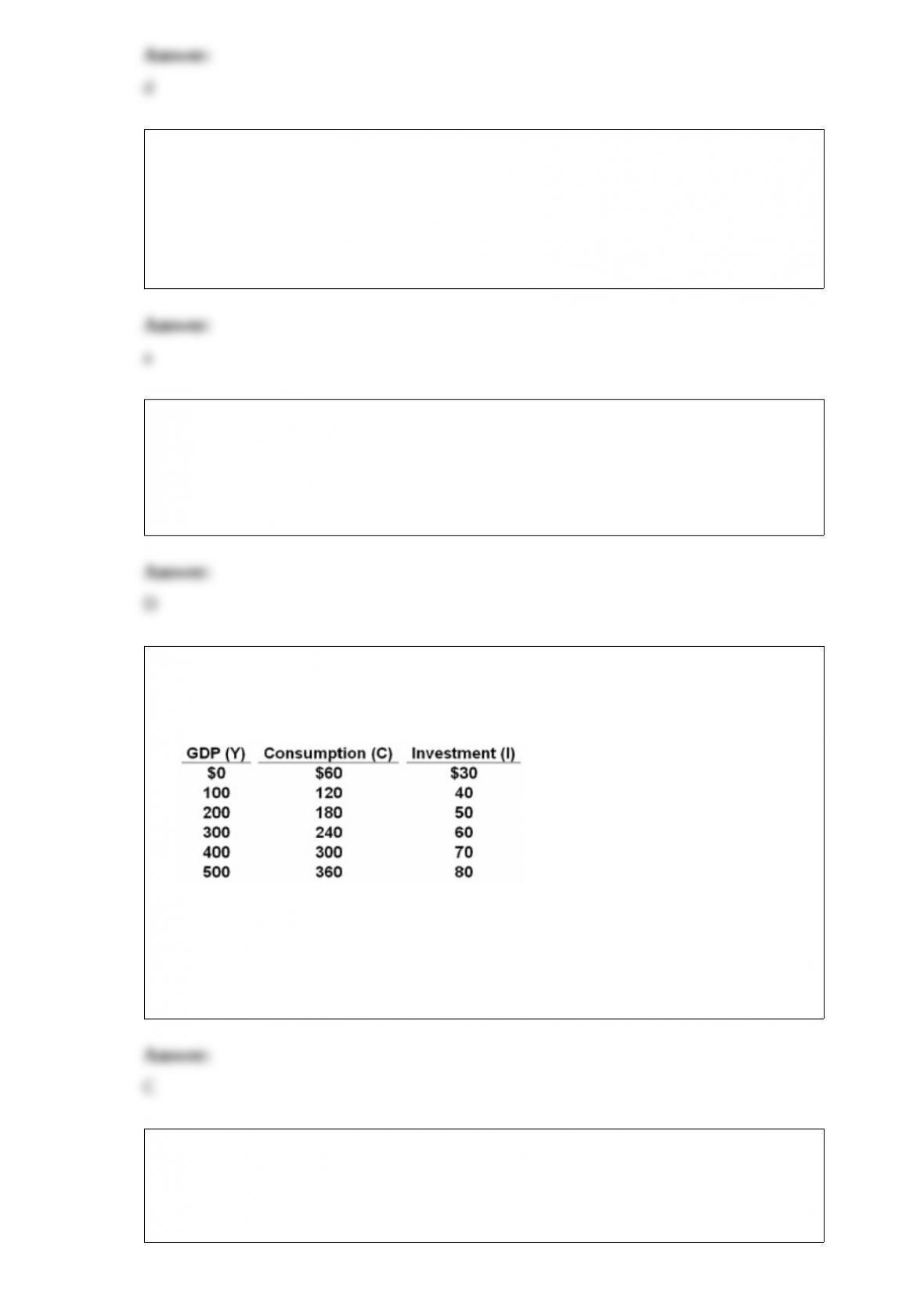
8) (Advanced analysis) Answer the next question(s) on the basis of the following data
for a private closed economy. The letters Y, C, S, and I are used to represent real GDP,
consumption, saving, and investment respectively.
Refer to the above data. Equilibrium Y (= GDP) is:
A.$100.
B.$200.
C.$300.
D.$400.
9) which one of the following expressions best states the idea of opportunity cost?
a.”a penny saved is a penny earned.”
b.”he who hesitates is lost.”
c.”there is no such thing as a free lunch.”
d.”all that glitters is not gold.”
10) which of the following institutional arrangements is most likely to promote growth?
a.patents and copyrights that expire quickly and are loosely enforced.
b.strong government control over resource allocation decisions.
c.unrestricted trade between nations.
d.all of these.
11)
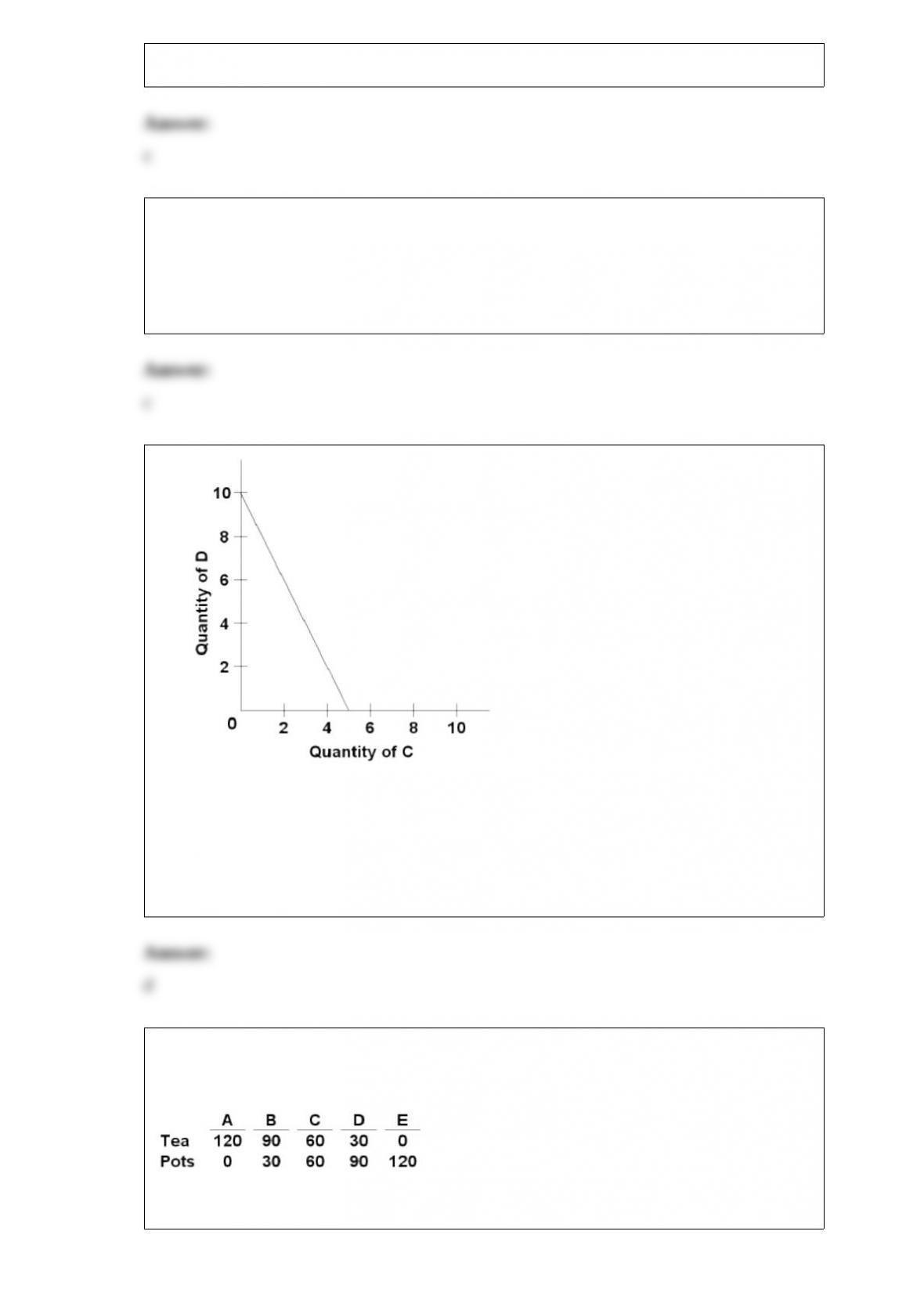
refer to the budget line shown in the diagram above. the absolute value of the slope of
the budget line is:
a.muc/mud.
b.one-half.
c.pd/pc.
d.pc/pd.
12) The following production possibilities data for Gamma and Sigma. All data are in
tons.
Gamma production possibilities:
Sigma production possibilities:
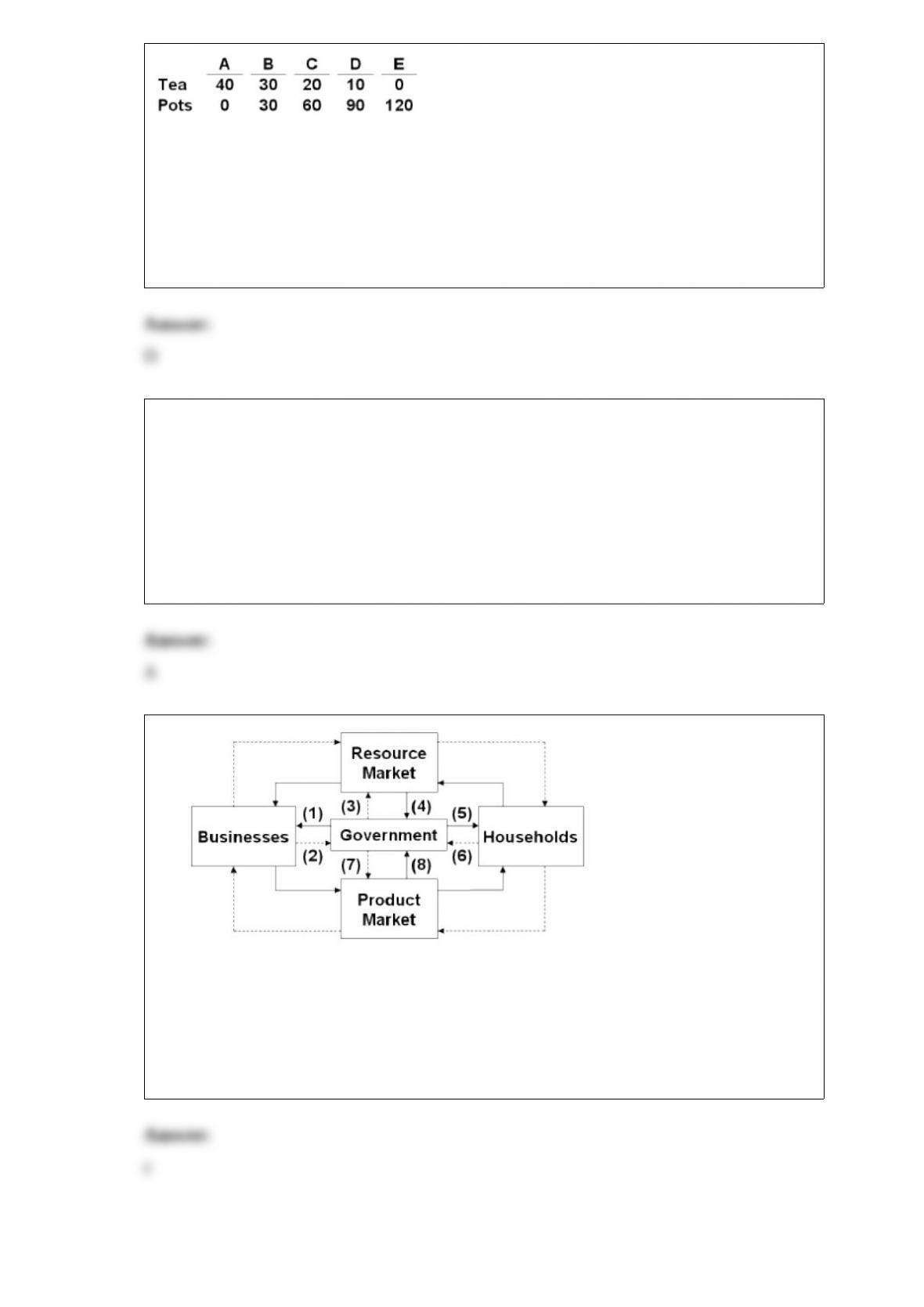
Refer to the above data. Assume that before specialization and trade Gamma and Sigma
both chose production possibility “C.” Now if each specializes according to
comparative advantage, the gains from specialization and trade will be:
A.40 tons of pots.
B.20 tons of tea and 20 tons of pots.
C.20 tons of tea.
D.40 tons of tea.
13) Which one of the following best exemplifies the principal-agent problem in the
employer-employee relationship?
A.A worker takes 20 minute coffee-breaks although the employer allots only 15
minutes for this purpose.
B.A worker is on the job 50 hours per week although only 40 hours are required for
promotion.
C.A worker opts for early retirement in response to the firm’s incentive plan.
D.A worker’s productivity is independent of the wage paid.
14)
refer to the above diagram, in which solid arrows reflect real flows; broken arrows are
monetary flows. flow (2) might represent:
a.the provision of national defense by government.
b.a government subsidy to farmers.
c.corporate income tax payments.
d.welfare payments to low-income families.