
Why do consumers tend to gravitate towards non-profit firms when evaluating credence
goods?
a) Consumers like giving to charities
b) Non-profit firms charge lower prices
c) Consumers can deduct some or all of the purchase price for tax purposes
d) Non-profit firms offer goods and services not offered by for profit firms
e) Consumers believe non-profit sllers will be less likely to skimp on quality for profit.
Which of the following is not an example of a way a seller can increase switching
costs?
a) Creating a product line compatible with parts that are made by other manufacturers
b) Offering coupons that tie discounts to the completion of a series of transactions
c) Offering warranties if product is not serviced at authorized dealer
d) Bundling complementary products that fit together in a product line
e) Offering ‘frequent customer’ points that tie promotions to the completion of a series
of transactions
Which of the following is not a part of the five-forces framework?
a) Supplier Power

b) Internal rivalry
c) Regulation
d) Buyer Power
e) Substitutes and Complements
What term describes the process of using market prices of unfinished and semifinished
goods to estimate the incremental value-created by distinctive parts of the value chain?
a) Value-added analysis
b) Value creation analysis
c) Market value analysis
d) Value benefit drivers
e) Value cost drivers
Which of the following is false with respect to the strategy of cost leadership?
a) A firm following a strategy of cost leadership is following a generic strategy narrow
in scope
b) A firm can follow a cost leadership strategy through achieving benefit parity by
making products with the same B, but at a lower C than its rivals

c) A firm can follow a cost leadership strategy through achieving benefit proximity by
offering a B that is not much less than those of competitors
d) A firm following a strategy of cost leadership creates more value than its competitors
by offering products that have a lower C than those of its rivals
e) A firm can follow a cost leadership strategy by offering a product that is qualitatively
different from that of its rivals
Which of the following is not a characteristic of performance based pay?
a) The slope of the relationship between pay and performance for an employee provides
incentives for effort, not the level of pay
b) Employees will always prefer performance based pay thus aligning principal/agent
objectives
c) The overall value maximizing effort level for an employee occurs when personal
marginal benefit equals personal marginal cost
d) Performance based pay can resolve hidden information problems
e) Pay contracts approaching 100% commission and negative salaries can occur
What term best refers to a wage payment made to an agent that exceeds his opportunity
cost of working and discourages the agent from shirking?

a) Living wage
b) Efficiency wage
c) Minimum wage
d) Efficiency payment
e) Termination wage
What term best describes when quiet periods in markets are punctuated by fundamental
‘shocks’ or ‘discontinuities’ that destroy old sources of advantage and replace them with
new ones?
a) Creative destruction
b) Entrepreneurship
c) Innovation
d) Market for ideas
e) Disruptive technologies
What aspect(s) of internal context are important in situations of chronic goal conflict?
a) Formal authority
b) Formal controls
c) Contracts
d) Power and culture
e) Exclusive dealings
What term coined by Michael Porter describes a tool that can be used to show how
nearly every industry can be broken down into smaller pieces known as segments?
a) Industry breakdown matrix
b) Industry five forces matrix
c) Industry value creation matrix
d) Industry segmentation matrix
e) Industry dimensions matrix
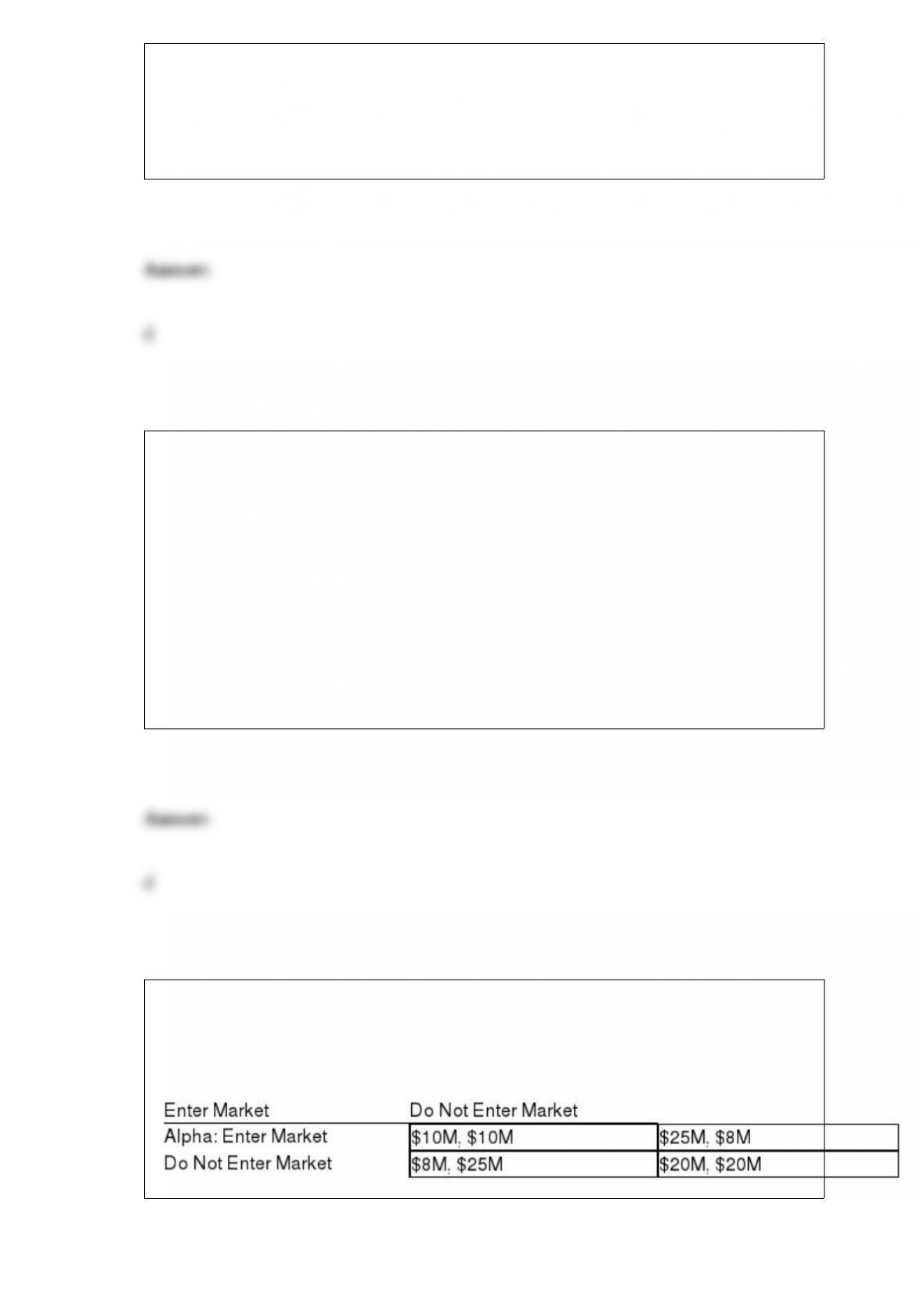
What are the Nash Equilibrium Strategies and corresponding payoffs for the following
matrix?
Beta: