Which of the following is a major import for the United States?
a. corn
b. soybeans
c. coal
d. fish
e. none of the above
When the government _____________ mortgage lending standards, the indirect result
is likely to be _____________ home prices.
a. lowers; higher
b. increases; lower
c. lowers; lower
d. increases; higher
e. a and b
It often appears as if there are “too few” workers at the Department of Motor Vehicles
(DMV) to service all of its customers at a given point in time.Based on one of theories
discussed in the textbook, this is probably because
a. the equilibrium “price” to be served by the DMV is lower than the “price” charged

customers.
b. the equilibrium “price” to be served by the DMV is higher than the “price” charged
customers.
c. the equilibrium “price” to be served by the DMV minus the “price” charged to
customers is zero.
d. b and c
e. none of the above
John purchases a baseball card for $10 that turns out to be so rare that a collector offers
to buy it from him for $2,000. Instead, John decides to give the card to his sister (an
avid baseball-card collector) as a birthday present. The opportunity cost of John’s
generosity is
a. $10, the purchase price.
b. $0, because at the time the decision is made, $10 are sunk cost, i.e., at that point there
is no cost to John of giving the card away.
c. $2,000, the amount offered by the collector.
d. $1,005, the average of $10 and $2,000.
Which of the following statements is false?
a. Since (total) fixed costs are constant as output changes in the short run, it follows that
average fixed cost is constant in the short run.
b. Marginal cost is the cost of producing an additional unit of output.
c. Changes in variable costs are reflected dollar-for-dollar in changes in total cost.
d. Fixed costs exist in the short run, but not in the long run.
Smith says she gets 5 utils from consuming the fifth unit of a good whereas Jones says
he gets 10 utils from consuming the fifth unit of a good. It follows that
a. the fifth unit of the good means more to Jones than Smith.
b. the fifth unit of the good means more to Smith than Jones.
c. the fifth unit of the good means twice as much to Jones as it means to Smith.
d. if the law of diminishing marginal utility holds, both Smith and Jones will get less
utility from the sixth unit of the good than the fifth.
e. a and d
Exhibit 22-13
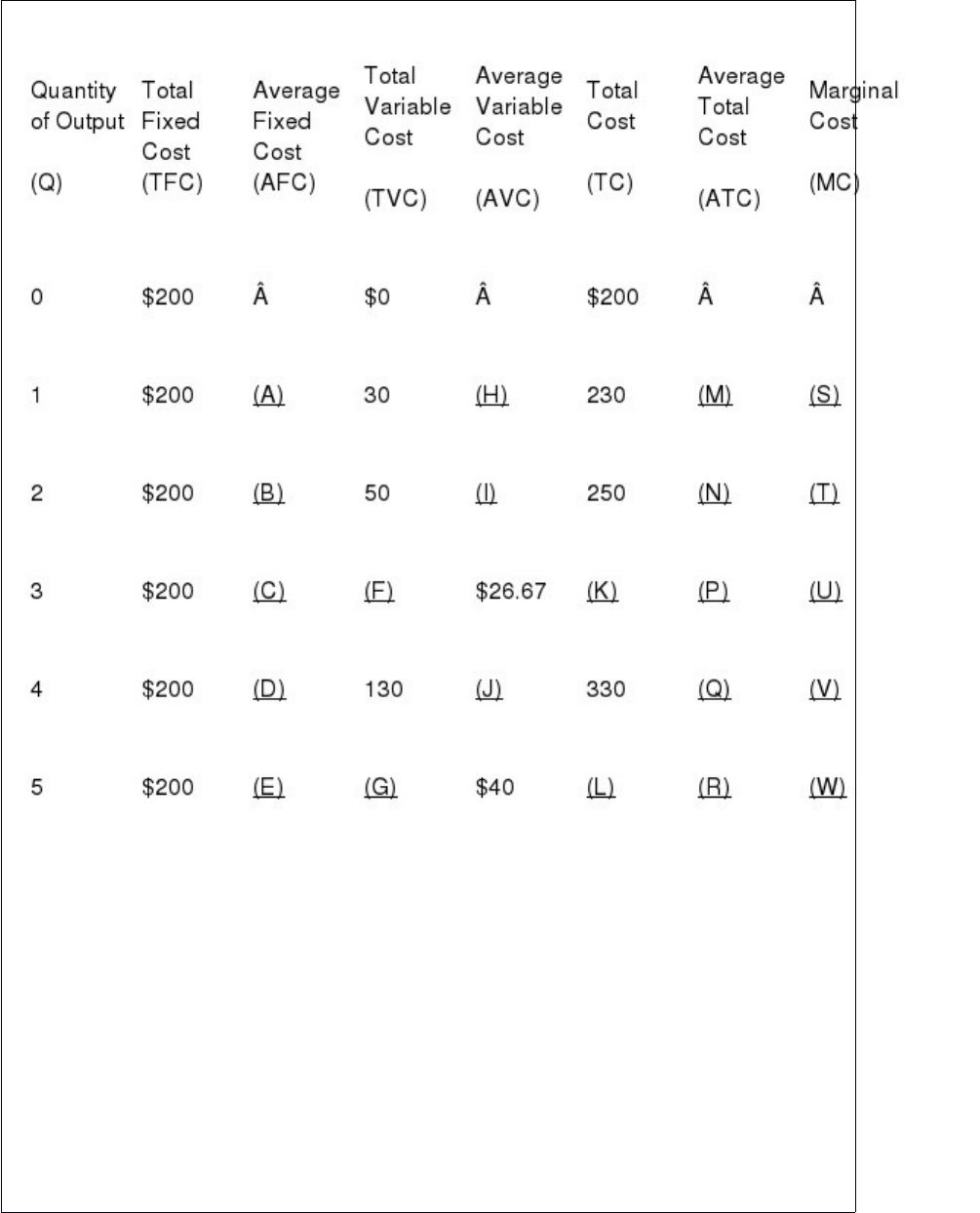
What dollar amounts go in blanks (T) and (U), respectively?
a. $10; $10
b. $20; $50
c. $20; $30
d. $42; $40
e. There is not enough information to answer this question.

The social insurance justification for government welfare assistance holds that
a. individuals want to provide welfare assistance to the needy because this is the right
thing to do.
b. individuals currently not receiving welfare think they might one day need welfare
assistance and thus they support welfare programs today.
c. it is society’s duty or obligation to provide health insurance to those who cannot
afford it.
d. a person benefits from the alleviation of poverty even if he doesn’t contribute to
alleviating poverty.
e. none of the above
Supply-restricting policies are intended to __________ prices and __________ farmers’
revenues.
a. lower; increase
b. lower; reduce
c. raise; increase
d. raise; reduce
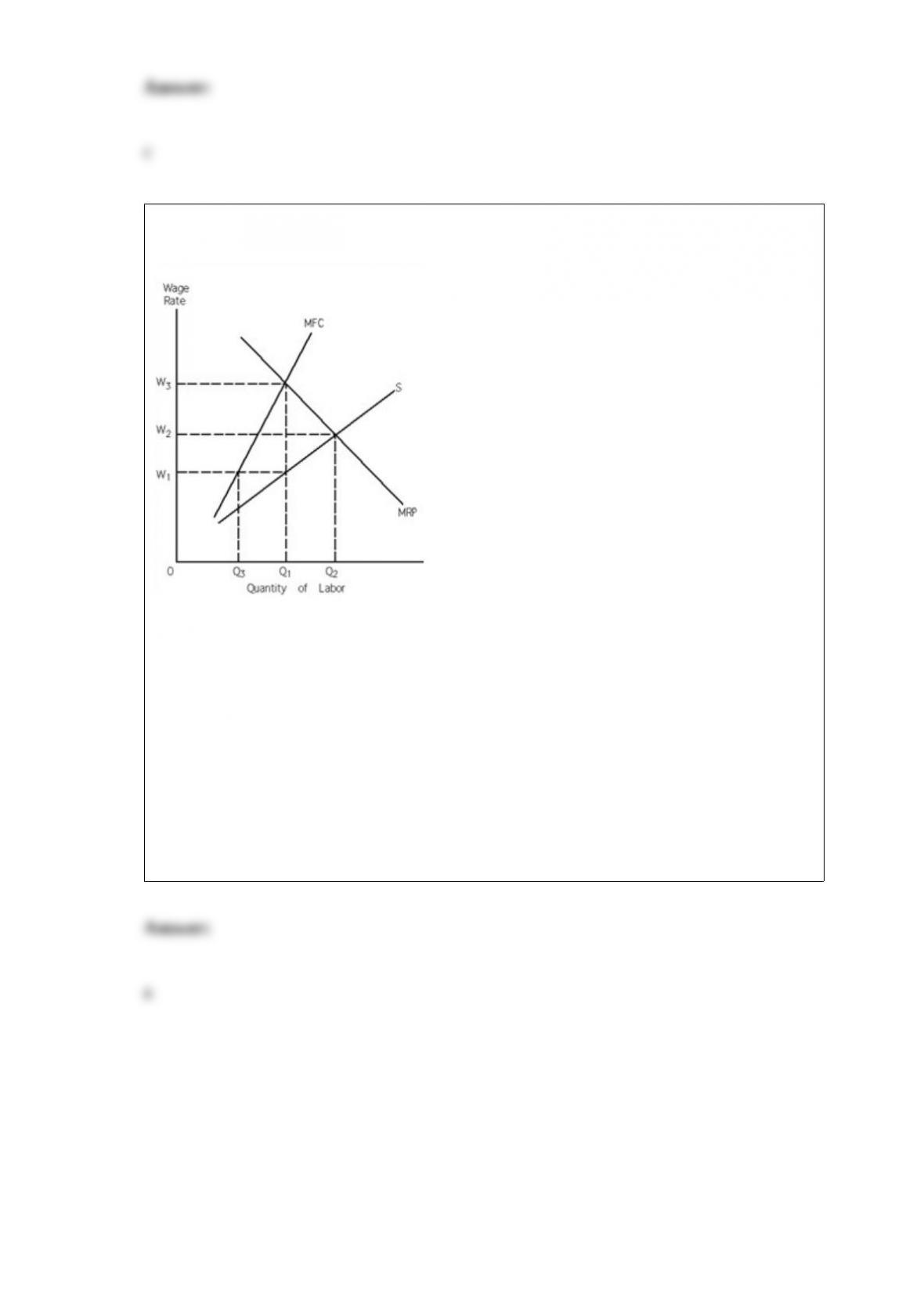
Exhibit 28-3
Consider the monopsony setting. In the absence of collective bargaining, what quantity
of labor does the profit-maximizing monopsonist hire?
a. Q1
b. Q2
c. Q3
d. none of the above