
Suppose the demand curve for a product is represented by a typical downward-sloping
curve. Now suppose the demand for this product decreases. Which of the following
statements accurately predicts the resulting decrease in price?
A) The more elastic the supply curve, the greater the price increase.
B) The more elastic the supply curve, the smaller the price decrease.
C) The increase in price is not affected by the elasticity of the supply curve.
D) The decrease in price will always be proportional to the magnitude of the demand
shift.
Which of the following is used to argue that the self-interest of public policymakers will
often lead to actions that are inconsistent with the preferences of the voters they
represent?
A) the voting paradox
B) the median voter theorem
C) rent seeking
D) transitivity of voters’ preferences
There has been catch-up among ________, but there has not been catch-up among
________.
A) developing countries such as Niger; industrialized countries such as Japan
B) industrialized countries such as Japan; all countries of the world
C) developing countries such as Niger; all countries of the world
D) all countries of the world together; industrialized countries such as Japan
An agreement among firms to charge the same price or otherwise not to compete is
called
A) a payoff matrix.
B) a subgame-perfect equilibrium.
C) a Nash equilibrium.
D) collusion.
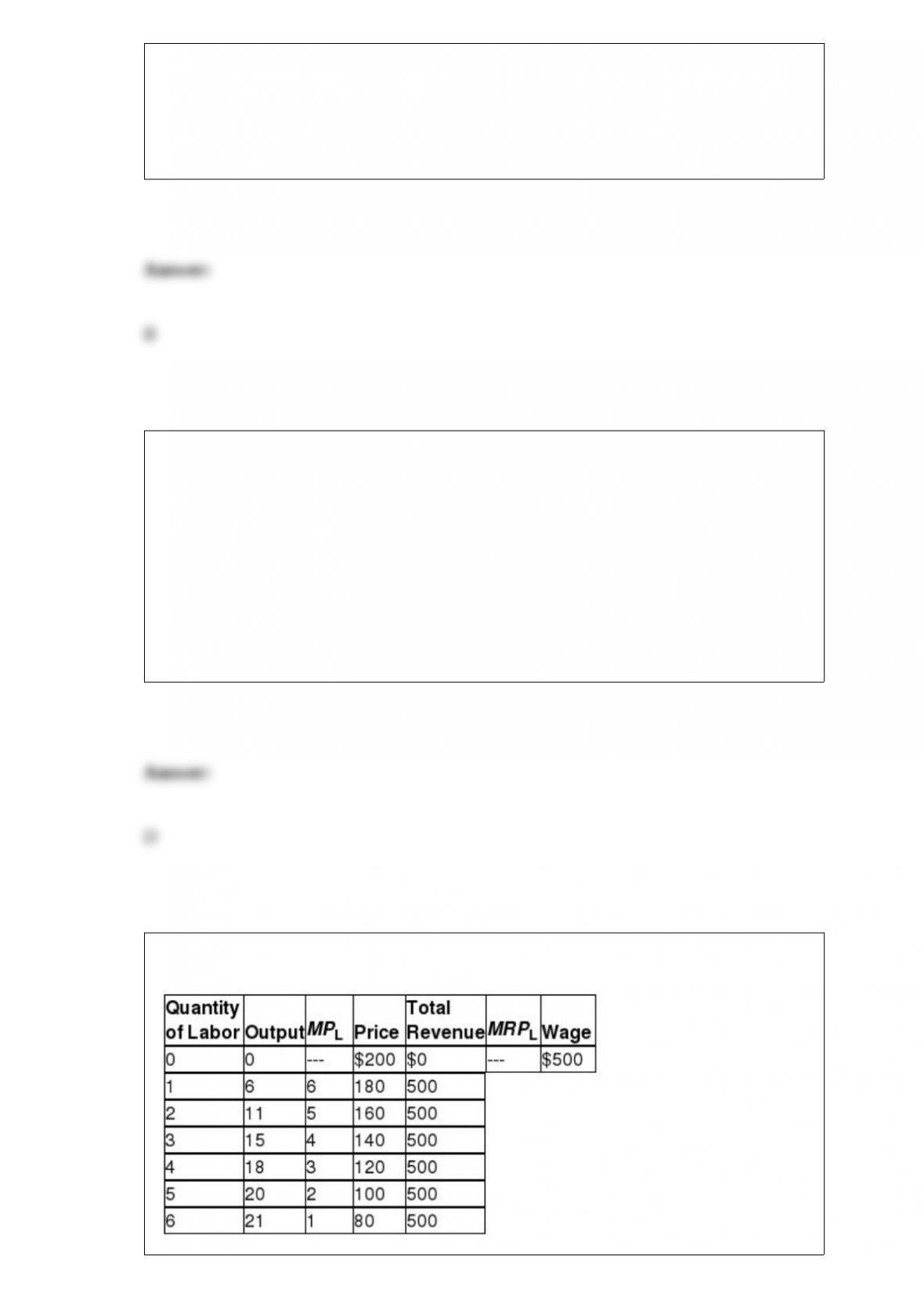
Table 17-4

Table 17-4 lists data for the production of Apple iPods. Apple is assumed to be a price
maker, so to increase its sales of iPods the firm must lower its price. MPL and MRPL
refer to the marginal product of labor and the marginal revenue product of labor,
respectively.
What are the quantity of labor and marginal revenue product of labor that will
maximize the profit Apple would earn from selling iPods?
A) 2; $160
B) 3; $340
C) 2; $680
D) 3; $140
An unplanned decrease in inventories results in
A) a decrease in planned investment.
B) an increase in planned investment.
C) actual investment that is greater than planned investment.
D) actual investment that is less than planned investment.
Since 1999, the capital account has recorded
A) transactions that affect net capital flows in the economy.

B) relatively minor transactions, such as migrants’ transfers, and sales and purchases of
nonproduced, nonfinancial assets.
C) transactions that affect the balance of trade or the balance of services.
D) statistical discrepancy between the current account and the financial account.
Which of the following will not shift the demand curve for a good?
A) an increase in population
B) an increase in the price of the good
C) a decrease in the price of a substitute good
D) an increase in consumer incomes
During a(n) ________ many firms experience reduced profits, which reduces ________
and investment spending.
A) expansion; business confidence
B) recession; cash flow
C) expansion; cash flow
D) recession; government spending
If the price of propane-fueled gas grills was to decrease, then
A) the demand for propane would decrease.
B) the demand for propane would increase.
C) the quantity of propane demanded would increase.
D) the quantity of propane demanded would decrease.
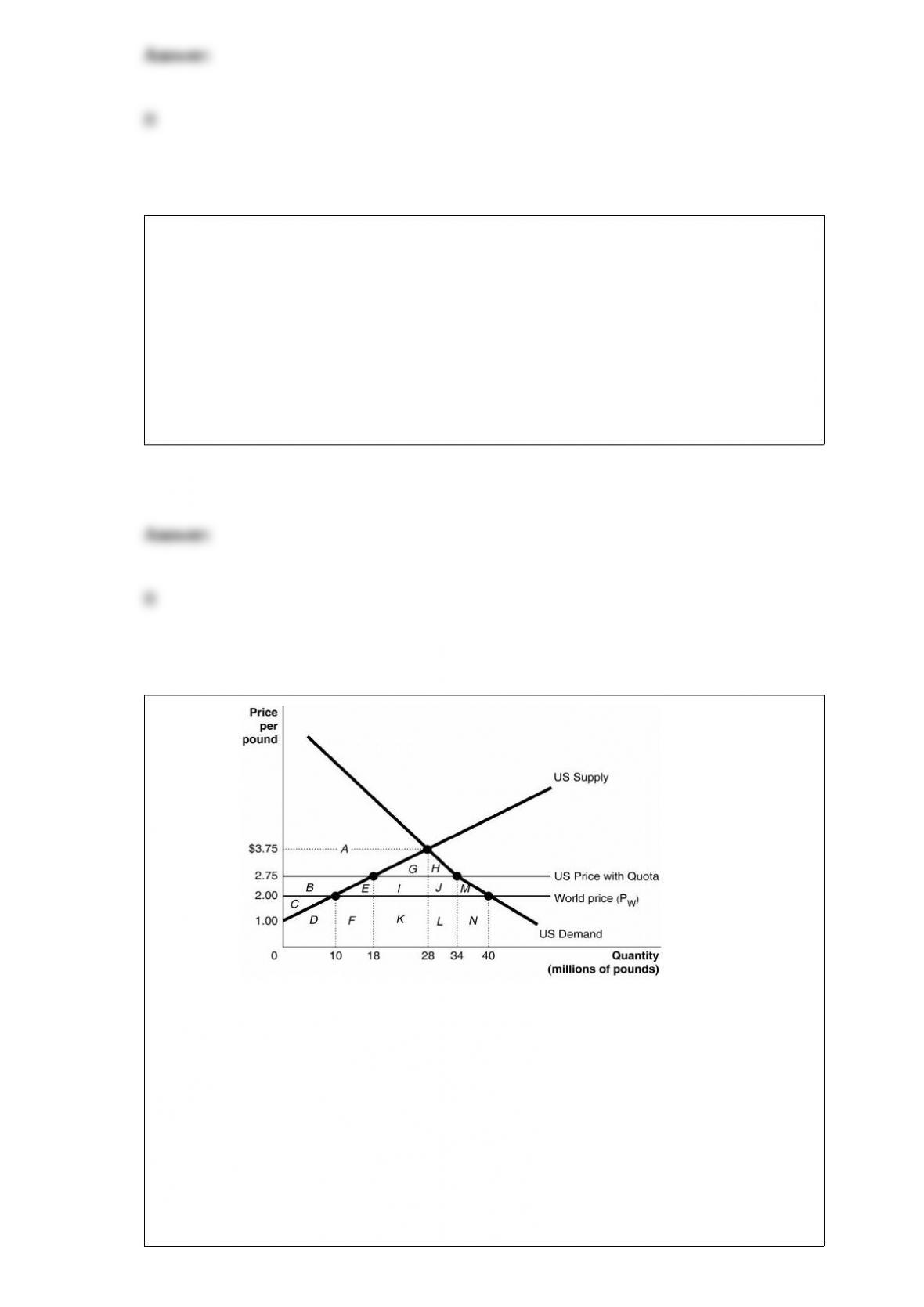
Figure 9-3 Since 1953 the
United States has imposed a quota to limit the imports of peanuts. Figure 9-3 illustrates
the impact of the quota. What is the area of consumer surplus after the imposition of the
quota?
A) A + G + H
B) G + H + E + I+ J + M
C) G + H
D) A
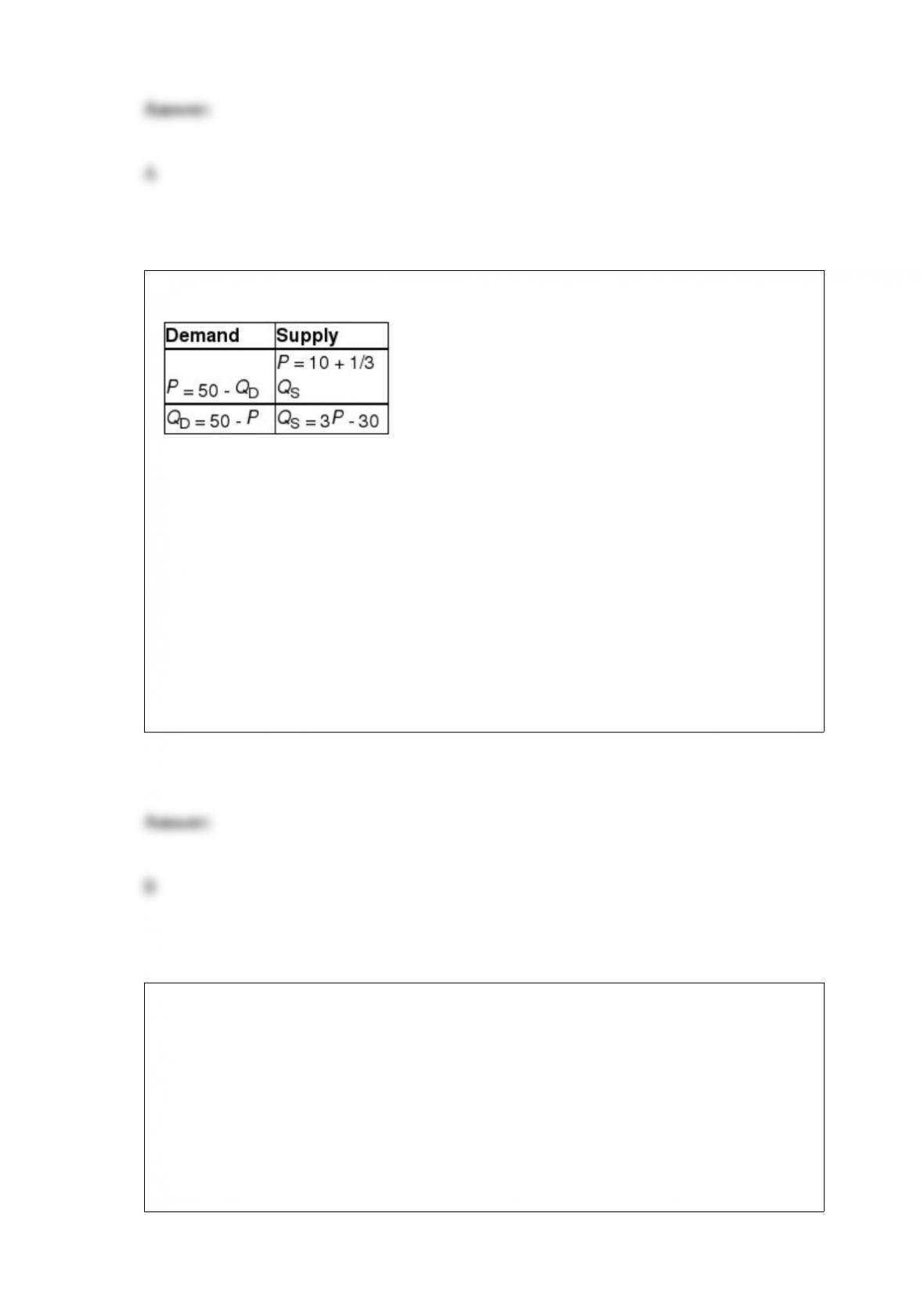
Table 4-6
The equations above describe the demand and supply for Aunt Maud’s Premium Hand
Lotion. The equilibrium price and quantity for Aunt Maud’s lotion are $20 and 30
thousand units. What is the value of consumer surplus?
A) $300 thousand
B) $450 thousand
C) $900 thousand
D) $1,500 thousand
You have an absolute advantage whenever you
A) are better educated than someone else.
B) can produce more of something than others with the same resources.
C) prefer to do one particular activity.
D) can produce something at a lower opportunity cost than others.

An example of a final good would be
A) the soy milk sold to Starbucks.
B) the whipped cream sold to Starbucks.
C) a soy latte sold by Starbucks to a student.
D) the coffee beans sold to Starbucks.
If a firm’s average total cost is less than price where MR = MC,
A) the firm should shut down.
B) the firm should raise its price.
C) the firm should continue to produce the output it is producing.
D) the firm should cut back on its output to lower its cost.

If potential GDP is equal to $600 billion, what does the long-run aggregate supply
curve look like?
A) It is a horizontal line at $600 billion of GDP.
B) It is a vertical line at a level of GDP below $600 billion.
C) It is a vertical line at $600 billion of GDP.
D) It is a vertical line at a level of GDP above $600 billion.
Which of the following leads to a decrease real GDP?
A) an increase in government spending
B) an increase in the inflation rate in other countries, relative to the inflation in the
United States
C) an increase in interest rates
D) Households have increasingly optimistic expectations about future income.
To be a natural monopoly a firm must
A) control a key resource input.
B) have economies of scale that are so large that it can supply the entire market at a
lower cost than two or more firms.
C) have significant network externalities.

D) be very large relative to the total market.
The GDP deflator is a measure of the
A) total production of the economy adjusted for inflation.
B) total production of the economy unadjusted for inflation.
C) average level of prices of final goods and services in the economy.
D) average level of prices of intermediate goods and services in the economy.