
According to the textbook, The Wonderful Wizard of Oz is alleged to be a story about
a. the California gold strikes of 1849.
b. the end of the gold standard in 1934.
c. the presidential election of 1896.
d. the financial panic of 1907.
Starting from short-run equilibrium, the following occurs: labor productivity rises and
individuals expect higher (future) incomes. What is the effect on the price level and
Real GDP in the short run?
a. Real GDP falls and the price level necessarily rises.
b. Real GDP rises and the effect on the price level cannot be determined.
c. Real GDP rises and the price level necessarily falls.
d. Real GDP falls and the effect on the price level cannot be determined.
e. Real GDP rises and the price level necessarily rises.

If an economist says “the higher the price of oranges, the fewer oranges individuals will
buy, ceteris paribus,” this means that
a. individuals don’t like high-priced oranges.
b. as the price of oranges rises, individuals’ preferences change and they no longer like
oranges as much as they once did.
c. as the price of oranges rises, individuals’ preferences do not change, nor does
anything else, but individuals buy fewer oranges in response to the higher price of
oranges.
d. the higher the price of oranges, the fewer oranges individuals will buy, assuming that
people have economic motives.
Exhibit 9-5
Point C on graph (2) would correspond to the intersection of an AD curve and a SRAS
curve at which point(s) on graph (1)?
a. I or J
b. K

c. L or M
d. I or L
e. J or M
The economy is in the horizontal portion of the AS curve, investment spending is
interest insensitive and there is no liquidity trap. According to the Keynesian
transmission mechanism, if the money supply increases the interest rate will
__________, investment spending will __________, the AD curve will __________,
and Real GDP will __________.
a. fall; fall; left; fall
b. rise; drop; left; fall
c. fall; remain unchanged; not shift; not change
d. rise; remain unchanged; not shift; not change
e. none of the above
Which of the following is a nonmarket good?
a. the corn you grow in your home garden and consume
b. the clothes you sew and sell to a neighbor who pays you by writing you a check
c. the self-portrait hanging in your den

d. a and c
e. a, b, and c
According to a new Keynesian theorist, a correctly anticipated increase in aggregate
demand will
a. cause the price level to increase by a greater amount in the short run than what a new
classical rational expectations theorist would predict.
b. cause the price level to increase by a smaller amount in the short run than what a new
classical rational expectations theorist would predict.
c. cause the price level to increase by the same amount in the short run that a new
classical rational expectations theorist would predict.
d. leave the price level unchanged in the short run, but Real GDP will increase more
than what a new classical theorist would predict.
e. leave the price level unchanged in the short run, but Real GDP will increase less than
what a new classical theorist would predict.
A “decrease in demand” means that
a. the demand curve has shifted to the left.
b. price has declined and consumers want to purchase more of the good.
c. the demand curve has shifted to the right.

d. the price of the good can be expected to decline, assuming supply stays constant.
According to the monetarist transmission mechanism, a decrease in the money supply
__________ aggregate demand.
a. directly increases
b. indirectly increases
c. directly decreases
d. indirectly decreases
e. equals the increase in
The AD curve shows the various amounts of real output that people are willing and able
to
a. buy at different income levels.
b. buy at different price levels.
c. sell at different profit levels.
d. sell at different price levels.
e. none of the above
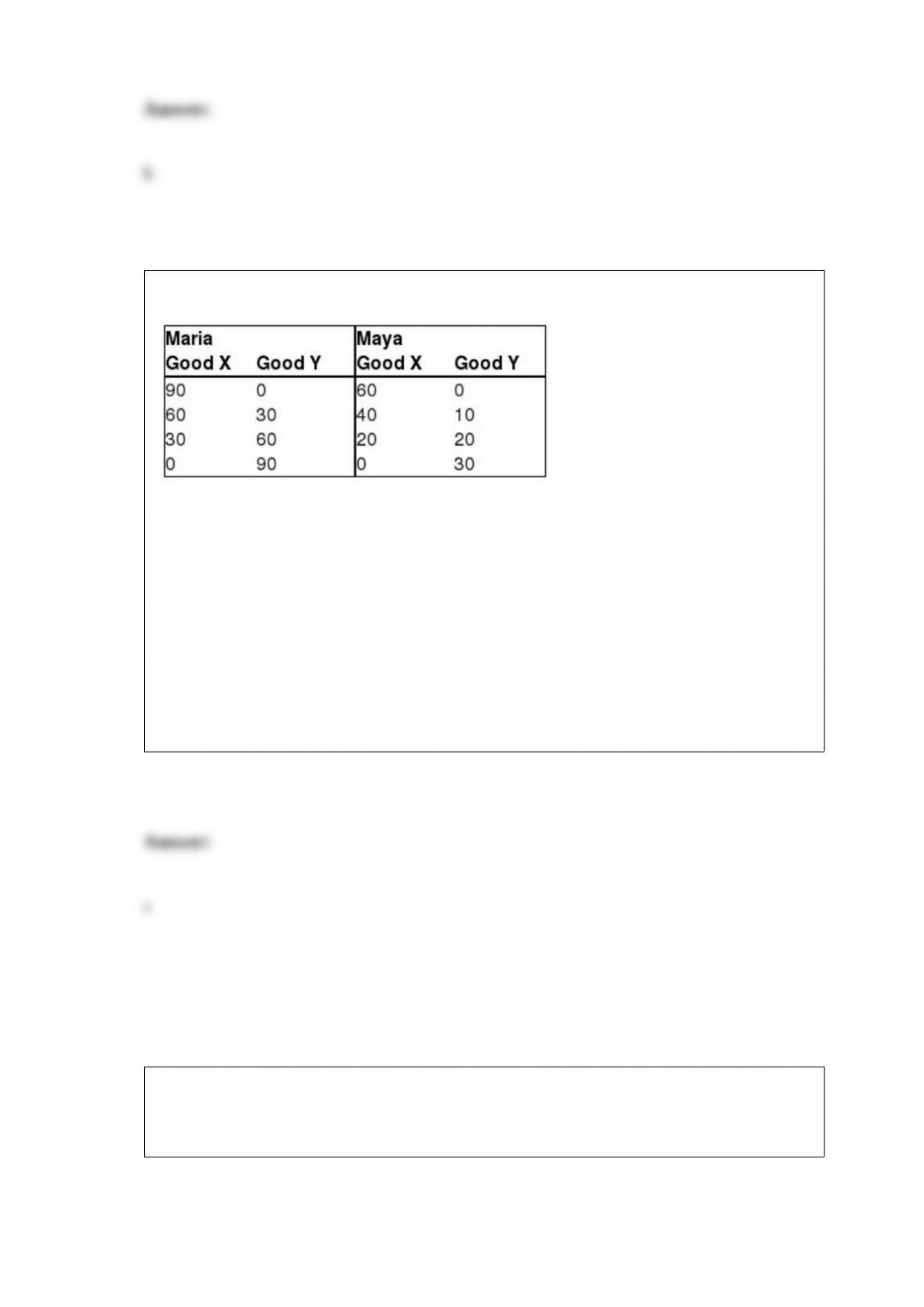
Exhibit 2-8
If Maria and Maya each specialize in the good in which she has a comparative
advantage and then engage in trade, ____________________ can consume a
combination of goods that lies beyond her PPF.
a. Maria, but not Maya,
b. Maya, but not Maria,
c. both Maria and Maya
d. neither Maria nor Maya
Exhibit 6-2
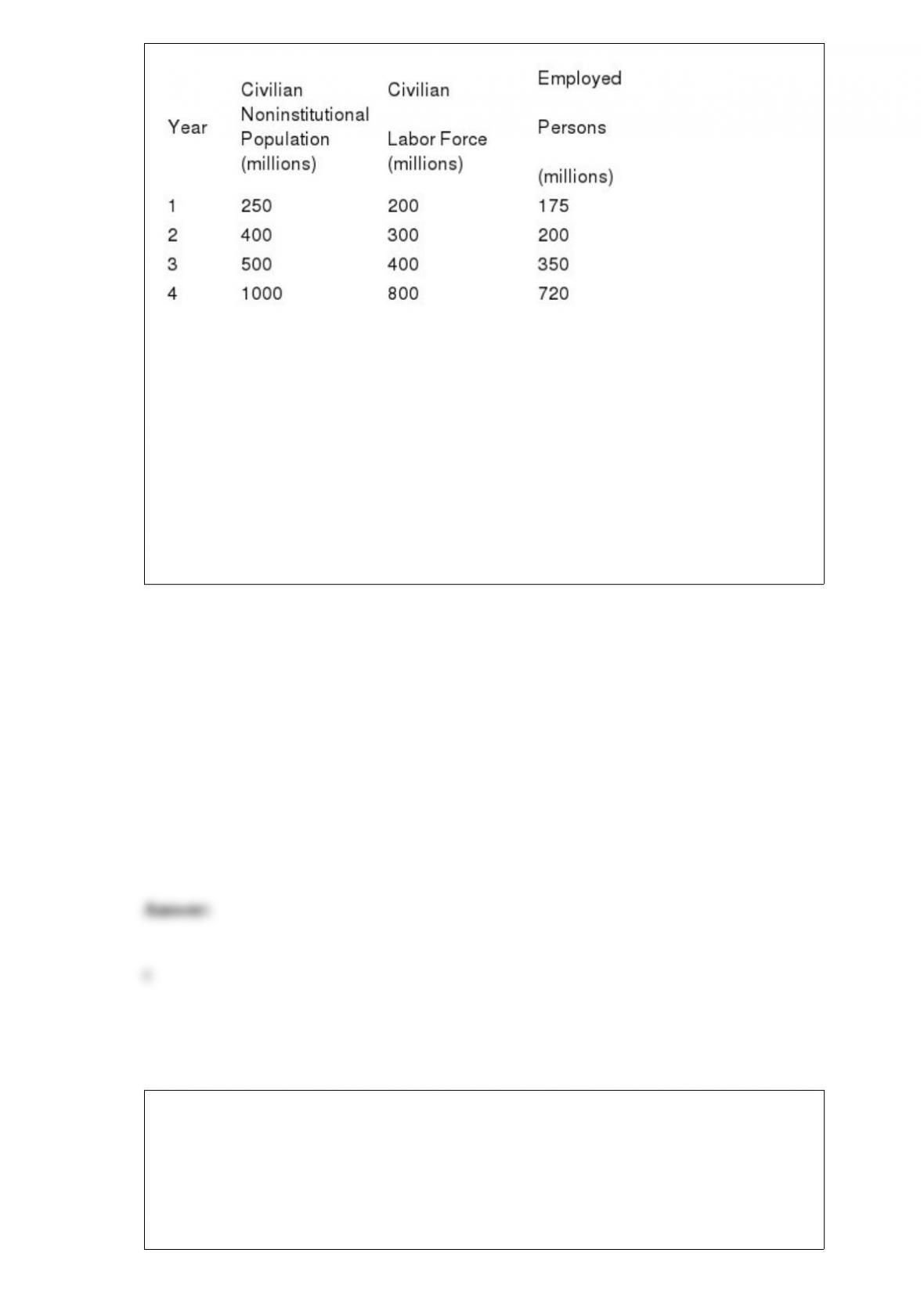
The employment rate in year 4 is
a. 12.5 percent.
b. 7.2 percent.
c. 72 percent.
d. 10 percent.
e. 90 percent.
The president of the Federal Reserve Bank of ________________ holds a permanent
seat on the _________________________.
a. New York; Board of Governors of the Federal Reserve System
b. Washington D.C.; FOMC

c. San Francisco; FOMC
d. New York; FOMC
e. Washington D.C.; Board of Governors of the Federal Reserve System