
1) firms in a monopolistically competitive industry have no reason to engage in
nonprice competition because their products are uniquely different from other sellers in
the market.
2) a vertically integrated firm is a group of plants each operating at different stages of
production.
3) As oil prices rise, alternative energy sources become economically viable.
4) Environmentalists generally support price supports because these subsidies motivate
additional farm production.
5) The rising general level of real wages in the United States has occurred because
growing population has increased the supply of labor relative to the demand for it.
6) personal income usually exceeds disposable income.
7) Fidelity, Putnam, Dreyfus, and Kemper are examples of mutual fund companies.

8) illegal immigration helps improve the standard of living for u.s. citizens by keeping
prices lower.
9) Equal increases in government expenditures and tax collections will leave the
equilibrium GDP unchanged.
10) if real gdp is 50 and nominal gdp is 100, the gdp price index is 200.
11) allocative efficiency occurs where the collective sum of consumer and producer
surplus is at a maximum.
12) The supply of money increases when the public buys government securities from
commercial banks.
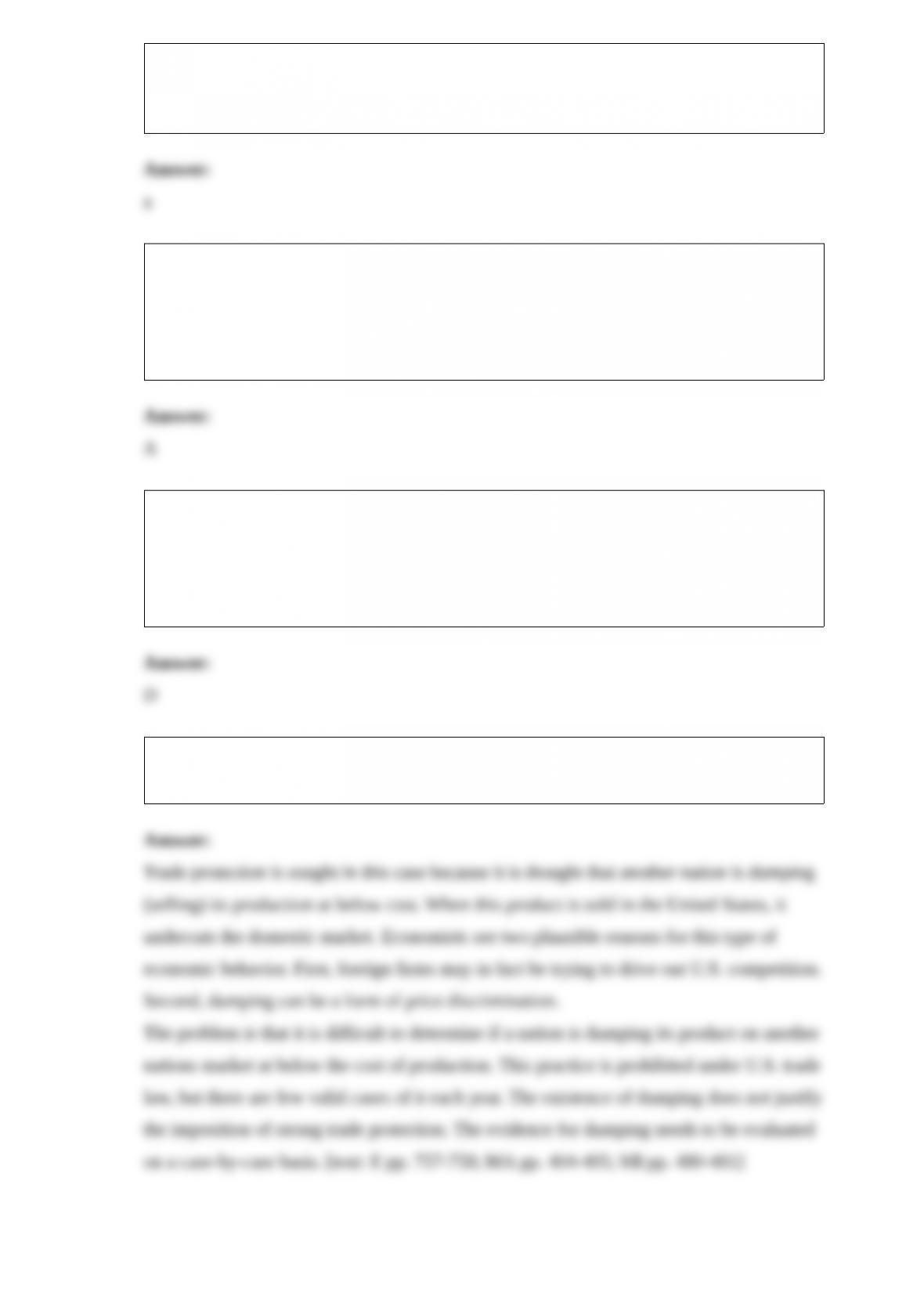
13) refer to the above diagram for a nondiscriminating monopolist. if the government
regulates the monopolist so that it charges the price that achieves allocative efficiency,
the monopolist will produce output q
14) a nation’s gross domestic product (gdp):
a.can be found by summing c + ig + g + xn.
b.is the dollar value of the total output produced by its citizens, regardless of where they
are living.
c.can be found by summing c + s + g + xn.
d.is always some amount less than its ndp.
15)
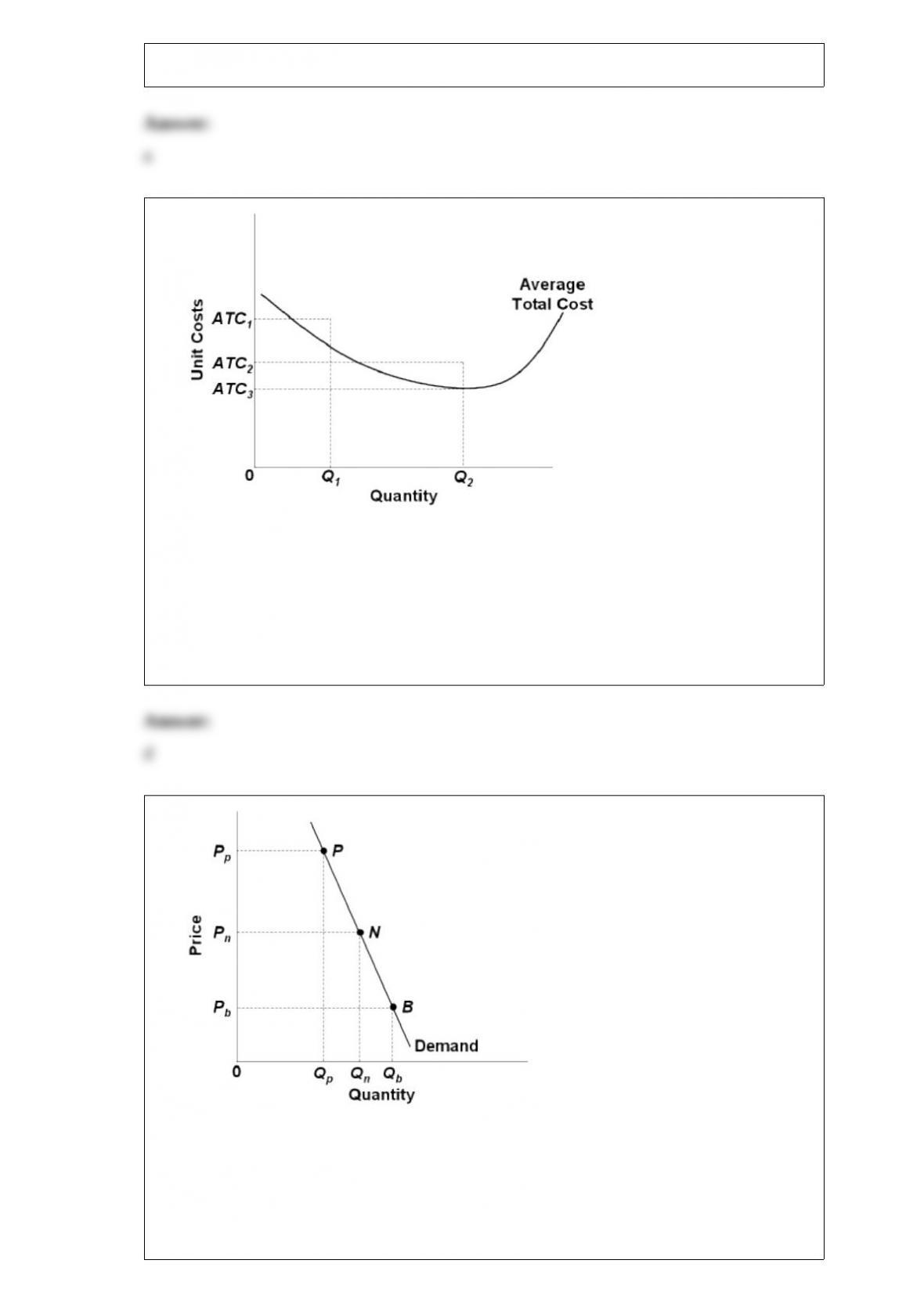
refer to the above long-run cost diagram for a firm. if the firm produces output q2 at an
average cost of atc3, then the firm is:
a.producing the profit-maximizing output, but is failing to minimize production costs.
b.incurring x-inefficiency, but is realizing all existing economies of scale.
c.incurring x-inefficiency and is failing to realize all existing economies of scale.
d.producing that output with the most efficient combination of inputs and is realizing all
existing economies of scale.
16)
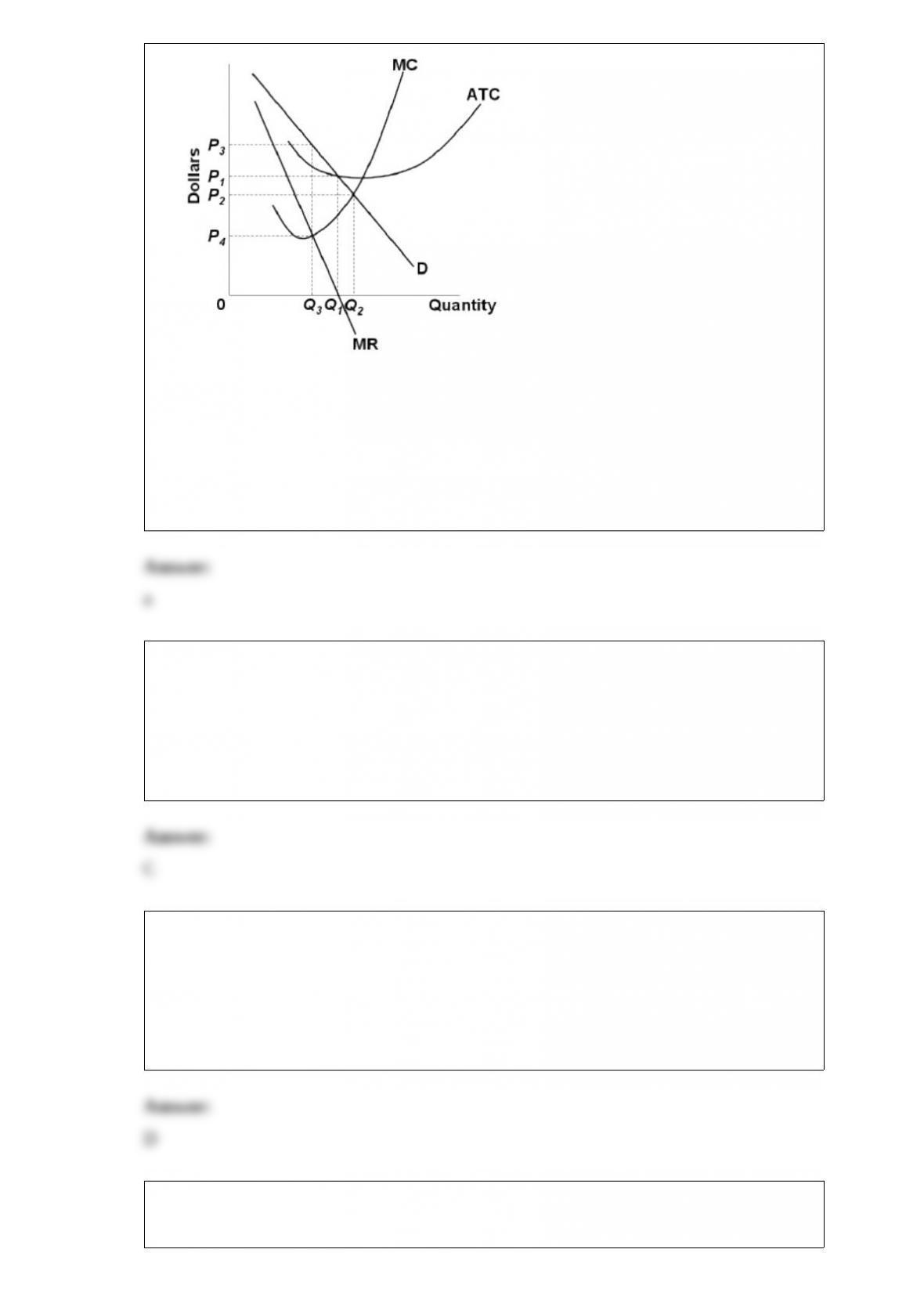
Refer to the above diagram. If output changes from a poor crop, Qp, to a bumper crop,
Qb:
A.farm incomes will decrease.
B.farm incomes will increase.
C.price and quantity will both increase.
D.farm incomes may either rise or fail.

17) Suppose complementary inputs A and B are being used by a firm in the
profit-maximizing amounts. If the price of A now increases, the firm should use:
A.more of B, provided the substitution effect exceeds the output effect.
B.more of B because of the substitution effect.
C.less of B because of the substitution effect.
D.less of B because of the output effect.
18) Which of the following is not a condition of the international gold standard?
A.a nation must be willing to accept very wide fluctuations in its exchange rate
B.a nation must allow gold to be freely exported and imported
C.a nation must be willing to convert gold into paper money and vice versa at a
stipulated rate
D.a nation must define its monetary unit in terms of a certain quantity of gold
19) the maximum federal marginal tax rate on taxable personal income is currently
(2008):
a.50 percent.
b.35 percent.
c.45 percent.
d.28 percent.
20)
refer to the above diagram for a pure monopolist. suppose a regulatory commission is
created to determine a legal price for the monopoly. if the commission seeks to provide
the monopolist with a “fair return,” it will set price at:
a.p1.
b.p3.
c.p2.
d.p4.
21) Graphical analysis of tariffs reveals that:
A.they benefit domestic consumers at the expense of domestic producers.
B.revenue gains outweigh the costs to domestic consumers.
C.they increase domestic production of the good for which imports face tariffs.
D.although the benefits are not shared equally, everyone in the domestic economy
benefits from tariffs.
22) An exchange rate:
A.is the ratio of the dollar volume of a nation’s exports to the dollar volume of its
imports.
B.measures the interest rate ratios of any two nations.
C.is the amount that one nation must export to obtain $1 worth of imports.
D.is the price at that the currencies of any two nations exchange for one another.
23) cost-push inflation:
a.reduces real output.
b.increases real output.
c.reduces the unemployment rate.
d.raises the natural rate of unemployment.
24) Firms are not likely to provide sufficient workplace safety if:
A.workers are unaware of workplace hazards.
B.they have some degree of monopoly power.
C.they are pure competitors and therefore price takers.
D.they are profit-maximizers.
25) Most modern banking systems are based on:
A.money of intrinsic value.
B.commodity money.
C.100 percent reserves.
D.fractional reserves.
26) What is the problem with protecting industries in the United States from the
dumping of foreign products on the domestic market?
27) Explain what happens in the extended aggregate demand and aggregate supply
model when there is a recession.
28) Summarize the four supply factors in economic growth.
29) What is the effect of the multiplier when aggregate demand increases and there is a
large increase in the price level? What happens when there only is a small increase in
the price level?
30) Under what conditions will a purely competitive firm realize an economic profit?
Give a response from a marginal revenue and marginal cost perspective and from a total
revenue and total cost perspective.
31) Define wealth. What is the effect of increase in wealth on the consumption and
saving schedules?
32) Why might many R&D expenditures be affordable, but not worthwhile? Are
outcomes from R&D guaranteed?