
The Soviet Union’s economy grew rapidly in terms of GDP per hour worked in the
1950s, but eventually this growth slowed. Why did this occur?
A) Capital per hour worked grew rapidly from 1950 to 1980, but technological change
occurred very slowly.
B) Capital per hour worked grew slowly, but technological change grew very rapidly.
C) Increasing implementation of new technologies eventually suffered diminishing
marginal returns.
D) The centrally planned economy invested too heavily in technological change.
The decision about what goods and services will be produced made in a market
economy is made by
A) lawmakers in the government voting on what will be produced.
B) workers deciding to produce only what the boss says must be produced.
C) producers deciding what society wants most.
D) consumers and firms choosing which goods and services to buy or produce.
E) consumers dictating to firms what they need most.
Which of the following is a true statement about the length of recessions and
expansions in the United States economy?
A) After 1950, the length of expansions equaled the length of recessions.

B) After 1950, the length of expansions were much less than the length of recessions.
C) After 1950, the length of expansions were much longer than the length of recessions.
D) After 1950, the length of expansions were brief and almost nonexistent.
If the Fed buys Treasury bills, this will shift the
A) money supply curve to the right.
B) money supply curve to the left.
C) money demand curve to the right.
D) money demand curve to the left.
If rational workers and firms know that the Federal Reserve is following a
contractionary monetary policy, they will expect inflation to ________ and will adjust
wages so that the real wage ________.
A) increase; remains unchanged
B) decrease; remains unchanged
C) decrease; increases
D) increase; decreases

Economists who support market-based reforms for health care believe that increased
competition among providers of health care would
A) decrease costs but decrease economic efficiency.
B) decrease costs and increase economic efficiency.
C) increase costs but increase economic efficiency.
D) increase costs and decrease economic efficiency.
What do the highest stock price and the lowest stock price over the previous year
indicate?
A) Add them together and divide by two to get the stock’s current market price.
B) What the stock’s price-earnings ratio is
C) How volatile the stock’s market price has been
D) They generate the dividend yield.

Which of the following could explain why there is an increase in potential GDP but the
equilibrium level of GDP does not rise?
A) SRAS shifted to the right by more than LRAS.
B) AD shifted to the right by more than SRAS.
C) AD shifted to the right by less than SRAS.
D) SRAS and AD do not shift.
An increase in government purchases, ceteris paribus, will
A) increase public saving.
B) increase the supply of loanable funds.
C) reduce investment.
D) reduce real GDP.
If speculators believe a currency is undervalued, their trades in international exchange
markets will
A) increase the surplus of the currency at the existing fixed exchange rate.
B) decrease the surplus of the currency at the existing fixed exchange rate.
C) decrease the shortage of the currency at the existing fixed exchange rate.
D) increase the shortage of the currency at the existing fixed exchange rate.
Economists assume that
A) individuals behave in unpredictable ways.
B) consumer behavior is explained by the existence of unlimited resources.
C) people put other people’s interests ahead of their own.
D) optimal decisions are made at the margin.
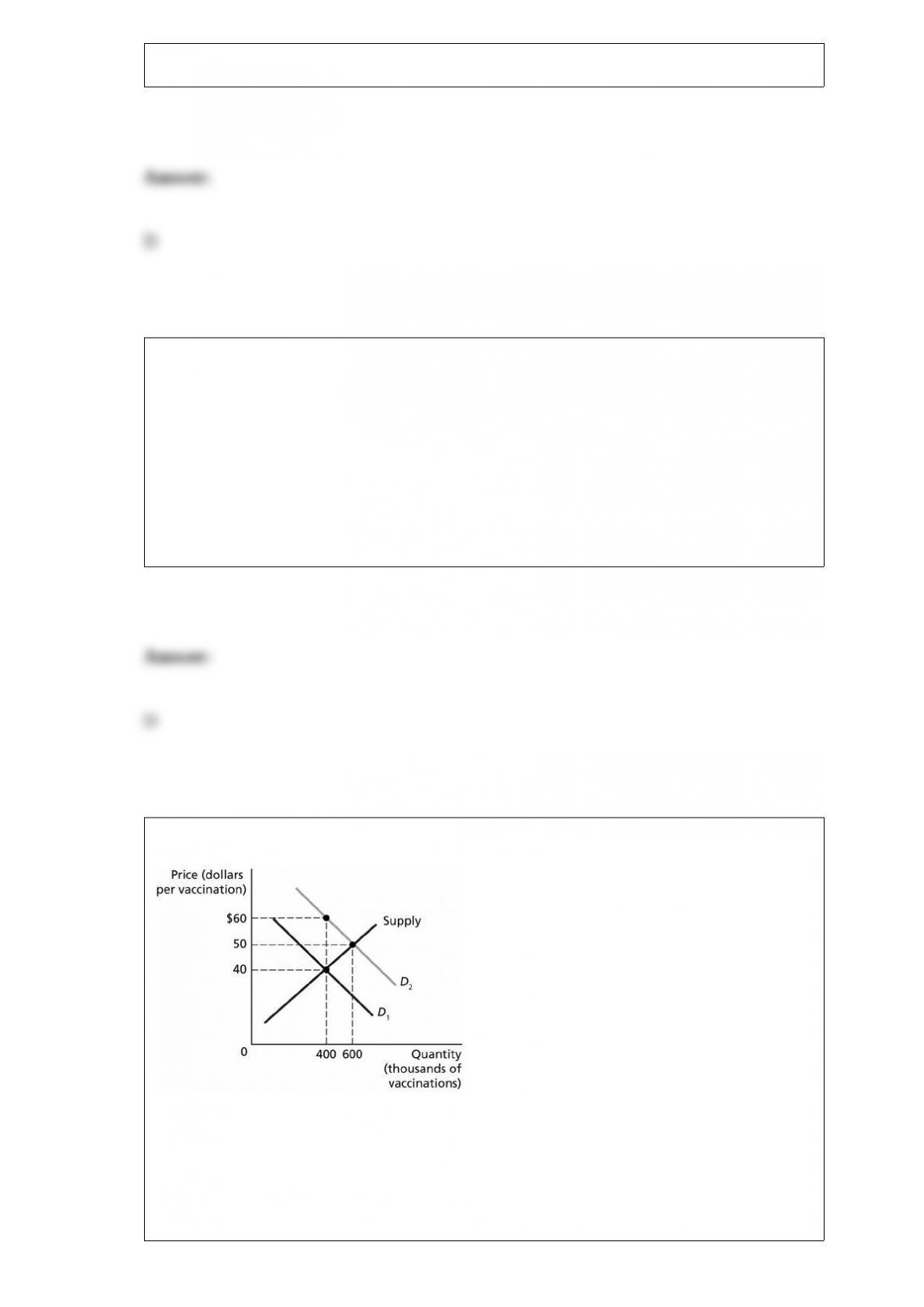
Figure 5-1
Figure 5-1 represents the market for vaccinations. Vaccinations are considered a benefit
to society, and the figure shows both the marginal private benefit and the marginal
social benefit from vaccinations.
Refer to Figure 5-1. The market equilibrium price is

A) $60.
B) $50.
C) $40.
D) <$40.
If the bank of Waterloo receives a $10,000 deposit, and the reserve requirement is 10
percent, how much can the bank loan out? (Assume that before the deposit this bank is
just meeting its legal reserve requirement.)
A) $1,000
B) $9,000
C) $10,000
D) $11,000
The per-worker production function shows the relationship between ________ per hour
worked and ________ per hour worked, holding ________ constant.
A) labor; real GDP; technology
B) capital; real GDP; technology
C) labor; capital; real GDP
D) capital; labor; real GDP

Consumption spending is $5 million, planned investment spending is $8 million,
unplanned investment
spending is -$2 million, government purchases are $10 million, and net export spending
is $2 million. What is GDP?
A) $15 million
B) $23 million
C) $25 million
D) $27 million
When President Obama took office in January 2009, he pledged to pursue an
expansionary fiscal policy to try to pull the economy out of the recession. The next
month, Congress passed the American Recovery and Reinvestment Act of 2009, an
$840 billion package of spending increases and tax cuts that was
A) the largest fiscal policy action in U.S. history.
B) second in size only to the fiscal policy action taken during the Great Depression.
C) small in comparison to the actions taken during the recession of 1974-1975
D) roughly equal to the spending increases and tax cuts implemented during the
recession of 1980-1982.

________ is equal to consumption spending plus planned investment spending plus
government purchases plus net exports.
A) Full employment GDP
B) Short-run aggregate supply
C) Planned inventory investment
D) Planned aggregate expenditure
If banks do not loan out all their excess reserves, then the real world multiplier is
A) smaller than 1/RR.
B) larger than 1/RR.
C) equal to 1/RR.
D) not related to 1/RR.