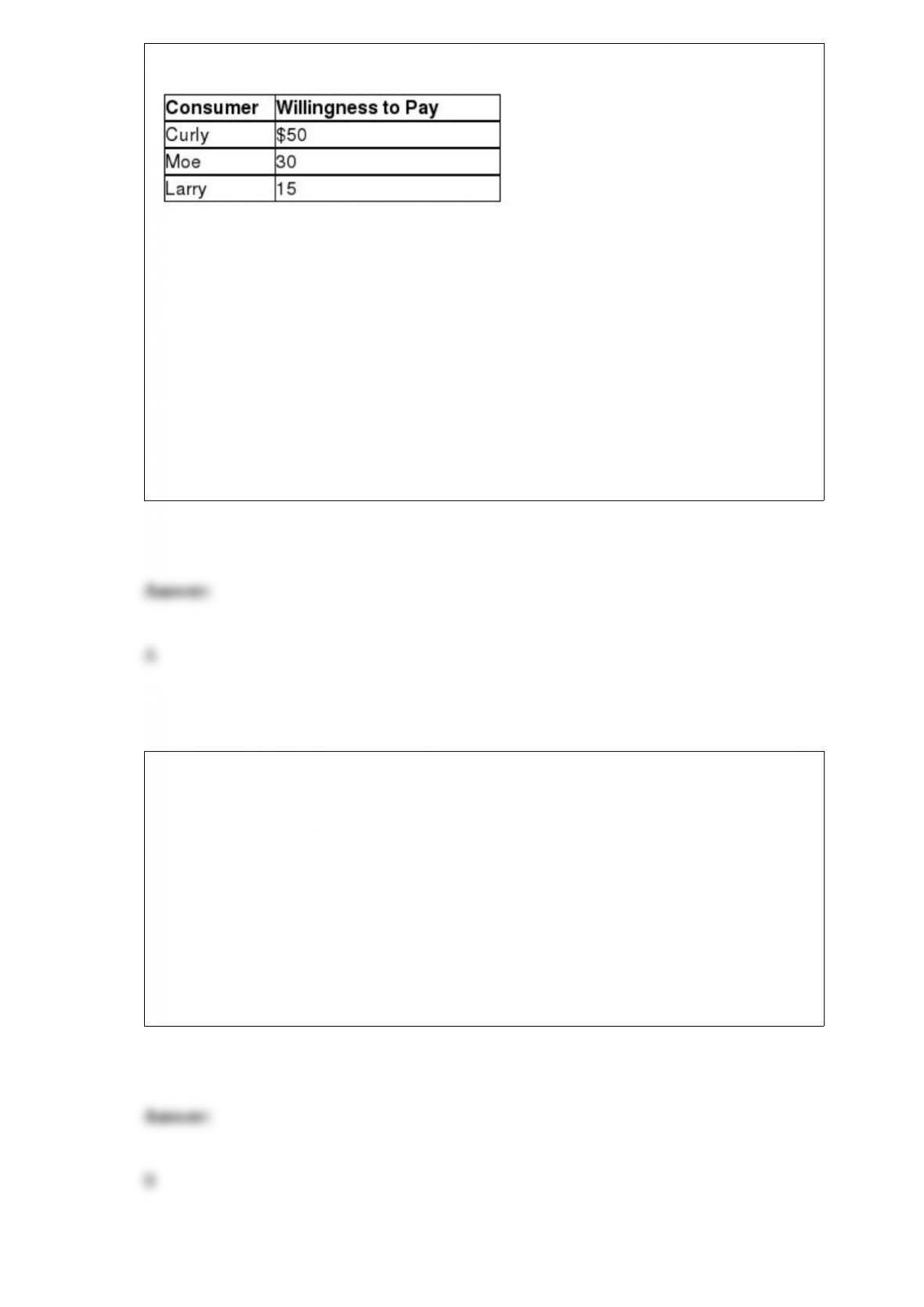
Table 4-1
The table above lists the highest prices three consumers, Curly, Moe, and Larry, are
willing to pay for a bottle of champagne. If the price of one of the bottles is $95 dollars,
total consumer surplus will be
A) $0.
B) $35.
C) $80.
D) $95.
In the early 1900s, Henry Ford revolutionized the automotive manufacturing industry
by instituting the assembly line. What impact did the assembly line method for
producing automobiles have on the per-worker production function for Ford?
A) It became flatter.
B) It shifted up.
C) It shifted down.
D) It became linear.
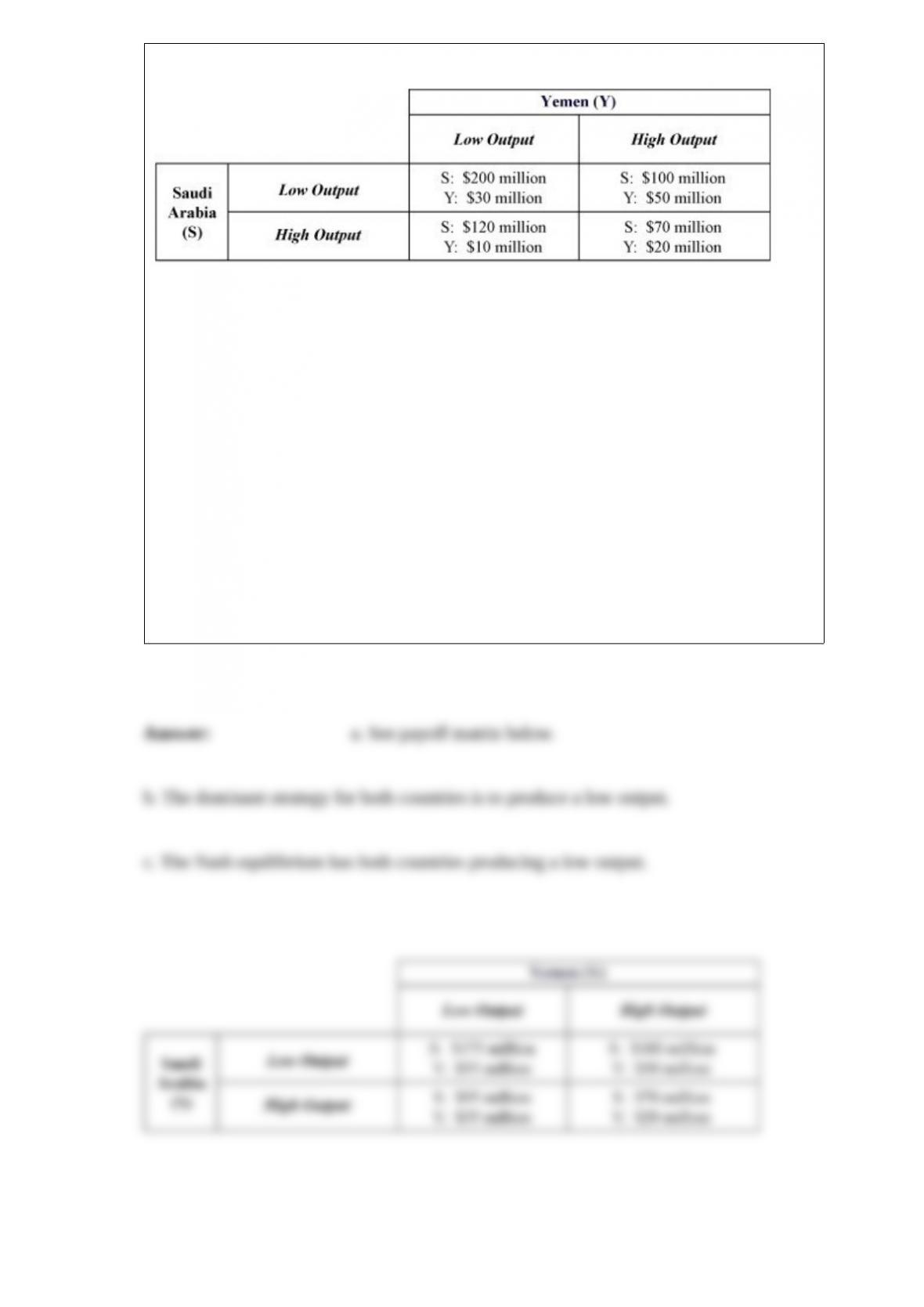
Table 14-10
Suppose the payoff matrix in the above figure represents the payoffs to Saudi Arabia
and Yemen for the production of oil. Saudi Arabia and Yemen must decide how much
oil to produce. Since the demand for oil is inelastic, relatively low production rates
drive up prices and profits. Saudi Arabia, the world’s largest and lowest cost producer, is
able to influence market price; it has an incentive to keep output low. Yemen, on the
other hand, is a relatively high cost producer with much smaller reserves. Assume Saudi
Arabia now decides to try to further influence the oil market by offering to pay Yemen
$25 million to produce a low output.
a. Create a new payoff matrix that reflects Saudi Arabia’s willingness to pay Yemen $25
million to produce a low output.
b. What is the dominant strategy for each country in this new game?
c. What is the new Nash equilibrium?

You have a bond that pays $60 per year in coupon payments. Which of the following
would result in an increase in the price of your bond?
A) Coupon payments on newly-issued bonds rise to $80 per year.
B) The likelihood that the firm issuing your bond will default on debt increases.
C) The price of a share of stock in the company falls.
D) Coupon payments on newly-issued bonds fall to $50 per year.
Decreasing government spending ________ the price level and ________ equilibrium
real GDP.
A) decreases; increases
B) increases; decreases
C) increases; increases
D) decreases; decreases
As a business type, corporations ________ in the United States.
A) earn the majority of profits
B) are the most common
C) are the least common
D) are subject to the least amount of taxes
In the United States, government policies with respect to monopolies and collusion are
embodied in
A) the U.S. Constitution.
B) common law, which the United States adopted from English law.
C) the Supreme Court.
D) antitrust laws.
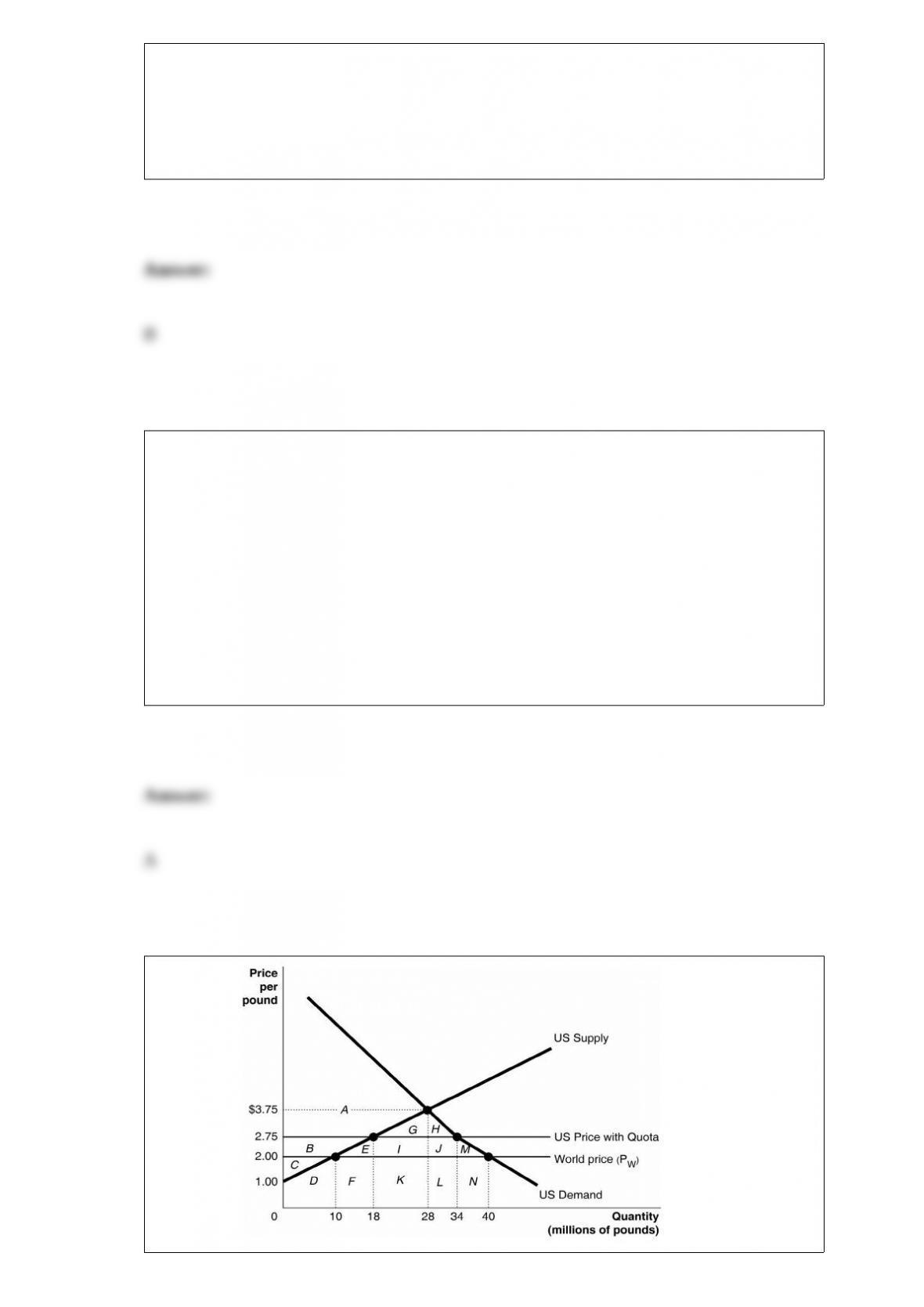
Table 4-11
The equations above describe the demand and supply for Chef Ernie’s Sushi-on-a-Stick.
What are the equilibrium price and quantity (in thousands) for Chef Ernie’s sushi?
A) $80 and 80 thousand
B) $60 and 20 thousand
C) $50 and 100 thousand
D) $40 and 50 thousand
All of the following are assumptions made by the dynamic model of aggregate demand
and aggregate supply except
A) aggregate demand and potential real GDP decrease continuously.
B) the aggregate demand curve shifts to the right during most periods.
C) potential real GDP increases continuously.
D) the short-run aggregate supply curve shifts to the right except during periods when
workers and firms expect higher wages.
Figure 9-3 Since 1953 the

United States has imposed a quota to limit the imports of peanuts. Figure 9-3 illustrates
the impact of the quota. With a quota in place, what is the quantity supplied by
domestic producers?
A) 8 million pounds
B) 10 million pounds
C) 16 million pounds
D) 18 million pounds
An investor is more likely to buy a firm’s stock if the firm’s income statement shows
________ and if its balance sheet shows ________.
A) a large net worth; a large price-earnings ratio
B) a large after-tax profit; a large net worth
C) a large price-earnings ratio; a large dividend yield
D) low opportunity costs; large liabilities
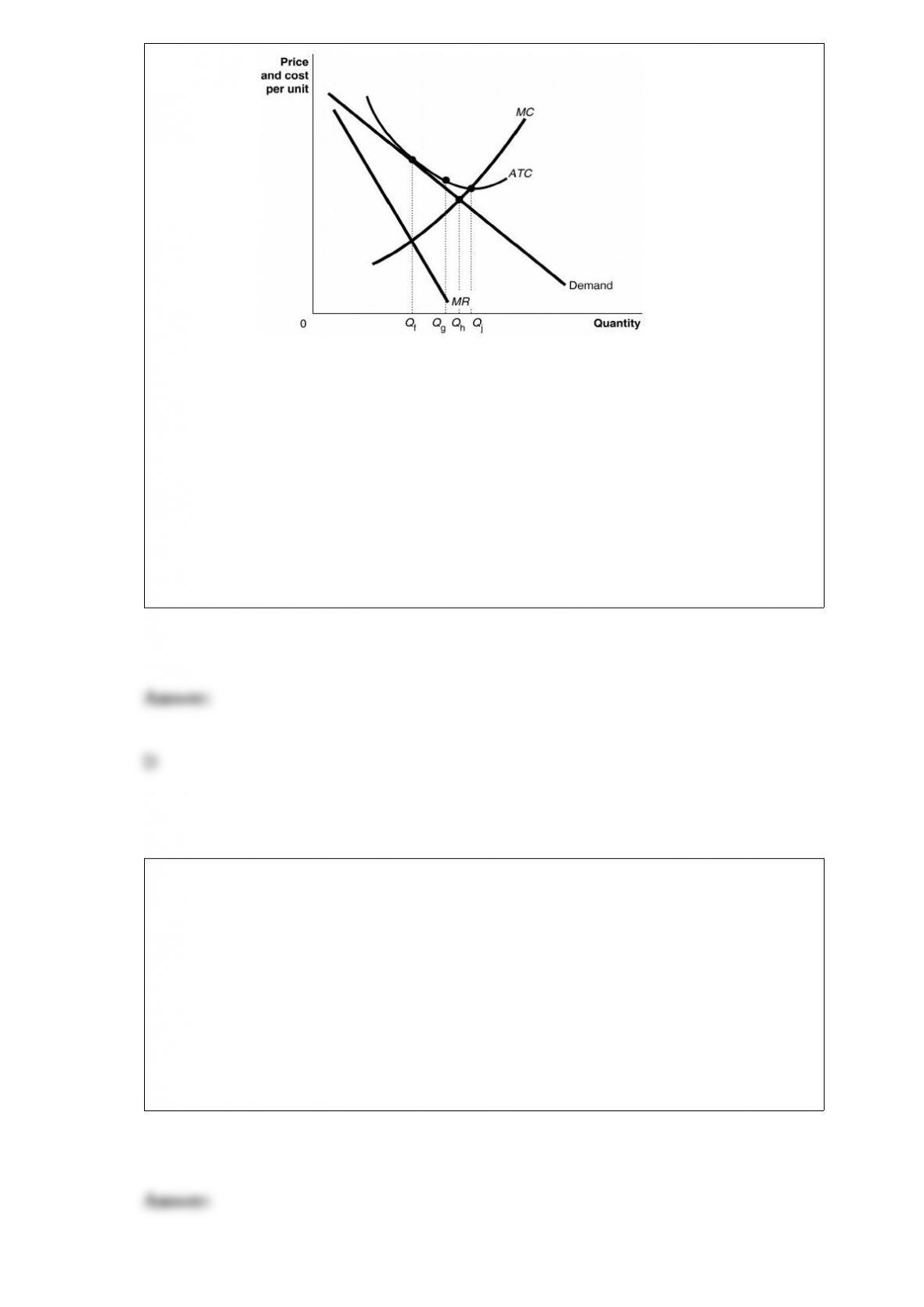
Figure 13-17
What is the productively efficient output for the firm represented in the diagram?
A) Qf units
B) Qg units
C) Qh units
D) Qj units
When the Federal Reserve increases the money supply, at the previous equilibrium
interest rate households and firms will now have
A) more money than they want to hold.
B) less money than they want to hold.
C) the amount of money that they want to hold.
D) to sell Treasury bills.
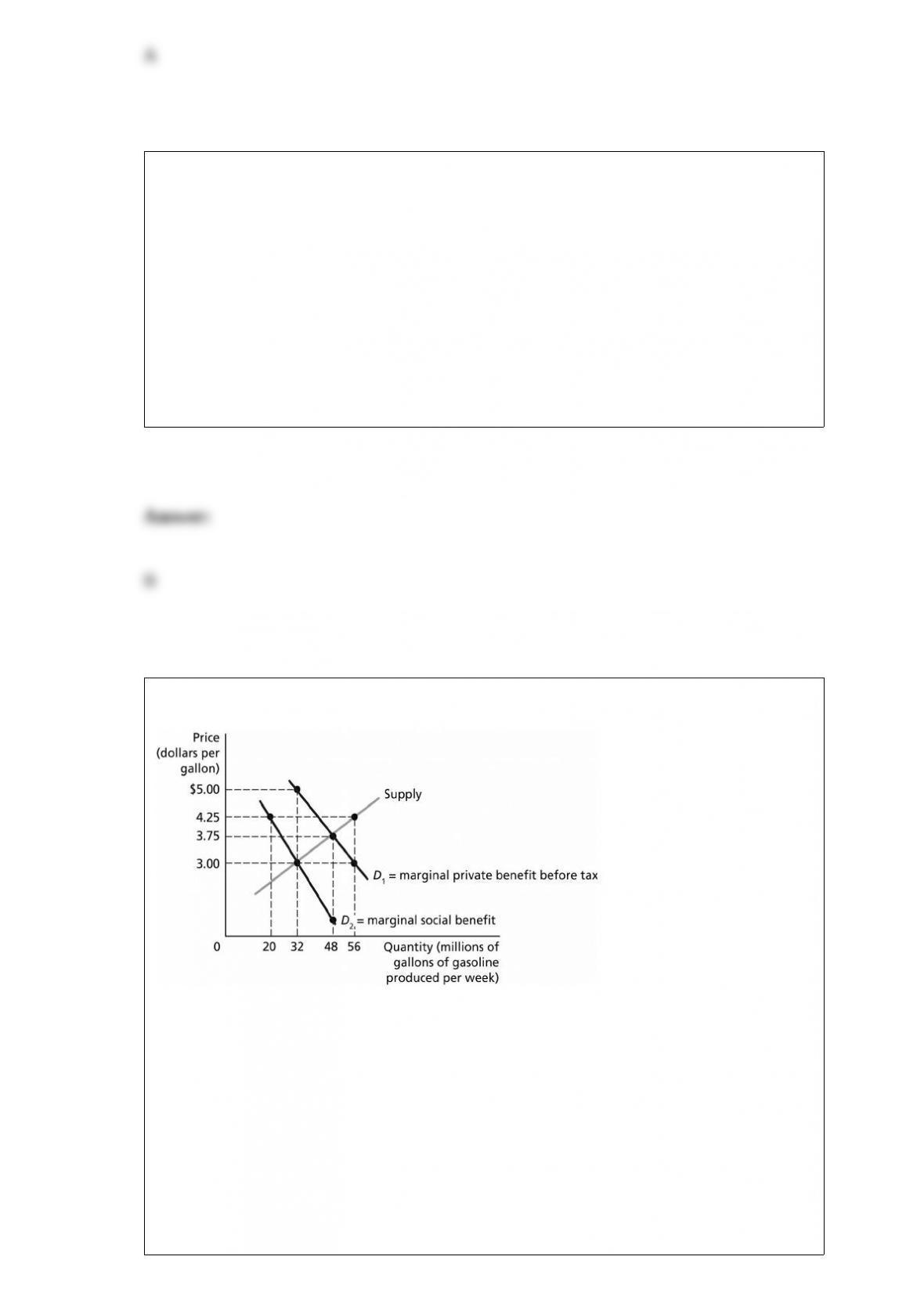
If firms in a monopolistically competitive market are earning economic profits, which
of the following scenarios best reflects the change a representative firm experiences as
the market adjusts to its long-run equilibrium?
A) Demand decreases and becomes less elastic.
B) Demand decreases and becomes more elastic.
C) Demand increases and becomes less elastic.
D) Demand increases and becomes more elastic.
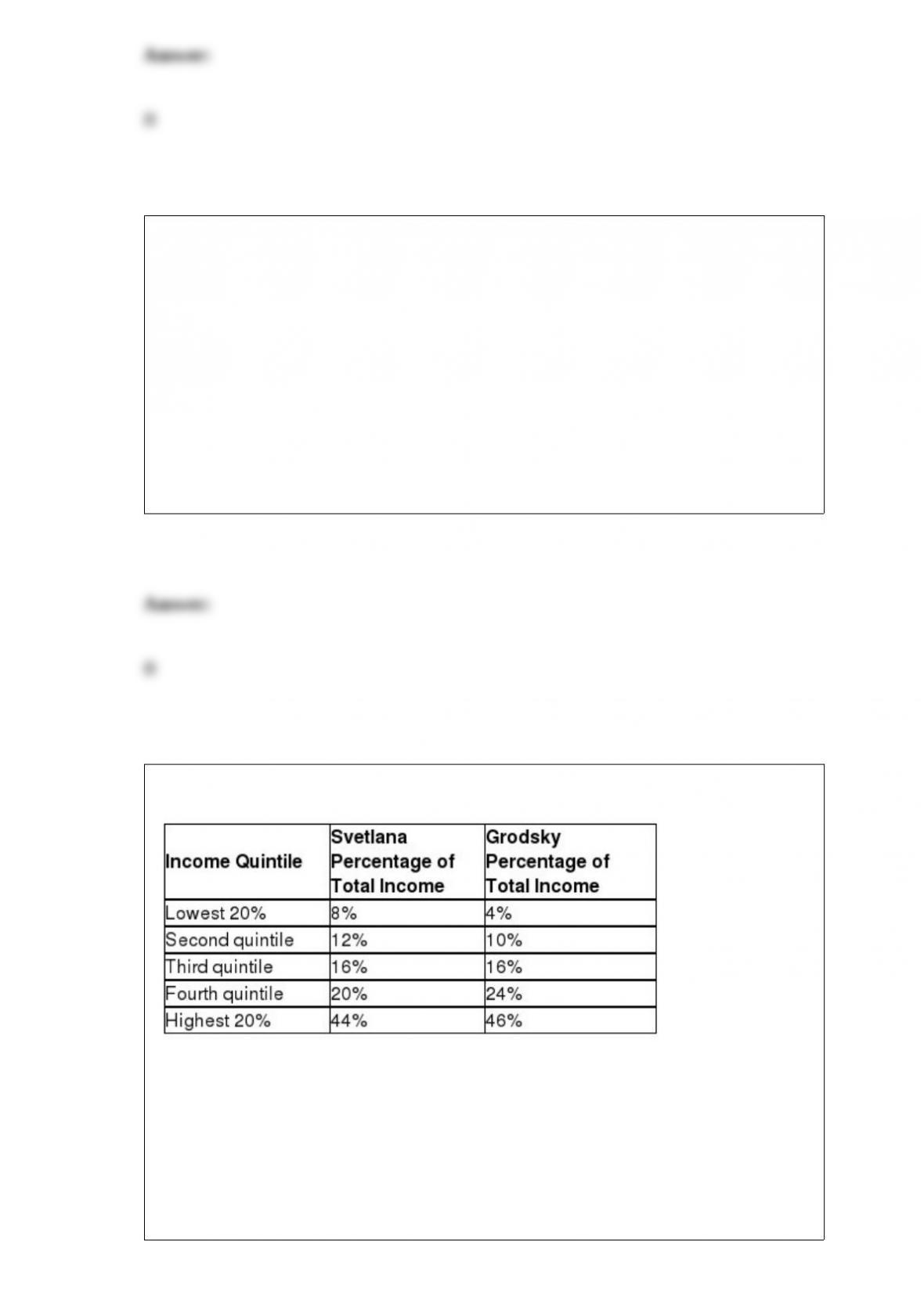
Figure 5-13
Figure 5-13 illustrates the
market for gasoline before and after the government imposes a tax to bring about the
efficient level of gasoline production.
The efficient equilibrium quantity of gasoline is ________ million gallons per month.
A) 20
B) 32
C) 48

D) 56
A patent
A) grants the creator of a book, film, or piece of music the exclusive right to use the
creation for 20 years.
B) grants the creator of a book, film, or piece of music the exclusive right to use the
creation during the creator’s lifetime.
C) gives a firm the exclusive right to a new product for 20 years from the date the
product is invented.
D) gives the firm the exclusive right to a new product during the product inventor’s
lifetime.
The “Buy American” provision in the 2009 stimulus package required that stimulus
money be spent only on U.S.-made goods, effectively acting as a quota of zero imports
when stimulus money was being spent. For the U.S. steel industry, a “Buy American”
provision would create gains for all of the following except
A) U.S. steel companies.
B) U.S. taxpayers.
C) U.S. steel workers.
D) All of the above would gain from the provision.
Why doesn’t the Fed have both a money supply target and an interest rate target?
A) Short-term interest rates do not respond to changes in the money supply, which the
Fed can control.
B) The Fed does not control money demand.
C) The Fed cannot offset the impact of changes in cash management by the public or
changes in lending policies of commercial banks on the money supply.
D) Only the level of interest rates matters when we consider rates of growth in real
GDP, employment, and rates of price inflation.
Table 18-11
Table 18-11 shows income distribution data for two countries. Use this data to answer
the following questions.
a. Draw a Lorenz curve for each country.
b. Which country has the more equal distribution of income?
c. Based on the Lorenz curve for the two countries, can you determine which country
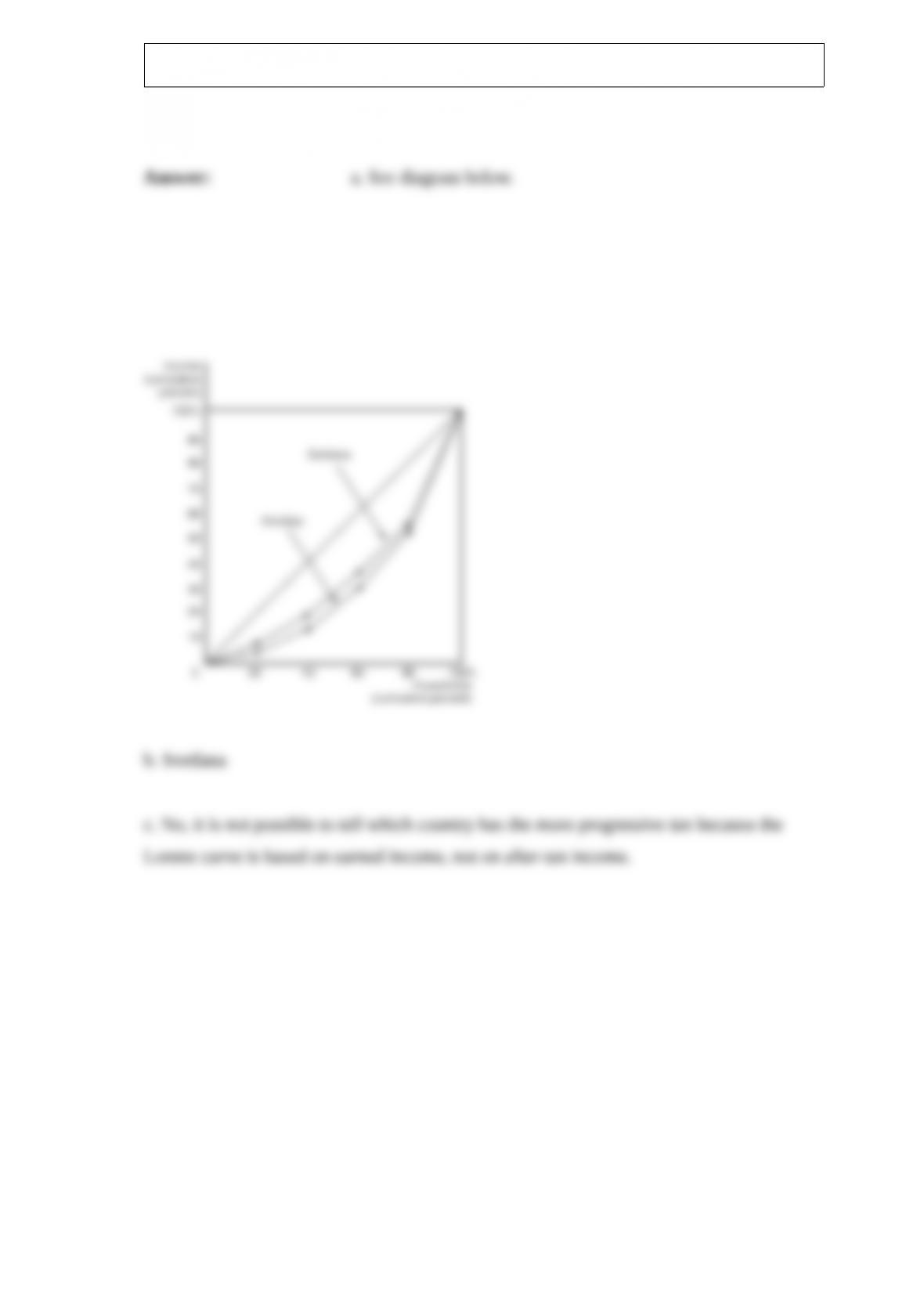
has the more progressive tax system? Explain your answer.