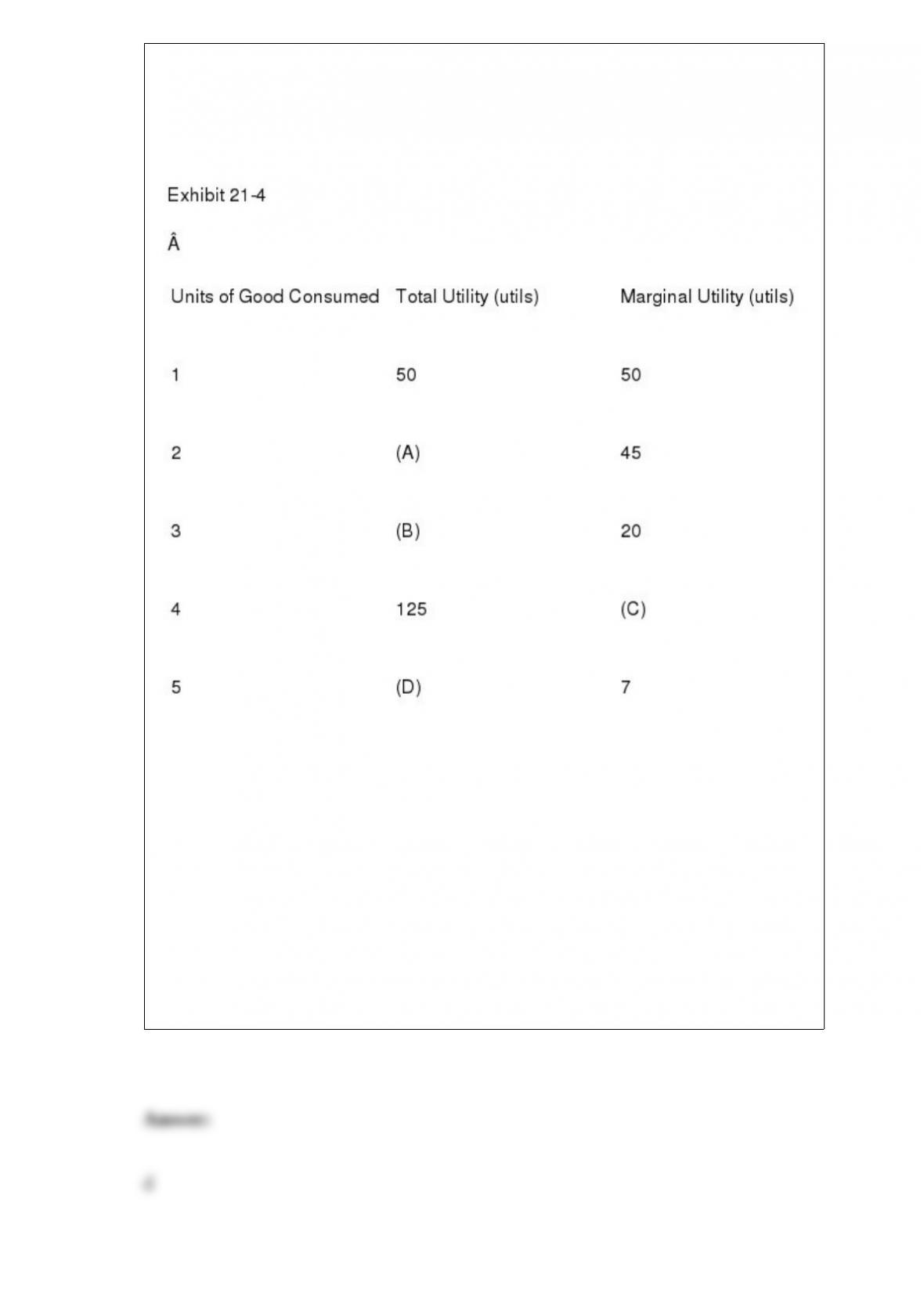
What value goes in blank (A)?
a. 47.5
b. 100
c. 80
d. 95
e. There is not enough information to answer this question.

A change in the expected rate of inflation from 3 percent to 5 percent will
a. increase the real interest rate by 2 percentage points.
b. decrease the real interest rate by 3 percentage points.
c. increase the nominal interest rate by 2 percentage points.
d. decrease the nominal interest rate by 2 percentage points.
One U.S. Senator promises to vote for a measure that another U.S. Senator wants only
if the favor is returned in kind. This is an example of
a. rational ignorance.
b. median voter politics.
c. logrolling.
d. public interest talk.
e. none of the above
An “increase in the quantity demanded” means that
a. the demand curve has shifted to the right.
b. the supply curve has shifted to the left.
c. price has declined and consumers therefore want to purchase more of the good.

d. given supply, the price of the good can be expected to rise.
We state that the evidence __________________ if evidence is consistent with a
theory’s predictions.
a. fails to reject the theory
b. proves the theory is correct
c. proves the theory is invalid
d. none of the above
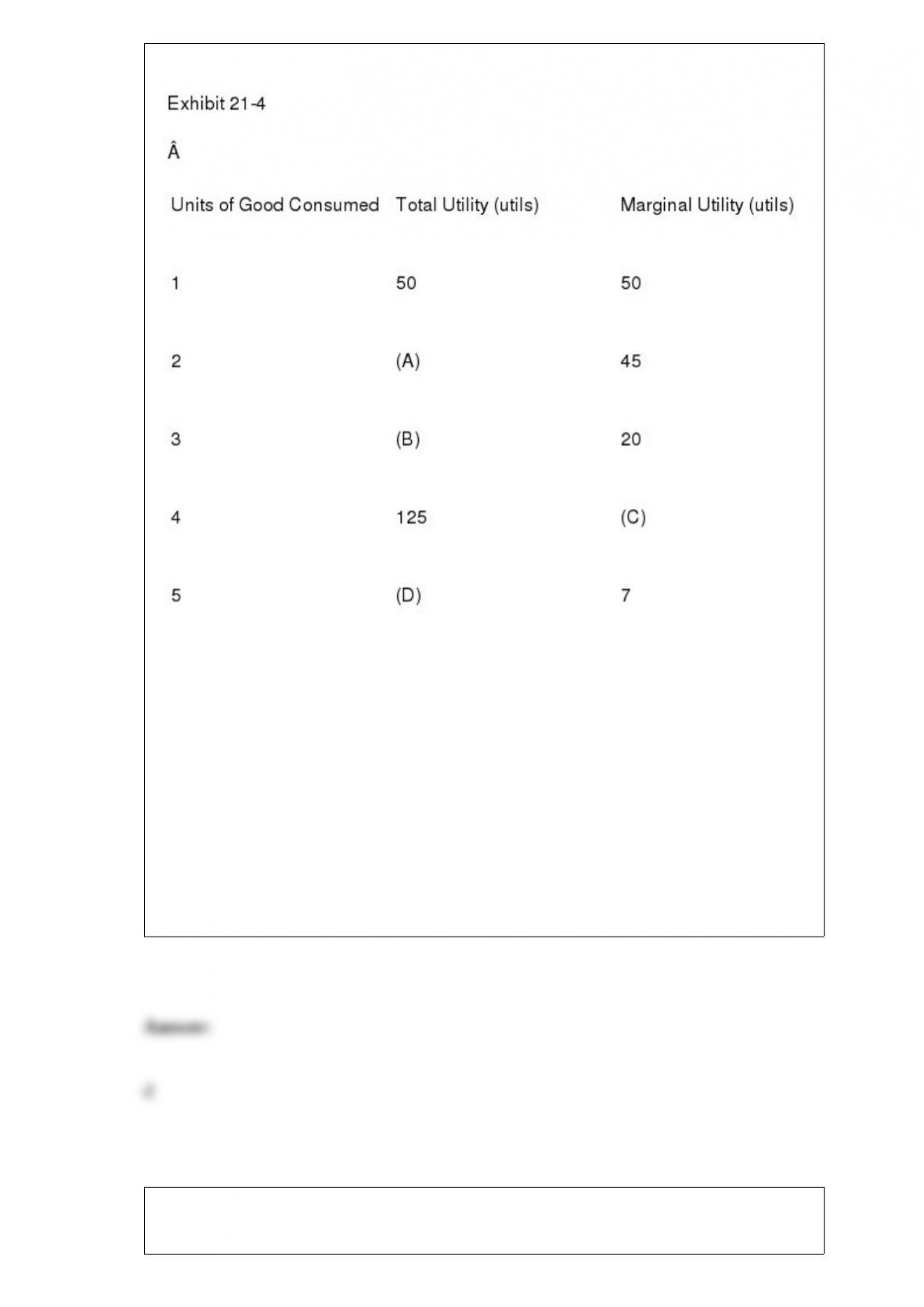
What value goes in blank (C)?
a. 25
b. 5
c. 14.5
d. 10
e. There is not enough information to answer this question.
Suppose the current exchange rate between the U.S. dollar and the Mexican peso is
$0.12 = 1 peso. Furthermore, suppose the price level in the United States rises 25

percent at a time when the Mexican price level is stable. According to the purchasing
power parity theory, what will be the new equilibrium exchange rate?
a. $0.15 = 1 peso
b. $0.09 = 1 peso
c. $0.13 = 1 peso
d. $0.08 = 1 peso
If Smith will give up three units of Y to get one additional unit of X, then
a. he has transitive preferences.
b. his budget constraint is upward sloping.
c. his indifference curve is downward sloping.
d. the price of X must be three times as high as the price of Y.
e. none of the above
Exhibit 39-4
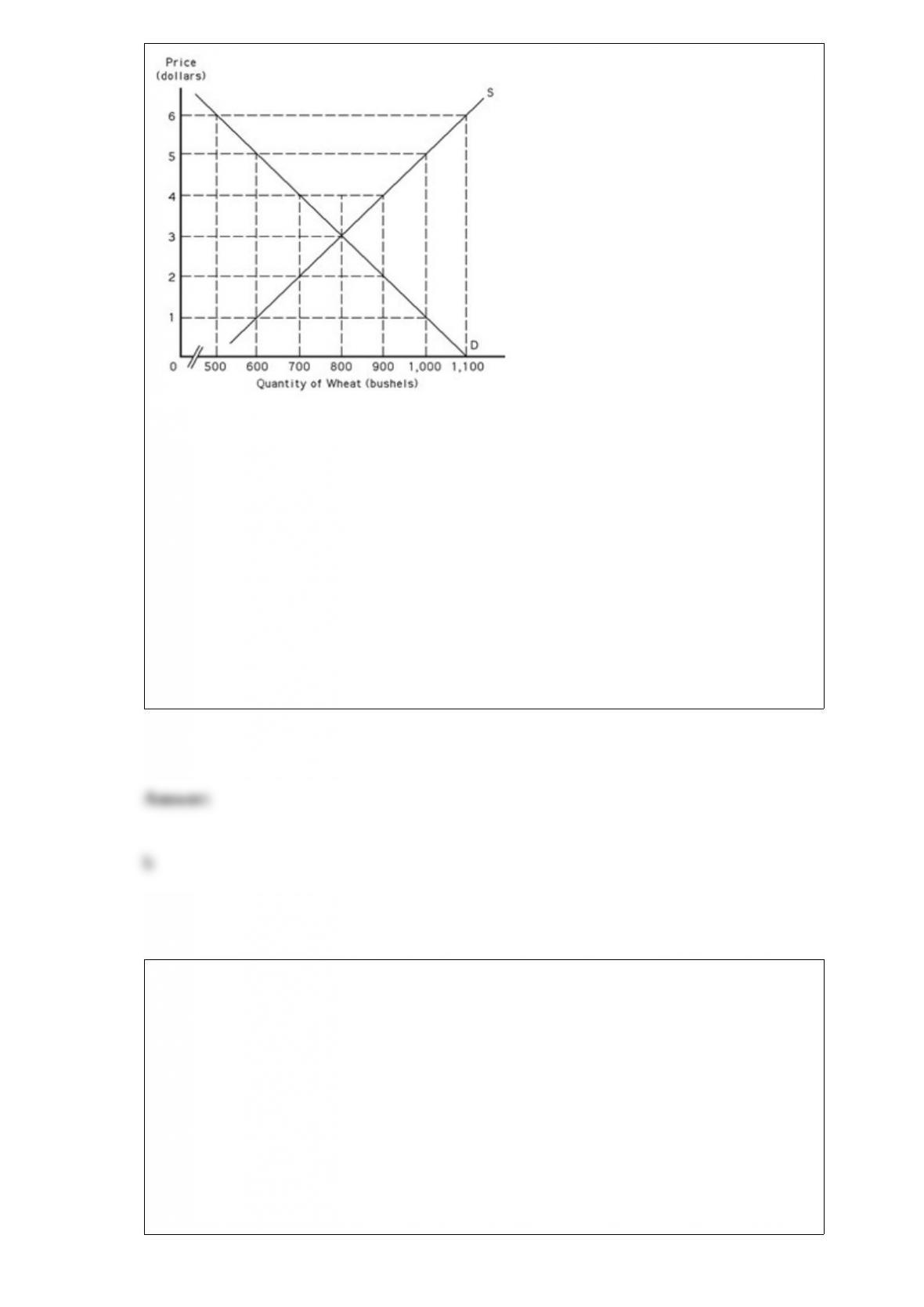
The price support of $6 per bushel results in private citizens spending __________ on
wheat.
a. $600
b. $3,000
c. $3,600
d. $4,800
e. $6,600
Samantha is given a flu shot by her doctor. This reduces the probability that she will get
the flu and it also reduces the probability that others will get the flu, too. The latter is an
example of a
a. negative externality.
b. positive externality.
c. substitute good.
d. complementary good.

Suppose that there are two goods, X and Y, that are competing for dominance in a
market with network externalities.Furthermore, suppose that the market has chosen
good X even though it is inferior to good Y and that the net benefits of switching from
X to Y are $20 while the costs of switching are $30.If the market stays with good X,
then __________________ has occurred.If the costs of switching were to fall to $15
and the market still stays with good X then ___________________________.
a. no market failure; market failure has occurred.
b. market failure; no market failure has occurred.
c. no market failure; there will still be no market failure.
d. market failure; there will still be market failure.
Suppose farmers get together and decide to be less productive. They want to do this so
that they can shift the supply curve of farm products leftward and raise the price. What
are the thoughts of a profit-maximizing farmer most likely to be once this agreement
has been made?
a. If I break the agreement while everyone else holds to it, I can make myself better off.
b. I am happy that we decided to be unproductive; I can’t be unproductive by myself.
c. I will definitely hold to the agreement.
d. Everyone will break the agreement but me.

The shorter the period of time consumers have to adjust to price changes, the
__________ the __________ elasticity of demand.
a. lower; income
b. lower; price
c. higher; income
d. higher; price