Jack was unemployed two weeks ago but just started a new job. As a result of this
increase in the number of employed workers, which of the following occurred?
A) The labor force participation rate increased.
B) The unemployment rate increased.
C) The labor force participation rate decreased.
D) The unemployment rate decreased.
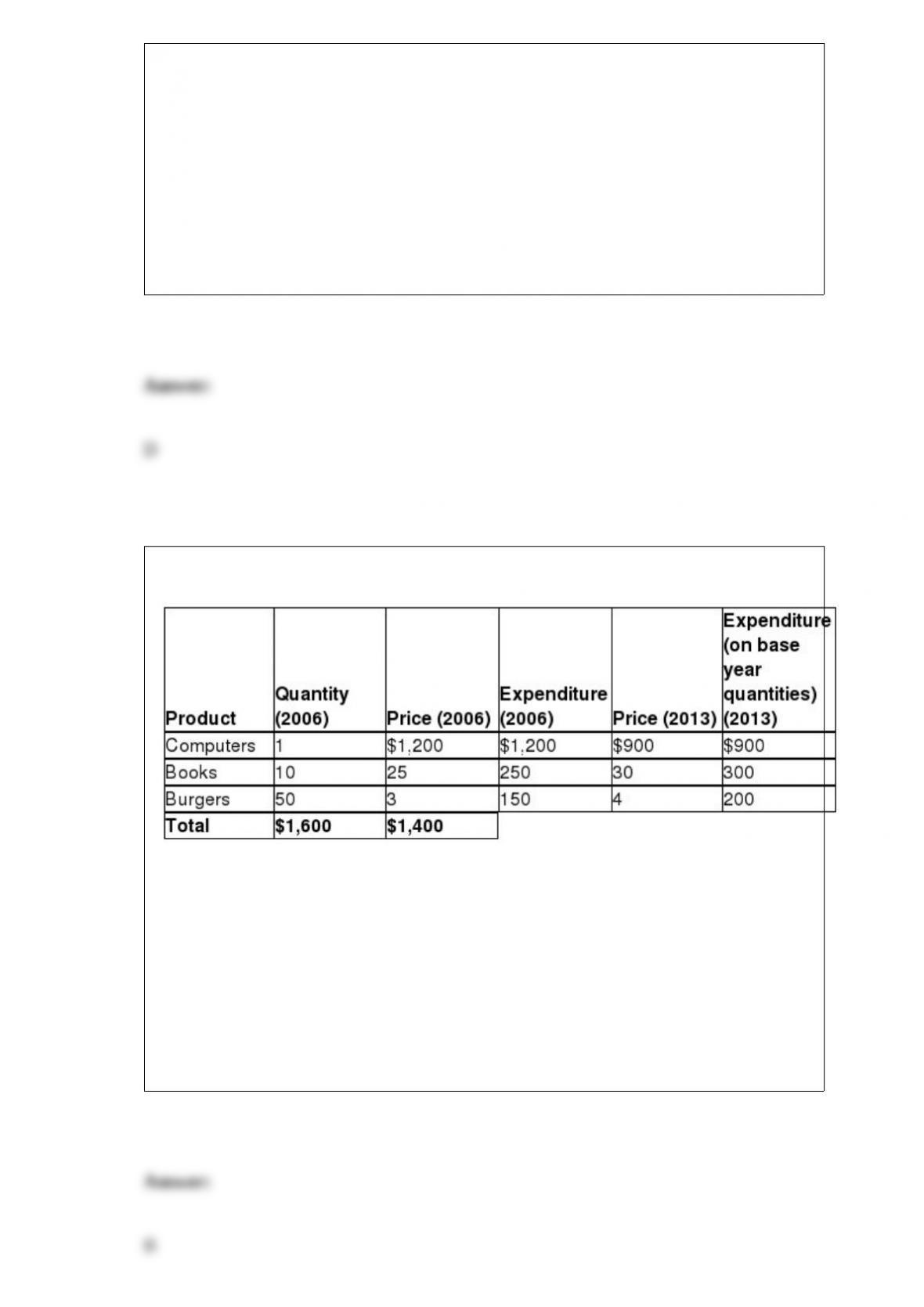
Table 9-10
Suppose an economy has only three goods and the typical family purchases the amounts
given in the table above. If 2006 is the base year, then what is the CPI for 2013?
A) 14.3
B) 87.5
C) 114.3
D) 160
Some economists have argued that certain characteristics of the delivery of health care
justify government intervention. One of these characteristics is
A) health care is a public good.
B) health care is nonrivalrous and nonexcludable.
C) health care generates negative externalities.
D) health care generates positive externalities.
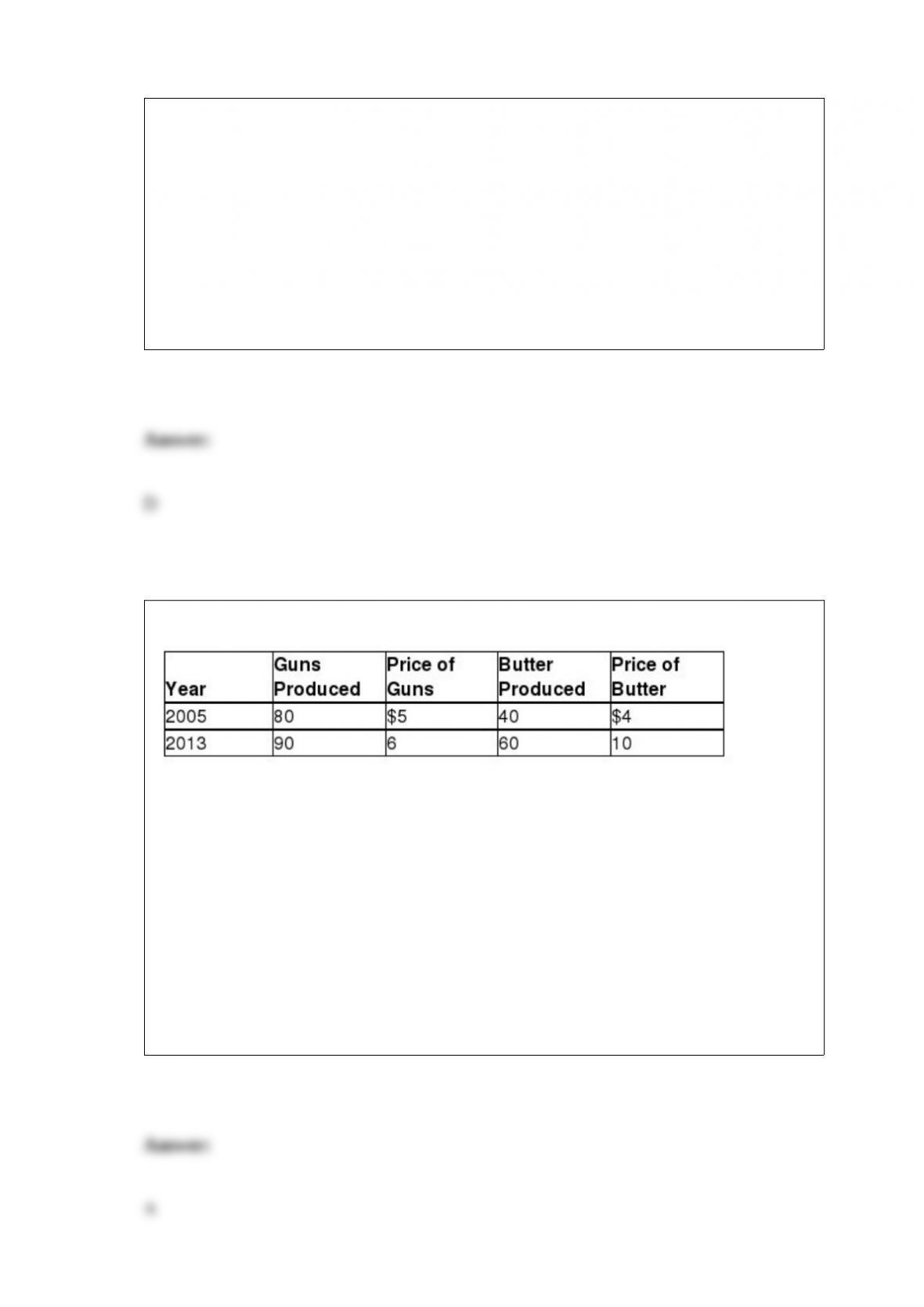
Table 8-11
Consider the following data for Tyrovia, a country that produces only two products:
guns and butter.
Nominal GDP for Tyrovia in 2013 equals
A) $1,140.
B) $880.
C) $690.
D) $560.

The largest component of spending in GDP is
A) consumption spending.
B) investment spending.
C) government spending.
D) net export spending.
National income is equal to
A) personal income minus personal taxes.
B) GDP minus depreciation.
C) disposable personal income plus depreciation plus personal taxes.
D) GNP plus depreciation.
The economy suffered a mild recession in 2001. Despite the recession, home sales and
durable goods sales remained high. Which of the following is a plausible explanation?
A) The Fed’s pursuit of contractionary policy stimulated these markets.

B) The Fed caused a reduction in the federal funds rate to its lowest level in 40 years.
C) Rising inflation encouraged many to invest in the real estate market.
D) Home building and consumer durable purchases are always high during a recession.
Which two factors make regulating mergers complicated?
A) First, firms may lobby government officials to influence their decision to approve
the merger. Second, by the time the government officials reach a decision regarding the
merger, the firms often decide not to merge.
B) First, the time it takes to reach a decision to approve a merger is so long that the
firms often have new owners and mangers. Second, by law, government officials are not
allowed to consider the impact of foreign trade (exports and imports) on the degree of
competition in the markets of the merged firms.
C) First, the Federal Trade Commission and the Antitrust Division of the U.S.
Department of Justice must both approve mergers. Second, the concentration ratios that
are used to evaluate the degree of competition the merged firms face are flawed.
D) First, it is not always clear what market firms are in. Second, the newly merged firm
might be more efficient than the merging firms were individually.
Golda Rush quit her job as a manager for Home Depot to start her own hair dressing
salon, Goldilocks. She gave up a salary of $40,000 per year, invested her savings of
$30,000 (which was earning 5 percent interest) and borrowed $10,000 from a close
friend, agreeing to pay 5 percent interest per year. In her first year, Golda spent $18,000
to rent a salon, hired a part-time assistant for $12,000 and incurred another $15,000 on
equipment and hairdressing material. Based on this information, what is the amount of

her explicit costs?
A) $45,000
B) $45,500
C) $47,000
D) $87,000
At market equilibrium,
A) demand equals supply.
B) quantity demanded equals quantity supplied.
C) surpluses are greater than shortages.
D) shortages are greater than surpluses.