
The Great Depression of the 1930s led to a revolution in macroeconomic thinking,
following the work of
a. Arthur Laffer.
b. Milton Friedman.
c. Adam Smith.
d. John Maynard Keynes.
e. David Ricardo.
Unlike a perfectly competitive firm, a monopolistically competitive firm
a. faces a perfectly inelastic demand curve.
b. can earn positive economic profit in the short run and in the long run.
c. cannot earn positive economic profit even in the short run.
d. has a negatively sloped demand curve.
Aggregation involves adding together different products and services.
a. True

b. False
A firm has $200,000 to spend on either direct sales or advertising. Suppose further that
if the $200,000 is spent on direct sales, it will bring in an accounting profit of $40,000.
Instead, the (accounting) profit it could obtain from a $200,000 investment in
advertising is $X. Compare the profitability of the two options if (a) X = 50,000, (b) X
= 30,000, or (c) X = 40,000.
Suppose the dollar depreciates from 89 Japanese yen to 79 Japanese yen. One would
expect
a. U.S. imports to increase
b. U.S. exports to increase.
c. Japanese exports to increase.

d. Japanese net exports to increase.
Al’s Donuts produces about 600 dozen doughnuts daily. If flour prices increase 20
percent
a. only marginal cost will shift up.
b. only marginal cost and average total cost will shift up.
c. marginal cost, average variable cost, and average total cost will shift up.
d. marginal cost, average total cost, average variable cost, and average fixed cost will
shift up.
Policies to lower the natural rate of unemployment include
a. proposals to raise the minimum wage rate.
b. mandated prison sentences for drug dealers.
c. retraining programs and employment services.
d. changes in the tax laws.

Under perfect competition, a firm’s:
a. demand curve and average revnenue curve are identical, but the marginal revenue
curve is different.
b. demand curve is different, but the average revenue curve and the marginal revenue
curve are identical.
c. demand curve, average revenue curve and marginal revenue curve are identical.
d. none of these is true.
Millionaires do not face the problem of scarcity.
a. True
b. False
After the American Civil War, many prominent Southerners lamented the fact that the
South “overproduced” cotton and “underproduced” food. In fact, the South did import a

very large percentage of its food. Nevertheless, rather than reduce cotton production
and grow more food, Southern farmers did the opposite because
a. they were irrational and distraught over the loss of slavery.
b. the South had a comparative advantage in cotton production.
c. the North had a comparative advantage in cotton production.
d. corn was absolutely cheaper to produce in the North.
The price of an airline ticket rises as the amount of time between purchase and flight
departure gets smaller. The airlines base the policy on the assumption that
a. consumers are not aware of airline prices.
b. consumer demand is unrelated to prices.
c. consumer demand becomes more elastic as departure time approaches.
d. consumer demand becomes less elastic as departure time approaches.
Assuming that resources are specialized, the opportunity cost of an item increases as
production of it rises. Therefore, we expect that firms will produce more if
a. the price increases.

b. the price decreases.
c. the opportunity cost is greater than the price.
d. government asks firms to produce more.
e. the income of buyers increases.
Price elasticity of demand is a numerical measure of how much quantity demanded
rises as price falls or quantity demanded falls as price rises.
a. True
b. False
Service sector outputs could be expected to increase in price less than industrial sector
outputs as an economy grows.
a. True
b. False

As a rule, the more of a commodity a consumer acquires, the smaller will be her total
utility from that good.
a. True
b. False
Compared to people in other nations, people in the United States pay
a. much higher taxes.
b. somewhat higher taxes, on average.
c. about the same amount taxes.
d. lower taxes.
A perfectly competitive firm’s short-run supply is infinite at the market price.
a. True

b. False
Which of the following is not a problem for the price system allocating resources
among different time periods?
a. Interest rates are used for a variety of purposes other than influencing investment.
b. The market devotes too much to immediate consumption.
c. Our market system leads to lesser real incomes for later generations.
d. Our market system despoils irreplaceable natural resources.
If the economy is in a recessionary gap, and the government attempts to balance the
budget, the effect will be to
a. counteract the recession.
b. worsen and prolong the recession.
c. end the recession sooner.
d. increase the level of real GDP.

Ticket “scalping” is an example of
a. experimental economics.
b. the limitation of the volume of transactions.
c. the development of a black market.
d. favoritism.
If expected inflation is 12 percent and the publicly regulated electric utility company is
legally limited to a 10 percent rate of return, then we should expect
a. increased investment by the utility.
b. expansion of electric power generating capacity.
c. future power shortages.
d. excess investment by the electric utility.

Which of the following is not held constant along a demand curve for labor by a firm?
a. the firm’s technology of production
b. the price of the firm’s output
c. the marginal product of labor for the firm
d. the price of substitutes for the firm’s output
Loopholes have the effect of
a. encouraging particular patterns of behavior and favoring particular types of people.
b. eroding the progressivity of the income tax.
c. altering the pattern of economic incentives.
d. All of the above are correct.
Which of the following would cause an increase in demand for Toyota automobiles?
a. an increase in the price of Toyota automobiles
b. a decrease in the price of Toyota automobiles
c. a decrease in the price of Honda automobiles

d. an increase in the price of Honda automobiles
Owners of a corporation have limited liability for the debts of the business.
a. True
b. False
A decrease in the price level causes a lower equilibrium quantity demanded.
a. True
b. False
Which of the following have been suggested as sources of economic profit?
a. exercise of monopoly power by firms
b. accepting a large degree of risk
c. successful innovation
d. All of the above are correct.
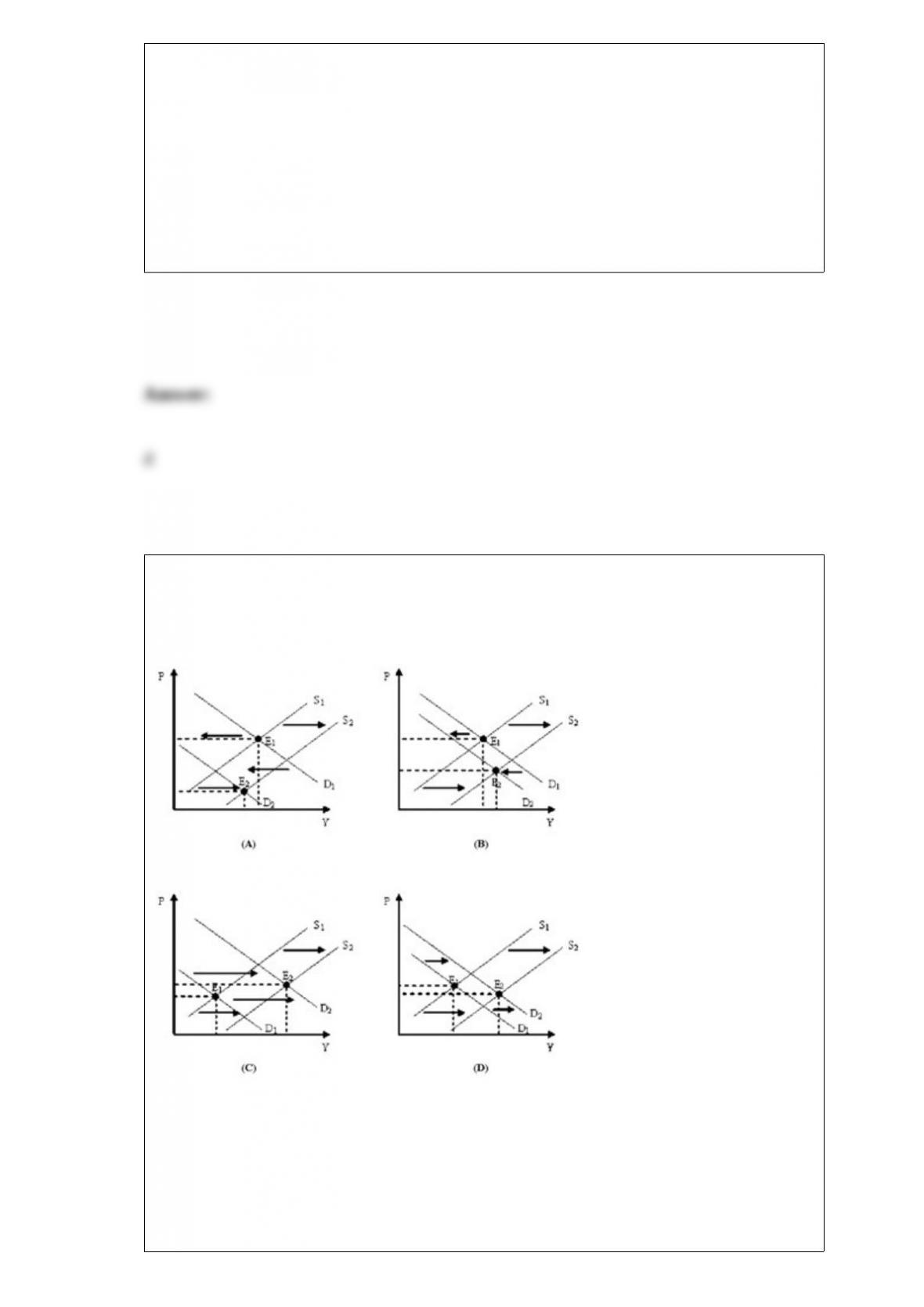
Figure 10-7
Refer to Figure 10-7. Which of the diagrams in Figure 10-7 represents a decrease in
consumer spending combined with a positive supply shock?
a. Panels (A) & (B)
b. Panels (C) & (D)

c. Panels (A) & (C)
d. Panels (B) & (D)
Over long periods of time, labor productivity growth rates must differ by at least ____
percent to yield significant differences in standards of living.
a. 1
b. 5
c. 10
d. 15
An increase in the capital stock has the same effect on the production function as an
increase in
a. labor.
b. output.
c. GDP.
d. technology.

Firms often seek to borrow money to expand their capital stock, and the price they pay
for the money is the interest rate. What happens to the quantity of money supplied if the
interest rate increases?
a. It increases.
b. It decreases.
c. It does not change.
d. It depends entirely on the interest rate.
The Federal Reserve System can be described as a bank for bankers.
a. True
b. False

Average cost curves decline because
a. fixed cost is spread out over larger amounts of production.
b. it becomes cheaper to produce an infinite amount of goods.
c. additional units of production are inferior.
d. variable costs increase with each additional amount of production.
Which of the following positions would a mercantilist support?
a. Trade in manufacturing goods is good for the US.
b. Imports to the U.S. from Japan are beneficial to the U.S.
c. Exports from Japan to the U.K. are beneficial to Japan.
d. Movement of labor from UK to US is beneficial to US.
Higher prices can discourage use/consumption, which in turn may better allocate scarce
resources.
a. True
b. False