
Since 1973, in the United States wages of skilled workers have:
A) risen more slowly than those of unskilled workers.
B) fallen due to foreign trade.
C) remained constant.
D) risen faster than those of unskilled workers.
Producer surplus is equal to:
A) the area under the supply curve.
B) the area above the supply curve below the good’s price.
C) the area under the supply curve below the good’s price.
D) the good’s price times the quantity purchased.
What have Neuroscientists been able to measure in terms of cash purchases and
credit-card purchases?
A) Credit-card purchases generate much stronger insula activity than cash purchases.
B) Credit-card purchases generate much weaker insula activity than cash purchases.

C) Credit-card purchases generate the same insula activity as cash purchases.
D) Neuroscientists have not been able to measure anything about cash or credit card
purchases.
Two goods are complements if the:
A) price elasticity of each is greater than one.
B) income elasticity of each is negative.
C) cross-price elasticity is negative.
D) cross-price elasticity is positive.
An oligopoly might occur as a result of:
A) economies of scale in production.
B) government barriers to entry.
C) advertising.
D) all of the above

In which of the following cases did the government break up a monopoly?
A) Staples/Office Depot
B) Interstate Bakeries and Continental Bakery
C) Xidex
D) AT&T
A possible reason to impose a protectionist policy such as a tariff is to:
A) increase the welfare of domestic consumers.
B) slow domestic production.
C) aid other nations in developing their own industries.
D) protect domestic workers from foreign competition.
In wealthy countries such as the United States, the price elasticity of the demand for
food is ________ it is in poorer countries.
A) greater than
B) less than
C) the same as
D) None of the above; it is not possible to make international comparisons of price
elasticity.
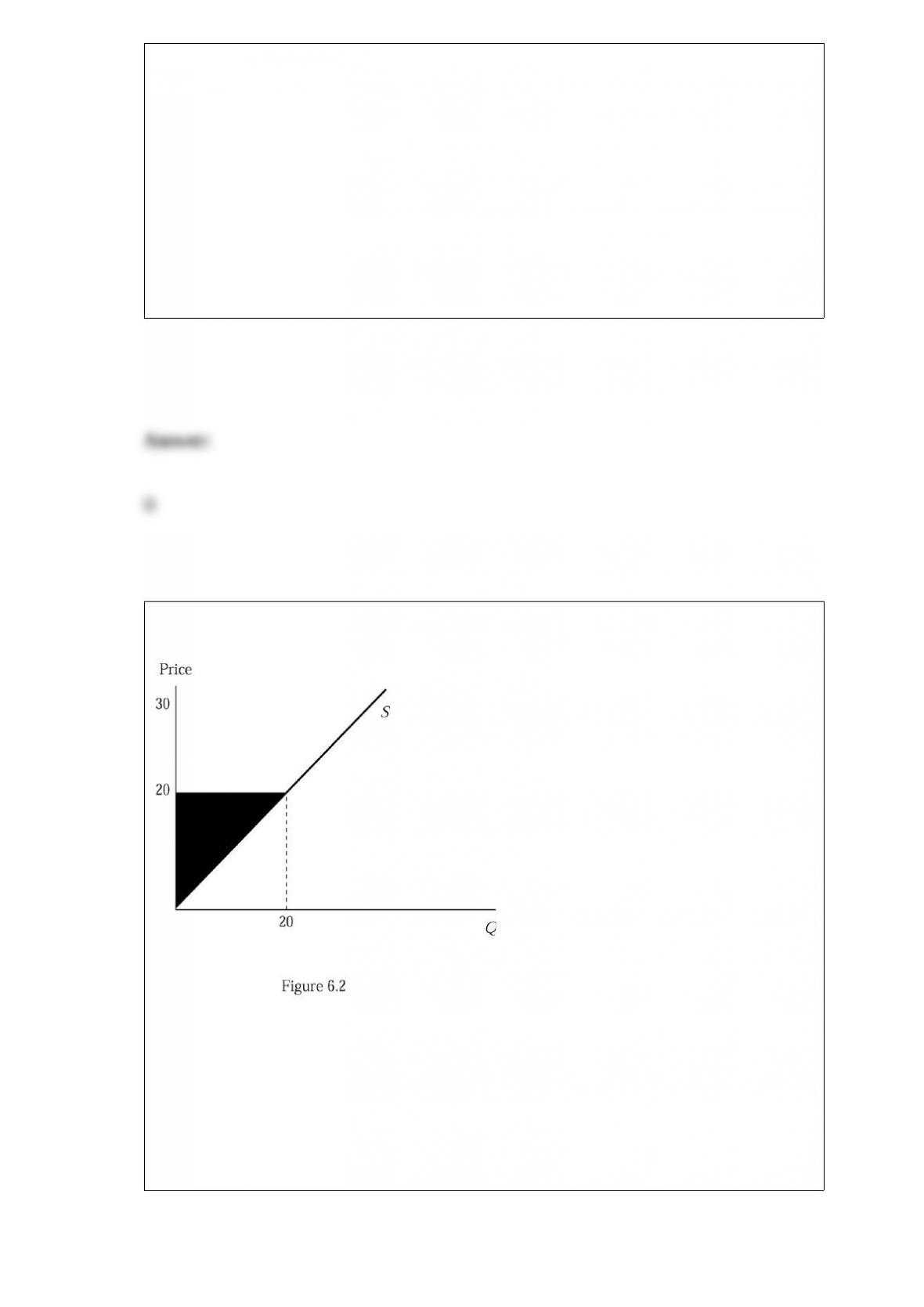
In Figure 6.2 the price is $20 and the shaded area represents:
A) producer surplus.
B) consumer surplus.
C) market equilibrium.
D) a price ceiling.

The government can facilitate the transfer of unskilled workers to high-skilled jobs by:
A) increasing tariffs to help unskilled workers.
B) increasing tariffs to speed the development of jobs requiring skilled labor.
C) providing assistance for education and training for unskilled workers.
D) laying off skilled workers to provide jobs for unskilled workers.
A market equilibrium will generate the largest possible surplus when:
A) there are no external benefits and external costs.
B) there is perfect competition.
C) perfect information is available.
D) all of the above.

Mario has a company that produces plastic freezer bags. His company objective is to
maximize:
A) his company’s revenues.
B) his company’s total out-of-pocket costs.
C) his company’s opportunity costs of each factor of production.
D) his company’s economic profits, the difference between total revenue and total cost.
The deadweight loss from a taxation is:
A) the difference between total burden of tax and the amount of revenue collected by
the government.
B) affected by the size of the tax imposed by the government.
C) extra money consumers must pay for the tax imposed by the government.
D) B and C are correct
We can use macroeconomic analysis to:
A) learn how to balance a checkbook.
B) study the choices made by households.

C) understand marginal changes in the macroeconomy.
D) understand why economies grow.
Raphael’s Salon has $5,000 in fixed cost and $15,000 in variable costs monthly.
Raphael’s Salon gives 1500 hair cuts a month. What is the average total cost for
Raphael’s Salon?
A) 8
B) 7
C) 0.075
D) 13.33
Figure 2.2 presents a production possibilities curve for a country that can either produce
highways or provide people with medical care in a given year. The opportunity cost of
the fourth new highway built in a year is:
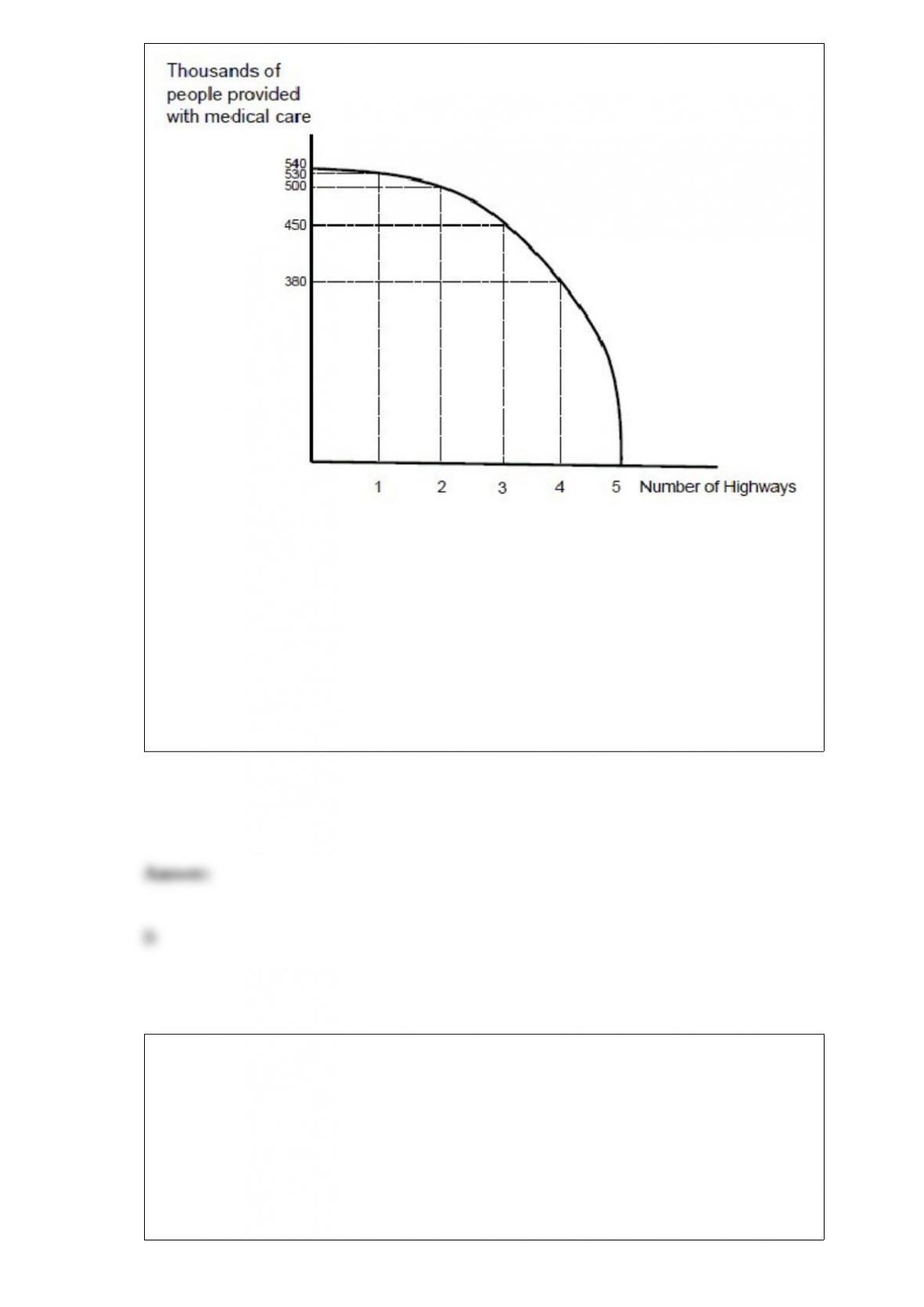
Figure 2.2
A) 50,000 people provided with medical care.
B) 70,000 people provided with medical care.
C) 30,000 people provided with medical care.
D) 90,000 people provided with medical care.
Lower wages for women relative to those for men constitute wage discrimination if
women earn lower wages:
A) but are equally productive.
B) and have lower productivity than men.
C) in clerical and service occupations.

D) due to career interruptions to raise children.
Price-fixing by firms in an oligopoly is:
A) more likely when the firms play a game repeatedly.
B) more likely when firms must commit to a single pricing strategy for the lifetime of
the firm.
C) more likely when neither firm chooses the low-price guarantee strategy.
D) never sustainable because firms have an incentive to underprice each other.
The brain operates effectively only when it has a plentiful supply of:
A) dopamine.
B) insulin.
C) glucose.
D) carbon monoxide.

If an economy is fully utilizing its resources, it can produce more of one product only if
it:
A) doubles manufacturing of the product.
B) produces less of another product.
C) adds more people to the labor force.
D) reduces the prices of the most expensive products.
A firm’s long run marginal cost is:
A) the change in long run cost resulting from producing one more unit of output.
B) the change in long run fixed cost resulting from producing one more unit of output.
C) the change in long run variable cost resulting from producing one more unit of
output.
D) none of the above.
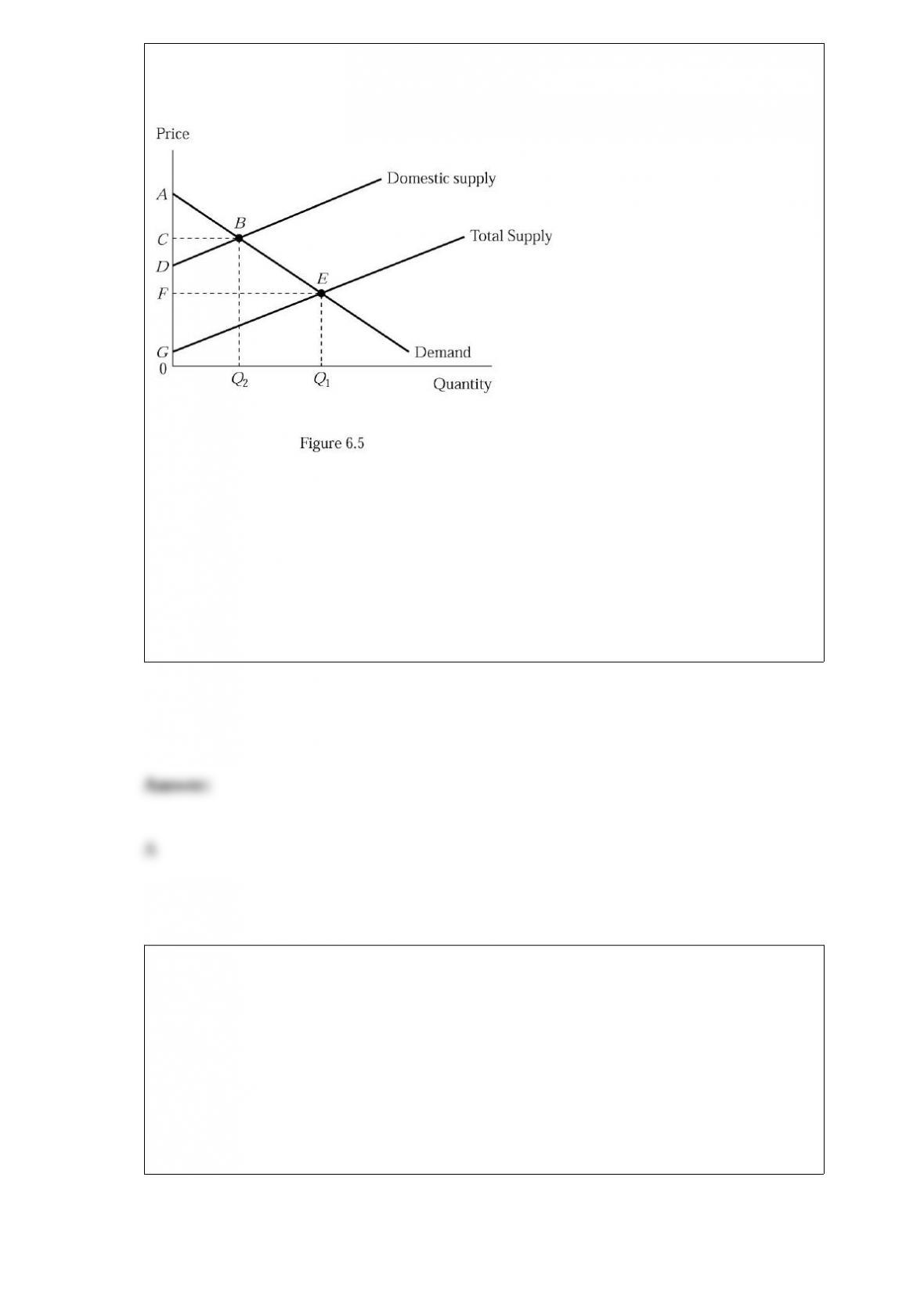
Figure 6.5 illustrates the market for sugar. If sugar imports were banned, consumer
surplus in the market would be shown as area:
A) ABC.
B) AEF.
C) GEQ1.
D) ABQ20.
Barriers to entry are used to:
A) enable a firm to exercise control over the price of its product.
B) prevent other firms from entering the market.
C) allow the firm to earn economic profits.
D) all of the above

Suppose Smith’s oil refinery and Jones’ paper mill both pollute a river and both firms
operate under a system of marketable pollution permits. If it costs Smith $45 to reduce
pollution by 500 gallons per day, and Jones can reduce costs by $65 by increasing
pollution by 500 units per day:
A) the firms cannot gain by trading the right to pollute.
B) both firms can benefit if Smith trades the right to increase pollution by 500 gallons
to Jones for $30.
C) both firms can benefit if Smith trades the right to increase pollution by 500 gallons
to Jones for $50.
D) both firms can benefit if Jones trades the right to increase pollution by 500 gallons to
Smith for $30.
Suppose that the population of a country increases. Assuming that people in that
country enjoy eating steak, we would predict that the equilibrium quantity of steak will
________ and the equilibrium price of steak will ________ in that country.
A) rise; rise
B) rise; fall
C) fall; rise
D) fall; fall

In the market for pollution permits, the total supply of permits is:
A) inelastic.
B) elastic.
C) determined by the Chicago Board of Trade.
D) always equal to the demand for permits.
What is the consumer budget line?
A) It shows a consumer’s tradeoff between two goods.
B) It shows the quantity of a single good that a consumer is willing to buy at different
prices.
C) It shows combinations of two or more different consumers’ budget set.
D) It includes all combinations of two goods that exhaust the consumer’s budget.

Suppose that during the pledge drive in October, the local public radio gives
contributors a free subscription to the daily newsletters return for their monetary
contribution. This gift will likely:
A) lower the amount of voluntary contributions the station receives.
B) help the stations overcome the free-rider problem.
C) cost the stations more that they are worth.
D) all of the above
Assume that there is rent control in Chicago. Which of the following is true?
A) All consumers in the rental market will benefit because the rent will be lower.
B) The total surplus will fall because there will be a shortage of apartments.
C) The total surplus will rise because consumer surplus will increase.
D) Consumer surplus will increase and as a result all consumers in the rental market
will benefit.
If your firm is producing a good at a level where marginal revenue equals marginal
cost, and price is greater than average total cost, your firm:
A) should shut down and suffer a loss equal to your fixed costs.

B) is earning an economic profit greater than zero.
C) should decrease output.
D) should increase output.
Suppose that the percentage change in demand is 10%, the price elasticity of supply is
2, and the percentage change in the equilibrium price is 3.33%. What is the price
elasticity of demand?
A) 0
B) 1
C) 2
D) 3
In the application, what was/were the reason(s) why a lower price of cigarettes will
increase the quantity demanded for cigarettes?
A) lower prices make current smokers smoke more cigarettes.
B) lower prices encourage people to start smoking.
C) lower prices encourage people to quit smoking.

D) A and B are both correct.