
The marginal rate of technical substitution is measured by
A) the slope of the isoquant.
B) the relative input prices.
C) the slope of the isocost line.
D) the ratio of the product’s price to the product’s cost of production.
Farmers can plant either corn or soybeans in their fields. Which of the following would
cause the supply of soybeans to increase?
A) an increase in the price of soybeans
B) a decrease in the price of corn
C) an increase in the demand for corn
D) an increase in the price of soybean seeds
Table 2-3
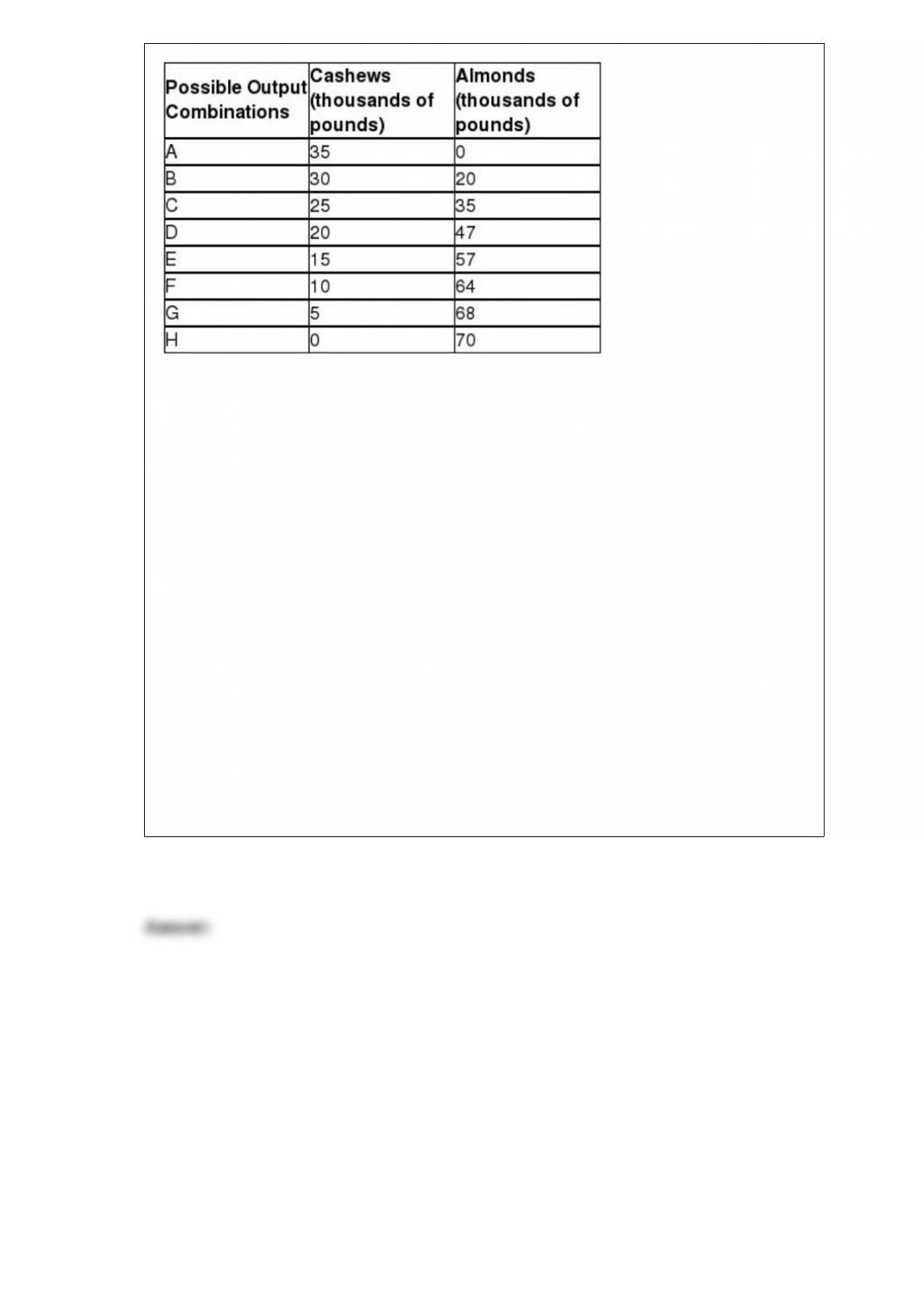
The Nut House produces only cashews and almonds. The table aboveshows the
maximum possible output combinations of the two nuts using all resources and
currently available technology. a. Graph The Nut House’s production possibilities
frontier. Put almonds on the horizontal axis and cashews on the vertical axis. Be sure to
identify the output combination points on your diagram.
b. Suppose The Nut House is currently producing at point C. What is the opportunity
cost of producing an additional 12,000 pounds of almonds?
c. Suppose The Nut House is currently producing at point C. What happens to the
opportunity cost of producing more and more almonds? Does it increase, decrease or
remain constant? Explain your answer.
d. Suppose The Nut House is currently producing at point F. What happens to the
opportunity cost of producing more and more cashews? Does it increase, decrease or
remain constant? Explain your answer.
e. Suppose The Nut House is plagued by a variety of white root-rot disease, which
destroys cashew trees but not almond trees. Show in a graph what happens to its PPF.
The Bay Area subway system, BART, offers senior citizens discounted fares for BART
rides. This suggests that BART authorities believe that senior citizens have a ________
demand for subway rides.

A) more income elastic
B) less income elastic
C) more price elastic
D) less price elastic
Which of the following is the largest source of revenue for the U.S. federal
government?
A) the individual income tax
B) social insurance taxes
C) sales taxes
D) property taxes
An increase in the money supply will
A) increase the interest rate.
B) decrease the interest rate.
C) have no affect on the interest rate.
D) decrease the equilibrium quantity of money in the economy.

The U.S. work week has declined from 60 hours in 1890 to 40 hours today. The impact
of the decline in working hours
A) increases U.S. GDP and increases the well-being of a typical working person in the
U.S.
B) increases U.S. GDP and decreases the well-being of a typical working person in the
U.S.
C) decreases U.S. GDP and increases the well-being of a typical working person in the
U.S.
D) decreases U.S. GDP and decreases the well-being of a typical working person in the
U.S.
Assume that the demand curve for DVD players shifts to the left and the supply curve
for DVD players shifts to the right, but the supply curve shifts more than the demand
curve. As a result
A) both the equilibrium price and quantity of DVD players will decrease.
B) the equilibrium price of DVD players will decrease; the equilibrium quantity may
increase or decrease.
C) the equilibrium price of DVD players may increase or decrease; the equilibrium
quantity will increase.
D) the equilibrium price of DVD players will decrease; the equilibrium quantity will
increase.
Which of the following is a true statement?
A) excess reserves = actual reserves – required reserves
B) excess reserves = deposits – required reserves
C) excess reserves = deposits – loans
D) excess reserves = loans – required reserves
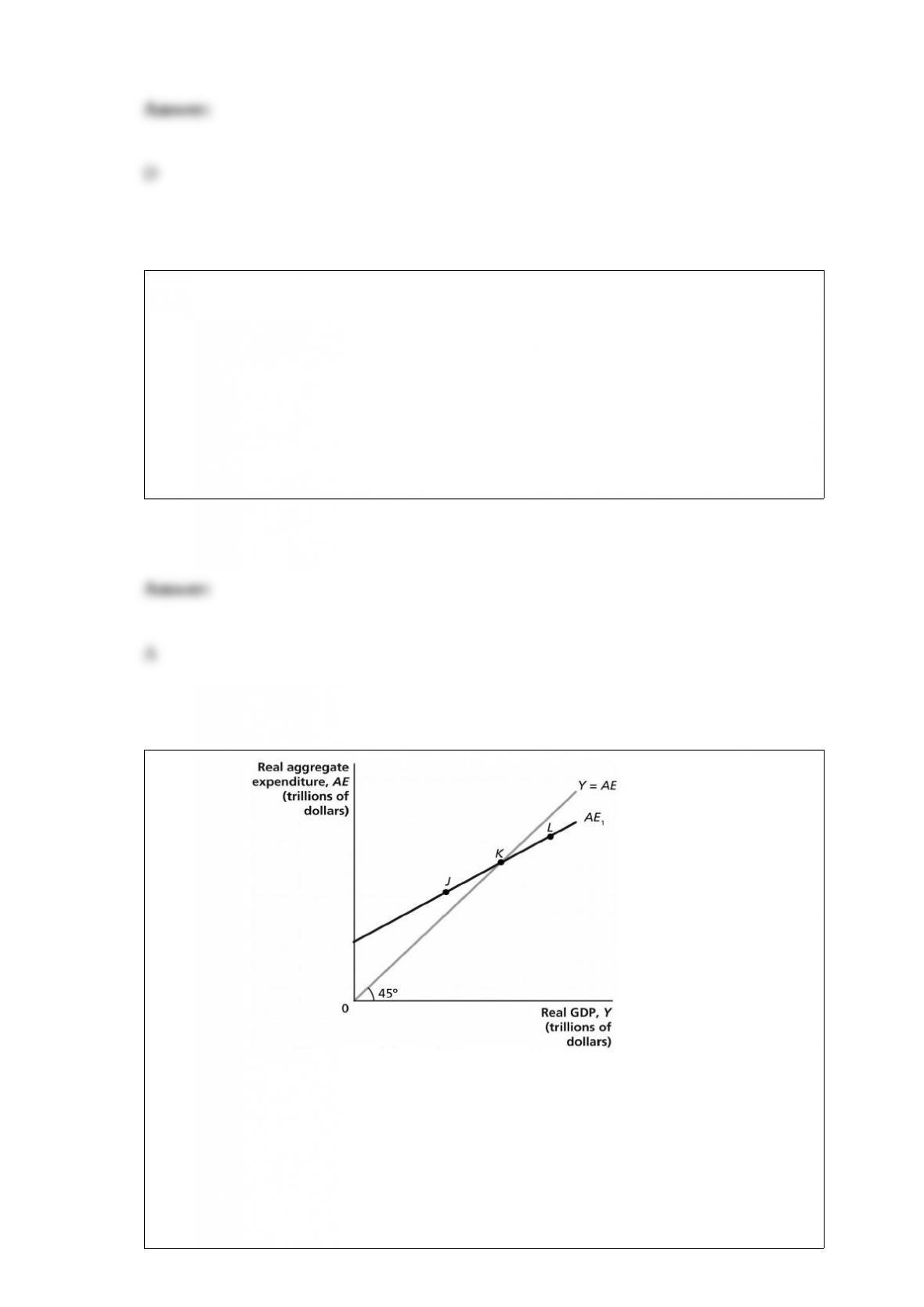
Figure 12-1
If the economy is at point L, what will happen?
A) Inventories have fallen below their desired level, and firms decrease production.
B) Inventories have fallen below their desired level, and firms increase production.
C) Inventories have risen above their desired level, and firms decrease production.

D) Inventories have risen above their desired level, and firms increase production.
Which of the following is part of an economic model?
A) assumptions
B) norms
C) opinions
D) preferences of economic agents
The World Trade Organization (WTO) promotes foreign trade and investment, or
globalization. In recent years opposition to globalization has led to violent protests at
meetings of the WTO. One reason for these anti-globalization protests is
A) foreign trade and investment are examples of zero-sum games.
B) protesters believe that globalization will result in a return to communism in
developing countries.
C) protesters believe that free trade destroys the distinctive cultures of many countries.
D) protesters object to the loss of intellectual property (such as software programs and
movies) that results from foreign trade and investment.