
1) assume that in the short run a firm is producing 100 units of output, has average total
costs of $200, and average variable costs of $150. the firm’s total fixed costs are:
a.$5,000.
b.$500.
c.$.50.
d.$50.
2) Which one of the following research findings is most consistent with the hypothesis
that unions increase productivity?
A.Other things equal, firm profits are lower where unions are present.
B.Union workers receive, on average, higher fringe benefits relative to wages than
nonunion workers.
C.The average amount of work time lost annually to strikes is surprisingly small.
D.Labor turnover is less in unionized firms than in nonunionized firms.
3) “because the outputs of many industries are the inputs to other industries, the failure
of any single industry to fulfill the output quantities specified in the central plan caused
a chain-reaction of adverse repercussions on production.” this quotation best identifies
the:
a.incentive problem under central planning.
b.self-sufficiency dilemma under communism.
c.resource overcommitment problem under communism.
d.coordination problem under central planning.
4) if an industry creates externalities so that resources are overallocated to the industry:
a.a principal-agent problem must be present.
b.the industry is producing a public good.
c.external costs are involved.
d.external benefits are involved.
5) Defined narrowly as wages and salaries, labor’s share of the national income is about:
A.70 percent.
B.53 percent.
C.42 percent.
D.89 percent.
6) in economics, a group of firms that produce identical or similar products is called
a(n):
a.industry.
b.plant.
c.conglomerate.
d.firm.
7) you should decide to go to a movie:
a.if the marginal cost of the movie exceeds its marginal benefit.
b.if the marginal benefit of the movie exceeds its marginal cost.
c.if your income will allow you to buy a ticket.
d.because movies are enjoyable.
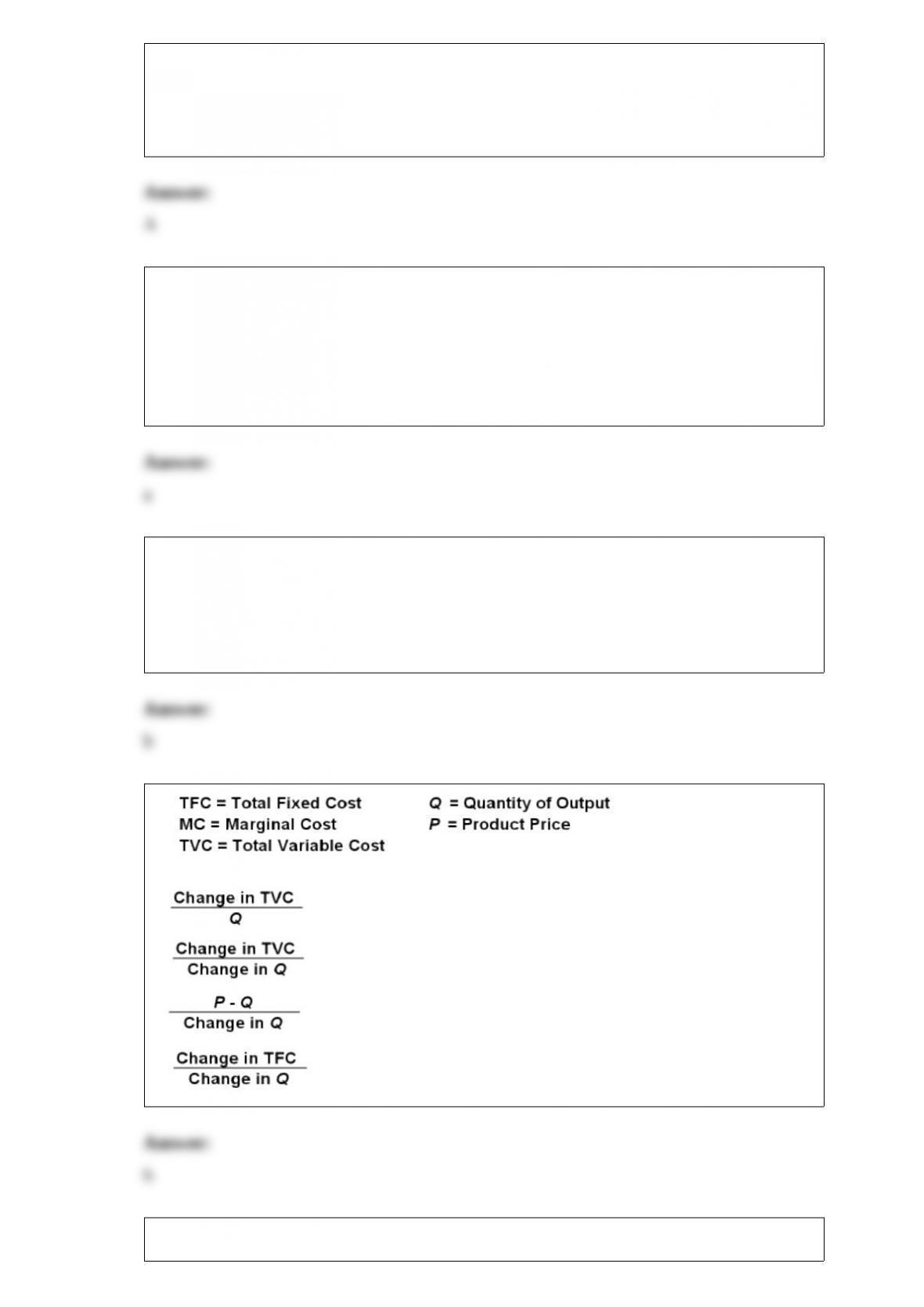
8)
refer to the above information. marginal cost is:
a.
b.
c.
d.
9) x-inefficiency refers to a situation in which a firm:
a.is not as technologically progressive as it might be.
b.encounters diseconomies of scale.
c.fails to realize all existing economies of scale.
d.fails to achieve the minimum average total costs attainable at each level of output.
10) When the benefits of conservation and future use are excluded from a cost-benefit
analysis, there is a tendency to:
A.more efficiently allocate resources.
B.overvalue future resources by considering them “priceless.”
C.stop resource extraction.
D.extract and use resources as quickly as possible.
11) if the production possibilities curve is a straight line:
a.the two products will sell at the same market prices.
b.economic resources are perfectly substitutable between the production of the two
products.
c.the two products are equally important to consumers.
d.equal quantities of the two products will be produced at each possible point on the
curve.
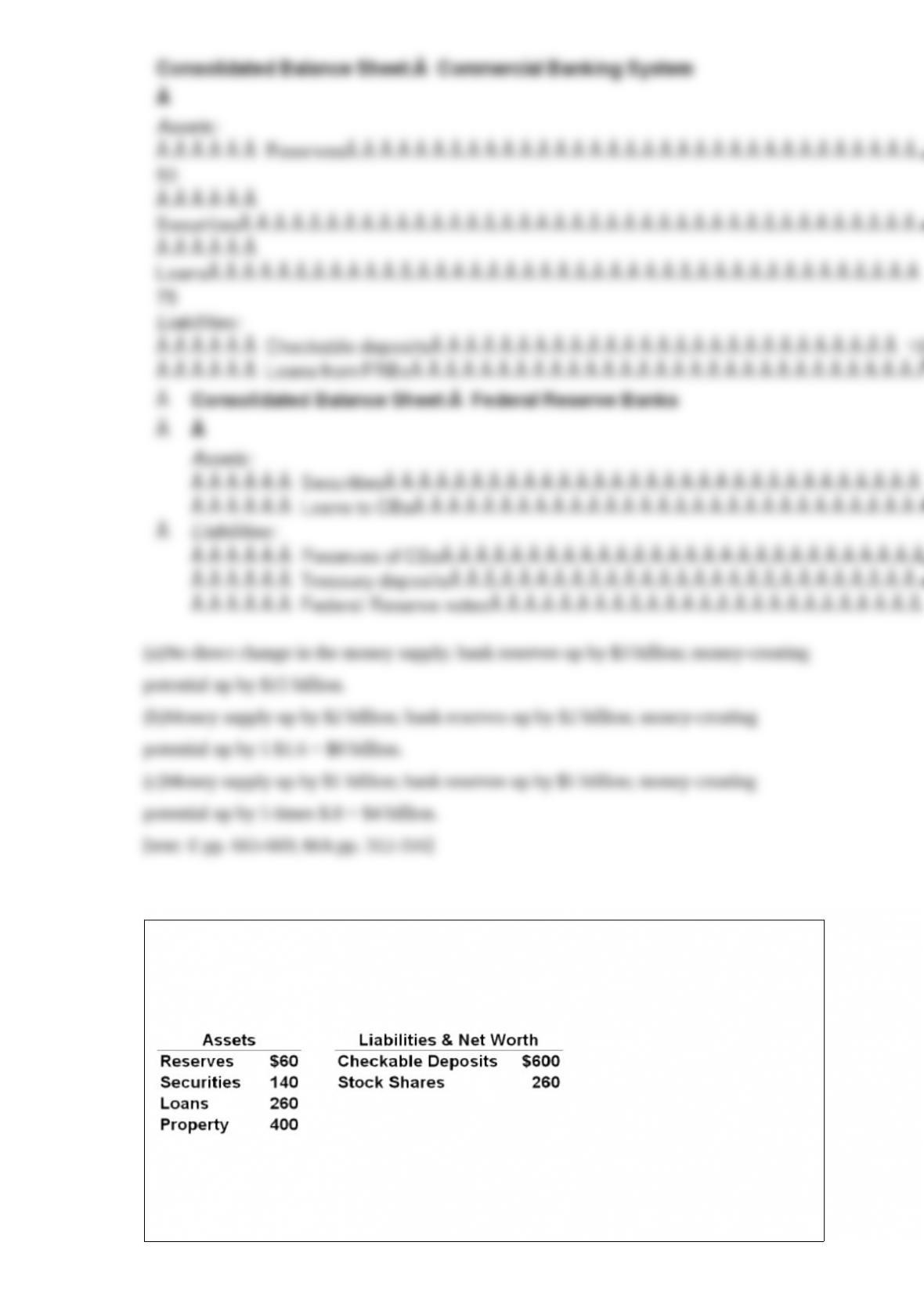
12) The following are simplified balance sheets for the commercial banking system and
the Federal Reserve System. Perform each of the following three transactions, a, b, and
c, making appropriate changes in columns (1) through (3) in each balance sheet. Do not
cumulate your answers. Also, answer these three questions for each part: (a) What
change, if any, took place in the money supply as a direct result of this transaction? (b)
What change, if any, occurred in commercial bank reserves? (c) What change occurred
in the money-creating potential of the commercial banking system if the reserve ratio is
20%? All figures are in billions of dollars.
(a)Suppose a drop in the discount rate causes commercial banks to borrow an additional
$3 billion from the Fed. Show the new sheet figures in column 1.
(b)The Fed buys $2 billion of government bonds from the public. Show the new sheet
figures in column 2.
(c)The Treasury spends $1 billion on research on new farm products. Show the new
sheet figures in column 3
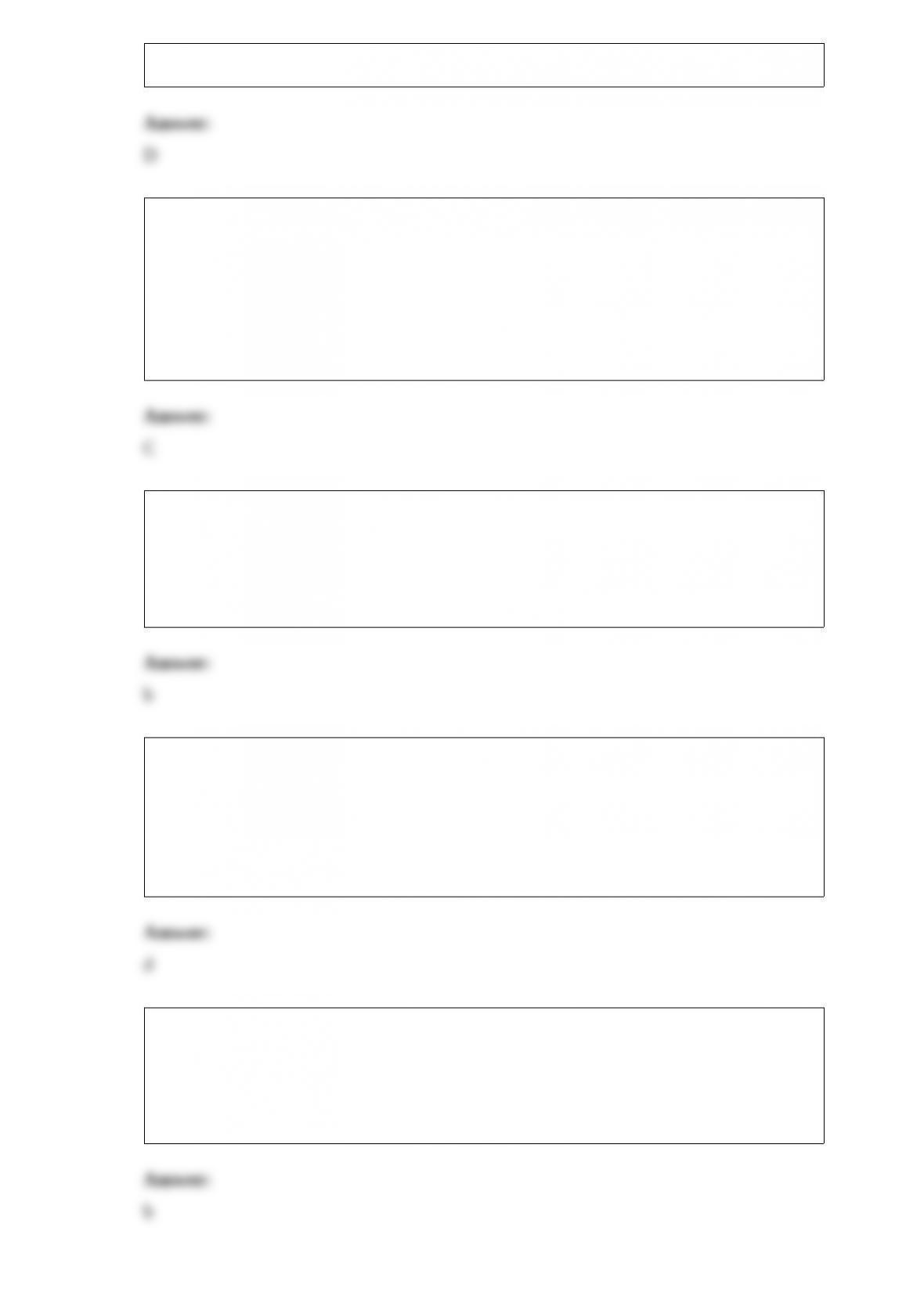
13) The following consolidated balance sheet of the commercial banking system.
Assume that the reserve requirement is 10 percent. All figures are in billions and each
question should be answered independently of changes specified in any preceding ones.
Refer to the above data. The commercial banking system has excess reserves of:
A.$10 billion.
B.$5 billion.
C.$2 billion.
D.zero.
14) Which of the following is correct?
A.The Federal tax system is regressive, while the state and local tax system is
progressive.
B.Both the Federal tax system and the state and local tax system are regressive.
C.The Federal tax system is progressive, while the state and local tax system is
regressive.
D.Both the Federal tax system and the state and local tax systems are progressive.
15) an increasing-cost industry is associated with:
a.a perfectly elastic long-run supply curve.
b.an upsloping long-run supply curve.
c.a perfectly inelastic long-run supply curve.
d.an upsloping long-run demand curve.
16) voluntary migration of skilled craftworkers from low-paying to high-paying nations
is most likely to be opposed by:
a.business groups in the high-paying nations.
b.craft workers who stay in the low-paying nations.
c.industrial unions in the high-paying nations.
d.craft unions in the high-paying nations.
17) the largest goods imports of the united states (in dollar volume) are:
a.chemicals, consumer durables, aircraft, and grain.
b.petroleum, automobiles, metals, and household appliances.
c.iron and steel, clothing, electronic equipment, and sugar.
d.aircraft, paper products, television sets, and furniture.
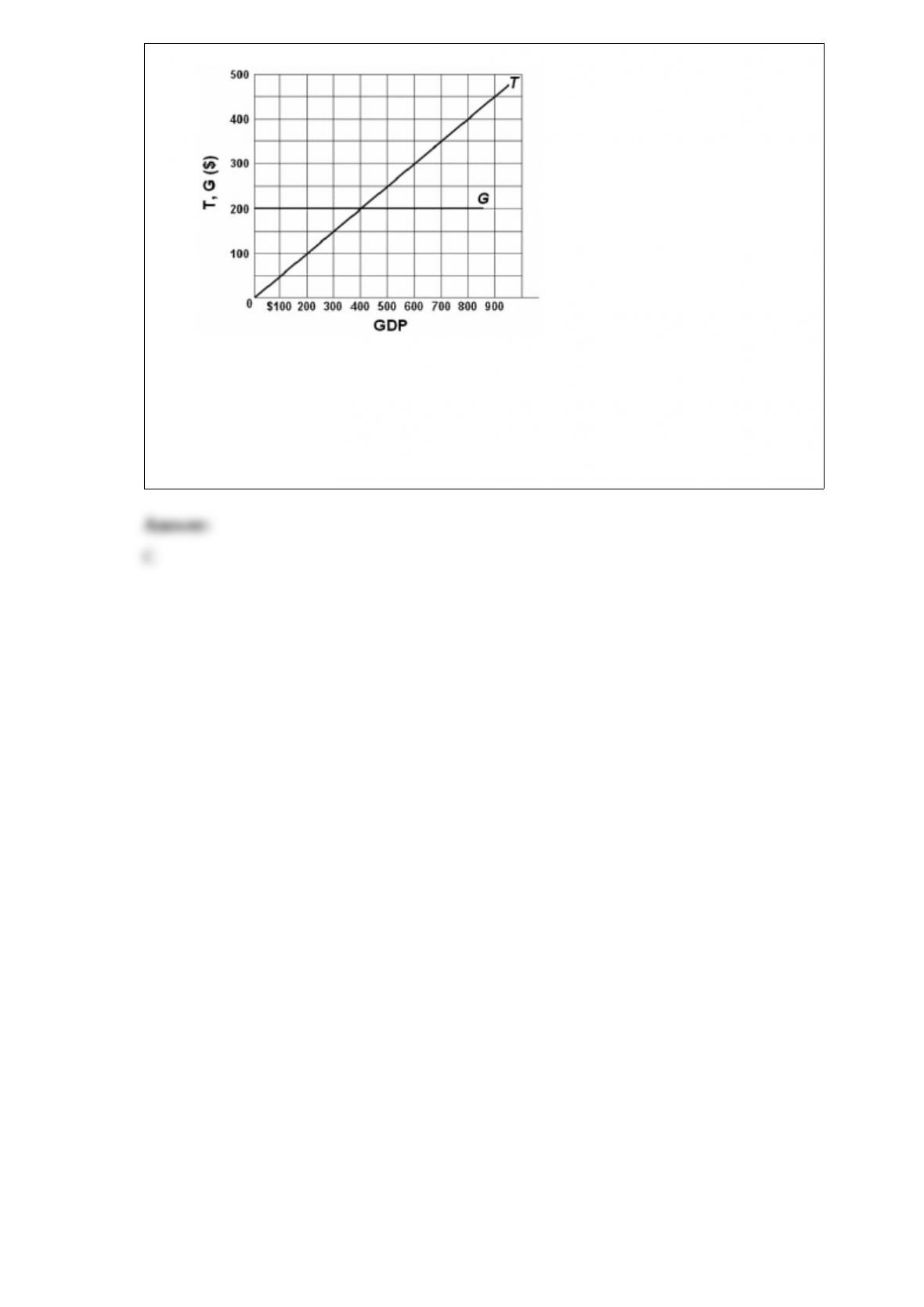
18)
Refer to the above diagram in which T is tax revenues and G is government
expenditures. All figures are in billions. The budget will entail a deficit:
A.at all levels of GDP.
B.at any level of GDP above $400.
C.at any level of GDP below $400.
D.only when GDP is stable.